How to Start Gas Pressure Washer: Fuel, Priming and the First Pull
A gas pressure washer that sat through storage usually needs fresh fuel and the right starting order before it will fire.

On this page
The driveway is partly washed and the washer just quit, or the washer sat in the corner of the garage all winter and now the cord pulls with no catch at all. A gas pressure washer that will not start is usually a fuel problem before it is a machine problem, and the starting routine below walks through the checks in the order that finds it. This guide covers how to start gas pressure washer, from fresh fuel to the first pull, and the fuel treatments that keep a stored washer ready.
As an Amazon Associate I earn from qualifying purchases. GarageToolHQ earns a commission when you buy through links on our product pages, at no extra cost to you. Read our affiliate disclosure.
Below: the starting routine step by step, why old fuel stops a washer, the fuel treatments that help, and answers to the questions that come up most.

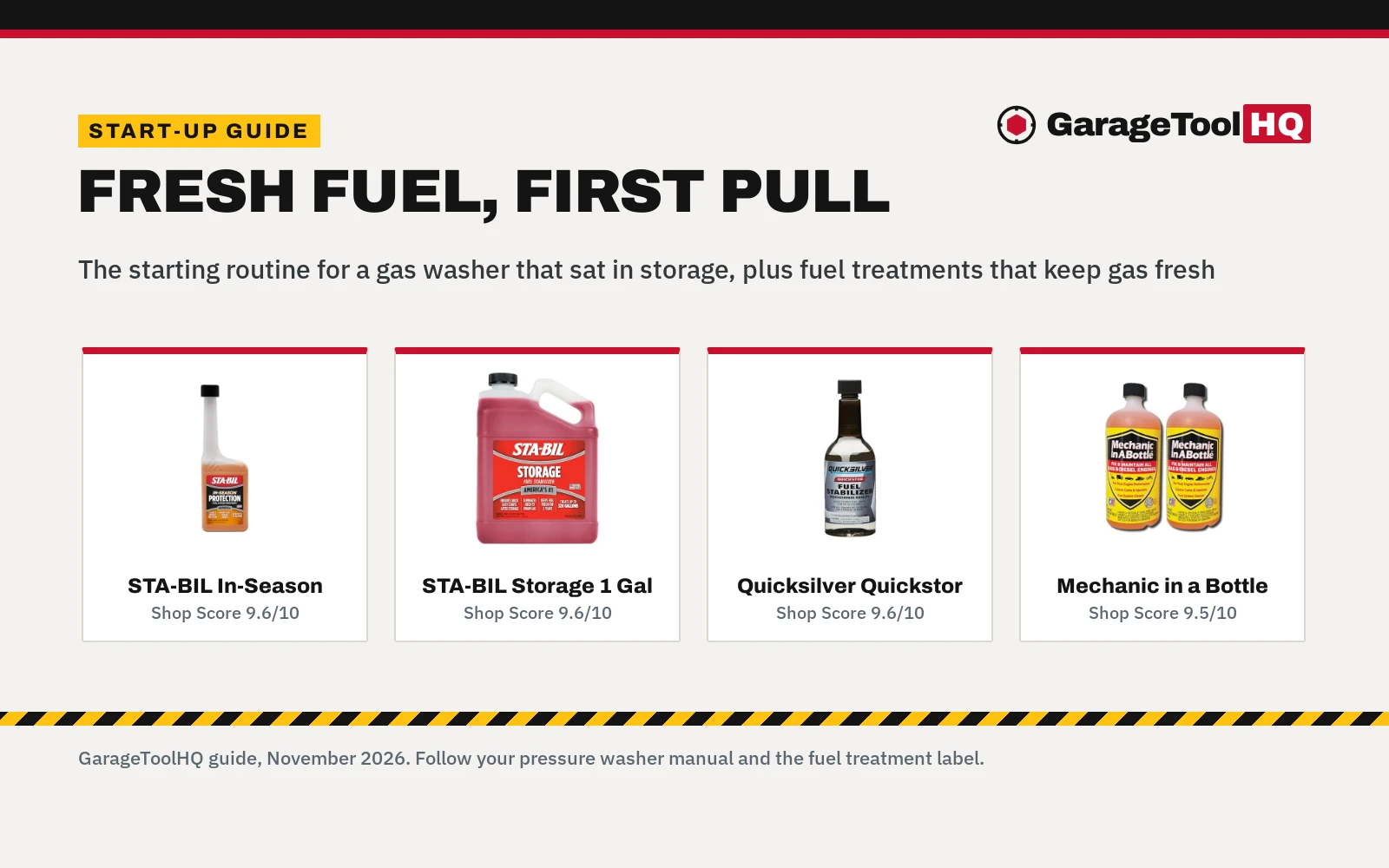
STA-BIL In-Season Protection Fuel System Treatment
A 10 oz in-season fuel system treatment that treats 50 gallons, cleans injectors and lines, and protects against corrosion and ethanol damage.
Pros
- Treats 50 gallons from a 10 oz bottle
- Cleans fuel injectors, lines and pumps
- Protects against rust and corrosion
- 1 year manufacturer warranty stated
Cons
- Treats less fuel per bottle than the storage jug here
- Maker points storage needs to its Storage product, not this one
- No measuring cap stated
- No storage freshness figure stated for this formula

STA-BIL Storage Fuel Stabilizer, 1 Gallon
A 1 gallon storage stabilizer that treats 320 gallons and keeps fuel fresh for up to 24 months during storage.
Pros
- Treats 320 gallons
- Keeps fuel fresh for up to 24 months
- Protects against corrosion and ethanol damage
- Directions state a 5 minute run to treat the whole system
Cons
- Spec table lists a weight of 0.000625 pounds, which cannot be right for a 1 gallon jug
- No warranty term with a concrete length stated, only a satisfaction promise
- Needs 1 oz for every 2.5 gallons, so dosing needs care
- Large 1 gallon jug takes more shelf space than a small bottle

Quicksilver Quickstor Fuel Treatment & Stabilizer
A 12 oz fuel treatment and stabilizer that keeps stored fuel fresh for up to two years, with 1 oz treating 5 gallons.
Pros
- Stabilizes fuel for up to two years
- 1 oz treats 5 gallons
- Made to meet Mercury Marine original equipment manufacturer specifications
- Suits boats, generators, lawnmowers and other powersports equipment
Cons
- No warranty term stated
- 12 oz bottle treats less fuel than the larger jugs here
- No injector cleaning claim stated
- Dimensions of 10.875 x 8.25 x 8.5 inches make it a wide bottle for a small shelf

Mechanic in A Bottle for Gas & Diesel Fuel Systems
A 24 oz 2 pack fuel system cleaner and stabilizer for gas and diesel fuel systems that removes varnish, shellac and carbon deposits.
Pros
- Cleans injectors and the entire fuel system
- Removes varnish, shellac and carbon deposits
- Disperses water in the fuel system
- 2 pack covers gas and diesel systems
Cons
- No treatment volume in gallons stated
- No warranty term with a concrete length stated
- No dose per gallon stated
- No freshness period in months stated
How to start gas pressure washer
Work through the routine in order. Each step rules out a cause before you move to the next.
- Move the washer outside. Never run a gas engine in a closed garage, even with the door partly open.
- Check the fuel. If the fuel in the tank sat through storage, drain it. If the fresh fuel will sit in the tank, pour the treatment into the empty tank before adding gasoline, as the STA-BIL listings direct, then fill with fresh fuel. The STA-BIL Storage listing states that treated fuel stays fresh for up to 24 months during storage, so fuel kept longer than that, or kept without treatment, is the first suspect.
- Dose the treatment as the label states. The STA-BIL Storage listing states 1 oz for every 2.5 gallons of gas, and the Quicksilver listing states 1 oz treats 5 gallons.
- Turn the fuel valve on and set the choke as the washer manual directs.
- Prime the pump. Connect the water, turn the water on, and squeeze the trigger until water runs steady, then release.
- Pull the starter cord with a firm, full pull. If the engine catches and dies, reset the choke as the manual directs and pull again.
- Run it for 5 minutes if the fill was just treated. The STA-BIL Storage directions state a 5 minute run to treat the entire fuel system, so when stabilizer has just been added to the tank, let the engine run for 5 minutes after it catches so the treated fuel reaches the whole system.
If the washer still will not start after fresh fuel and the routine above, the carburetor is the usual suspect. Old fuel leaves gum and varnish in the fuel system, and the cleaner listings below state that they remove varnish and gum. A fuel system cleaner does a different job from a stabilizer, and the comparison below explains the difference.
Why a washer that sat all winter will not start
Gasoline changes in storage. The listings here state that fuel breaks down, that ethanol in fuel harms the fuel system, and that corrosion follows. A washer that sat with untreated fuel in the tank gives the engine fuel that will not burn cleanly, and deposits collect in the small passages of the carburetor.
The storage listings put a figure on it. STA-BIL Storage keeps fuel fresh for up to 24 months during storage, and Quicksilver states its treatment stabilizes fuel for up to two years. STA-BIL also states an expiration date of 2 years from the opening of the bottle, or 5 years from the date of production, so even a sealed bottle has a limit. Fuel past those figures, or fuel stored with no treatment at all, is the most likely reason a stored washer will not start.
That is why the routine above starts with the fuel, not with the engine. Fresh fuel, a treated tank and a short run to move the treated fuel through the system cover the usual causes before any part comes off the washer.
Fuel treatments that keep a stored washer ready
The gear below is the fuel side of the starting routine. Each treatment handles the part of the job where stale fuel stops a washer, from storage through the first start of the season.
The same rule covers anything that burns fuel. Never run a gas pressure washer, a generator or any gas engine in a closed garage, even with the door partly open. Start it outside, in fresh air.
Use rated jack stands on solid ground, wear eye protection with power and air tools, keep fuel-burning equipment out of a closed garage, and follow the manual for every tool. Read our Safety Disclaimer.
Stabilizer or injector cleaner: which one the job needs
A stabilizer and a cleaner do different jobs, and the listings here show both. A stabilizer keeps fuel fresh during storage: STA-BIL Storage keeps fuel fresh for up to 24 months, and Quicksilver stabilizes fuel for up to two years. A cleaner removes what old fuel left behind: the In-Season listing states that it cleans the entire fuel system, including lines and fuel pumps, and removes water, gum and varnish. A pressure washer has no fuel injectors, so for this machine the cleaning that matters is the lines, the pump and the carburetor.
For a washer going into storage, use a storage stabilizer, dosed as the label states. For a washer that already runs rough after storage, a cleaner is the tool for the fuel system, and the storage stabilizer goes in with the fresh fuel that follows. Our fuel stabilizer vs fuel injector cleaner guide compares the two kinds in detail, and our best fuel stabilizers for cars roundup covers more treatments of the same kind.
FAQ: garage tools
Can I start a gas pressure washer with last season’s fuel?
Start with fresh fuel. Treated fuel stays fresh for up to 24 months with STA-BIL Storage, and up to two years with Quicksilver Quickstor, but fuel that sat untreated through storage is the most likely reason a washer will not start. Drain the tank, fill with fresh fuel, and run through the routine above.
Do I need fuel stabilizer in a pressure washer?
Only when the fuel will sit. A storage stabilizer keeps fuel fresh while the washer waits between seasons, and an in-season treatment cleans and protects the fuel system while the washer is in use. If the washer runs through its fuel in a short spell of work, no treatment is needed for that tank.
How long can fuel sit in a pressure washer?
The listings give figures for treated fuel only: up to 24 months with STA-BIL Storage, and up to two years with Quicksilver Quickstor. No listing here states a figure for untreated fuel, so there is no safe figure to quote for a tank left untreated. Treat the fuel before storage, and drain a tank that sat untreated.
What if my washer still will not start after fresh fuel?
Look at the carburetor next. Old fuel leaves gum and varnish in the fuel system, and the cleaner listings here state that they remove varnish, gum and carbon deposits. Follow the washer manual for the carburetor, and never run the engine indoors while you work on it.
Can I use a fuel injector cleaner instead of a stabilizer?
They do different jobs. A cleaner cleans the fuel system, while a stabilizer keeps stored fuel fresh. The STA-BIL In-Season listing states that it does both in season, cleaning the system and stabilizing fuel, but for storage the maker points to its Storage product. Use the cleaner for a dirty system and the stabilizer for a stored tank.
Related: our best gas pressure washers and gas vs battery pressure washers.