How to Use Steam Cleaner for Car Detailing
Fill with water, heat, work in short passes, and wipe dry: how steam loosens grime on seats, trim, vents and glass, and where to stop.

On this page
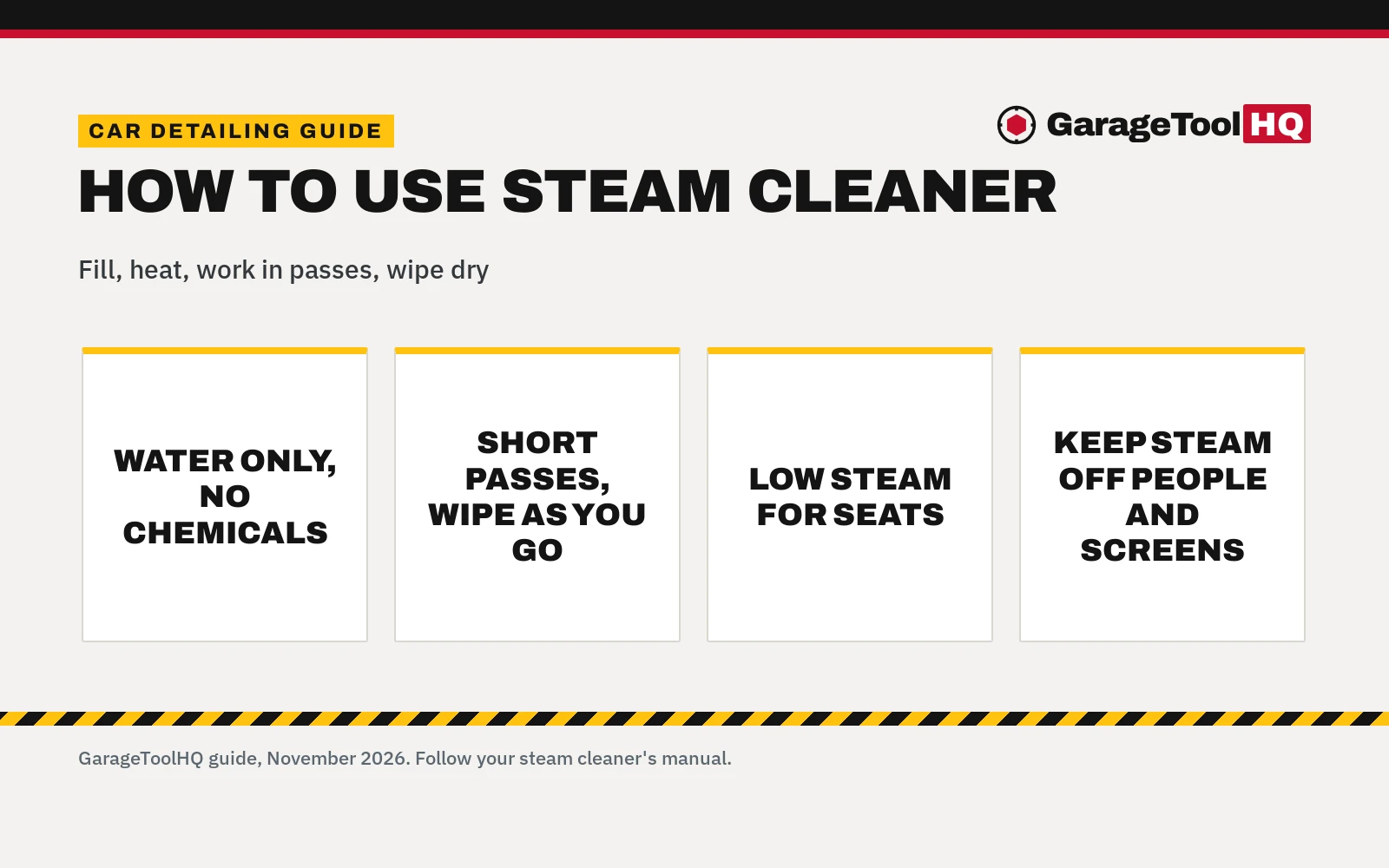
A family car that has hauled kids, dogs and coffee for a season shows it: crumbs in the seat seams, a dull film on the vents, door pockets that feel sticky. Here is how to use steam cleaner for car detailing without soaking the seats or scorching the trim: fill the tank with water, let the unit heat, work in short passes, and wipe and dry as you go. Steam loosens grime so a cloth can lift it away, and the listings for these machines state they work with water alone, no chemicals.
As an Amazon Associate I earn from qualifying purchases. GarageToolHQ earns a commission when you buy through links on our product pages, at no extra cost to you. Read our affiliate disclosure.
Below: what steam does inside a car, what to check before you start, the step-by-step pass for seats and hard trim, and where steam should stop.
How to use steam cleaner: what the steam does
A steam cleaner heats water in a tank until it leaves the nozzle as hot vapor. The vapor softens dried grime, grease and sticky residue so a brush or cloth can remove it with less scrubbing. Listings for handheld machines state steam temperatures from 221°F to 230°F, and several state the steam is 100% chemical-free. The Shark listing states its steam mop removes 99.9% of common household bacteria using just water, and the Bissell listing states the same 99.9% figure for germs and bacteria. Treat those as maker claims, not as a promise for every surface in a car.
Heat-up time and run time vary a lot across listings. Makers state heat-up times from 3 seconds to 40 seconds, and steam run times from 20 minutes to 60 minutes on a fill. Power runs from 1200W to 2500W, and tank sizes run from a 7.3 oz tank to an 1800 mL tank. A bigger tank usually runs longer between refills, though steam output matters too; listed weights run from 1.2 lbs to 6.13 lbs. Follow the manual for the machine you hold.
Steam adds moisture as it cleans, so the job runs in stages: loosen with steam, then lift the moisture and grime away with a cloth. Keep clean microfiber towels within reach, and wipe each area right after the steam pass. Our picks for the best microfiber towels cover cloths sized for dashboards, glass and trim.
What to check before you start
Park where you can open every door, and give the car a quick vacuum first so loose crumbs and grit are gone before steam touches anything. Grit under a brush can mark trim, so get it out of the way while the machine heats. Wear closed shoes and keep kids and pets out of the car while you work.
Fill the tank with water only, up to the fill line the maker marks. The DreamNature listing states its 1100ml tank fills below the max level to avoid overflow: leave room, or water can spit from the nozzle. Several listings state a removable tank, which fills at a sink without carrying the whole machine. Check cord and hose reach: listed cords run from 4.9ft to 10 ft, and listed hoses run from 180cm to 9.84 ft.
Pick the attachment for the surface: a nylon brush for vents and textured plastic, a cloth pad for seats, a squeegee for glass. Listings for these machines list accessory sets from 9 pieces to 18 pieces. Fit the attachment before the unit heats, and change it only after the steam stops: the DreamNature listing advises heat-resistant gloves when changing accessories, and warns never to direct steam toward any person. Steam at 230°F burns on contact, so keep the machine upright and never turn it upside down, since hot water sits inside.
How to use steam cleaner on seats and upholstery
Start with the lowest steam setting the machine offers: listings state 2-level, 3-level and 6-level controls, and the DreamNature listing pairs low steam with upholstery and curtains and high steam with tiles and ovens.
- Vacuum the seat first. Loose grit comes off dry; steam turns it into paste.
- Fit a cloth pad or upholstery tool. A bare nozzle concentrates heat in a single spot, while a pad spreads it and picks up grime as it goes.
- Hold the nozzle close and keep it moving. The GYQXJDM listing states the nearer the nozzle is to the surface, the hotter the steam gets. Move in slow, overlapping passes, and never park the nozzle in a single spot.
- Wipe right after each pass. Follow the steam with a dry microfiber cloth, lifting the loosened grime and the moisture together.
- Let the seat dry with the doors open. A seat that feels damp needs air before anyone sits on it.
For leather seats, keep passes short and wipe promptly, then follow the care steps in our guide to the best leather cleaner for car seats. Steam can dry leather if it lingers, so treat leather as a light-touch surface: low steam, brief contact, dry wipe, and no pooling in the seams.
How to use steam cleaner on hard trim, vents and glass
Hard trim, vents, cup holders and window tracks take steam well, because the surface does not soak it up. The DOURARY listing names car cup holders and window tracks among the places its machine cleans, and the Tuxumind listing names car interiors and engine bays. Work each area with a brush or nozzle, then wipe the loosened grime away before it dries back on.
For vents, give a short burst from a brush nozzle, then wipe the slats with a cloth wrapped around a finger. For cup holders, lift out the liner if it comes out, steam the well, and wipe it dry. For window tracks, run the nozzle along the channel and wipe the loosened grit out with a cloth edge. Our guide to the best car interior cleaner covers tools that pair with steam here.
Glass needs a light touch. Use the squeegee attachment the DreamNature listing includes among its accessories, pass the steam over the glass, and draw the squeegee down in a single stroke, wiping the blade between strokes. Finish with a dry microfiber cloth. For streak-free interior glass after steaming, see our picks for the best car window cleaner for inside.
What steam cannot do, and where to stop
Steam loosens grime; it does not vacuum it up. On a soaked carpet or a seat that has held a spill for days, steam alone leaves the moisture in the fibers, so wipe and dry, and bring in an extractor for a deep clean. See our comparison of steam cleaners and carpet extractors: steam cleaner vs carpet extractor.
Keep steam off screens, sensors and any part the manual says to keep dry. The Shark listing states its mop is for sealed hard floors: steam suits sealed, hard surfaces and sturdy fabric, not open electronics or bare wiring. If a surface has peeling coating, cracked leather or loose trim, leave it alone and clean it by hand.
Steam at 230°F burns on contact. Keep the nozzle away from hands, faces and pets, and keep children out of the car while the machine is hot. If steam escapes from a joint, switch the machine off and let it cool.
Keep electric pressure washers on a GFCI outlet, never point the wand at people or pets, wear eye protection with polishers and chemicals, and read the label before mixing any cleaning products. Read our Safety Disclaimer.
FAQ: garage tools
Can I use a steam cleaner on car seats?
Yes, with low steam and a cloth pad or upholstery tool. Vacuum first, work in short passes, and wipe each pass dry with a microfiber cloth. Let the seat dry with the doors open, and keep steam brief on leather.
Does a steam cleaner need soap or chemicals?
No. The listings state they clean with water alone, and several describe the steam as 100% chemical-free. The Shark listing states its steam removes 99.9% of common household bacteria using just water. Soap can leave residue in the tank, so use water only.
How long does a tank of water last?
It depends on the tank. Listings state run times from 20 minutes to 60 minutes per fill: a 550ml tank states 25 minutes, an 18 oz tank states 30 minutes, a 1100ml tank states 35-45 mins, and an 1800 mL tank states 60 minutes. A bigger tank usually runs longer, though steam output matters too, so match the tank to the job.
Can I use a steam cleaner on car windows?
Yes. Use the squeegee attachment, pass steam over the glass, and draw the squeegee down, wiping the blade between strokes. Finish with a dry microfiber cloth. Keep the nozzle moving so heat does not sit in a single spot on the glass.
Can steam damage leather seats?
It can if it lingers. Keep passes short, use low steam, and wipe promptly so moisture does not sit in the seams. If the leather is cracked or peeling, skip the steam and clean it by hand. Our guide to the best leather cleaner for car seats covers products made for leather care.
Related: best steam cleaner for car detailing, the best steam cleaner for car interior, our best steam cleaner for car upholstery picks, the car detailing hub and the best car interior cleaner.