Inverter vs Transformer Welder: Which One Should You Buy? (2026)
Inverter vs transformer welder: how the two types differ, what two inverter listings state about weight, voltage and features, and who should pick which side.

On this page
Top picks at a glance
As an Amazon Associate we earn from qualifying purchases.
- 1
 ARCCAPTAIN Plasma Cutter Machine9.7/10View on Amazon
- 2
 Weldpro 200 Amp MIG Welder9.8/10View on Amazon
- 3
 HONE Stick Welder 110v9.7/10View on Amazon
- 4
 YESWELDER 205Amp Stick Welder Digital Inverter IGBT ARCView on Amazon
- 5
 Arc Stick Welder 165AView on Amazon
- 6
 Welding Machine 110V 200A IGBT Inverter Welder Machine HotView on Amazon
- 7
 GZ GUOZHI Plasma CutterView on Amazon
Verdict: On inverter vs transformer welder, choose an inverter welder if you want portability: farm repairs, garage work, and jobs where the machine rides in the truck. Choose a transformer welder if the machine will live in one spot and you value simple, heavy construction over light weight. Both listings in this comparison are inverter machines, so the inverter side below is concrete and the transformer side is general guidance.
Two welders can lay the same bead while being built nothing alike inside. An inverter welder uses electronics to shape the welding current; a transformer welder uses a heavy copper-and-iron transformer to do the same job. The inverter vs transformer welder choice comes down to weight, portability and simplicity: one travels, the other stays put. This comparison puts the two side by side, with both example listings on the inverter side. Where the transformer side has no listing behind it, the text says so instead of inventing one.
GarageToolHQ earns a commission when you buy through links on this page, at no extra cost to you. Read our affiliate disclosure.

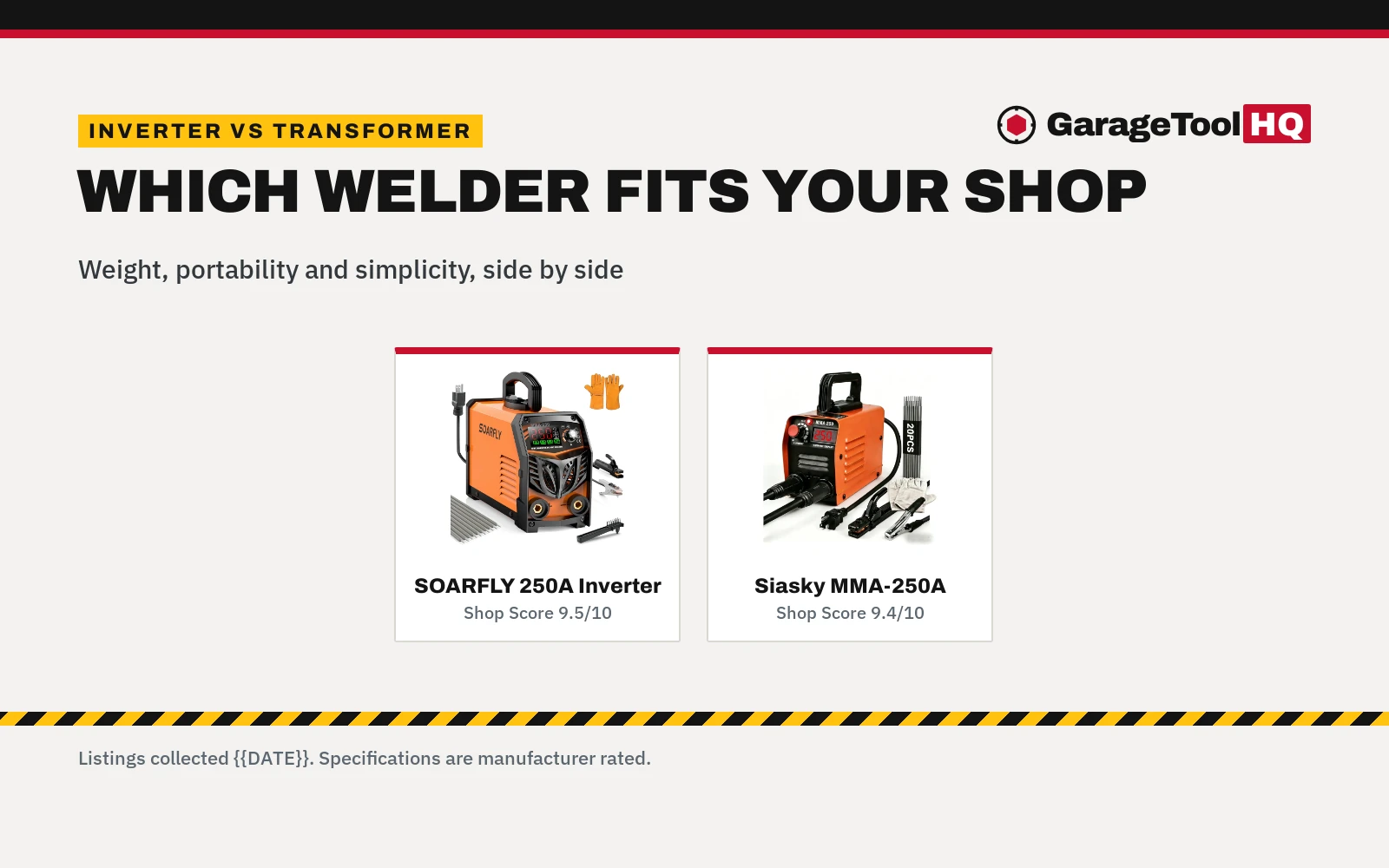
Stick Welder, 110V/220V Dual Voltage Welding
A dual-voltage 110V/220V IGBT inverter stick welder with 250A output, Hot Start, Arc Force, Anti-Stick and full protection features.
Pros
- 110V/220V dual voltage input
- 250A with 2.5 to 3.2mm rod range
- Overheat, overcurrent, overload, overvoltage protection
- Full kit: gloves, holder, clamp, 10 rods
Cons
- 220V needs an adapter, not included
- Around 3.7 kg, heavier than the Siasky
- No warranty term stated
- 10 rods vs the Siasky's 20

Siasky Mini Welding Machine
A 110V IGBT inverter stick welder with 250A output, Hot Start, Arc Force and Anti-Stick, with 20 rods in the box.
Pros
- 3.3 lb per the bullets, lightest here
- 250A IGBT inverter on 110V
- Hot Start, Arc Force, Anti-Stick
- 20 rods, clips, shield and brushes included
Cons
- 110V only, no dual voltage
- Bullets say 3.3 lb, spec table says 6.83 lb
- No protection features stated
- No warranty term stated
More options to compare
 YESWELDER 205Amp Stick Welder Digital Inverter IGBT ARCCheck price on Amazon
 Arc Stick Welder 165ACheck price on Amazon
 Welding Machine 110V 200A IGBT Inverter Welder Machine HotCheck price on Amazon
 GZ GUOZHI Plasma CutterCheck price on Amazon
Side by side
| Siasky (inverter) | SOARFLY (inverter) | Transformer side | |
|---|---|---|---|
| Listings | MMA-250A, tagged inverter | 250A, tagged inverter | No transformer listing in this data |
| Weight stated | 3.3 lb (bullets) | Around 3.7 kg | Not stated here |
| Voltage stated | 110V | 110V/220V dual | Not stated here |
| Output stated | 250A | 250A | Not stated here |
| Key features | Hot Start, Arc Force, Anti-Stick, LED display | Hot Start, Arc Force, Anti-Stick, LED, protection set | Not stated here |
Example figures are manufacturer rated, as published on each listing and collected 22 October 2026. Read the transformer column as the absence of data, not as a claim about transformer welders in general. Both listings are tagged inverter; no transformer listing is in this data, so the transformer column states what the listings leave unclear rather than guessing.
Inverter vs transformer welder: how they differ
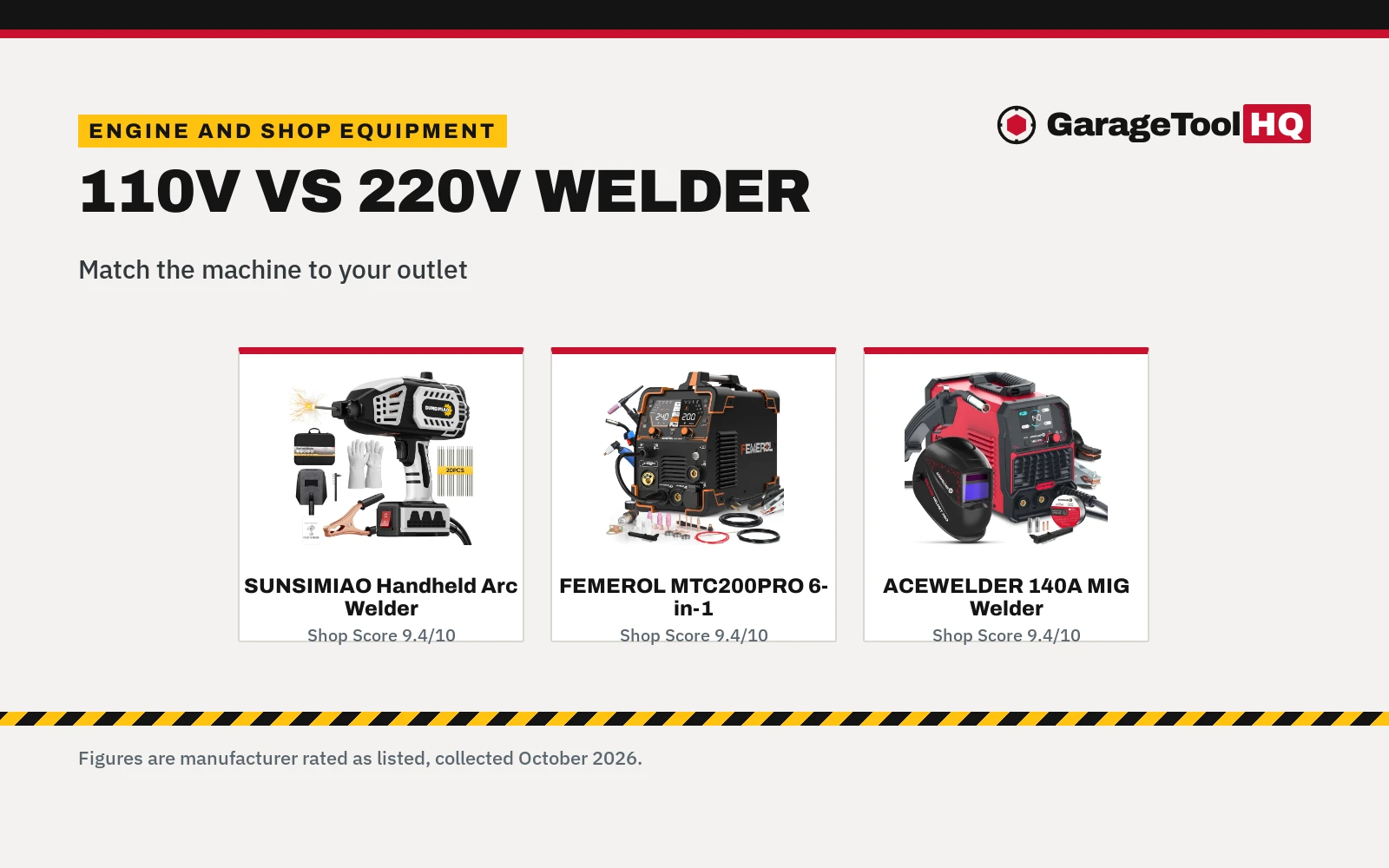
An inverter welder converts the input power electronically; both listings here name IGBT inverter technology, which is why the machines can be small and light: 3.3 pounds on the Siasky bullets and around 3.7 kg on the SOARFLY. A transformer welder does the same conversion with a large wound transformer, which makes the machine heavy and simple, with fewer electronics to fail. Neither side welds better by definition; the difference is what you carry and where the machine lives. That is the whole of the decision for most buyers: the arc does not care which technology made it, but your back and your shop layout do. A portable inverter earns its keep the first time you weld somewhere without a shop, while a transformer machine earns its keep by never needing to move at all.
What the inverter listings state
Both examples are 250A stick welders with IGBT inverters, Hot Start, Arc Force and Anti-Stick functions, and LED displays showing the current. Those three assists are worth understanding: Hot Start boosts the current to strike the arc, Arc Force boosts current when the arc gets tight to keep it from stubbing out, and Anti-Stick cuts the current when the rod sticks, so you can pull it free. The Siasky runs on 110V household power, weighs 3.3 pounds per its bullets, and ships with 20 welding rods at 2.5mm plus electrode clips, work clips, a face shield, brushes and a manual. First listed in March 2024, it is the longer-running listing of the two. The SOARFLY, first listed in June 2025, runs on 110V or 220V dual voltage, with 250A output covering 2.5 to 3.2mm rods (E6010, E6013, E7018, E308-16 and more) on stainless steel, carbon steel and cast iron, and adds overheat, overcurrent, overload and overvoltage protection with a cooling fan.
Weight and portability
Weight is the inverter’s headline advantage, and the listings state it plainly. The Siasky bullets claim 3.3 pounds, though its spec table says 6.83 pounds; the bullets win, but even at the higher figure it is a one-hand carry. The SOARFLY states around 3.7 kg with a built-in handle. Both listings pitch outdoor maintenance, farms, garages and home DIY: jobs where the welder moves to the work. The Siasky even names handicrafts, and the SOARFLY names construction sites, which tells you how broad the portable use case runs. A transformer machine of similar output would weigh several times more, which is why that side belongs at a fixed station. Portability is not a small thing in welding work: the listings pitch farms, garages and outdoor maintenance precisely because dragging a heavy machine to a broken gate is nobody’s idea of a good afternoon.
Voltage and output
The Siasky is 110V only, which covers standard household outlets. The SOARFLY adapts to 110V or 220V automatically, though its listing notes that 220V use requires an adapter that is not included. Both are rated 250A, and the SOARFLY spells out the rod range: 2.5 to 3.2mm, about 3/32 to 1/8 inch. For a buyer choosing between the two examples, dual voltage is the SOARFLY’s clearest edge; for the inverter-versus-transformer question, both sides weld from the same wall outlets. Note the SOARFLY’s 220V use requires an adapter that is not included, so budget for that if your shop has 220V waiting.
Choose an inverter welder if
- You carry the welder to the work: farms, garages, job sites
- Light weight matters: 3.3 pounds to around 3.7 kg here
- You want Hot Start, Arc Force and Anti-Stick assists
- 110V household power is what you have
Choose a transformer welder if
- The machine lives in one shop spot permanently
- You prefer the simplest possible internals
- Weight is irrelevant because the welder never moves
- You are buying used: old transformer machines are common secondhand and their simplicity is the selling point
Example welders
For more choices, see the best 110V portable stick welder roundup, and if you are starting out, the best flux core welder for beginners. Either way, match the machine to where the work happens: the welder that is already where the broken thing is beats the better welder sitting in another building.
Use rated jack stands on solid ground, wear eye protection with power and air tools, keep fuel-burning equipment out of a closed garage, and follow the manual for every tool. Read our Safety Disclaimer.
Frequently Asked Questions
What is an inverter welder?
A stick welder that shapes its welding current with IGBT inverter electronics instead of a heavy transformer. Both listings here use IGBT inverter technology, which is why they weigh 3.3 pounds to around 3.7 kg while delivering 250A.
What is a transformer welder?
A welder that converts input power with a large wound transformer rather than electronics. No transformer listing is in this data, so take the comparison as the general pattern rather than a spec sheet; in general they are heavier and simpler than inverters of similar output, and they suit fixed shop stations.
Can these welders run on 220V?
The SOARFLY adapts to 110V or 220V automatically, though its listing notes the 220V adapter is not included. The Siasky is 110V only.
What rods do they take?
The SOARFLY lists E6010, E6013, E7018, E308-16 and more in 2.5 to 3.2mm, about 3/32 to 1/8 inch, for mild steel, stainless steel and cast iron. The Siasky ships with 20 rods at 2.5mm.
Which example is lighter?
The Siasky at 3.3 pounds per its bullets, against around 3.7 kg on the SOARFLY. Note the Siasky spec table says 6.83 pounds against the bullets; the bullets win.
Related: the best 110V portable stick welder roundup, the best flux core welder for beginners guide and the engine and shop equipment hub.