Oil Extractor vs Drain Pan: Which One Should You Buy?
Oil extractor vs drain pan compared as oil change methods, with four fluid extractors featured on capacity, hose reach and warranties.

On this page
Top picks at a glance
As an Amazon Associate we earn from qualifying purchases.
- 1
 VEVOR Fluid Extractor9.7/10View on Amazon
- 2
 Spill-Less DrainMate™ 14 Quart Oil Drain Pan/Container9.8/10View on Amazon
- 3
 Capri Tools CP21023 Portable Oil Drain Pan9.6/10View on Amazon
- 4
 Roughneck Pneumatic Oil ExtractorView on Amazon
- 5
 Amarine Made Oil PumpView on Amazon
- 6
 DasMarine 12V 60W Electric Oil Extractor PumpView on Amazon
- 7
 Oil Pump 12V 100WView on Amazon
- 8
 Oil Extractor Pump 12V 80WView on Amazon
- 9
 AIGMlSON Oil Change Pump Extractor 12V 80W Electric Oil PumpView on Amazon
Oil extractor vs drain pan is a mess-versus-access question: an extractor pulls oil out through the dipstick tube so you never crawl under the car or touch the drain plug, while a drain pan catches the full flow from underneath. Pick an extractor for quick top-side oil changes on mowers, cars and boats; pick a drain pan when you want the pan fully drained or you are changing the filter underneath anyway. One honest note: all four listings here are extractors or transfer tools; no drain pan is listed among these examples, so this guide presents the extractor side on its stated merits and covers the drain pan as the method.
More options to compare
 Roughneck Pneumatic Oil ExtractorCheck price on Amazon
 Amarine Made Oil PumpCheck price on Amazon
 DasMarine 12V 60W Electric Oil Extractor PumpCheck price on Amazon
 Oil Pump 12V 100WCheck price on Amazon
 Oil Extractor Pump 12V 80WCheck price on Amazon
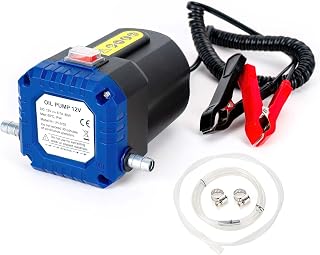 AIGMlSON Oil Change Pump Extractor 12V 80W Electric Oil PumpCheck price on Amazon
GarageToolHQ earns a commission when you buy through links on this page, at no extra cost to you. Read our affiliate disclosure.
Oil extractor vs drain pan: the short answer
An oil extractor is a hand pump with a hose down the dipstick tube. You pump, the oil comes up into the extractor’s tank, and you carry the tank to disposal. No jack, no creeper, no hot drain plug. A drain pan is the classic method: remove the plug, let gravity do the work, and the pan catches it all, including the last of the old oil and anything sitting at the bottom of the pan. Extractors win on convenience and cleanliness; drain pans win on completeness and cost. For the drain pan side, see our steel vs plastic oil drain pan comparison.
The gear: four extractors, ranked
1. OEMTOOLS 24389 (5.3L). The top pick: 5.3 liters, a 41-inch dipstick hose with adapters, an overflow shutoff valve that stops extraction when full, and the only stated warranty here, a limited one year. Manual pump, no electricity or air, for low-viscosity fluids including oil, coolant and transmission fluid.
2. EWK EB0261 (6L). The capacity pick: 6 liters, the largest tank here, with a 59-inch clear hose and a 42-inch flexible metal probe that reaches deep into the pan. A step-on base keeps it steady and a clear level gauge shows how much you have pulled. Stated limits: not for gasoline, not for fluids above 175 degrees F, and not for the Mercedes W212 E350 or C218 CLS350.
3. Briggs & Stratton 5431K (4L). The OEM pick: a genuine Briggs & Stratton 4-liter kit with a manual siphon pump, a 51-inch suction hose, a custom funnel and a sealing cap. Stated for mowers, tractors, generators, marine engines and passenger vehicles, extracting oil, fuel, water and coolants through dipstick tubes or filler ports.
4. FOUR UNCLES FU-FET200 (200cc). The precision pick: a 200cc fluid transfer syringe with a flexible hose for extraction and refilling in tight spots. The transparent barrel shows fluid movement and the smooth plunger gives steady control. At 12.3 ounces it is the lightest here, for small transfers rather than full oil changes.
What the extractor listings state
Capacity runs 200cc to 6 liters: the EWK holds 6L, the OEMTOOLS 5.3L, the Briggs & Stratton 4L (about 4.2 quarts), and the FOUR UNCLES syringe 200cc. Hose reach: 59 inches on the EWK plus its 42-inch probe, 51 inches on the Briggs & Stratton, 41 inches on the OEMTOOLS with dipstick adapters. The OEMTOOLS is the only one with an overflow shutoff valve and the only one with a stated warranty, a limited one year. The Briggs & Stratton warranty reads only “as labelled,” which is not a concrete term.
Fluids: the OEMTOOLS is stated for low-viscosity fluids such as oil, coolant, power steering fluid and gear oil; the EWK handles engine oil, ATF, coolant and power steering fluid; the Briggs & Stratton extracts motor oil, fuel, water and coolants; the syringe transfers engine oil, gear oil, transmission and differential fluid. Read each listing’s fluid limits before you pump: the EWK excludes gasoline and fluids above 175 degrees F.
When a drain pan still wins
No drain pan is listed here, but the method deserves its place. A drain pan drains the sump fully through the plug hole, which an extractor through the dipstick tube may not match on every engine. If the drain plug is easy to reach and you are already under the car for the filter, the pan is the complete job. Extractors shine where access is bad: mowers and tractors you do not want to tip, boats, and cars where the filter is on top. Many home mechanics own both and choose per job.
Use rated jack stands on solid ground, wear eye protection with power and air tools, keep fuel-burning equipment out of a closed garage, and follow the manual for every tool. Read our Safety Disclaimer.
Stated limits worth knowing
The listings state their limits plainly. The EWK states it is not for gasoline, fluids above 175 degrees Fahrenheit, or Mercedes W212 E350 and C218 CLS350 models, and states a 6-liter capacity with a 59-inch clear hose and a 42-inch flexible metal probe. The OEMTOOLS states it is for low-viscosity fluids only, with a built-in overflow shutoff valve and a leak-proof bottom. The Briggs and Stratton states a 4-liter (about 4.2 quart) capacity for full oil volume changes in a single pass, with a 51-inch suction hose and a custom funnel. The FOUR UNCLES states a 200CC capacity in its model name, a transparent barrel for monitoring fluid, and a stated 12.3 ounces, making it a precision tool rather than a full oil-change extractor. For a full oil change on a car, the EWK’s stated 6 liters and the OEMTOOLS’ stated 5.3 liters are the capacity story; for topping off or small jobs, the FOUR UNCLES’ stated 200CC is the precision story.
Frequently Asked Questions
Does an extractor get all the oil out?
The listings describe full oil volume changes in a single pass (Briggs & Stratton 4L) and complete drains via the dipstick tube (EWK), but a drain pan through the plug hole remains the reference for a full drain. Match the method to the engine.
Which extractor holds the most?
The EWK at 6 liters, then the OEMTOOLS at 5.3 liters, then the Briggs & Stratton at 4 liters. The FOUR UNCLES syringe holds 200cc for small transfers.
Do I need to lift the car to use an extractor?
No. That is the point: the listings describe extraction through the dipstick tube with no drain plug removal and no lifting. The OEMTOOLS listing names garages, driveways and boat docks as use spots.
Which has a warranty?
The OEMTOOLS states a limited one-year warranty. The Briggs & Stratton warranty reads only “as labelled.” The EWK and FOUR UNCLES listings state no warranty term.
What fluids can these handle?
Per the listings: engine oil, transmission fluid, coolant, power steering fluid and gear oil, depending on the model. The EWK is not for gasoline or fluids above 175 degrees F. Check the listing for your fluid before pumping.
Related: our steel vs plastic oil drain pan comparison and the best oil filter wrench roundup.