Parts Washer Heater: Options and How to Choose One
A parts washer heater warms the solvent in a parts washer tank so grease and grime come off faster, and the choice comes down to a washer with heat built in or an add-on immersion heater that fits the tank and the solvent.

On this page
Cold solvent cuts grease slowly, and a winter garage makes it slower still. A parts washer heater warms the solvent in the tank so parts come clean with less scrubbing, and the choice is between a washer with heat built in and an add-on immersion heater that fits a plain washer tank. The right pick depends on the tank, the solvent and the power available, not on the heater alone.
As an Amazon Associate I earn from qualifying purchases. GarageToolHQ earns a commission when you buy through links on our product pages, at no extra cost to you. Read our affiliate disclosure.
Below: how a parts washer heater works, the heater types, a checklist for choosing a heater, and the safety rules that come with heating solvent.
Parts washer heater: what it is and how it works
A parts washer heater is an immersion heating element that sits in the solvent tank of a parts washer and holds the solvent warm while you clean. Warm solvent dissolves grease and oil faster than cold solvent, so brushes and agitation do less of the work and parts come out cleaner. The heater does not replace the solvent, the brush or the agitation: it only sets the solvent temperature.
Heat also changes how a washer behaves. Warm solvent gives off more vapor than cold solvent, so ventilation and a lid matter more with a heated tank. The element itself must stay covered by solvent at all times: an exposed element in air overheats, and a dry element can fail or scorch what it touches. That rule shapes every choice below, from the heater type to the tank it fits.
Parts washer heater types
| Type | How it heats | What to check |
|---|---|---|
| Heated parts washer, heater built in | Element built into the washer by the maker | Solvent list from the washer maker; thermostat control |
| Threaded immersion cartridge heater | Element screws into a threaded port in the tank wall | Thread size, tube length, power, solvent match |
| Drop-in immersion heater | Element hangs or clamps over the tank wall into the solvent | Element stays covered; cord stays clear of the rim; solvent match |
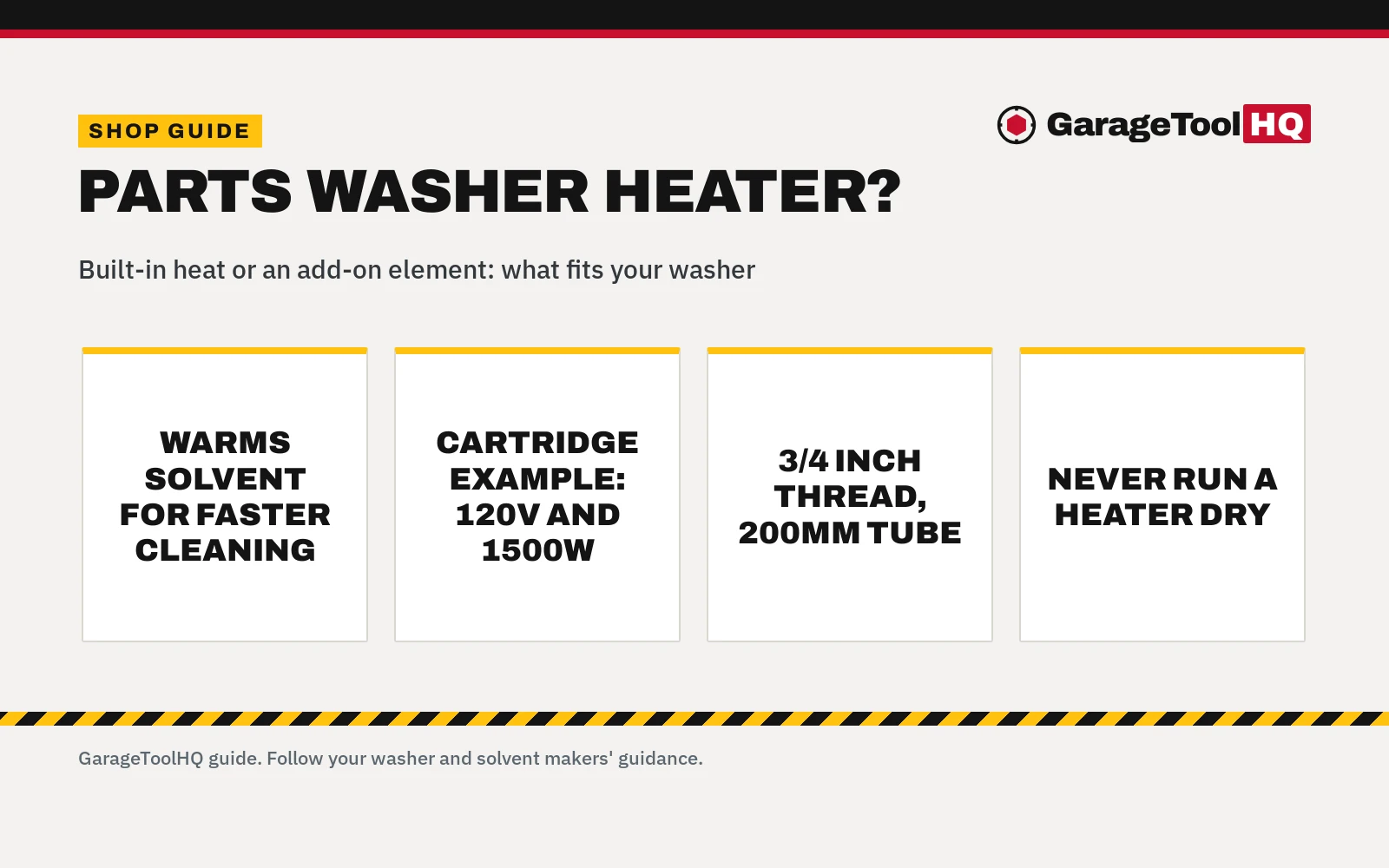
A cartridge heater listing states what an immersion element looks like on paper: a DERNORD cartridge heater states 120V and 1500W, a 3/4 inch thread and a tube length of 200mm, which the listing also gives as 7.9 inch. The tube is stainless steel 304, which the listing describes as giving high corrosion prevention. That listing describes the heater for manufacturing plastic and rubber parts in the car industry and for food processing, so it is an example of the figures to compare, not a washer part on its own: check the figures against the washer and the solvent before fitting any element to a tank.
How to choose a parts washer heater: the checklist
- Match the washer. Check that the tank has a threaded port for a cartridge heater, or room for a drop-in element with the lid still closing. If the washer maker offers a heated version, that pairing is the safest match.
- Match the thread and the length. A threaded element must match the port in the tank, and the tube must fit the tank depth. The DERNORD example states a 3/4 inch thread and a 200mm tube: compare those figures with the tank before buying.
- Match the power. Check the voltage and the watts on the listing against the circuit in the garage and the washer maker’s guidance. The DERNORD example states 120V and 1500W. Have a licensed electrician wire any heater that needs a new circuit or a hardwired connection.
- Match the solvent. A heater must be rated for the solvent in the tank. Never heat a solvent the washer maker forbids, and never heat a flammable solvent in a washer made for water-based fluid.
- Look for a thermostat. A heater with a thermostat or a temperature control holds the solvent at the temperature you set. An element with no control can keep heating until the solvent gets too hot.
- Check the material. The element sits in solvent all day, so corrosion resistance matters. The DERNORD example uses a stainless steel 304 tube, which the listing describes as giving high corrosion prevention.
- Plan for the element to stay covered. Mark the minimum solvent level on the tank, and never run the heater with the element in air. Top up the solvent before switching the heater on.
- Read the washer manual before fitting anything. Check the manual for the solvents the tank can hold and the heater types the maker allows. If the manual says nothing about heat, ask the maker before adding a heater.
Solvent and heat do not mix with an open flame or a spark. Never heat a flammable solvent, never smoke near a heated washer, and keep the tank away from grinders, welders and other ignition sources.
Never run a fuel-burning heater, generator or engine in a closed garage: carbon monoxide builds up fast and has no smell. Fit a CO alarm, keep clearances to cars and storage, use vented gas heaters installed to code, and put 240V electric heaters on a dedicated circuit. See CPSC carbon monoxide guidance. Read our Safety Disclaimer.
Heated vs unheated parts washer
An unheated washer cleans with solvent at room temperature and needs more brush time on heavy grease. A heated washer cleans faster and can stretch the solvent further, since warm solvent holds more grime before it needs changing. The trade is power use, vapor and care: a heated tank needs ventilation, a lid and a heater that never runs dry.
For a home garage that cleans parts now and then, an unheated washer with a good brush and fresh solvent may do the job. For a garage that cleans greasy parts often, heat pays off in time saved at the tank. Either way, the solvent and the washer matter more than the heater: a heater cannot save a washer full of spent solvent.
Solvent, heat and fire safety
Heating solvent adds fire risk, and a heated tank gives off more vapor. Work with ventilation, keep a lid on the tank when the washer is idle, and keep a fire extinguisher for the garage within reach. Never leave a heated washer running while you leave the garage, and switch the heater off before draining or moving the tank. Store spare solvent in sealed containers away from the washer and away from ignition sources, and check local rules for disposal of spent solvent.
FAQ: garage tools
Can I add a heater to any parts washer?
No. The washer needs a way to hold the element, such as a threaded port or room for a drop-in heater, and the washer maker must allow heat with the solvent in the tank. Check the manual before adding a heater, and ask the maker if the manual says nothing about heat.
What power does a parts washer heater need?
Check the listing and the washer manual. A DERNORD cartridge heater listing states 120V and 1500W, but the right figures depend on the tank and the circuit: check the listing against the circuit in the garage. Have a licensed electrician wire any heater that needs a new circuit or a hardwired connection.
Can a parts washer heater boil the solvent?
A heater with a thermostat holds the solvent at the temperature you set, so it should not boil. An element with no control can keep heating, which is why a thermostat matters and why the element must stay covered by solvent. Never run a heater dry, and switch it off if the solvent level drops.
Is a cartridge heater the same as a parts washer heater?
A cartridge heater is a type of immersion element, and it can serve as a parts washer heater when the thread, length and power all suit the tank and the solvent. The DERNORD listing states 120V, 1500W, a 3/4 inch thread and a 200mm tube, but it describes the heater for manufacturing use, so check that it suits washer use before fitting it.
Can I heat any solvent in a parts washer?
No. Use only solvents the washer maker lists for the tank, and never heat a flammable solvent. Water-based fluids and petroleum solvents behave differently with heat, so the washer and solvent makers’ guidance decides what can be heated.
Do I need a thermostat on a parts washer heater?
A thermostat is the safe way to run one: it keeps the solvent at the temperature you set and switches the element off when it gets there. A heater with no control needs constant watching.
Related: the best parts washer for a home garage, parts washer fluid, the best parts cleaner for a parts washer and the engine and shop equipment hub.