Pneumatic vs Cordless Die Grinder: Which One Should You Buy?
Pneumatic vs cordless die grinder: air models spin 18,000 to 56,000 rpm on shop air; cordless trades sustained output for portability. How to choose.

On this page
Top picks at a glance
As an Amazon Associate we earn from qualifying purchases.
- 1
 JUSTOOL Heavy Duty Pneumatic Rivet Gun 3916 LBF Air Rivet Gun9.8/10View on Amazon
- 2
 Chicago Pneumatic CP8759.6/10View on Amazon
- 3
 EYPINS Air Die Grinder 1/4 inch9.6/10View on Amazon
- 4
 PROSHI 1/4-Inch Mini Angle GrinderView on Amazon
- 5
 JET 1/4-Inch Pneumatic Extended Die GrinderView on Amazon
- 6
 WORKPRO Pneumatic Straight Die GrinderView on Amazon
You are halfway through cleaning up a weld or port-matching an intake when the die grinder question comes up: pneumatic vs cordless die grinder. The short answer: pneumatic wins on sustained power if you already own a compressor big enough to feed it; cordless wins on grab-and-go freedom if you do not. Every listing referenced here is pneumatic, so the pneumatic side gets figures and the cordless side gets the honest general case.
More options to compare
 PROSHI 1/4-Inch Mini Angle GrinderCheck price on Amazon
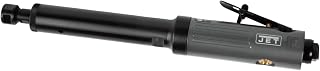 JET 1/4-Inch Pneumatic Extended Die GrinderCheck price on Amazon
 WORKPRO Pneumatic Straight Die GrinderCheck price on Amazon
GarageToolHQ earns a commission when you buy through links on our product pages, at no extra cost to you. Read our affiliate disclosure.
Below: what the pneumatic listings state, what cordless gives up and gains, and how to match either to your garage.
pneumatic vs cordless die grinder: the short answer
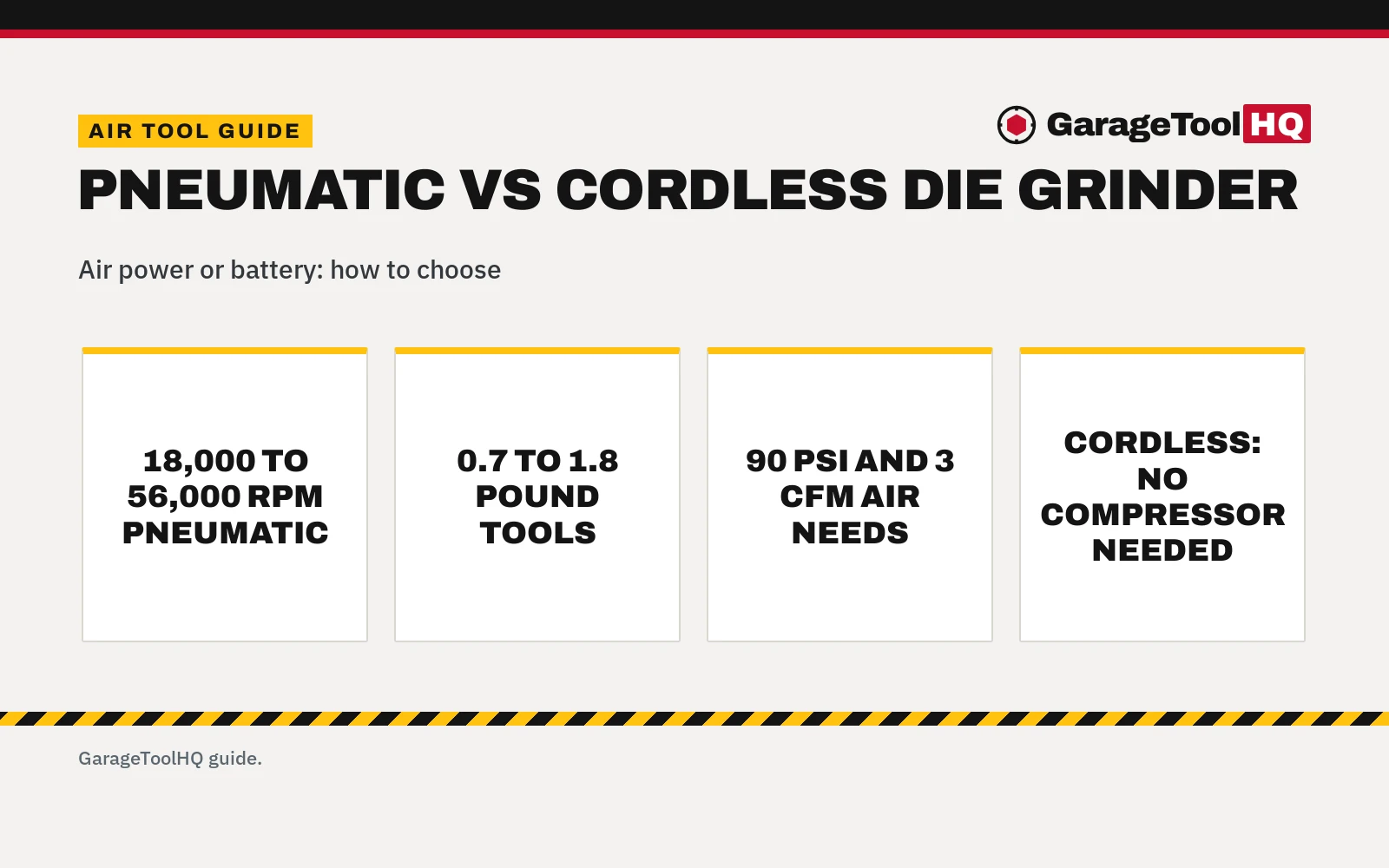
Buy pneumatic if a compressor already lives in your garage: the listings show 18,000 to 56,000 rpm, weights from 0.7 to 1.8 pounds, and air needs as low as 90 psi and 3 cfm. Buy cordless if you work away from the compressor, hate dragging hose, or have no compressor at all; you trade sustained output for portability and a battery to keep charged. Either way, match the collet to your bits: 1/4 inch and 1/8 inch are the common sizes here.
What the pneumatic listings show
Speed first: the Astro pencil type lists 56,000 rpm for detail porting, the Ingersoll Rand 307B lists 28,000 rpm, the 3107G 27,000 rpm, and the WORKPRO, PROSHI and AEROPRO listings sit at 20,000 rpm, with the AIRCAT at 18,000 rpm. Power runs 0.25 hp on the IR 307B through 0.33 hp on the 3107G, 0.6 hp on the PROSHI 315B and .75 hp on the AIRCAT 6280; the Chicago Pneumatic CP872 claims 0.63 HP and 470 W in its bullets against 0.3 HP and 220 W in its spec table, so treat that listing’s power with care. Weight stays friendly: 0.7 pounds on the IR 307B, 1 pound on the 3107G and WORKPRO, 1.1 pounds on the PROSHI 315B, 1.8 pounds on the AIRCAT. Most take 1/4 inch collets with 1/8 inch backups; the IR 307B even includes a 6mm collet. Warranties run 1 year limited on the IR pair and the CP872, and 2 years with proof of purchase on the AIRCAT.
Angle, straight or pencil: pick the shape
Die grinders come in angle, straight and pencil shapes, and the listings cover all of them. The 90-degree angle head, on the WORKPRO, both PROSHI listings, the AIRCAT 6280 and the Chicago Pneumatic CP872, turns the business end sideways for tight spots and angled work. The straight body, on the Ingersoll Rand 3107G at 6.6 inches and the 307B at 5.2 inches, points straight ahead for open access. The Astro 218 is the pencil type: slim, 12.8 ounces, 56,000 rpm, built for detail porting and small parts. Lengths run 4.88 inches on the CP872 to 7 inches on the AIRCAT, so reach varies more than you would expect. Match the shape to the job: angle for corners, straight for open grinding, pencil for fine detail.
The cordless side, in general terms
No cordless listing is in the reference set, so this side gets no figures. The trade is simple: a cordless die grinder carries its power in a battery pack, so there is no compressor to buy, no hose to drag and no cfm math. The costs are runtime, weight and sustained output: batteries run down, add heft, and the tool cannot outrun its pack the way an air tool runs as long as the compressor keeps up. For quick jobs away from the shop, that trade is worth it; for long grinding sessions at the bench, air wins.
Air supply: the requirement nobody lists first
A pneumatic grinder is only as good as the air behind it. The WORKPRO and AEROPRO listings want 90 psi and 3 cfm (85.5 l/min); AEROPRO suggests a 1.5 HP compressor. The Chicago Pneumatic CP872 lists 22 cfm at load, a much bigger appetite. Starve the tool and rpm sags under load no matter what the free-speed figure says. Note the CILEONBE listing’s own wobble: 25,000 rpm in the title against 20,000 rpm in the spec table. And both Ingersoll Rand listings state the compressor is not included, so price the air separately if you are starting from zero. A couple of small extras in the listings help the air side: the PROSHI 315B has a built-in air regulator for precise speed control, and the WORKPRO has an air inlet filter to keep contamination out of the tool. The AEROPRO even includes an oil bottle in the box, a reminder that air tools want a drop of oil now and then.
Weight, noise and handling
Die grinders live in the hand, so ounces matter. The range here runs 0.7 pounds (IR 307B) to 1.8 pounds (AIRCAT 6280), with most near 1 pound; the Astro pencil type is 12.8 ounces and the CILEONBE under a pound at 12.32 ounces. The AIRCAT claims 79 dBA with a tuned exhaust, the only noise figure stated. Rear exhaust on the IR 3107G, WORKPRO and PROSHI blows away from the work; the IR 307B uses front exhaust. Throttles lean safe: self-locking on both IR listings, safety-lock levers on WORKPRO and AEROPRO, twist throttle on the Astro.
Wear eye protection with every air tool, use impact-rated sockets on impact wrenches, disconnect the air line before changing accessories, and finish lug nuts with a torque wrench to the vehicle's spec. See OSHA eye and face protection. Read our Safety Disclaimer.
Wear eye protection; a die grinder throws chips and spent abrasive at speed.
Frequently Asked Questions
Do I need an air compressor for a pneumatic die grinder?
Yes. The WORKPRO and AEROPRO listings call for 90 psi and 3 cfm; the CP872 wants 22 cfm at load. Both Ingersoll Rand listings state the compressor is not included.
What collet sizes do these use?
1/4 inch and 1/8 inch are standard across the listings; the IR 307B adds a 6mm collet in the box and the PROSHI 315B a 1/8 inch (3.18mm) backup.
How fast do they spin?
18,000 rpm on the AIRCAT up to 56,000 rpm on the Astro pencil; most sit at 20,000 to 28,000 rpm.
How heavy are they?
0.7 pounds on the IR 307B up to 1.8 pounds on the AIRCAT 6280; most are around 1 pound, light enough for one-handed work.
Will a small compressor run one?
Check cfm, not just psi. A 3 cfm tool sips; the CP872 at 22 cfm at load needs serious air. Match the tool’s appetite to your compressor’s rating.
What warranty comes with them?
1 year limited on the Ingersoll Rand pair and the Chicago Pneumatic; 2 years with proof of purchase on the AIRCAT.
Related: our best air die grinder and best cordless die grinder picks, the air compressor types guide and air compressor vs tire inflator.