Polyurethane vs Rubber Air Hose: Which One Should You Buy?
Polyurethane vs rubber air hose: PU is lighter and stays flexible in the cold; rubber is heavier and tougher under abuse. Compare weight, pressure and handling.

On this page
Top picks at a glance
As an Amazon Associate we earn from qualifying purchases.
- 1
 EVOULTES 1/4 In x 28 Ft Recoil Air Compressor Hose9.7/10View on Amazon
- 2
 MaxWorks 50 Foot Auto Rewind Retractable Air Hose Reel with9.6/10View on Amazon
- 3
 Hromee 1/4 in x 25 ft Polyurethane Recoil Air Hose with Bend9.6/10View on Amazon
- 4
 Reinforced PolyurethaneView on Amazon
- 5
 1/4 inch x 25 feet Reinforced PolyurethaneView on Amazon
- 6
 50FT 1/4 Inch Air Hose Reinforced Polyurethane Air CompressorView on Amazon
- 7
 100FT 1/4 Inch Air Hose Reinforced Polyurethane AirView on Amazon
- 8
 25FT 1/4 Inch Air Hose Reinforced Polyurethane Air CompressorView on Amazon
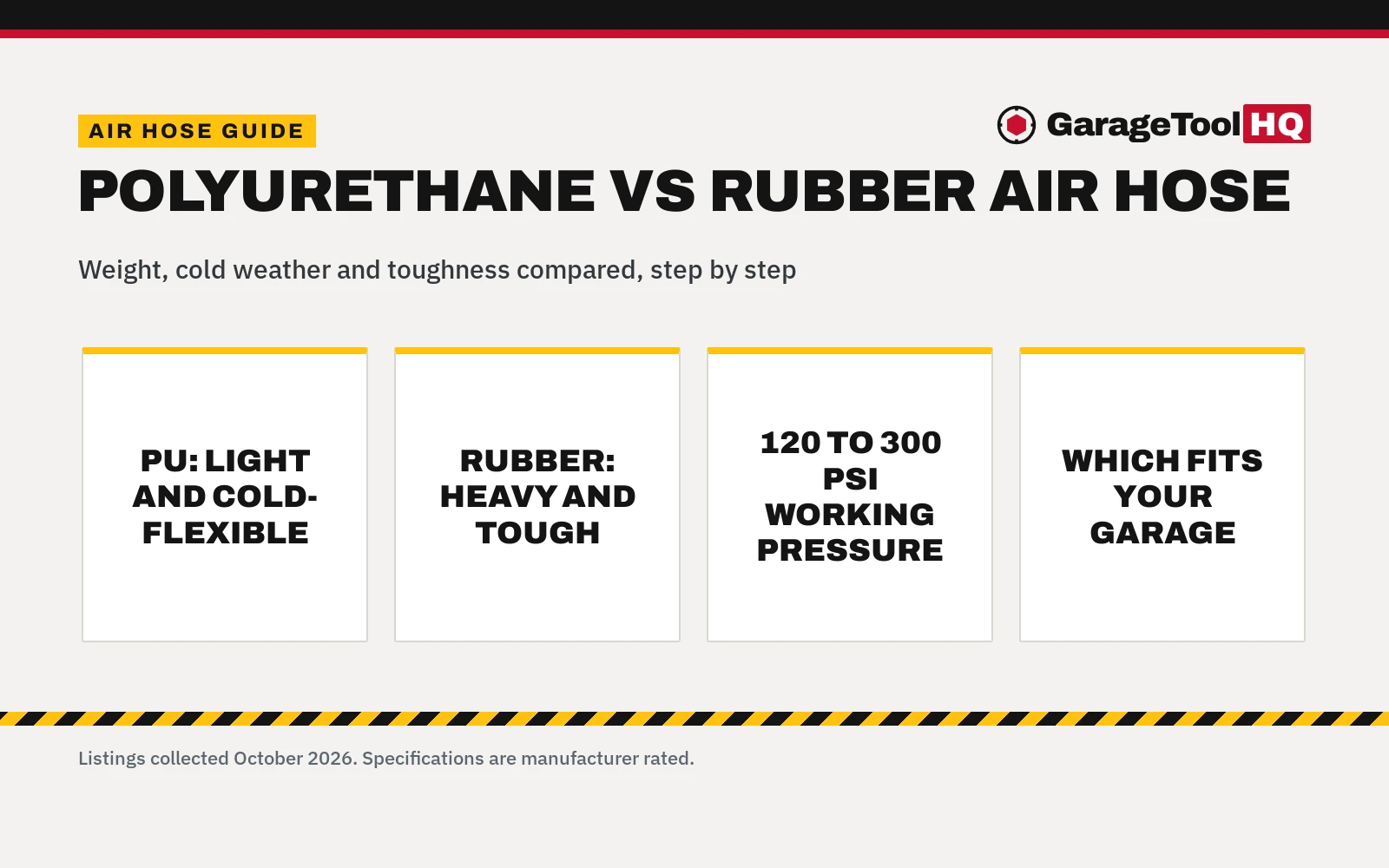
Polyurethane vs rubber air hose, the direct answer: a polyurethane hose is lighter, lays flat and stays flexible in the cold, which suits a home garage where the hose gets dragged around and stored often. A rubber hose is heavier and tougher under rough treatment, which suits shops where the hose takes abuse. The listings in this guide are all polyurethane, so the PU figures below are stated specs and the rubber side comes from general shop knowledge. This guide explains the differences step by step.
More options to compare
 Reinforced PolyurethaneCheck price on Amazon
 1/4 inch x 25 feet Reinforced PolyurethaneCheck price on Amazon
 50FT 1/4 Inch Air Hose Reinforced Polyurethane Air CompressorCheck price on Amazon
 100FT 1/4 Inch Air Hose Reinforced Polyurethane AirCheck price on Amazon
 25FT 1/4 Inch Air Hose Reinforced Polyurethane Air CompressorCheck price on Amazon
GarageToolHQ earns a commission when you buy through links on our product pages, at no extra cost to you. Read our affiliate disclosure.
Polyurethane vs rubber air hose: the short answer
Polyurethane (PU) hoses dominate the listings for one reason: weight. The Hromee 1/4-inch by 25-foot recoil hose weighs 1.2 pounds, the WYNNsky 25-foot reinforced hose weighs 1.1 pounds, and the SANFU 100-foot reinforced hose weighs 4.4 pounds. The SANFU listing states it is very lightweight in comparison to rubber air hose, which is the whole pitch of PU: less hose to drag, coil and carry.
Rubber hoses are the older technology. They are heavier, they take rough handling well, and they have been the shop standard for decades. The trade is simple: PU for handling and cold weather, rubber for brute toughness.
What a polyurethane hose brings
Flexibility is the PU headline. The Hromee and SANFU listings describe super-flexible polyurethane that stays flexible in cold weather, with the Hromee recoil hose rated for year-round use down to -20 C and the SANFU hose rated from -65 to +250 F. Cold garages are where PU earns its keep: a hose that stays limp at low temperatures does not fight you.
Pressure ratings on the listings run 120 PSI for the Hromee 25-foot recoil hose up to 300 PSI for the WYNNsky, Hromee 100-foot, Metabo HPT and SANFU hoses. Burst ratings are stated too: the Metabo HPT listings give a 3-to-1 burst ratio, and the SANFU and SYXQT listings state 1200 PSI maximum burst pressure. The Metabo HPT listing adds that its hose is 40% lighter than PVC and spiral reinforced for durability.
PU also resists the shop environment: the listings call out anti-kink, abrasion, oil and grease resistance, and the Hromee listings note a soft finish that is less likely to scratch painted surfaces, wood flooring and trim. Bend restrictors at the ends reduce kinking at the connection points, and several listings state a 2-year limited warranty.
What a rubber hose brings
Rubber is the heavyweight. A rubber hose shrugs off being driven over, dragged across concrete and left in the sun, which is why commercial shops have used them for decades. The cost of that toughness is weight and memory: rubber hoses are heavier to drag and slower to lay flat, and they stiffen in the cold where PU stays flexible.
Rubber also tolerates heat and rough handling that would scuff a PU hose. For a shop where the hose lives on the floor and takes a beating, rubber’s durability is the argument.
Side-by-side comparison
| Polyurethane hose | Rubber hose | |
|---|---|---|
| Weight | Light; a 25-foot hose can weigh 1.1 to 1.2 pounds | Heavy; stated as heavier than PU in the listings |
| Cold weather | Stays flexible; rated down to -20 C and -65 F | Stiffens in the cold |
| Pressure | 120 to 300 PSI working, up to 1200 PSI burst stated | Varies by hose; check the rating |
| Handling | Lays flat, anti-kink, easy to coil | Holds its coil, fights you in the cold |
| Toughness | Abrasion and grease resistant | Shrugs off being driven over and dragged |
| Warranty | 2-year limited stated on several listings | Varies by hose |
Which one should you buy
Buy a polyurethane hose if you work in a home garage, drag the hose around, coil it after every job and work through the winter. The 25-foot Hromee recoil hose at 120 PSI suits a small shop, while the 300 PSI 50 and 100-foot hoses from WYNNsky, Hromee, Metabo HPT and SANFU cover bigger spaces.
Buy a rubber hose if the hose takes real abuse: driven over, left out, dragged across rough concrete daily. For a home garage that sees weekend use, PU is the easier hose to live with.
Sizing the hose to your shop
Length and diameter decide how the hose feels in use. The listings show 25-foot, 50-foot and 100-foot PU hoses, all with a 1/4-inch inside diameter. A 25-foot hose suits a small garage where the compressor sits near the work; the Hromee 25-foot recoil hose self-coils, so it snaps back into shape instead of tangling. A 50-foot hose covers a 2-car garage from one compressor corner, and the WYNNsky and Metabo HPT 50-foot hoses both rate 300 PSI. A 100-foot hose reaches the driveway and the yard, and the SANFU 100-foot hose states a 1200 PSI maximum burst pressure with a -65 to +250 F temperature range.
Watch the fitting ends too. The listings show 1/4-inch NPT brass ends with universal quick couplers and I/M plugs, and the Hromee recoil hose uses double swivel brass ends with bend restrictors. Match the coupler type to the tools you already own, and keep a spare plug in the kit: couplers wear with daily connects.
Drain the tank after use so water does not rust it from the inside, never exceed the tool's rated pressure, wear eye protection, and run 240V units on the circuit the manual calls for. Do not run a gas engine compressor in a closed garage. Read our Safety Disclaimer.
Frequently Asked Questions
Is a polyurethane air hose lighter than rubber?
Yes. The listings give 1.1 to 1.2 pounds for 25-foot PU hoses and 4.4 pounds for a 100-foot PU hose, and the SANFU listing states its hose is very lightweight in comparison to rubber air hose.
What pressure do PU air hoses handle?
The listings state 120 PSI for the Hromee recoil hose and 300 PSI for the WYNNsky, Hromee 100-foot, Metabo HPT and SANFU hoses, with 1200 PSI maximum burst pressure stated on the SANFU and SYXQT listings.
Can I use a PU hose in winter?
The listings rate PU for cold weather: the Hromee hose for year-round use down to -20 C, and the SANFU hose from -65 to +250 F.
Do PU hoses kink?
The listings describe anti-kink construction with bend restrictors at the ends, and the Hromee recoil hose snaps back into shape after stretching.
What fittings do these hoses use?
The listings show 1/4-inch NPT brass and steel fittings with universal quick couplers and plugs, typically 1/4 inch.
Related: best air compressor dryer for garage picks, how an air compressor dryer works, and our air compressors hub.