Portable vs Stationary Tire Changer: Which One Should You Buy?
A manual duck-head kit, bead clamps or a shop combo machine: how portable and stationary tire changers differ, and which setup fits a home garage.

On this page
Portable vs stationary tire changer comes down to one question: how often do you change tires, and where do you do the work? A portable manual setup suits a home garage that sees a few tire jobs a year, while a stationary machine suits a shop that changes tires every day. The portable side here is a duck-head kit and a set of bead clamps, not a machine; the stationary side is a powered changer and balancer combo.
As an Amazon Associate I earn from qualifying purchases. GarageToolHQ earns a commission when you buy through links on our product pages, at no extra cost to you. Read our affiliate disclosure.
Below: what portable and stationary mean for a tire changer, what the 4 listings in this guide state, and how to match a setup to a home garage or a small shop.
Portable vs Stationary Tire Changer: What Changes in the Garage
A portable tire changer is a manual tool. You break the bead, mount the tire with a bar and a duck head, and put the kit away when the job is done. A stationary tire changer is a powered machine that stays in one spot in the bay: the KATOOL combo in this guide pairs a 2.0HP changer with a bead blaster and a wheel balancer in a single body that measures 47.0 by 39.0 by 34.0 inches. The manual kit needs muscle and floor space only while you work; the stationary machine needs a permanent spot, plus the power and air its manual calls for.
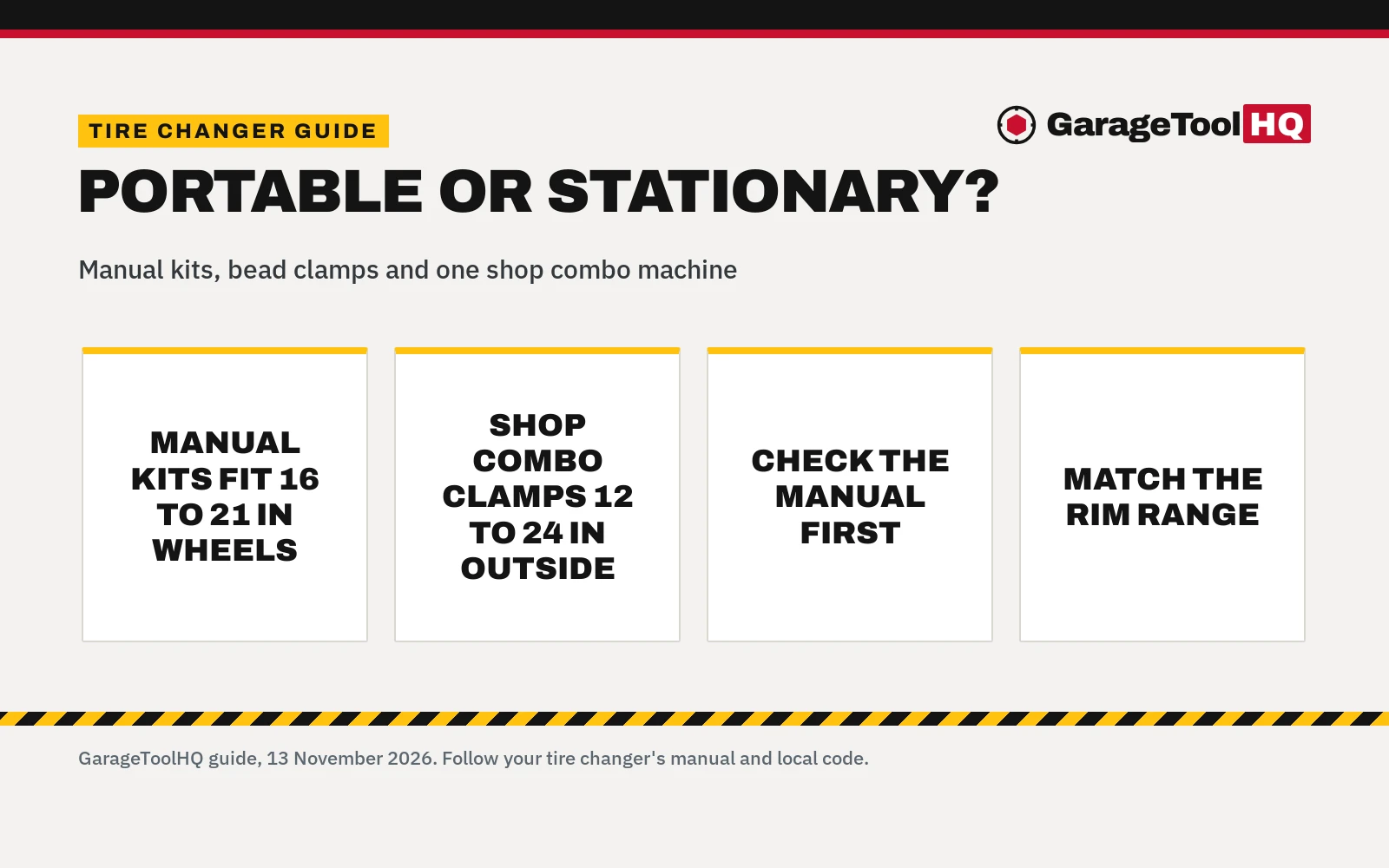
Rim range is the clearest split. The manual duck-head kits in this guide fit 16 to 21 in wheels, which covers cars, light trucks, SUVs, ATVs and trailers on the listings. The stationary combo clamps 12 to 24 in rims from the outside and 14 to 26 in rims from the inside. The manual kits rely on a bar, leverage and a bearing-assisted arm, while the stationary machine does the turning and the bead seating.
The 4 Listings in This Guide
The listings below are the only gear in this guide: duck-head kits for a manual changer, a set of bead clamps, and a stationary changer and balancer combo. None of the portable listings is a complete changer on its own.
| Listing | Type | Rim range stated | Warranty stated |
|---|---|---|---|
| Krysolad Duck Head Adapter Kit | Duck-head kit for a manual changer | 16 to 21 in wheels | 2-year warranty |
| Cikroci Duck Head Kit | Duck-head kit for a manual changer | 16 to 21 in wheels | 1-Year Warranty |
| Hedume Bead Clamp, 4 Pack | Nylon bead clamp set | Not stated | Not stated |
| KATOOL Tire Changer and Balancer Combo | Stationary changer and balancer | 12 to 24 in outside, 14 to 26 in inside | 1 year warranty |
3 listings state a warranty term and one does not, and only the KATOOL listing states a rim range wider than 16 to 21 in.
Portable: Manual Kits and Bead Clamps
The Krysolad duck-head kit fits 16 to 21 in wheels and pairs a silver cone with a bearing design that the maker says fixes parts in place and cuts friction while you work. The pipe wall is thickened steel with precision welding, built as one piece with an extended-handle tightening knob. The listing states a 2-year warranty. Read the fit claim with care: the title says the kit is compatible with most cars, trucks, SUVs and ATV tires, but the bullets say it is only fit for an HF tire changer. Trust the narrower claim.
The Cikroci duck-head kit also fits 16 to 21 in wheels, for cars, light trucks, SUVs, ATVs and trailers, and it fits manual changers with post caps up to 2 in. Its nylon duckhead guides the bead with a rim-friendly surface, and the kit includes 2 sets of thrust bearings, 2 lock collars, a centering cone and bar holder rings that hold the bar during the job. The lock collars tighten around approximately 1.9 to 2 in post caps, with rubber padding strips for smaller caps. The kit measures 10.0 by 2.0 by 50.0 inches and states a 1-Year Warranty.
The Hedume listing is different: a 4 pack of nylon bead clamps, not a changer and not a duck head. Each clamp pushes the bead down into the drop center of the wheel, which helps mounting and demounting, and a spring-loaded plunger holds it in place while you work. The maker says the nylon and plastic composite will not scratch or damage wheels. No rim range or warranty term is stated, so treat it as a helper. If the bead will not break loose, a dedicated tire bead breaker tool for aluminum car wheels does that step.
Stationary: The Shop Combo Machine
The KATOOL KT-T830+KT-B700 is the only powered machine in this guide: a 2.0HP tire changer with a bead blaster and a wheel balancer in one fully closed body, built for high-volume shops. The outside clamp fits 12 to 24 in rims and the inside clamp fits 14 to 26 in rims, with an 8 inch cylinder driving the clamp. The body is solution-treated stainless steel, the alloy steel jaws are carburized to 0.8 to 1.1mm with soft jaw covers, and the closed body keeps dirt, grease and shop debris out. The listing states a 1 year warranty.
2 figures inside the KATOOL listing do not agree, so note them before you plan the bay. The title and part number give the model as KT-T830+KT-B700, while the spec table lists the model as 530Z+600: trust the title and the part number. The spec table also lists two size figures: Product Dimensions of 47.0 by 39.0 by 34.0 inches and a Size of 40*30*35. Measure the space against the larger figure.
How to Choose for Your Garage
Start with the wheels you change. If every wheel you touch falls in the 16 to 21 in range and you already own a manual changer, a duck-head kit is the portable answer: the Krysolad kit if you run an HF tire changer, the Cikroci kit if your changer has a 2 in post cap. Outside that range, the stationary combo covers 12 to 24 in outside and 14 to 26 in inside.
Then check the space and the power. A manual kit stores on a shelf and works wherever the changer stands, while the KATOOL combo measures 47.0 by 39.0 by 34.0 inches and stays in the bay, so measure the spot before you buy and check the manual for its power and air needs. A small shop that changes tires every day gets its value from the powered head, the bead blaster and the balancer; a home garage that changes tires a few times a year gets more from a kit that stores small.
Finally, weigh the warranty the listing states. The Krysolad kit states a 2-year warranty, the Cikroci kit and the KATOOL combo each state a 1 year warranty, and the Hedume clamps state none. A warranty term is not a promise of fit: check the rim range, the post cap size and the changer model first.
Changing tires means lifting the car, so mind the safety basics. Never get under a vehicle held up by a jack alone: use rated stands on solid level ground, follow the manual for lift points, and keep hands clear of the duck head and the bead breaker while the bar moves. Seat beads only as the manual states.
Use rated jack stands on solid ground, wear eye protection with power and air tools, keep fuel-burning equipment out of a closed garage, and follow the manual for every tool. Read our Safety Disclaimer.
FAQ: garage tools
Can I change tires at home with a manual tire changer?
Yes, with a manual changer and a duck-head kit to guide the bead. The kits in this guide fit 16 to 21 in wheels, and the Cikroci kit fits manual changers with 2 in post caps, so check your changer and wheel size against the listing.
What rim sizes does a stationary tire changer handle?
It depends on the machine. The KATOOL combo in this guide clamps 12 to 24 in rims from the outside and 14 to 26 in rims from the inside, with an 8 inch cylinder. Other machines state their own ranges, so check the listing.
Do I need a bead blaster to seat a tire bead?
Not always. Bead clamps like the Hedume 4 pack hold the bead in the drop center while you mount the tire, which helps mounting and demounting. The KATOOL combo includes a bead blaster for stubborn beads.
What is a duck head on a tire changer?
The duck head is the shaped guide that leads the tire bead over the rim edge while the bar turns. The kits in this guide use a nylon duckhead or a silver cone duck head, and the nylon surface is kinder to rims.
Which tire changer fits a small home garage?
A manual changer with a duck-head kit fits a small garage best, since the kit stores on a shelf and the changer stands where you work. The stationary combo measures 47.0 by 39.0 by 34.0 inches and stays in the bay, so it suits a shop with room for it.
Related: tire bead breaker tool for aluminum car wheels, tire patch tool, rechargeable cordless tire inflator and how to remove a valve core.