Pressure Washer Pump Repair: Common Fixes and Parts
Pressure washer pump repair means finding the failed part, from the unloader and seals to the thermal relief valve, and matching a replacement pump to the engine.
On this page
Top picks at a glance
As an Amazon Associate I earn from qualifying purchases.
- 1
 AAA 3700 PSI 2.5 GPM Horizontal Replacement Pressure Washer9.7/10View on Amazon
- 2
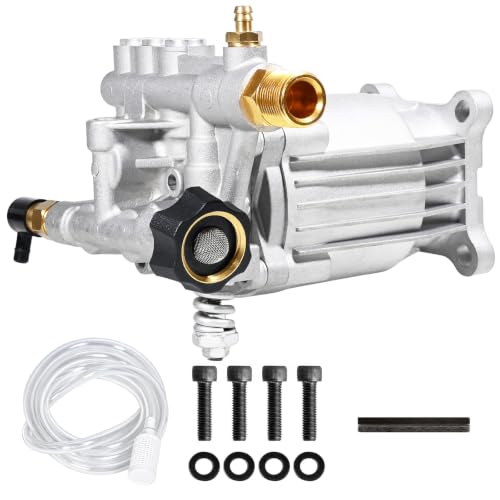 YAMATIC 3/4" Horizontal Shaft Pressure Washer Pump Max 34009.6/10View on Amazon
- 3
 WOJET Horizontal Self-Priming Pressure Washer Pump 3/4"Shaft9.6/10View on Amazon
The washer runs, the engine sounds fine, and the spray comes out weak or not at all. That can be a sign of a pump problem, and pressure washer pump repair starts with finding which part failed: the unloader, the seals, the valves, or the pump head itself. Some of these faults come down to one part, and when the pump body is worn past repair, a replacement pump fits onto the same shaft.
GarageToolHQ earns a commission when you buy through links on our product pages, at no extra cost to you. Read our affiliate disclosure.
Below: the common pump faults and how to fix each one, the steps to take before ordering parts, and four replacement pumps that fit the repair.
AAA 3700 PSI 2.5 GPM Horizontal Replacement
A triplex replacement pump rated up to 3700 PSI at 2.5 GPM for horizontal engines with a 3/4-inch shaft, with PowerBoost Technology and a brass manifold.
Pros
- Up to 3700 PSI at 2.5 GPM, the highest pressure here
- PowerBoost Technology with a hand knob to match power to the task
- Brass manifold and dual oversized ball bearings
- 5-year warranty stated in the listing
Cons
- Heaviest pick here at 9.0 lb
- Largest body here, at 12.0 by 9.0 by 4.0 inches
- No pre-filled oil is stated in the listing
- Fits horizontal engines only, so engine orientation must match
YAMATIC 3/4" Horizontal Shaft Pressure Washer Pump
An axial cam replacement pump rated at 3400 PSI and 2.5 GPM for 3/4-inch horizontal shafts, with a thermal relief valve and an adjustable unloader.
Pros
- 3400 PSI at 2.5 GPM with a 3400 RPM rated speed
- Adjustable unloader to match pressure to the engine
- Thermal relief valve protects the pump in bypass mode
- Pre-filled oil, so the first oil fill is skipped
Cons
- No warranty term is stated in the listing
- Spec table lists identical figures for length, width and height
- Not for 7/8-inch or 1-inch shafts, vertical engines, or idle-down systems
- Rated for 200 hours of running life, a household-grade figure
WOJET Horizontal Self-Priming Pressure Washer Pump
A self-priming axial pump rated at 3400 PSI and 2.5 GPM for 3/4-inch shafts, with a hand-twist unloader and a die-cast aluminum body.
Pros
- Self-priming, so it can draw water from a bucket, pool or tank
- Hand-twist unloader, no wrench needed to adjust pressure
- Die-cast aluminum body resists rust
- Thermal relief valve releases hot water and draws in cooler water
Cons
- No warranty term is stated in the listing
- Spec table spells the color as Sliver
- Direct engine crankshaft mount only, with no other mounting options
- Fits 180 to 225cc engines only, so check engine size first

Hourleey 3/4" Shaft Horizontal Pressure Washer
A horizontal replacement pump rated at 3400 PSI and 2.5 GPM for 3/4-inch shafts, pre-filled with oil and supplied with a detergent hose and mounting hardware.
Pros
- 3400 PSI at 2.5 GPM for walls, fences, sidewalks and vehicles
- Pre-filled oil with a maintenance-free crankcase
- Double seal system helps avoid oil and water leaks
- Kit includes a detergent hose, bolts, a shaft key, pads and washers
Cons
- No warranty term is stated in the listing
- No adjustable unloader is stated in the listing
- No engine size range is stated in the listing
- No dimensions are stated in the listing
Pressure washer pump repair: common problems and fixes
A pump that loses pressure often has a stuck unloader or worn seals. The unloader controls how much pressure reaches the nozzle, and when it sticks open, the spray stays weak even with the engine running well. Worn seals let water past the pistons, which drops pressure and can show up as a leak at the pump body.
Heat is the quiet pump killer. A pump left running in bypass with the trigger closed keeps churning the same water, and the water heats up. That is the job of the thermal relief valve: it releases hot water and draws in cooler water to keep the pump from overheating. A valve that is stuck shut leaves the pump with no relief.
How to fix a pressure washer pump step by step
Start with the water supply. The water supply must reach the pump without kinks or a clogged inlet screen, and the inlet connection must sit tight. Next, look at the unloader: several of the pumps below have adjustable unloaders, and a stuck unloader is a common cause of weak spray.
Before ordering, match the replacement to the engine. Every pump below fits a 3/4-inch horizontal shaft, and each one lists a maximum pressure and flow that must match the washer. Confirm the inlet and outlet threads too: a garden hose inlet with a threaded outlet is the standard fit on all four picks here.
Eye protection belongs on before the trigger is pulled, and the spray must never point at people or pets. Release the pressure before disconnecting any hose or fitting, and let a hot pump cool before touching it.
Use rated jack stands on solid ground, wear eye protection with power and air tools, keep fuel-burning equipment out of a closed garage, and follow the manual for every tool. Read our Safety Disclaimer.
Replacement pumps for pressure washer pump repair
Each pump below fits onto a 3/4-inch horizontal shaft and handles one step of the repair: matching pressure and flow, fitting the inlet and outlet, or replacing a pump that no longer holds pressure.
When to rebuild and when to replace the pump
A rebuild makes sense when the fault sits in one part: a tired seal, a stuck unloader, or a spent thermal relief valve. A replacement makes sense when the body is scored, the pistons are worn, or the head no longer seals after a rebuild. At that point a new pump replaces the worn pump in one swap.
FAQ: garage tools
How do I fix a pressure washer pump that has no pressure?
Check the water supply and the inlet first, then the unloader and the seals. A stuck unloader or a worn seal is a common cause. If the body is scored or the pistons are worn, a replacement pump is the fix.
How do I repair a pressure washer pump that leaks water?
Find where the water escapes. A leak at a fitting may need only a snugger connection, while a leak at the pump body points at a seal.
How do I rebuild a pressure washer pump?
A rebuild swaps the worn parts: seals, the unloader, and the thermal relief valve if it is stuck. If the body or pistons are worn, a full replacement pump is the better route.
How do I know if a replacement pump will fit my pressure washer?
Match the shaft size, the engine orientation, the maximum pressure and flow, and the inlet and outlet threads.
What does a thermal relief valve do on a pressure washer pump?
It protects the pump when the trigger is closed and the pump runs in bypass. The valve releases hot water and draws in cooler water, which keeps the pump from overheating.
Related: the best electric pressure washer picks and the best pressure washer for engine bay guide. Also see the GarageToolHQ picking method.