Pressure Washer Surface Cleaner Tips for Driveways and Cars
Match the cleaner to the washer's pressure and flow, work in slow overlapping passes, and let the spinning jets clean driveways and patios without stripes.

On this page
Top picks at a glance
As an Amazon Associate I earn from qualifying purchases.
- 1
 Simpson 16.5" Stainless Steel Pressure Washer9.6/10View on Amazon
- 2
 Biswing 14" Pressure Washer Surface Cleaner with 49.5/10View on Amazon
- 3
 14'' Pressure Washer Surface Cleaner Green9.4/10View on Amazon
- 4
 GreenWorks 5210902 15" Extension Included Surface9.4/10View on Amazon
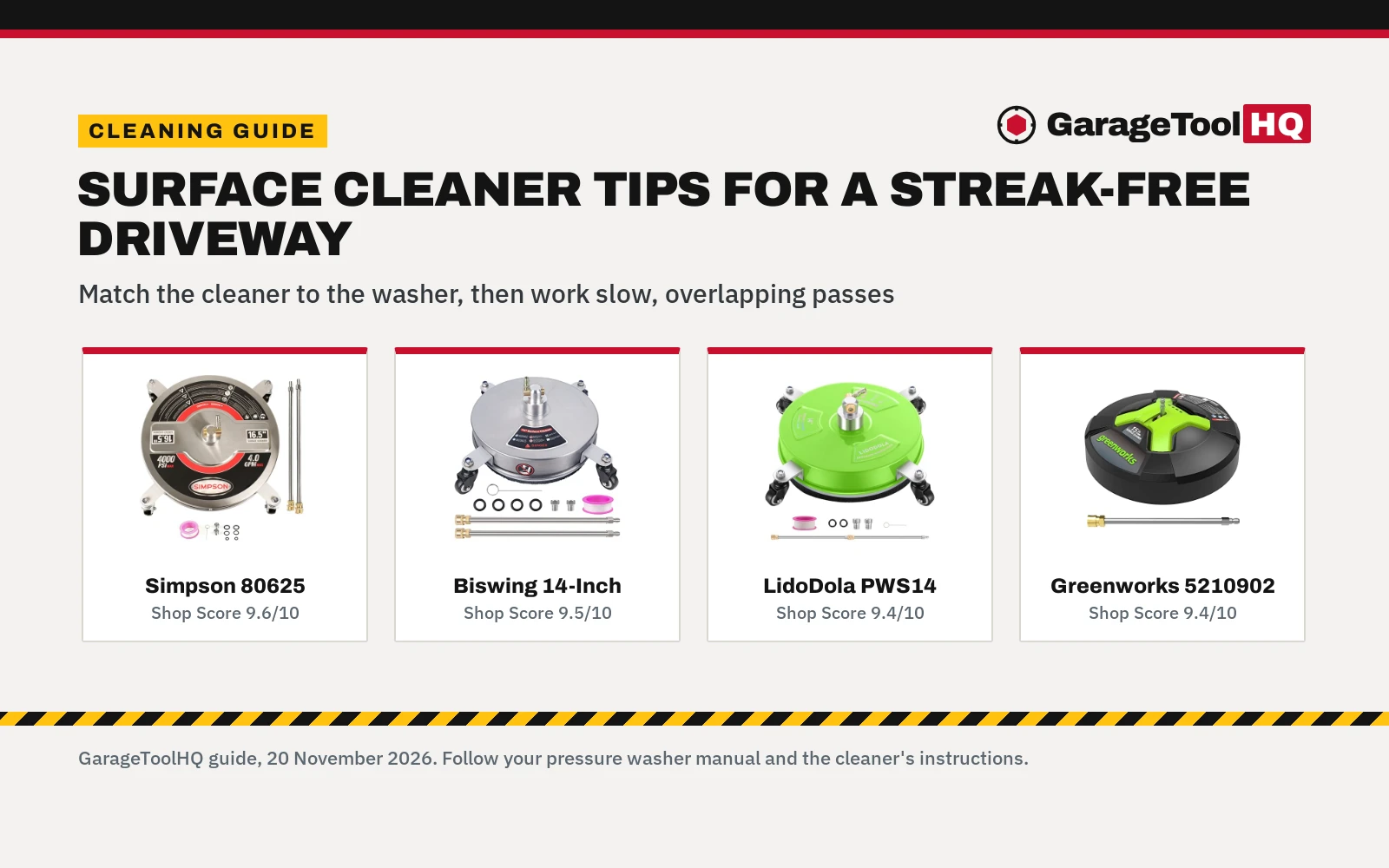
A driveway that has spent a season under leaves, tire marks and road grime is slow, streaky work with a fan nozzle alone. The narrow spray leaves stripes and throws dirty water back at the user. Pressure washer surface cleaner tips start with the right match: a cleaner sized to the washer, run in slow, overlapping passes, with the jets kept moving.
GarageToolHQ earns a commission when you buy through links on our product pages, at no extra cost to you. Read our affiliate disclosure.
Below: how to match a surface cleaner to a pressure washer, the pass pattern that avoids stripes, and the gear that fits each step.
Simpson 16.5" Stainless Steel Pressure Washer
A 16.5 inch stainless steel surface cleaner rated at 2000 to 4000 PSI and 2.5 to 4 GPM, with 4 wheels and a nozzle cleaning tool.
Pros
- 16.5 inch diameter, the widest path here
- Rated 2000 to 4000 PSI and 2.5 to 4 GPM
- Stainless steel shroud and nozzles
- Nozzle cleaning tool included
Cons
- Heaviest pick here
- Cold water only, 140 degrees F maximum
- No electric-washer fit is stated
- No extension wands in the box
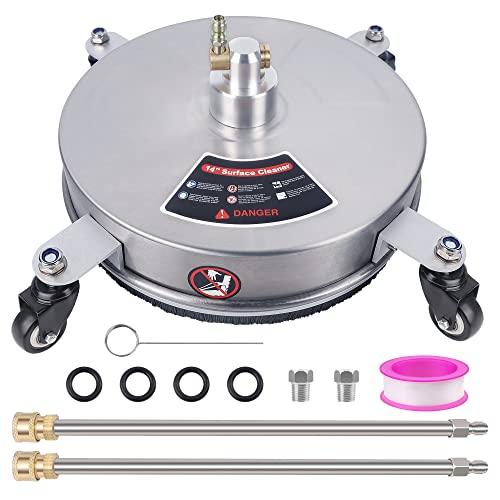
Biswing 14" Pressure Washer Surface Cleaner with 4
A 14 inch stainless steel surface cleaner with 4 wheels, 2 extension wands and 2 replacement nozzles, rated up to 4000 PSI with a 1.8 to 3.7 GPM flow range.
Pros
- Rated up to 4000 PSI, 2000 PSI minimum
- 1.8 to 3.7 GPM flow range stated
- 2 extension wands of 15 inches, 2 nozzles
- Built-in filter at the inlet
Cons
- No warranty term is stated
- Not for garden hoses or water hoses
- Needs an adapter if the gun fitting does not match
- 14 inch path is narrower than the 16.5 inch pick
14'' Pressure Washer Surface Cleaner Green
A 14 inch stainless steel surface cleaner with 4 wheels, a brush skirt, 2 extension wands and 2 replacement nozzles, for gas and electric washers.
Pros
- Stainless steel housing, 4 swivel wheels
- Brush skirt contains spray and debris
- 2 extension wands, 2 replacement nozzles
- Fits gas and electric washers
Cons
- No warranty term is stated
- No pressure or flow range is stated
- 14 inch width covers less ground per pass
- No inlet filter is listed
GreenWorks 5210902 15" Extension Included Surface
A 15 inch surface cleaner with a 1/4 inch quick-connect fitting and an extension included, weighing 5.39 lb and backed by a 3 year warranty.
Pros
- Lowest weight here at 5.39 lb
- 15 inch width for driveways, patios and decks
- 3 year warranty stated
- Extension included in the box
Cons
- No pressure or flow range is stated
- No replacement nozzles in the box
- 15 inch width covers less ground per pass
- No wheels are stated
Pressure Washer Surface Cleaner Tips: Match the Cleaner to the Washer
Start with the washer’s own numbers. A surface cleaner needs a minimum pressure and flow to spin its jets, and it has a maximum it can take. The two cleaners below that state a range both start at 2000 PSI and top out at 4000 PSI, one with 1.8 to 3.7 GPM and the other with 2.5 to 4 GPM. If the washer cannot reach the minimum, the jets spin too slowly and the cleaner cleans unevenly. Every cleaner here uses a 1/4 inch quick-connect fitting, so confirm the wand fitting matches before ordering.
The Gear for the Job: 4 Surface Cleaners
Each cleaner below handles one part of the job: the wide path for big driveways, the stated pressure and flow range for matching the washer, the light body for easy pushing, and the brush skirt for keeping spray under the housing.
Work in Slow, Overlapping Passes
Stripes usually come from pace or overlap. A slow, steady pace with light pressure keeps the jets at an even distance from the ground, and overlapping each pass keeps the edges from showing as clean bands next to dirty ones. The makers claim faster work than a standard nozzle: one listing puts cleaning time reduced by up to 60 percent and surfaces cleaned up to 5 times faster, and another puts coverage at 10X more. Those claims still depend on pace, so slow down if the first pass looks uneven.
Keep the Jets Moving and the Spray Contained
A surface cleaner works because its jets spin at a consistent height, and even coverage only holds while the cleaner keeps moving. Stop in one spot and the jets dig a clean ring into the concrete. Three of the four cleaners here roll on 4 wheels, and two include 2 extension wands that add reach; the LidoDola wands also help the user stand upright with less bending. One cleaner here lists a brush skirt that holds water and debris under the housing, and another lists a shroud that helps prevent overspray.
Check the Fit Before the First Pass
Fit is more than the quick-connect fitting. One cleaner here is for cold water only, with a 140 degrees F maximum, so a hot-water washer is the wrong partner. One listing states that it does not fit a garden hose or a water hose, and that an adapter is needed if the washer gun fitting does not match. Two cleaners here list gas and electric washers, while one names gas-powered washers. See pressure washer quick connect sizes for the fitting question.
Work Safe Around a Spinning Cleaner
Spinning jets throw water, grit and small stones back at the user, so eye protection goes on before the trigger is pulled, and the spray never points at people, pets or the user’s own feet. Keep bystanders clear, and release the trigger and let the pressure drop before lifting the housing.
Keep electric pressure washers on a GFCI outlet, never point the wand at people or pets, wear eye protection with polishers and chemicals, and read the label before mixing any cleaning products. Read our Safety Disclaimer.
FAQ: garage tools
What PSI does a pressure washer surface cleaner need?
It depends on the cleaner. The two cleaners here that state a range both start at 2000 PSI and top out at 4000 PSI, one with 1.8 to 3.7 GPM and the other with 2.5 to 4 GPM. The other two state no range, so check the washer’s output before ordering.
Can I use a surface cleaner on a deck?
Yes, with the right cleaner. Two of the cleaners here list decks among their surfaces, along with driveways, sidewalks and patios. Work at a slow pace and check the deck maker’s guidance before pressure washing wood.
Do surface cleaners work with electric pressure washers?
Some do. Two of the cleaners here list gas and electric washers, while one names gas-powered washers. Check the cleaner’s rating against the washer’s pressure and flow, and confirm the 1/4 inch quick-connect fitting matches.
Why does my surface cleaner leave stripes?
Stripes usually come from pace or overlap. Moving too fast, stopping in one spot, or leaving gaps between passes all show up as bands. Slow down, keep a steady pace with light pressure, and overlap each pass.
Can I use a surface cleaner on a wall?
Most surface cleaners are built for flat ground, but one cleaner here lists vertical surfaces such as brick walls, stucco and siding. Check the cleaner’s own guidance before aiming one at a wall.
What size surface cleaner do I need?
The four cleaners here run 14, 15 and 16.5 inches wide. A wider path covers a big driveway in fewer passes, while a narrower one takes less room to store. Match the width to the area and to the washer’s pressure and flow.
Related: best pressure washer for car cleaning, pressure washer quick connect sizes, our car detailing hub and car detailing tips.