Reverse Osmosis vs Deionizer for Car Washing: Which One Should You Buy?
A deionizer strips rinse-water minerals through resin; reverse osmosis blocks them with a membrane. Four DI systems compared on flow, resin life and color-change indicators.

On this page
Top picks at a glance
As an Amazon Associate we earn from qualifying purchases.
- 1
 Car & RV Wash Brush Kit with 48-144״ Long Extendable Handle9.8/10View on Amazon
- 2
 2 Pcs 5 Gallon Bucket Dolly with 5 360° Swivel Wheel Casters9.6/10View on Amazon
- 3
 MR.SIGA Professional Microfiber Towels for Cars9.6/10View on Amazon
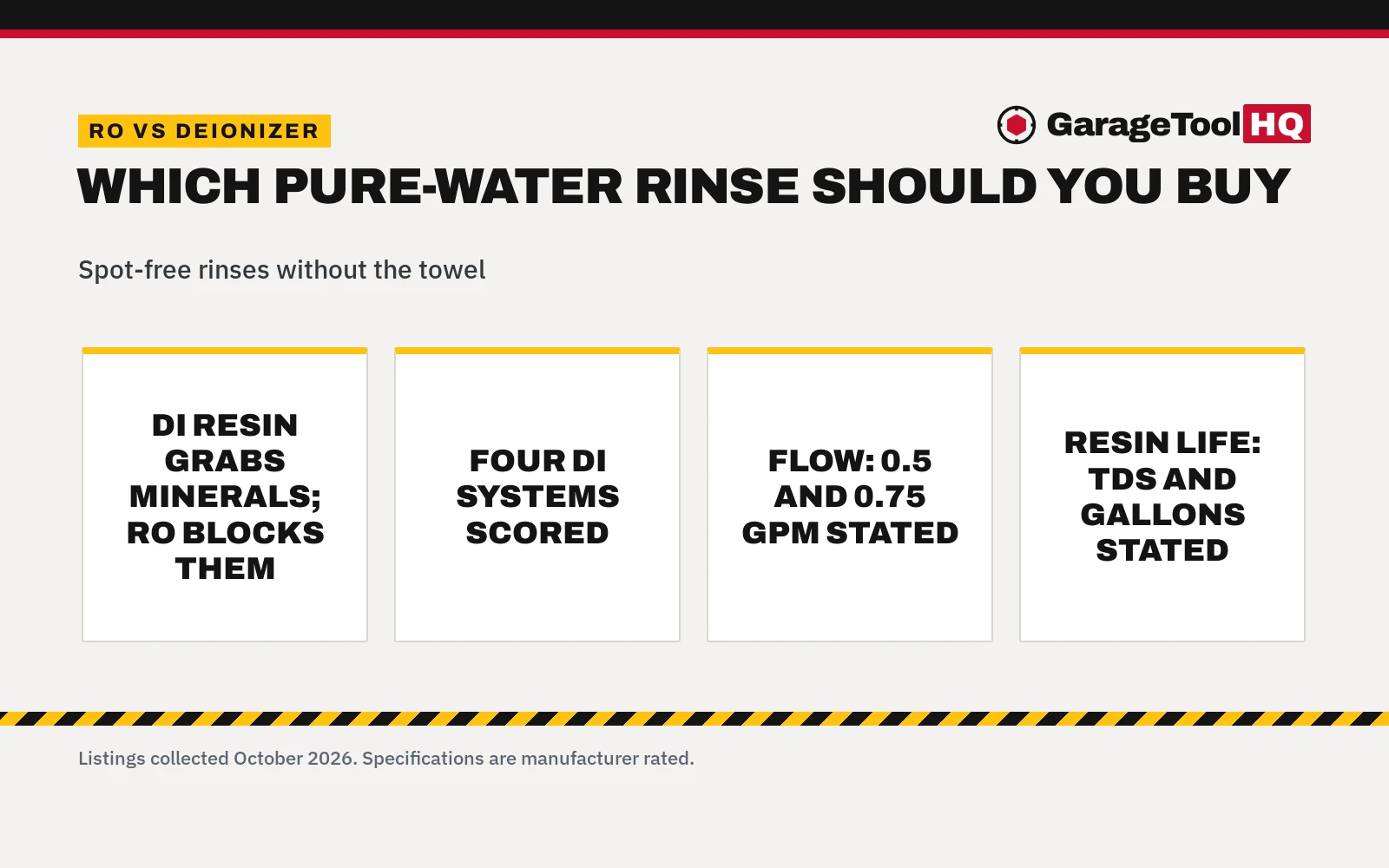
The reverse osmosis vs deionizer for car washing question is about how you strip minerals from rinse water so the car air-dries spot-free. A deionizer passes water through resin that grabs dissolved minerals; reverse osmosis pushes water through a membrane that blocks them. For home car washing, the deionizer is the simpler pick: no drain line, no wastewater, just resin that you replace or refill when it is spent. All four listings below are deionizer systems; no reverse osmosis unit was in this set, so the RO side is described as the category, not a scored product.
GarageToolHQ earns a commission when you buy through links on this page, at no extra cost to you. Read our affiliate disclosure.
How a deionizer works, from the listings: reverse osmosis vs deionizer for car washing
The listings agree on the mechanism: water passes through resin, and total dissolved solids (TDS), the calcium, magnesium and other minerals that leave spots, are removed. The Aquatic Life listing states each cartridge removes approximately 1,800 to 2,000 TDS before the resin needs replacing; the XINSHUO listing states the same 1,800 to 2,000 TDS per filter. The resin tells you when it is done by changing color: tan on the Aquatic Life when the resin is used up, purple to brown on the VEVOR, blue to orange or dark brown on the XINSHUO. The Aquatic Life describes refilling with bulk color-changing resin; the VEVOR and XINSHUO describe replacing the filter. Our deionized vs distilled water guide covers the water types.
What reverse osmosis does differently
Reverse osmosis is the membrane alternative. Where these deionizers swap ions in resin, an RO unit forces water through a semipermeable membrane and sends the rejected minerals down a drain as wastewater. That means an RO setup needs a drain, steady water pressure and usually a storage tank, since membranes produce pure water slowly. The tradeoff is running cost: a membrane lasts far longer than resin, but the upfront system costs more and wastes water. For a final rinse a few times a month, the resin systems below are the lower-friction choice; for very hard water or daily washing, RO’s membrane economics start to make sense. No RO listing was in this set, so compare any RO unit against the resin figures below.
The four deionizers, ranked
1. Aquatic Life DI Spot-Free Car Rinse System. The most complete kit here: a dual DI unit housing with mounting bracket, 2 cartridges, wrench, adapters, flow regulator, plumber’s tape and instructions, in an 11 by 6 by 17 inch wall-mounted unit. The listing states a 0.75 gpm maximum flow rate, the highest here, and 1,800 to 2,000 TDS removal per cartridge, with the resin turning tan when spent and refillable from bulk color-changing resin. The rinse promise is explicit: wash, rinse with the unit, and let the car air-dry with no towel drying.
2. VEVOR Deionized Water System. The capacity-stated pick: 2 by 0.5L of color-changing mixed-bed resin with a rated purified water capacity of up to 50 gallons under average 200 ppm water conditions, in a 7.17 lb unit measuring 9.45 by 5.12 by 13.39 inches. Purple resin means keep using it, brown means replace it, and the transparent housing shows the change. It mounts on a wall bracket and the listing lays out the workflow: wash and soap with regular water, rinse, then a final DI rinse and air-dry.
3. WaterSentinel SF-20W. The inline simple option: a 1.5 lb filter that threads onto a standard 3/4 inch garden hose with a braided flex hose extension, no tools or mounting needed. The listing states a 0.5 gpm maximum flow rate, brass crimped ends, a sediment pack that reduces chlorine, dust, rust, sand and silt, and reusable blue caps to keep the resin fresh. It is made in the USA. One honest difference: where the Aquatic Life promises no towel drying, the WaterSentinel listing recommends wiping off excess water and letting the car air-dry in the sun.
4. XINSHUO Deionized Spot Free Car Rinse Unit. The portable pick: a lightweight mixed-bed resin unit with an adapter for a home faucet or campsite water source, no complex installation. The listing states 1,800 to 2,000 TDS removal per filter, with the resin blue before use and orange to dark brown after. Suited to cars, RVs, motorcycles and yachts on the move; the least stated about flow rate and capacity of the four.
Flow rate and capacity: reading the figures
Two figures matter and the listings state them unevenly. Flow rate: the Aquatic Life states 0.75 gpm and the WaterSentinel 0.5 gpm; the VEVOR and XINSHUO state none. Resin life: the Aquatic Life and XINSHUO state 1,800 to 2,000 TDS per cartridge or filter, and the VEVOR states 50 gallons at 200 ppm. TDS removal per cartridge and gallons at a given ppm are different ways of saying the same thing: how much mineral load the resin can take. If your tap water is very hard, expect the low end of any resin-life claim; the color change tells you when you are there.
Which should you buy
Buy a deionizer when you want spot-free rinses without new plumbing: pick the Aquatic Life for the fullest kit and highest stated flow, the VEVOR for a stated 50-gallon capacity, the WaterSentinel for hose-thread simplicity, or the XINSHUO for portability. Consider reverse osmosis when the wash volume is high enough that resin replacement becomes the bigger cost, and you have a drain and pressure to feed it. See our car wash kit and water blade picks for the rest of the wash.
Frequently Asked Questions
What is TDS and why does it cause spots?
TDS is total dissolved solids: the calcium, magnesium and other minerals dissolved in tap water. When rinse water evaporates, the minerals stay behind as spots. The listings state their resin removes TDS, which is why the car can air-dry clean.
How do I know when the resin is spent?
By color. The Aquatic Life resin turns tan, the VEVOR changes from purple to brown, and the XINSHUO from blue to orange or dark brown. The Aquatic Life listing describes refilling with bulk resin; the VEVOR and XINSHUO listings describe replacing the filter.
Do I still need to towel dry after a DI rinse?
The listings differ. The Aquatic Life promises a spot-free rinse with air-drying and no towel drying; the VEVOR workflow ends with air-dry as well. The WaterSentinel recommends wiping off excess water first and then air-drying in the sun. Follow the listing for the unit you buy.
Will a DI filter fit my garden hose?
The WaterSentinel states a standard 3/4 inch garden hose thread and includes a hose extension. The XINSHUO includes an adapter for a home faucet or campsite water source. The Aquatic Life and VEVOR are wall-mounted units with adapters and brackets in the box.
Deionizer or reverse osmosis: which costs less to run?
The listings do not state running costs, only resin life: 1,800 to 2,000 TDS per cartridge or filter on two listings, 50 gallons at 200 ppm on the VEVOR. Resin is a consumable you replace or refill; an RO membrane lasts longer but the system costs more upfront and wastes water. For occasional washing, the DI math is simpler.