Rubber vs Plastic Wheel Chocks: Which One Should You Buy?
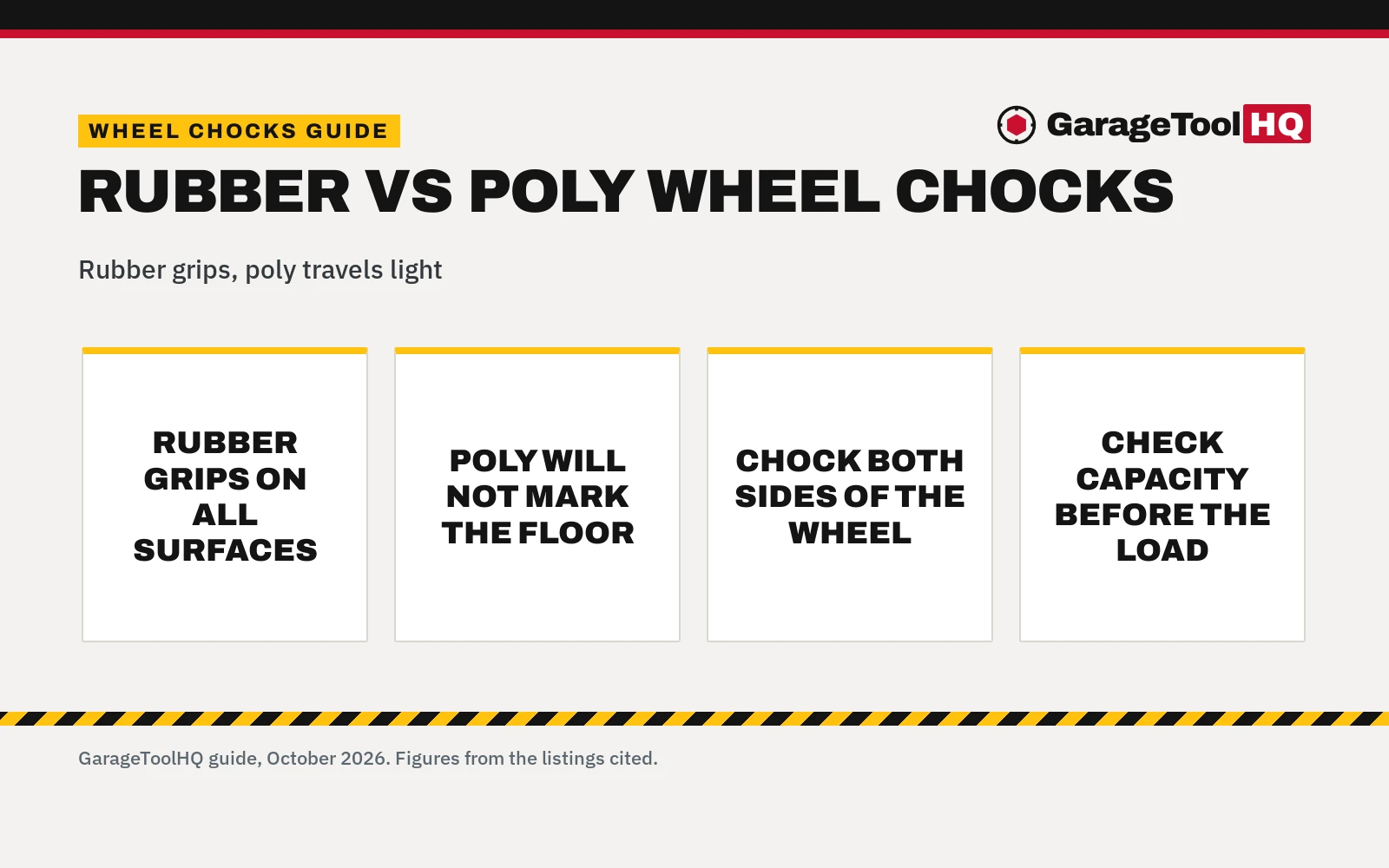
Rubber and plastic wheel chocks compared for RVs, trailers and trucks: how each material grips, fits and weathers, with one rubber example and two plastic examples.

On this page
Top picks at a glance
As an Amazon Associate I earn from qualifying purchases.
- 1
 Komokeru Wheel Chocks for Trailers9.6/10View on Amazon
- 2
 Seuqhck 4 Pack Wheel Chocks9.6/10View on Amazon
- 3
 WEYCALI Wheel Chocks for RV Trailer Car Camper9.6/10View on Amazon
Verdict: Choose rubber if you park on grass, gravel or uneven ground and want a chock that grips and conforms to the surface. Choose plastic if you want a set that stacks away, pulls out by rope and resists sun.
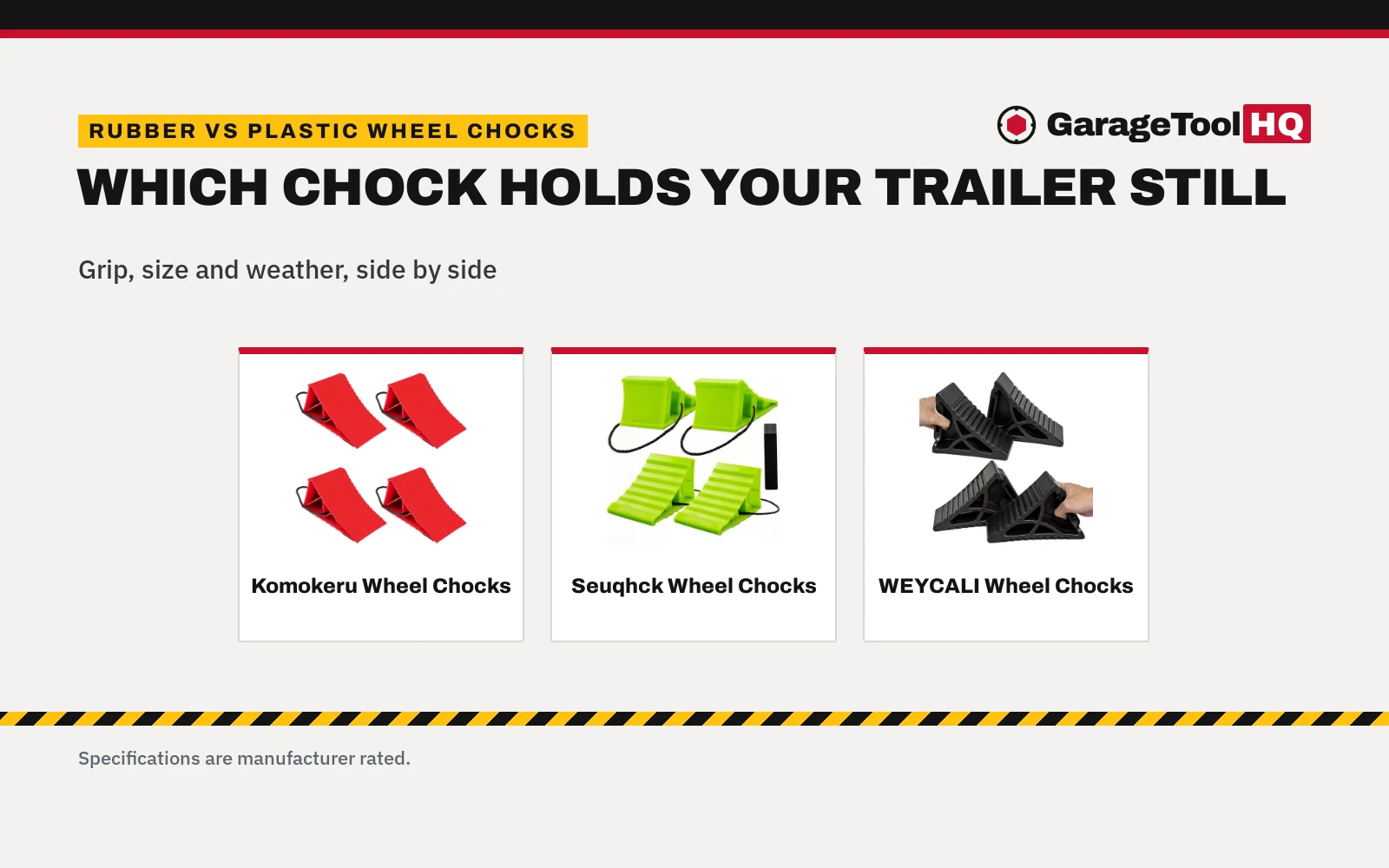
A trailer that creeps forward on a sloped driveway turns a simple unhitch into a stressful job. Chocks sit behind the tires and hold the rig still while you unhitch, level or work around the wheels. This rubber vs plastic wheel chocks comparison looks at one rubber example and two plastic examples, and at what each material does well on pavement, gravel and grass.
GarageToolHQ earns a commission when you buy through links on this page, at no extra cost to you. Read our affiliate disclosure.
Example wheel chocks
| # | Product | Shop Score | Buy |
|---|---|---|---|
| 1 | Komokeru Wheel Chocks for Trailers | 9.6/10 | Buy on Amazon |
| 2 | Seuqhck 4 Pack Wheel Chocks | 9.6/10 | Buy on Amazon |
| 3 | WEYCALI Wheel Chocks for RV Trailer Car Camper | 9.6/10 | Buy on Amazon |
Komokeru Wheel Chocks for Trailers
A hard plastic wheel chock with a non-slip base, a rope for removal and a 1 year manufacturer warranty, sized 4.8 x 4.2 x 8.3 in.
Pros
- Hard plastic with UV inhibitors for outdoor use
- Non-slip base and rope for easy removal
- Triangular shape fits tire shapes closely
- 1 year manufacturer warranty
Cons
- No load capacity stated
- No built-in rigid carry handle; removal relies on the rope and handle strap
- Check the 8.3 in dimension against the space behind the tire
- The listing gives no maximum tire size
Seuqhck 4 Pack Wheel Chocks
A 4 pack of HDPE wheel chocks with 16 anti-slip pads and a 28.7 in rope handle, sized 7.8 x 4.5 x 4.25 in.
Pros
- High-density polyethylene (HDPE) resists UV damage, cracking and road chemicals
- 16 anti-slip pads, 4.3 x 1 in, plus a textured base
- 28.7 in integrated rope handle for placement and removal without bending down
- Stackable design for compact storage
Cons
- No warranty term stated
- No load capacity stated
- The listing gives no maximum tire size
- Check the 7.8 x 4.5 x 4.25 in size against the tire before ordering
WEYCALI Wheel Chocks for RV Trailer Car Camper
A 4 pack of solid rubber wheel chocks with a textured non-slip bottom and a built-in carry handle, sized 8.0 x 4.0 x 6.0 in.
Pros
- Solid rubber resists cracking, warping and deforming under pressure
- Textured non-slip bottom grips pavement, gravel, grass and garage floors
- Built-in carry handle for one-handed transport
- All-weather build stands up to sun, rain, snow, mud and salt
Cons
- No warranty term stated
- No load capacity stated
- Black color is hard to spot on dark pavement at night
- Suits light truck and trailer tires; larger tires are outside the stated fit
Side by side
| WEYCALI rubber chocks | Komokeru plastic chocks | Seuqhck plastic chocks | |
|---|---|---|---|
| Material | Solid rubber | Hard plastic | High-density polyethylene (HDPE) |
| Dimensions | 8.0 x 4.0 x 6.0 in | 4.8 x 4.2 x 8.3 in | 7.8 x 4.5 x 4.25 in |
| Pack | 4 | 4 | 4 |
| Grip | Textured non-slip bottom | Non-slip base | 16 anti-slip pads, 4.3 x 1 in, and textured base |
| Removal | Built-in carry handle | Rope and handle strap | 28.7 in integrated rope handle |
| Weather | Sun, rain, snow, mud and salt | UV inhibitors | UV-resistant, resists oil and grime |
| Warranty | No warranty term stated | 1 year manufacturer warranty | No warranty term stated |
These numbers are the tool makers’ rated figures, as their listings print them on 25 November 2026.
Rubber vs plastic wheel chocks: how each material holds the tire
Rubber holds by grip and fit. The rubber example is solid rubber with a curved face shaped to wrap around various tires and conform to the ground. Its textured bottom grips pavement, gravel, grass and garage floors, and the maker says it will not crack, warp or deform under pressure.
Plastic holds by shape and friction. Both plastic examples use a triangular shape that sits close against the tire, with a non-slip base underneath. The Seuqhck example adds 16 anti-slip pads to a textured base, while the Komokeru example pairs its non-slip base with a rope and a handle strap. Neither side states a load capacity, so this comparison does not rank the sides on rated hold.
Grip and ground contact
On flat pavement, either material can hold a parked tire, since both sides list a non-slip base. The difference is in how they meet rough ground: rubber conforms to the surface, which suits grass, gravel and slightly inclined surfaces, while the plastic examples keep their shape and rely on friction, which their listings also claim for uneven ground. The Komokeru listing calls its base design suited to uneven surfaces, and the Seuqhck listing claims grip on driveways, gravel, slopes and uneven ground. The Seuqhck pads add friction on varied surfaces.
Size, storage and carrying
The rubber example measures 8.0 x 4.0 x 6.0 in, the Komokeru plastic example measures 4.8 x 4.2 x 8.3 in, and the Seuqhck plastic example measures 7.8 x 4.5 x 4.25 in. Check each size against the space behind the tire and the spot where the set will live between jobs.
For carrying, the rubber example has a built-in handle for one-handed transport, while both plastic examples use a rope: the Komokeru set pairs a rope with a handle strap, and the Seuqhck set has a 28.7 in integrated rope handle. For storage, both plastic examples stack, which keeps a 4 pack compact in a compartment or toolbox.
Weather and wear
Both sides claim outdoor durability, in different words. The rubber example claims all-weather use in sun, rain, snow, mud and salt. The plastic examples claim UV resistance: the Komokeru set uses hard plastic with UV inhibitors, and the Seuqhck set uses HDPE that resists UV damage, cracking and road chemicals like oil and grime.
Choose rubber if
- You park on grass, gravel or uneven ground
- You want a chock that conforms to the surface
- You want a built-in carry handle
- You park outdoors in sun, rain, snow, mud and salt
Choose plastic if
- You want a set that stacks away compactly
- You want a rope handle for removal without bending down
- You want UV resistance, with the Seuqhck example also claiming protection from oil and grime
- You want the only stated warranty among the three examples
For more choices, see the best wheel chocks for trucks and the best wheel chocks for ATV, and for the rest of the setup, the best jack stands.
Read the manual before first use, wear eye protection, keep the work area clear and ventilated, and stay within every stated rating. Read our Safety Disclaimer.
Garage Fit Check
- Measure the space behind the tire and check the fit before ordering.
- Check the surface: rubber conforms to grass and gravel, while the plastic examples rely on a non-slip base and pads, which their listings also claim for uneven ground.
- Plan storage: both plastic sets stack, while the rubber set needs a shelf spot of its own.
- Check the removal plan: a rope handle or a carry handle keeps you from bending down behind the tire.
- Check the warranty: only the Komokeru example states a term, at 1 year, so read the other listings with that gap in mind.
Use ramps on hard, level ground, drive on slowly and straight, set the parking brake and chock the wheels still on the floor. Stay within the stated capacity, and never work under a vehicle held by a jack alone. Read our Safety Disclaimer.
FAQ: garage tools
Are rubber or plastic wheel chocks better for an RV?
It depends on where the RV parks. Rubber suits grass, gravel and uneven ground, since the rubber example conforms to the surface. Plastic suits flat pavement and storage, since both plastic examples stack and pull out by rope.
Do plastic wheel chocks crack in the sun?
The plastic examples claim UV resistance: the Komokeru set uses hard plastic with UV inhibitors, and the Seuqhck set uses HDPE that resists UV damage and cracking. The rubber example claims it will not crack, warp or deform under pressure.
How do you pull a wheel chock out without bending down?
Use the rope or the handle. The Seuqhck set has a 28.7 in integrated rope handle, the Komokeru set has a rope and a handle strap, and the rubber example has a built-in carry handle.
What size wheel chock should I buy for a trailer?
Match the chock to the tire and to the space behind it. The rubber example measures 8.0 x 4.0 x 6.0 in, the Komokeru example measures 4.8 x 4.2 x 8.3 in, and the Seuqhck example measures 7.8 x 4.5 x 4.25 in.
Do wheel chocks replace the parking brake?
No. Chocks hold the tire, and the parking brake holds the vehicle, so use both. Set the parking brake first, place the chocks snugly behind the tires, and work on level ground where possible.
Related: the best wheel chocks for trucks, the best wheel chocks for ATV, the best jack stands and the best tire chains for trailers.