Sandblast Cabinet vs Wire Wheel: Which One Should You Buy?
Sandblast cabinet vs wire wheel for rust removal: how each works, speed, dust, cost and space compared, plus three blast cabinets ranked for the garage.

On this page
Top picks at a glance
As an Amazon Associate we earn from qualifying purchases.
- 1
 OMT 24pc Brake Caliper Compression Tool with Adapters &9.6/10View on Amazon
- 2
 6" Bench Grinder Wheel 120 Grit & Wire Wheel Brush with 1/2"9.7/10View on Amazon
- 3
 DEWALT Wire Wheel For Bench Grinder9.5/10View on Amazon
- 4
 15 Pack Carbon Steel Wire Wheel BrushView on Amazon
- 5
 Rocaris 10 Pack Carbon Steel Wire Wheel BrushView on Amazon
- 6
 Rocaris 6 Pack Carbon Steel Wire Wheel BrushView on Amazon
- 7
 6in Wire Wheel Brush for Bench GrinderView on Amazon
- 8
 6Pcs Wire Wheel Brush SetView on Amazon
- 9
 11 Pcs Metal Carbon Steel Wire Wheel for Drill SetView on Amazon
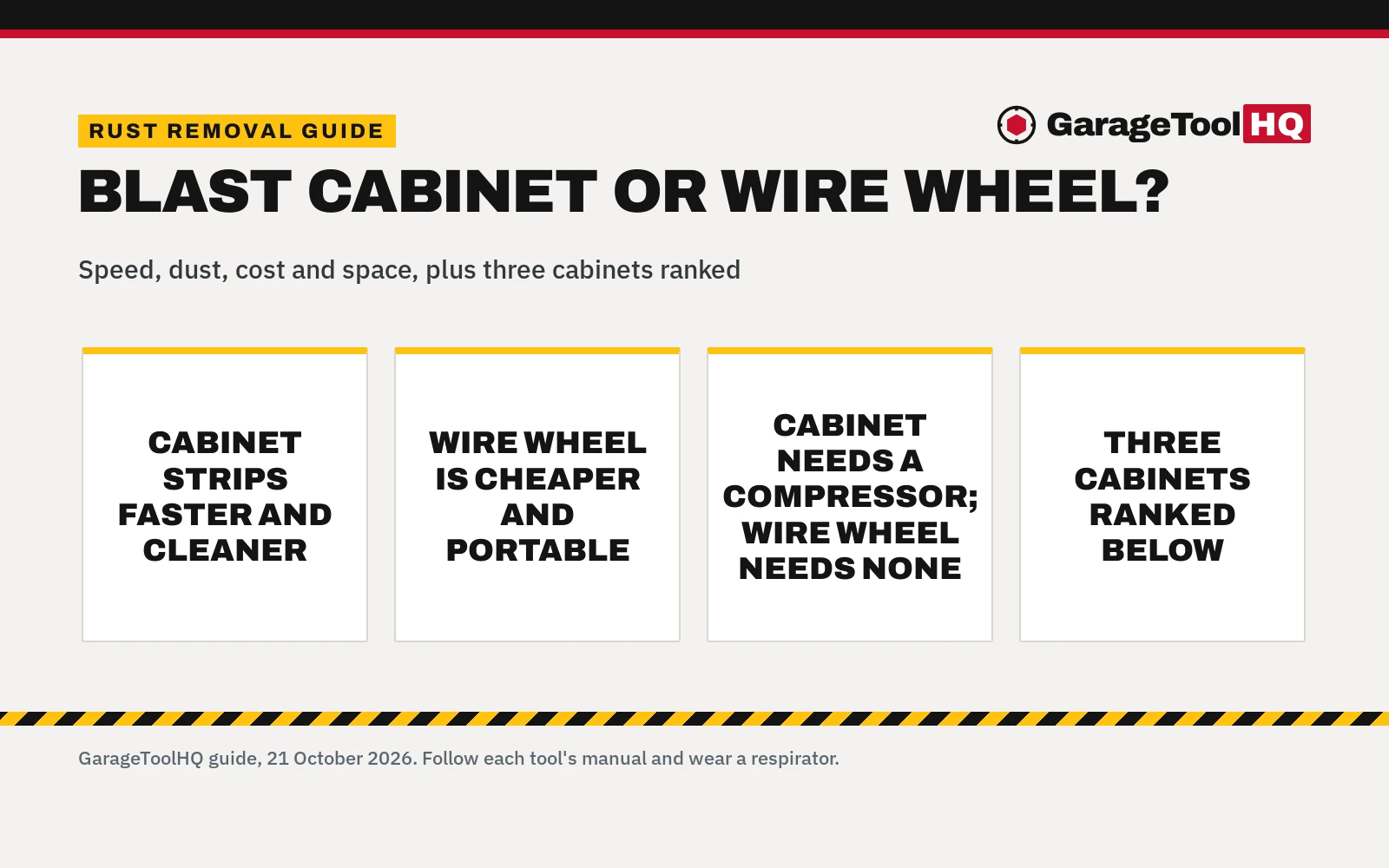
You have a rusty bracket, a crusty wheel or a painted part that needs to go back to bare metal, and two ways to get there. A sandblast cabinet vs wire wheel choice comes down to this: a blast cabinet strips rust and paint fast inside a contained box with dust control, while a wire wheel on a grinder or drill is cheaper, portable and better for spot work. If you strip small parts often, the cabinet wins; if you clean the occasional rusty spot in place, the wire wheel wins.
More options to compare
 15 Pack Carbon Steel Wire Wheel BrushCheck price on Amazon
 Rocaris 10 Pack Carbon Steel Wire Wheel BrushCheck price on Amazon
 Rocaris 6 Pack Carbon Steel Wire Wheel BrushCheck price on Amazon
 6in Wire Wheel Brush for Bench GrinderCheck price on Amazon
 6Pcs Wire Wheel Brush SetCheck price on Amazon
 11 Pcs Metal Carbon Steel Wire Wheel for Drill SetCheck price on Amazon
GarageToolHQ earns a commission when you buy through links on this page, at no extra cost to you. Read our affiliate disclosure.
How each method works: sandblast cabinet vs wire wheel
A sandblast cabinet is a sealed box with gloves, a window and a blasting gun. You put the part inside, close the door and fire abrasive media at it with compressed air: 40 to 120 PSI on the VEVOR listings here, 40 to 80 PSI on the Parts-Diyer. The cabinet contains the dust and the spent media stays in the box. The 25 gallon VEVOR includes gloves in the box; all three listings describe a window for watching the work, with LED lighting on the VEVORs and a fluorescent lamp on the Parts-Diyer. A wire wheel is a cup or wheel of twisted wire bristles that mounts on an angle grinder or drill and scrapes rust and paint off by abrasion, throwing dust and bristle fragments into the open air. No cabinet, no compressor, no media to buy.
Speed and finish
For small parts, the cabinet is faster and more even: the media hits every surface, including pits and corners a wire wheel cannot reach. The VEVOR 60 gallon listing states its cabinet handles paint, stain and rust removal with glass beads, silicon sand or aluminum oxide, and the Parts-Diyer listing adds silicon carbide, alumina and crushed walnut shells as media options. A wire wheel is slower on heavy rust but gives you control on a single spot, and it needs no setup or cleanup beyond sweeping. For a mirror-smooth finish before paint, the cabinet’s even blast is the better prep.
Dust, mess and safety
Dust is the real difference. The VEVOR cabinets list pre-installed sealing strips and sealant material to prevent dust leakage, and the 25 gallon VEVOR adds an air filter, gloves and lens protectors in the box. A wire wheel throws rust dust and the occasional wire bristle into your face, your clothes and the shop, so wear a respirator and face shield with it. The cabinet keeps the mess inside the box, which matters in a shared or attached garage.
Nozzles, media and lighting
The listings differ on what comes in the box. Both VEVOR cabinets include a blasting gun and 4 ceramic nozzles; the Parts-Diyer includes a blasting gun and 4 nozzles in 4, 5, 6 and 7 mm, so you can match the nozzle to the job. Media capacity is the big split: the 60 gallon VEVOR holds up to 203.4 lb of blasting media, while the 25 gallon VEVOR and the Parts-Diyer each hold up to 33 lb. The Parts-Diyer adds a dust collector port for hooking up extraction. For visibility, the VEVOR cabinets state an acrylic window with LED lighting, and the Parts-Diyer states a plexiglas window with a fluorescent lamp and a removable protective film.
Cost and space
A wire wheel costs a few dollars and lives in a drawer. A blast cabinet is a real purchase: the 60 gallon VEVOR weighs 79.4 lb and needs floor space plus a compressor that delivers 5 CFM at 40 to 120 PSI, while the 25 gallon VEVOR at 28.3 lb and the 33 lb Parts-Diyer sit on a bench. You also buy media and replacement nozzles over time. If you strip parts a few times a year, the wire wheel’s near-zero cost is hard to beat; if you restore parts monthly, the cabinet pays back in time saved. The 60 gallon VEVOR comes on a stand; the 25 gallon VEVOR and the Parts-Diyer are bench-top, with the Parts-Diyer also usable at a job site per its listing. All three need assembly, and the VEVOR listings point to installation videos for guidance.
The gear: three blast cabinets
The VEVOR 60 gallon (SBC200) is the big pick: a 60 gallon cabinet on a stand that holds up to 203.4 lb of blasting media, runs at 5 CFM and 40 to 120 PSI, and includes a blasting gun, 4 ceramic nozzles, an acrylic window with LED lighting and 4 lens protectors. At 79.4 lb it is a floor-standing unit for serious part work.
The VEVOR 25 gallon (SBC90) is the bench pick: 25 gallons, up to 33 lb of media, the same 5 CFM at 40 to 120 PSI, with a blasting gun, 4 ceramic nozzles, gloves, lens protectors, sealant and an air filter in the box. At 28.3 lb and 24.4 by 19 by 19.1 in, it fits a workbench.
The Parts-Diyer 25 gallon is the alternate bench pick: 25 gallons, 40 to 80 PSI at 5 CFM, with a blasting gun, 4 nozzles in 4, 5, 6 and 7 mm, a dust collector port, a plexiglas window with a fluorescent lamp and a removable protective film. It holds up to 33 lb of media and weighs 33 lb. Pick it if the VEVOR 25 gallon is unavailable; the specs are close.
All three state powder-coated steel construction for rust resistance. The choice comes down to capacity and space: the 60 gallon for volume work on a stand, the 25 gallon VEVOR for the bench with the most included accessories, and the Parts-Diyer as the alternate bench pick with its dust collector port.
Use rated jack stands on solid ground, wear eye protection with power and air tools, keep fuel-burning equipment out of a closed garage, and follow the manual for every tool. Read our Safety Disclaimer.
Frequently Asked Questions
Do I need a compressor for a sandblast cabinet?
Yes. All three cabinets here state 5 CFM at 40 to 120 PSI (the Parts-Diyer tops out at 80 PSI), so the cabinet is only half the purchase: the compressor must keep up.
What media can I use in these cabinets?
The VEVOR listings state glass beads, silicon sand and aluminum oxide; the Parts-Diyer adds silicon carbide, alumina and crushed walnut shells. Match the media to the job: aggressive media for heavy rust, gentle media for soft parts.
Can a wire wheel replace a blast cabinet?
For spot rust and small areas, yes. For whole parts, pitted rust or paint stripping before refinishing, the cabinet is faster and more even, and it contains the dust.
How do I keep the cabinet window clear?
All three listings address this: the VEVOR cabinets include 4 lens protectors, and the Parts-Diyer has a removable plastic film over the plexiglas plus a fluorescent lamp. Replace protectors as they etch.
Which cabinet suits a small garage?
The 25 gallon VEVOR at 28.3 lb or the 33 lb Parts-Diyer, both bench-top. The 60 gallon VEVOR at 79.4 lb needs floor space and a stand.
Related guides
Related: our best air die grinder for rust removal.