Spark Plug Problems: Signs, Causes, and Replacement Tools
Spark plug problems show up as hard starts, rough idle and lost pull; this guide covers the signs, the causes, and the gauge kits that pin down the fault.

On this page
The engine cranks, catches rough, and settles into a shaky idle that was not there last week. Spark plug problems are the usual suspect when an engine starts hard, idles rough, or loses pull under load: a worn or fouled plug, a cracked cable, or weak spark leaves fuel unburned and the engine running short on power. The signs point to the plugs, and a compression gauge plus a spark checker help show whether the fault sits in the plug, the cable, or deeper in the cylinder.
As an Amazon Associate I earn from qualifying purchases. GarageToolHQ earns a commission when you buy through links on our product pages, at no extra cost to you. Read our affiliate disclosure.
Below: the signs that point to the plugs, the causes behind them, what a gauge reading means, and the kits that help find the fault.

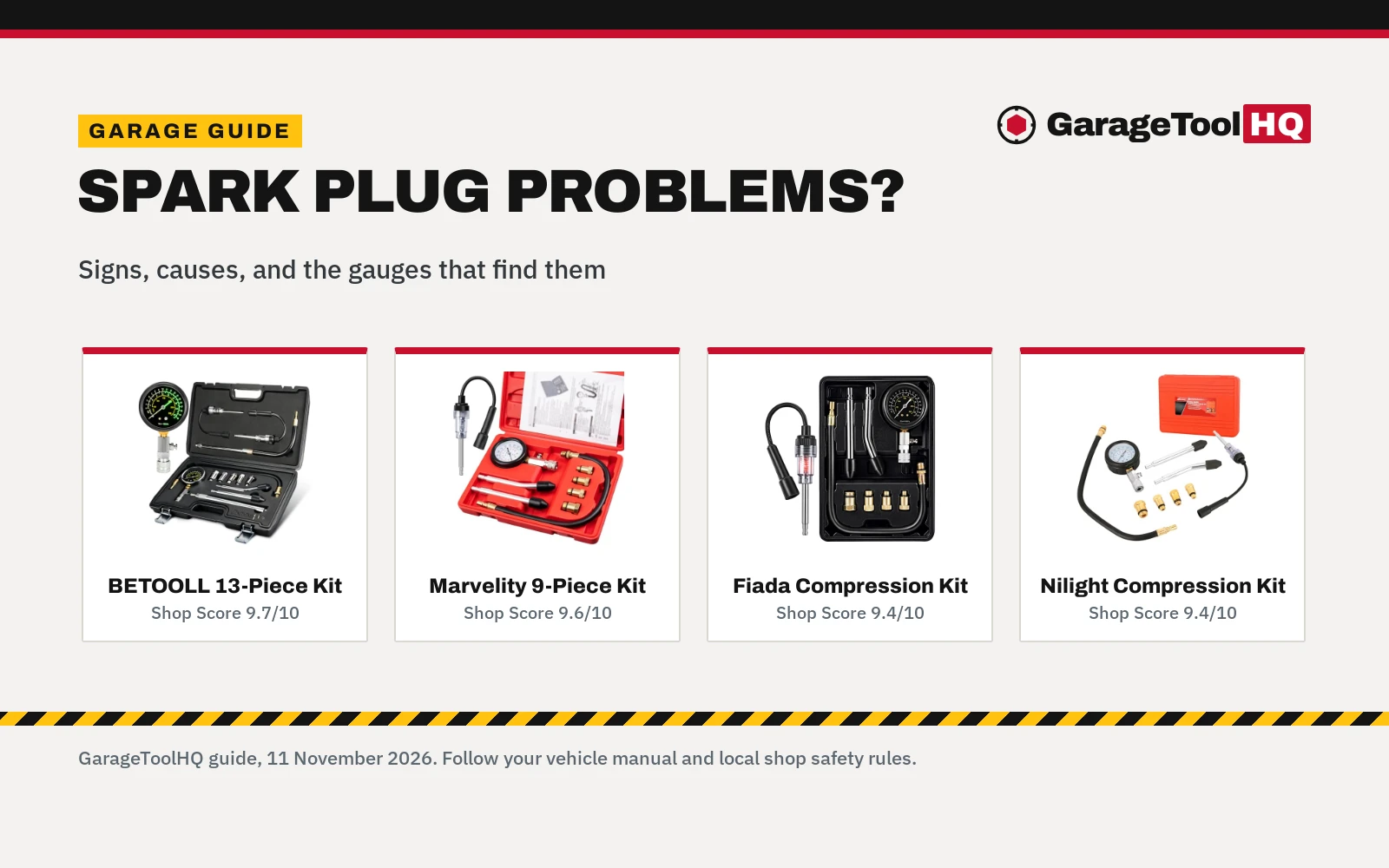
BETOOLL 13PCS Compression Tester Kit
A 13-piece kit with a fluorescent triple-scale gauge that reads 0-300 PSI, 0-20 Bar and 0-21 kg/cm², 10 adapters and 2 spark plug checkers for gas engines.
Pros
- 13 pieces with 10 adapters cover most gas engine cylinders
- Fluorescent triple-scale gauge reads 0-300 PSI, 0-20 Bar and 0-21 kg/cm²
- 2 spark plug checkers with indicator lights
- Built-in quick-release safety valve for single-handed use
Cons
- Gas engines only, not for diesel
- No warranty term is stated
- No case is listed
- Hose length is not stated

Marvelity 9pcs Petrol Engine Cylinder Compression
A 9-piece kit with a 3 inch dual-scale gauge that reads 0-300 PSI and 0-20 Bar, a 14 inch hose, 4 adapters and a spark plug checker.
Pros
- 3 inch dual-scale gauge reads 0-300 PSI and 0-20 Bar
- Built-in check valve holds the pressure reading
- One-click pressure release before disconnecting
- 4 adapters in M10, M12, M14 and M18 sizes
Cons
- Not for diesel engines
- No warranty term is stated
- No case is listed
- Quick connect adapters need a push-on fit, not a threaded fit

9 Pieces Automotive Compression Tester Kit
A 9-piece kit with a 300 PSI dual-unit gauge with a 3 inch dial, a 14 inch hose, 4 brass adapters, 2 rubber cone adapters and a spark plug checker, in an ABS case.
Pros
- 9 pieces cover gauge, checker, cones, adapters and hose
- 300 PSI dual-unit gauge with 3 inch dial
- ABS case holds every piece for storage
- 4 brass adapters plus straight and curved rubber cones
Cons
- No warranty term is stated
- No adapter sizes are listed
- No check valve is stated
- Cone adapters are push-on, not threaded

Nilight Compression Tester Kit with Spark Plug
A 9-piece kit with a 0-300 PSI dual-scale gauge, a 17.7 inch hose, M10, M12, M14 and M18 adapters and a spark plug checker, in a carrying case.
Pros
- 0-300 PSI dual-scale gauge with acrylic glass and rubber cover
- 17.7 inch hose with quick-connect adapters for flexible positioning
- M10, M12, M14 and M18 adapters fit a wide range of vehicles
- Carrying case included for storage and transport
Cons
- Spec table lists 1 item while the title lists 9 pieces
- No warranty term is stated
- No check valve is listed
- Straight and angled push-on connectors need a firm hand fit
Spark plug problems: the signs that point to the plugs
A plug fault rarely arrives without warning. The signs below come up again and again when plugs, cables or the ignition circuit start to fail:
- Hard starts. The engine cranks longer than usual before it catches.
- Rough idle. The engine shakes or hunts at idle instead of settling into a steady note.
- Lost pull under load. The engine feels flat when climbing or merging, as if a cylinder is not pulling its weight.
- Stumble or hesitation. A brief cut or jerk when the throttle opens, often worse when the engine is cold.
A single sign on its own can mean many things, so treat the list as a pointer toward the plugs, not a verdict. A fuel delivery fault or a problem with pistons, rings or valves can feel much the same, which is why a gauge reading matters before buying parts.
What causes spark plug problems
Most plug trouble comes from the plug itself wearing out or fouling, but the cause often sits upstream:
- Dirty or fouled plugs. Deposits on the plug nose keep the spark from jumping cleanly, so the cylinder misfires or does not fire at all.
- Bad cables or connections. A cracked cable or a loose connection bleeds spark away before it gets to the plug.
- Faulty points or coil connections. Worn points or a weak coil connection break the circuit the plug depends on.
- Fuel delivery faults. A fault in the fuel delivery system starves the cylinder or floods it, and the plug takes the blame.
- Piston, ring or valve trouble. Low pressure in a cylinder makes combustion weak, so the fault reads like a plug problem.
The list is why the plugs come out during diagnosis: a plug that looks fouled tells a story about the cylinder it came from, and a compression reading tells whether the story ends at the plug or goes deeper.
How a compression gauge helps with spark plug problems
A compression gauge screws or pushes into the plug hole and reads cylinder pressure while the engine cranks. The gauge scale on the kits below runs 0-300 PSI, so the reading is read straight off the dial. Compare the reading across cylinders: a cylinder that reads far below its neighbors points to piston, ring or valve trouble, while even readings across the cylinders, if they sit in the expected range for that engine, point back to the plugs, cables or fuel delivery.
A spark checker adds the rest of the picture. It sits between the plug and the cable, and its light flashes when spark is present. A flashing checker with even compression readings shows spark is getting to the plug, so the plug itself or the fuel delivery is the next suspect; a dark checker points to the cable, the coil connection, the points, or the checker connection itself.
Check the vehicle manual for the expected pressure range for that engine, and follow the kit manual for the fitting steps. Never touch the checker or any part of the set while the ignition is on, and switch the engine off and take the key out before touching them.
Use rated jack stands on solid ground, wear eye protection with power and air tools, keep fuel-burning equipment out of a closed garage, and follow the manual for every tool. Read our Safety Disclaimer.
Gauge kits for spark plug problems
A compression reading and a spark flash reading tell you whether the fault sits in the plug, the cable, or deeper in the cylinder, so the kits below combine a gauge with a spark checker and the adapters to fit the plug hole.
FAQ: garage tools
Can a dirty spark plug cause a rough idle?
Yes. A dirty plug fires weakly or not at all, so its cylinder drops out at idle and the engine shakes. A spark checker shows whether spark is present at that plug, and a compression reading shows whether the cylinder itself holds pressure.
What does a compression reading tell you about spark plug problems?
It tells you whether the cylinder holds pressure. Even readings across the cylinders, if they sit in the expected range for that engine, point back to the plugs, cables or fuel delivery, while a low reading on a single cylinder points to piston, ring or valve trouble instead.
Is a spark checker needed with a compression gauge?
A gauge reads pressure; a checker shows spark. A fault can sit in either place, so a kit that combines them covers the picture in a single session.
Can bad cables cause spark plug problems?
Yes. A cracked cable or a loose connection bleeds spark away before it gets to the plug, so the plug takes the blame while the cable is the cause. A flashing checker at the plug suggests the cable is passing spark, while a dark checker points back to the cable, the coil connection or the points.
What if a cylinder reads low on the gauge?
A low reading points toward piston, ring or valve trouble rather than the plug alone. Check the vehicle manual for the expected range for that engine, and let a shop confirm the cause before replacing parts the gauge has cleared.
Related: spark plug socket sizes, the feeler gauge set vs spark plug gap tool comparison, the thread repair kit for spark plug holes guide and the engine and shop equipment hub.