Stationary vs Portable Air Compressor: Which One Should You Buy?
Stationary vs portable air compressor: what CFM, tank size and power the listings show for each type, and which fits your garage work.

On this page
Top picks at a glance
As an Amazon Associate we earn from qualifying purchases.
- 1
 California Air Tools 20020 2.0 HP Ultra Quiet and Oil-Free9.6/10View on Amazon
- 2
 Craftsman 3 Gallon Hot Dog Air Compressor9.6/10View on Amazon
- 3
 ALL-TOP Air Compressor Kit9.6/10View on Amazon
- 4
 Ingersoll Rand 2475N7.5 7.5 HP Two-Stage Air CompressorView on Amazon
- 5
 Metabo HPT Portable Pancake Air CompressorView on Amazon
- 6
 RIDGID 6 Gal. Portable Electric Pancake Air CompressorView on Amazon
- 7
 CAMPBELL HAUSFELD 30 Gallon Horizontal Air CompressorView on Amazon
- 8
 ARB CKMP12V2 PORTABLE AIR COMPRESSOR HIGH OUTPUT andView on Amazon
- 9
 SmittyBilt AIR COMPRESSOR 5.65CFMView on Amazon
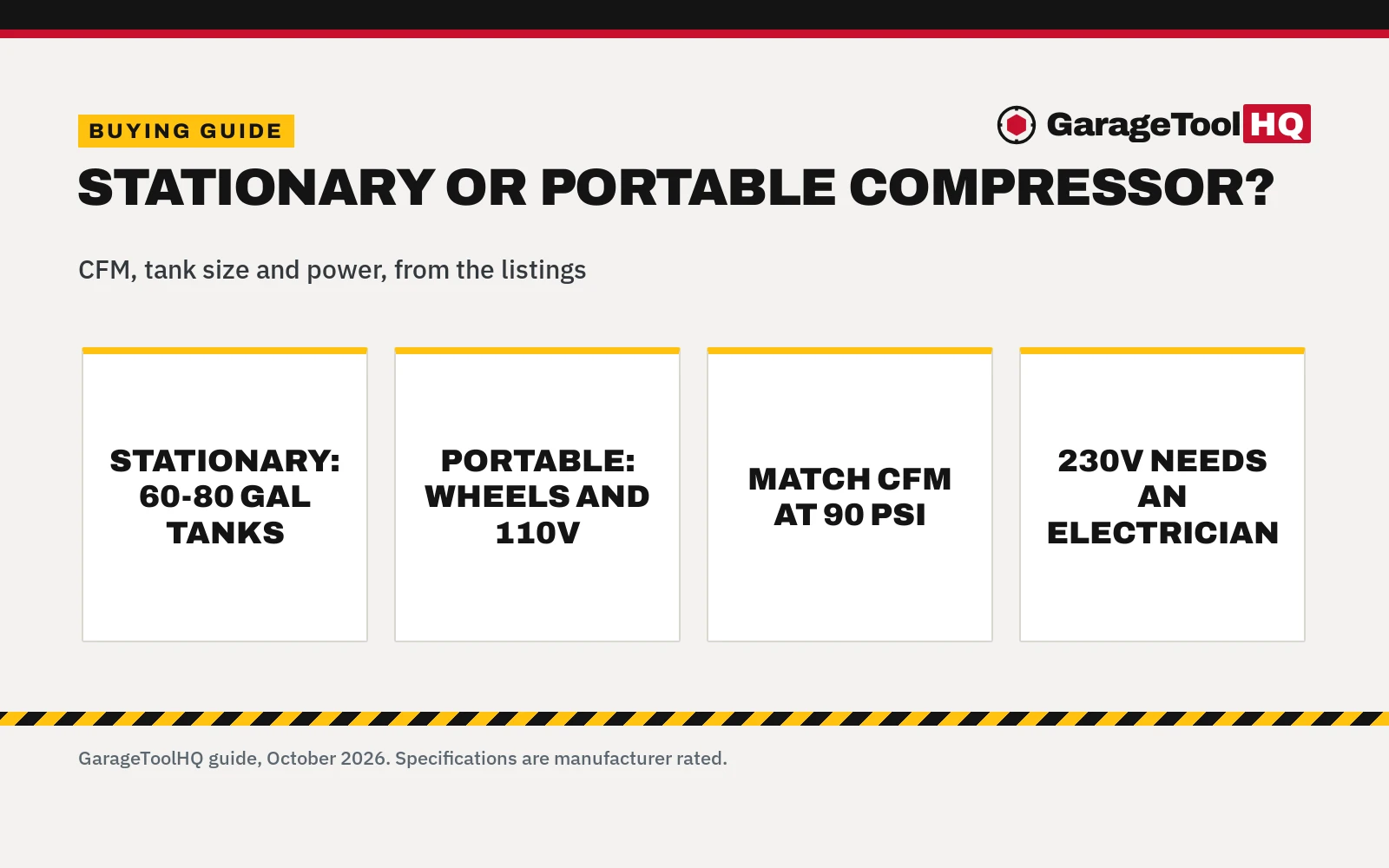
Brake job Saturday: the impact wrench is thirsty, the tires need topping off, and the stationary vs portable air compressor question is which one feeds your tools without running dry. Buy a stationary compressor if your tools live in the garage and drink air all day: the 60 to 80 gallon listings deliver 6.3 to 24.3 CFM at 90 PSI, mostly on 230V power. Buy a portable if the work moves around the driveway or the job site: the 15-gallon RyanTek example delivers 4.5 CFM at 90 PSI on 110V, with wheels and a handle.
More options to compare
 Ingersoll Rand 2475N7.5 7.5 HP Two-Stage Air CompressorCheck price on Amazon
 Metabo HPT Portable Pancake Air CompressorCheck price on Amazon
 RIDGID 6 Gal. Portable Electric Pancake Air CompressorCheck price on Amazon
 CAMPBELL HAUSFELD 30 Gallon Horizontal Air CompressorCheck price on Amazon
 ARB CKMP12V2 PORTABLE AIR COMPRESSOR HIGH OUTPUT andCheck price on Amazon
 SmittyBilt AIR COMPRESSOR 5.65CFMCheck price on Amazon
GarageToolHQ earns a commission when you buy through links on our product pages, at no extra cost to you. Read our affiliate disclosure.
Below: how CFM, tank size, power and noise compare between the two types, what the reference listings show for each, and how to match a compressor to your garage.
Stationary vs portable air compressor: what the listings show
Stationary compressors in the sample are 60 to 80 gallon vertical tanks, 3 to 10 HP, delivering 6.3 to 24.3 CFM at 90 PSI, with most maxing out at 175 PSI. They weigh 200 to 643 lb, run 65 to 87 dB, and most need 230V. The portable example is the 15-gallon RyanTek: 2 HP, 4.5 CFM at 90 PSI, 125 PSI max, 110V, 68.3 lb with wheels and a handle, and oil-free. Two listings break the mold: the JEGS 60-gallon stationary runs on 110V, and the Quincy 80-gallon listing tags itself portable in the spec table despite weighing 643 lb.
| Stationary (sample) | Portable (sample) | |
|---|---|---|
| CFM at 90 PSI | 6.3 to 24.3 | 4.5 |
| Tank | 60 to 80 gal, vertical | 15 gal |
| Power | 3 to 10 HP, mostly 230V | 2 HP, 110V |
| Max pressure | 115 to 175 PSI | 125 PSI |
| Weight | 200 to 643 lb | 68.3 lb, wheels and handle |
| Noise | 65 to 87 dB | 66 dB |
CFM at 90 PSI is the number that matters
Compare CFM at 90 PSI and nothing else. In the sample, stationary output runs from 6.3 CFM on the JEGS 3 HP to 24.3 CFM on the Ingersoll Rand 7.5 HP two-stage, with the Campbell Hausfeld 3.7 HP at 7.6 and the DEWALT 5 HP single-stage at 14.6. The portable RyanTek lists 4.5 CFM at 90 PSI. Where a listing gives CFM at another pressure, say so: the DEWALT two-stage lists 15.3 SCFM at 100 PSI and 13.5 at 175 PSI, and the DCYL rotary screw lists 39 CFM at 120 PSI. Match the compressor’s CFM at 90 PSI to your hungriest tool’s requirement, with margin.
Tank, power and noise
Tank size sets how long the motor rests between cycles. The stationary sample runs 60 to 80 gallons, most of it vertical to save floor space; the Campbell Hausfeld 60-gallon lists a 23 by 23 inch footprint. The portable RyanTek carries 15 gallons. Power is the real divider: the Campbell Hausfeld requires a dedicated 230/240V supply, and most stationary listings are 230V, so plan on a licensed electrician for the circuit. The JEGS 60-gallon is the exception at 110V. Noise runs 65 dB on the Campbell Hausfeld and the DEWALT two-stage up to 87 dB on the DEWALT 3.7 HP single-stage; the portable RyanTek lists 66 dB. A note on the JEGS and Quincy listings: the JEGS title says 200 lbs while its spec table says 310 lb, and we trust the title. And the Quincy 80-gallon spec table tags it portable at 643 lb, which no one is carrying anywhere.
Which one for your garage
Buy stationary if the compressor has a permanent home and your tools run for hours: sanding, grinding, painting and impact work all favor the 60-plus gallon tank and the higher CFM. The Ingersoll Rand 7.5 HP with 24.3 CFM at 90 PSI and 100% continuous duty is the sample’s heavy end; the Campbell Hausfeld 3.7 HP with 7.6 CFM suits a serious home shop. Buy portable if you air up tires, run a nailer or paint in different spots: the RyanTek’s 4.5 CFM at 90 PSI, 110V plug and 68.3 lb rolling weight fit that job. If you are torn, the JEGS 60-gallon on 110V splits the difference: big tank, standard outlet, 6.3 CFM at 90 PSI. For portable picks see our best heavy duty portable air compressor roundup, and for the full family see air compressor types.
Drain the tank after use so water does not rust it from the inside, never exceed the tool's rated pressure, wear eye protection, and run 240V units on the circuit the manual calls for. Do not run a gas engine compressor in a closed garage. Read our Safety Disclaimer.
Frequently Asked Questions
Can a portable compressor run an impact wrench?
Check the numbers. The portable RyanTek lists 4.5 CFM at 90 PSI and names auto repair among its uses, so light impact work is in scope; a large impact gun wants the 14-plus CFM the stationary 5 HP listings deliver. Match the tool’s CFM requirement to the compressor’s CFM at 90 PSI.
Do I need 230V for a stationary compressor?
Usually. Most stationary listings in the sample are 230V, and the Campbell Hausfeld requires a dedicated 230/240V supply, so have a licensed electrician wire the circuit. The JEGS 60-gallon is the 110V exception.
How loud are these compressors?
The sample runs 65 dB on the Campbell Hausfeld and the DEWALT two-stage up to 87 dB on the DEWALT 3.7 HP single-stage, with the portable RyanTek at 66 dB. Quieter matters if the shop shares walls with the house.
What does an ASME tank mean?
Several listings, including the Campbell Hausfeld, Ingersoll Rand and DEWALT models, state ASME tanks. It is the tank certification to look for; a compressor tank without a stated standard is a pass.
How much CFM do I need?
More than your hungriest tool asks for, at 90 PSI. The sample spans 4.5 CFM on the portable end to 24.3 CFM on the 7.5 HP stationary end. Add up the tools you run at once and buy above that.
Oil-free or oil-lubed?
The portable RyanTek is oil-free, which suits indoor and clean-air tasks; the stationary two-stage listings are oil-lubricated cast-iron pumps built for long life, with the Campbell Hausfeld rated up to 10,000 hours of pump life and the Ingersoll Rand over 15,000 hours. Oil-free means less maintenance; oil-lubed means longer pump life.
Related: the air compressor types guide, the rotary screw vs piston comparison, the best heavy duty portable air compressor picks and the dryer and regulator set up guide.