Straight Line vs Random Orbital Sander: Which One Should You Buy?
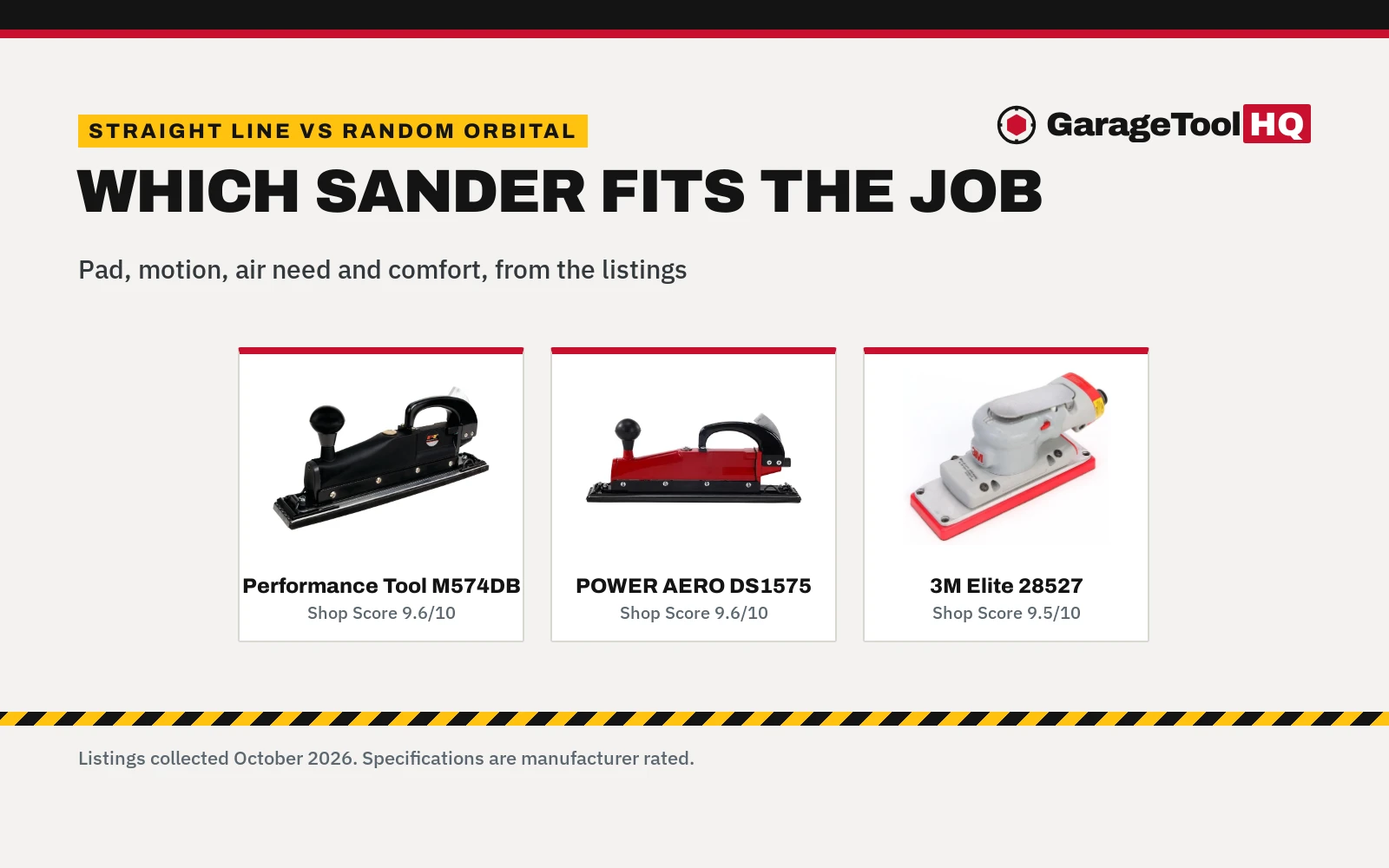
Two air-powered straight-line sanders and one random orbital sander, compared on pad size, motion, air need and comfort, from what each listing states.
On this page
Top picks at a glance
As an Amazon Associate I earn from qualifying purchases.
- 1
 Ingersoll Rand 315G 2.75" x 15" Straight-Line Air Sander9.6/10View on Amazon
- 2
 WORKPRO 150 Pack 5 Inch Sanding Discs Sandpaper9.7/10View on Amazon
- 3
 Performance Tool M574DB Dual Piston Pneumatic Straight Line9.6/10View on Amazon
- 4
 MAXXT Brushless Sheet Sander Electric 3mm Orbital 350W 3AView on Amazon
- 5
 6" Automotive Dual Action Orbital Sander for Custom PaintingView on Amazon
- 6
 MAXXT Brushless 2-in-1 Detail Sander and Sheet Sander SetView on Amazon
- 7
 Astro 888C Dual Piston Straight Line Sander Brand: APView on Amazon
- 8
 Orbital Sander Corded Hand Sander: DEKOPRO 5" Random OrbitalView on Amazon
- 9
 GALAX PRO 13000OPM Random Orbital Sander 6 Variable SpeedView on Amazon
Verdict: Choose a straight line sander for long flat panels, body filler work, shaping and leveling, where a long pad and twin pistons cover ground. Choose a random orbital sander for flat surface finishing and sealer sanding with access to tight corners, where a smaller pad and comfort grip matter more.
A long flat panel covered in body filler calls for a sander with a long pad that covers ground, while a finished panel with tight corners calls for a smaller pad that reaches in. The straight line vs random orbital sander choice comes down to pad motion and pad shape, compared here with listing examples.
GarageToolHQ earns a commission when you buy through links on this page, at no extra cost to you. Read our affiliate disclosure.

Performance Tool M574DB Dual Piston Pneumatic
A twin-piston pneumatic straight-line sander with a 2.75 x 16.75 inch pad for body filler work.
Pros
- Twin-piston design resists stalling, as stated
- 2.75 x 16.75 inch pad for large flat surfaces
- Two-handle design for comfortable operation
- Quick-action paper clamps stated
Cons
- No air consumption figure is stated
- No concrete warranty term is stated
- Spec table lists 2 A for an air-powered tool with no explanation
- No stroke rate is stated

Straight Line Air Sander Twin Piston Longboard
A twin-piston pneumatic straight-line sander for autobody work, with a 15-3/4 inch product length and a stated air need of 18 cfm.
Pros
- Twin-piston design with up to 2000 strokes per minute stated
- 15-3/4 inch product length for autobody work
- Two-handle design stated
- Air consumption of 18 cfm stated, with a 90 psi supply to maintain
Cons
- Needs a compressor that can maintain 90 psi
- No warranty term is stated
- Spec table lists 2500 rpm against the bullets' strokes-per-minute figure
- Spec-table weight of 2.75 kg stated, against 16 ounces for the Performance Tool example

3M Elite Non-Vacuum Random Orbital Sander, 28527
A non-vacuum random orbital sander with a 70 mm x 198 mm pad and 1/8 in orbit for flat finishing and sealer sanding.
Pros
- 1/8 in orbit stated for flat finishing
- Pad reaches tight corners, as stated
- Curved wrist support with gripping material stated
- Aluminum body with durable composite cover stated
Cons
- No power source is stated
- No warranty term is stated
- Spec-table weight of 0.27 g does not fit a shop sander
- No air consumption figure is stated
Other tools worth a look
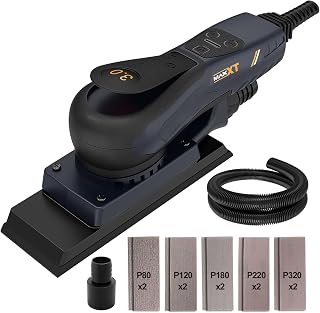 MAXXT Brushless Sheet Sander Electric 3mm Orbital 350W 3ACheck price on Amazon
 6" Automotive Dual Action Orbital Sander for Custom PaintingCheck price on Amazon
 MAXXT Brushless 2-in-1 Detail Sander and Sheet Sander SetCheck price on Amazon
 Astro 888C Dual Piston Straight Line Sander Brand: APCheck price on Amazon
 Orbital Sander Corded Hand Sander: DEKOPRO 5" Random OrbitalCheck price on Amazon
 GALAX PRO 13000OPM Random Orbital Sander 6 Variable SpeedCheck price on Amazon
Straight line vs random orbital sander: side by side
| Straight line | Random orbital | Listing note | |
|---|---|---|---|
| Pad | 2.75 x 16.75 inch pad; 15-3/4 inch product length | 70 mm x 198 mm | As stated |
| Motion | Twin-piston straight-line travel | Random orbit, 1/8 in orbit stated | As stated |
| Speed stated | 2000 strokes/min (POWER AERO); 8000 rpm max (Performance Tool) | 10000 rpm maximum | Different measures, not directly comparable |
| Air and power | Air powered; 90 psi and 18 cfm stated for one example | No power source stated | POWER AERO NOVIA example only |
| Stated jobs | Autobody work; body filler sanding, shaping, leveling | Flat surface finishing, sealer sanding, tight corners | As stated |
| Comfort | Two-handle design on both examples | Curved wrist support, gripping material, recessed lever | As stated |
Every rating comes from the brand’s listing and is not a shop test (gathered 29 October 2026).
How each sander moves
A straight-line sander drives its pad back and forth along one line. Both straight-line examples here use a twin-piston design, and the POWER AERO NOVIA example states up to 2000 strokes per minute. A random orbital sander moves its pad in a random orbit: the 3M example states a 1/8 in orbit and a maximum rotational speed of 10000 rpm. Strokes per minute and rpm are different measures, so the figures do not compare directly.
Pad size and reach
Pad length is the straight-line side’s edge. The Performance Tool example states a 2.75 x 16.75 inch pad for smooth sanding of large flat surfaces, and the POWER AERO NOVIA example states a product length of 15-3/4 in with a width of 2-3/4 in, but no pad size. The 3M example states a 70 mm x 198 mm pad with access to tight corners for flat surface finishing and sealer sanding. For a long panel, a long pad covers more per pass; for corners, the 3M pad is the stated fit for tight-corner access.
Air and power
Both straight-line examples are air powered. The POWER AERO NOVIA listing states air consumption of 18 cfm and warns to have an air compressor that can maintain 90 psi, so the shop air supply decides whether it runs as stated. The Performance Tool listing states pneumatic power with no air consumption figure. The 3M listing states no power source and no air consumption figure, only a spec-table amperage of 0.28 A.
Comfort and control
Both straight-line examples state a two-handle design, which suits a long pad pushed across a panel. The 3M example takes a different approach: an extended curved wrist support, 3M Gripping Material and a recessed lever, with precision-balanced steel workings the listing says give high performance with less vibration. The listings share no comfort measure, so compare the stated features rather than the adjectives.
Choose a straight line if
- You sand long flat panels, body filler, shaping and leveling work
- You have shop air that can maintain 90 psi
- You want a long pad that covers ground
- You prefer a two-handle design
Choose a random orbital if
- You finish flat surfaces and sand sealer coats
- You need access to tight corners
- You want a curved wrist support and gripping material
- You want a smaller finishing pad
Example sanders
See also the best air belt sander and the best air compressor for a home garage.
Wear eye protection with every air tool, use impact-rated sockets on impact wrenches, disconnect the air line before changing accessories, and finish lug nuts with a torque wrench to the vehicle's spec. See OSHA eye and face protection. Read our Safety Disclaimer.
Garage Fit Check
- Confirm the compressor holds 90 psi with 18 cfm for the POWER AERO NOVIA example.
- Measure the panel against the pad: 2.75 x 16.75 inch on the Performance Tool example, 70 mm x 198 mm on the 3M example.
- Both straight-line examples are pneumatic, while the 3M listing states no power source.
- Check the spec table on arrival: the 3M weight figure of 0.27 g does not fit a shop sander.
FAQ: garage tools
Which sander is better for large flat panels?
The straight-line listings state large flat surfaces and body filler work: the Performance Tool example states a 2.75 x 16.75 inch pad for large flat surfaces, and the POWER AERO NOVIA example states a 15-3/4 in product length for autobody work. The 3M listing states flat surface finishing too, with a smaller 70 mm x 198 mm pad and tight-corner access.
Do straight line sanders need a compressor?
Both straight-line examples are air powered. The POWER AERO NOVIA listing states air consumption of 18 cfm and warns to have a compressor that can maintain 90 psi. The Performance Tool listing states pneumatic power with no air consumption figure.
Which example states a warranty term?
None states a concrete term. The Performance Tool spec table states LIMITED WARRANTY with no term; the POWER AERO NOVIA and 3M listings state no warranty term.
Why does the 3M weight figure look odd?
The 3M spec table lists a weight of 0.27 g, which does not fit a shop sander, alongside included components of Valve and an item type of Valve. The title and bullets describe the sander, pad and orbit, so this article follows them; the weight is unclear.
Related: the best air belt sander, the best air compressor for a home garage and our air tools hub.