Topdon Tc001 vs Flir One: Which One Should You Buy?
Phone thermal cameras compared for garage diagnostics: how the Topdon TC001 and the FLIR One differ on resolution, range, accuracy, blending, app guides and warranty.

On this page
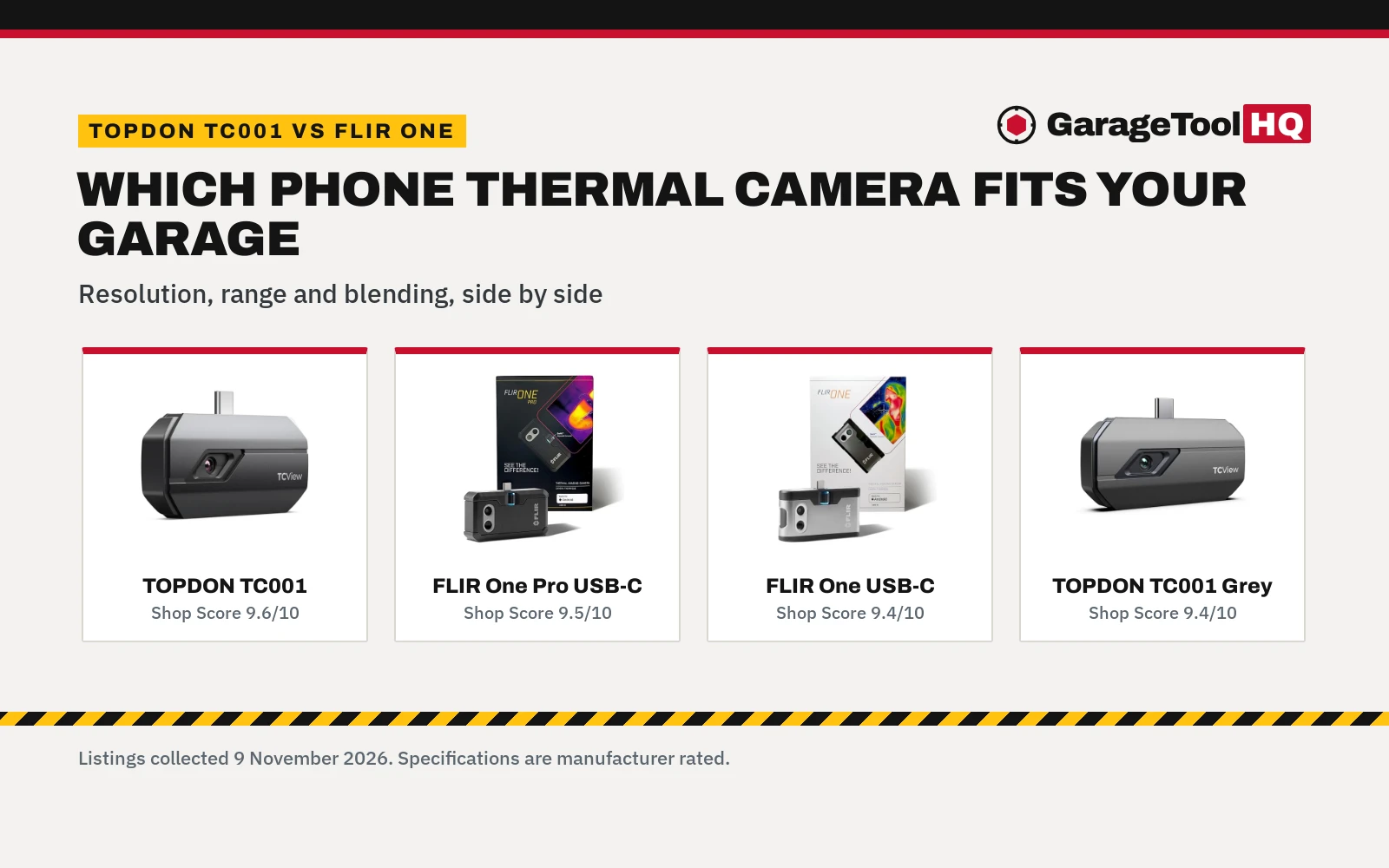
Verdict: Choose the Topdon TC001 if resolution and temperature range matter most: its listings state 256×192 native capture enhanced to 512×384 and a -4°F to 1022°F range. Choose a FLIR One if you want MSX image blending, step-by-step inspection guides in the app and a stated 1.5 meter drop rating.
A warm fuse box, a cold draft at a door seal, a brake that runs hotter than the rest after a drive: each job asks the same question, where is the heat coming from. That is the job for topdon tc001 vs flir one, phone thermal cameras that plug into an Android phone and turn it into a thermal imager. This comparison covers each side, with two examples from each side’s listings.
As an Amazon Associate I earn from qualifying purchases. GarageToolHQ earns a commission when you buy through links on this page, at no extra cost to you. Read our affiliate disclosure.

TOPDON TC001 Thermal Imaging Camera for Android
A phone thermal camera for Android with 256x192 capture enhanced to 512x384, 40mK sensitivity, a 25Hz refresh rate and a -4°F to 1022°F range, powered by the phone.
Pros
- 40mK thermal sensitivity with 256x192 capture
- 25Hz refresh rate
- -4°F to 1022°F range with ±2% accuracy
- No internal battery; draws 0.35W from the phone for 4-7 hours
Cons
- Title leads with 512x384 while the bullets state 256x192 capture
- Android, tablets and PC only; no iOS support
- No drop rating stated
- No in-app inspection guides stated
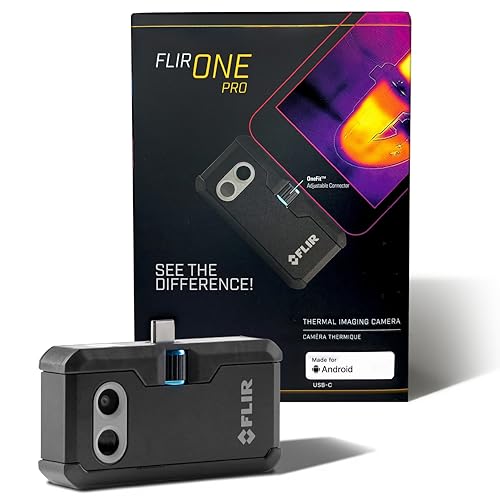
Flir One Pro Thermal Imaging Camera for Android
A USB-C phone thermal camera with MSX blending, VividIR upscaling to 480x360, in-app inspection guides and a 1.5 meter drop rating.
Pros
- MSX merges thermal and visual images in real time
- VividIR upscales 160x120 to 480x360
- Step-by-step inspection guides in the Flir One app
- Rated for a drop from 1.5 meters
Cons
- Native resolution is 160x120, below the Topdon listings at 256x192
- No full temperature range stated
- Accuracy of ±3°C or ±5% applies only inside stated unit and scene windows
- No refresh rate or sensitivity figure stated

Flir One Thermal Imaging Camera for Android USB-C
A USB-C phone thermal camera with MSX blending, VividIR upscaling to 240x180, in-app inspection guides and a 1.5 meter drop rating.
Pros
- MSX merges thermal and visual images in real time
- VividIR upscales 80x60 to 240x180
- Step-by-step inspection guides in the Flir One app
- Rated for a drop from 1.5 meters
Cons
- Native resolution is 80x60, the lowest of the four listings
- No full temperature range stated
- No refresh rate or sensitivity figure stated
- 1 Year warranty, shorter than the FLIR One Pro listing

TOPDON TC001 Thermal Camera for Android
A phone thermal camera for Android with 256x192 capture enhanced to 512x384, a -4°F to 1022°F range, 9 color palettes and point, line and surface detection, powered by the phone.
Pros
- 512x384 enhanced resolution from 256x192 capture with TISR
- -4°F to 1022°F range with readings to 0.1°C
- Point, line and surface detection across 9 areas at once
- 9 color palettes and image fusion with the phone camera
Cons
- No warranty term stated in the listing
- No refresh rate or sensitivity figure stated
- Android and PC only, not for iOS
- No drop rating stated
Topdon tc001 vs flir one: side by side
| Topdon TC001 | FLIR One | Notes | |
|---|---|---|---|
| Native IR resolution | 256×192 | 160×120 (Pro), 80×60 (One) | Topdon lists the higher native figure |
| Enhanced resolution | 512×384 (TISR) | 480×360 and 240×180 (VividIR) | Both upscale from a lower native image |
| Temperature range | -4°F to 1022°F | Not stated | Only Topdon states a full range |
| Accuracy | Within 3.6°F (2°C) or 2% (one listing); ±2% (other) | ±3°C or ±5% | Different units; check the stated windows |
| Refresh rate | 25Hz (one listing) | Not stated | Only one Topdon listing states a rate |
| Thermal sensitivity | 40mK (one listing) | Not stated | Only one Topdon listing states a figure |
| Image blending | Image fusion with the phone camera | MSX merges thermal and visual images | Both blend a visual image with the thermal image |
| In-app guides | Not stated | Step-by-step inspection guides | Only FLIR lists in-app guides |
| Drop rating | Not stated | Rated for a drop from 1.5 meters | Only FLIR states a drop rating |
| Power | 0.35W from the phone; no internal battery | Plugs into the phone charging port | Both run off the phone |
| Warranty | 1 year (one listing); not stated (other) | 2 years parts and labor, 10 years on the detector (Pro); 1 Year (One) | FLIR Pro states the longest warranty |
Example figures are manufacturer rated, as published on each listing and collected 9 November 2026.
Resolution and image quality
One Topdon listing states 256×192 native capture enhanced to 512×384 with TISR technology, and the other adds 40mK sensitivity with a 25Hz refresh rate. The FLIR listings state lower native figures, 160×120 on the Pro and 80×60 on the standard One, upscaled by VividIR to 480×360 and 240×180. Both sides blend a visual image with the thermal image: Topdon lists image fusion with the phone camera, while FLIR lists MSX merging thermal and visual images in real time. On stated resolution alone, the Topdon side leads; on blending, each side names its own method, so the listings leave no shared figure to rank them by.
Temperature range and accuracy
The Topdon listings state a -4°F to 1022°F range (-20°C to 550°C). One listing adds readings accurate within 3.6°F (2°C) or 2% and to 0.1°C, plus continuous measurement with a waveform graph of high, low and average temperatures, while the other states ±2% accuracy. The FLIR listings state no full range; they state accuracy of ±3°C or ±5% when the unit is within 15°C to 35°C and the scene is within 5°C to 120°C. The two sides state accuracy in different units and under different conditions, so do not call one side more accurate on these figures alone.
App features and power
The FLIR listings put step-by-step inspection guides in the Flir One app for typical faults, air leaks and moisture buildup, and one Topdon listing puts point, line and surface detection with 9 color palettes in the TC001 app. The Topdon camera has no internal battery and draws 0.35W from the phone, with 4-7 hours stated for phones from 3000-5000mAh; the FLIR listings state no battery figure and describe a camera that plugs directly into the phone charging port. One Topdon listing includes a 19.7 in cable with a USB converter, an EVA bag and a wiping cloth, and the other a 19.7 in extension cord, an EVA bag, a quick guide and a cleaning cloth; the FLIR listings include a case and a USB cable.
Durability and warranty
The FLIR listings state a 1.5 meter drop rating and describe the cameras as jobsite tough, while the Topdon listings state no drop rating. Warranty terms also differ: one Topdon listing states 1 year and the other states no term, the FLIR One Pro listing states 2 years parts and labor on the camera with 10 years coverage on the detector, and the standard FLIR One listing states 1 Year. If warranty length and drop protection matter to the job, the FLIR Pro listing states the strongest terms here.
Choose Topdon TC001 if
- You want the highest stated resolution and the widest stated temperature range
- You want the Topdon listing with point, line and surface detection and 9 color palettes
- You want 4-7 hours of stated run time from the phone
- You use Android, a tablet or a PC
Choose FLIR One if
- You want MSX blending and step-by-step inspection guides in the app
- You want a stated 1.5 meter drop rating for jobsite use
- You want the longest stated warranty on the Pro listing
- You use a USB-C Android phone such as Samsung Galaxy or Google Pixel
Example cameras
For more choices, see the best thermal camera for Android phone, and to weigh the form factor, the thermal camera vs inspection camera comparison.
Use rated jack stands on solid ground, wear eye protection with power and air tools, keep fuel-burning equipment out of a closed garage, and follow the manual for every tool. Read our Safety Disclaimer.
Garage Fit Check
- Both sides plug into an Android phone with USB-C; the Topdon listings state Android and PC, not iOS, so check the phone port before ordering.
- The Topdon camera draws 0.35W from the phone, so start with a charged phone; the listings state 4-7 hours with phones from 3000-5000mAh.
- The Topdon listings include a 19.7 in cable and an EVA bag; the FLIR listings include a case and a USB cable, so each camera has stated storage.
- The FLIR listings state a 1.5 meter drop rating; the Topdon listings state no drop rating, so handle the Topdon camera with care around concrete.
FAQ: garage tools
Which phone thermal camera should I buy first?
Pick the Topdon TC001 for the highest stated resolution and the widest stated temperature range, or the FLIR One Pro for MSX blending, in-app inspection guides, a 1.5 meter drop rating and the longest stated warranty. The standard FLIR One suits lighter use with the same MSX blending and guides at a lower native resolution.
Do the Topdon TC001 cameras work with an iPhone?
No. The listings state Android smartphones, tablets and PC, not iOS, and one listing notes the camera is not compatible with iPhone 15. The FLIR listings also describe USB-C Android devices only.
What does 512×384 mean on the Topdon TC001?
The titles lead with 512×384, while one listing’s bullets state 256×192 native capture enhanced to 512×384 with TISR technology. The other listing states 40mK sensitivity and a 25Hz refresh rate. Read 512×384 as the enhanced figure, not the native capture.
Do these cameras need their own battery?
One Topdon listing states no internal battery; both state the camera draws 0.35W from the phone, with 4-7 hours stated for phones from 3000-5000mAh. The FLIR listings state no battery figure; the cameras plug directly into the phone charging port.
Related: the best thermal camera, the best thermal imaging camera for car diagnostics, the best thermal imaging camera for electrical troubleshooting, and the thermal camera vs inspection camera comparison.