True RMS vs Non True RMS Multimeter: Which One Should You Buy?

On this page
Top picks at a glance
As an Amazon Associate I earn from qualifying purchases.
- 1
 2026 Upgraded FS899L Digital Multimeter9.6/10View on Amazon
- 2
 AstroAI Digital Multimeter9.5/10View on Amazon
- 3
 2026 Upgraded FS899L Digital Multimeter & 20 pcs Silicone9.5/10View on Amazon
- 4
 Neoteck 6000 Counts True RMS Digital MultimeterView on Amazon
- 5
 Rechargeable Digital Multimeter 6000 Counts True RMS SmartView on Amazon
- 6
 Fluke 325 True-RMS Clamp Meter with FrequencyView on Amazon
- 7
 True RMS Digital Multimeter TesterView on Amazon
- 8
 HC600 Clamp Meter for Electrician HVACView on Amazon
- 9
 Westinghouse 600V True RMS Auto-Ranging Digital MultimeterView on Amazon
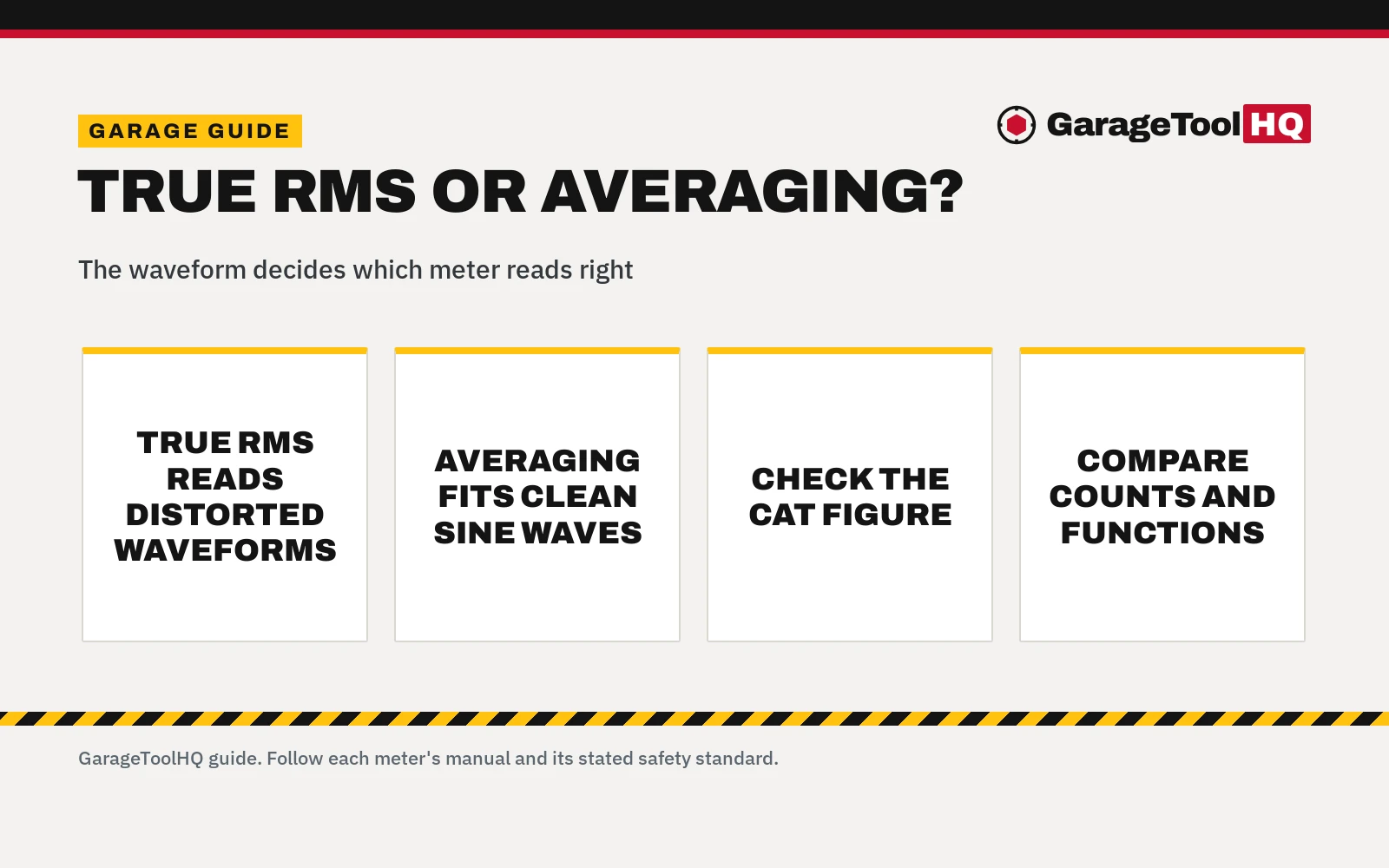
When a garage circuit gives a reading that does not match the symptoms, the question of true rms vs non true rms multimeter choice matters more than the brand on the case. A true RMS meter reads the real heating value of an AC waveform, even when that waveform is distorted, while a non-true-RMS meter, often called an averaging meter, reads accurately only on a clean sine wave. For clean household-style AC, both types agree; for distorted waveforms from modern garage equipment, the true RMS reading is the more dependable reading.
Other tools worth a look
 Neoteck 6000 Counts True RMS Digital MultimeterCheck price on Amazon
 Rechargeable Digital Multimeter 6000 Counts True RMS SmartCheck price on Amazon
 Fluke 325 True-RMS Clamp Meter with FrequencyCheck price on Amazon
 True RMS Digital Multimeter TesterCheck price on Amazon
 HC600 Clamp Meter for Electrician HVACCheck price on Amazon
 Westinghouse 600V True RMS Auto-Ranging Digital MultimeterCheck price on Amazon
GarageToolHQ earns a commission when you buy through links on our product pages, at no extra cost to you. Read our affiliate disclosure.
Below: how each type reads AC, how to choose between them, the meters from the listings in ranked order, and answers to common questions.
How true rms vs non true rms multimeter readings differ
An averaging meter measures the average value of an AC waveform and then scales that average as if the waveform were a clean sine wave. On a clean sine wave, that shortcut gives the correct reading. On a distorted waveform, the shortcut breaks down, because the average of a distorted shape does not scale to its real heating value in the same way.
A true RMS meter works differently. It reports the root mean square value of the waveform as it actually looks, which is the heating value of that waveform. That is why a true RMS meter stays accurate on distorted waveforms within its design limits, while an averaging meter misreads them: the true RMS meter reports the RMS value of the shape in front of it instead of assuming a sine shape.
Distorted waveforms are common in a modern garage. Variable-speed motors, dimmers, switching power supplies and inverter-driven equipment all draw current in shapes that are not clean sine waves. On those circuits, the gap between an averaging reading and a true RMS reading can matter for diagnosis. On a plain sine-wave circuit, the two types agree, and the averaging meter is not wrong.
| Type | How it reads AC | Where it stays accurate |
|---|---|---|
| True RMS meter | Reports the root mean square value of the waveform as it looks | Clean sine waves and distorted waveforms within its design limits |
| Averaging (non-true-RMS) meter | Measures the average value and scales it as if the wave were a sine wave | Clean sine waves only |
The table above is the whole decision in miniature: if the waveform is a clean sine wave, either type reads it; if the waveform is distorted, only the true RMS reading reflects the real heating value.
How to choose between the two types
- Match the meter to the waveform. If garage work involves variable-speed motors, dimmers or switching power supplies, a true RMS meter is the safer pick. If the work stays on clean sine-wave circuits, an averaging meter reads fine.
- Check the CAT figure the listing states. Match the stated CAT figure to the installation location and circuit the meter will touch, and never use a meter beyond the figure its maker states.
- Compare counts and functions. Display counts, NCV detection, continuity alert, data hold, backlight, flashlight and a support stand all change how easy a meter is to use in a dark engine bay or a tight wiring panel.
- Check the power source and the kit. A rechargeable meter avoids buying cells, while a battery meter keeps going with fresh cells on hand. A kit with leads, clips and adapters covers more jobs than a bare meter.
- Check whether a warranty term is stated. A stated warranty term is concrete information from the maker; silence on warranty is worth noting before buying.
- Know the limit of DIY electrical work. For panel work or any circuit beyond your comfort level, use a licensed electrician and follow the meter manual.
A meter only reports what it measures; it does not make a circuit safe to touch. De-energize a circuit before changing connections where the manual calls for it, keep leads and probes in good shape, and bring in a licensed electrician for panel work or any job beyond your skill.
Use rated jack stands on solid ground, wear eye protection with power and air tools, keep fuel-burning equipment out of a closed garage, and follow the manual for every tool. Read our Safety Disclaimer.
Meters from the listings, in ranked order
The listings below are ordered by overall listing strength: stated safety standards, stated warranty, and breadth of stated functions. A meter that states little ranks lower here, even when its headline functions look strong.
Westinghouse 600V True RMS Auto-Ranging Digital Multimeter. The listing states 600 Volt AC/DC voltage measurement, 10 Amp AC/DC current measurement, a large 4000-count LCD display, temperature measurement in °C and °F, and Relative Mode for differential measurements. It also states 6.5 Feet drop resistance, certification to UL 61010-1 and CSA C22.2 standards, and a 2-year Westinghouse warranty with 24/7 customer service.
DEASOMIYE True RMS Digital Multimeter. The listing states up to 1000V AC/DC voltage, 20A AC/DC current and 60M Ohms resistance, plus capacitance, continuity, frequency, diode, temperature and battery checking. It states 1000V CAT II and 600V CAT III safety standards, fuses of 600mA/250V and 20A/250V, a silicone protective case, data hold, a large LCD backlit screen, a support stand, a flashlight function, a thermocouple, 4 AAA batteries and a storage bag. No warranty term is stated.
Neoteck 6000 Counts True RMS Digital Multimeter. The listing states AC/DC voltage and current, resistance, capacitance, frequency, diodes, continuity, temperature, live wire and NCV detection, auto/manual-ranging mode switching, overload protection, built-in dual fuses, CAT III 600V protection, a silicone protective cover, an LCD screen with bright backlight, a stand that holds the meter at a 45-degree angle, a built-in flashlight, data hold, a continuity buzzer and auto-off. No warranty term is stated.
Rechargeable Digital Multimeter with 5-Inch Screen. The listing states True RMS accuracy for AC/DC voltage, current, resistance, capacitance, frequency, diode, continuity and temperature, a high-brightness backlit color display, a built-in flashlight, USB-C charging with up to 8 hours of continuous operation, a kit of 20 leads, clips and adapters, auto-ranging, continuity alert, non-contact voltage detection, a protective ABS housing, CAT III safety, overload protection and a dual fuse system. No voltage figure accompanies the CAT III marking in this listing, no item weight is stated, and no warranty term is stated.
Which type fits which garage job
For plain sine-wave circuits, such as simple household-style AC checks, either type serves. The averaging meter reads the same value as the true RMS meter there, and there is no penalty for the simpler design.
For circuits with distorted waveforms, such as variable-speed motors, dimmers and switching power supplies, the true RMS meter is the right call. Its reading reflects the waveform as it is within its design limits, which keeps diagnosis honest when the shape is not a clean sine wave.
For automotive diagnostics, the listings pitch several of these meters for car circuits, and the same rule applies: clean signals read fine on either type, while distorted signals call for true RMS. When in doubt about the waveform, the true RMS meter covers both cases within its design limits, which is why it ranks as the default pick for a garage that sees mixed equipment.
FAQ: garage tools
What does true RMS mean on a multimeter?
True RMS means root mean square: the heating value of an AC waveform. A true RMS meter reports the root mean square value of the waveform as it actually looks, rather than assuming the waveform is a clean sine wave.
Does a non-true-RMS meter read wrong on every AC circuit?
No. On a clean sine wave, an averaging meter agrees with a true RMS meter. Errors show up on distorted waveforms, where the average of the shape does not scale to the real heating value.
Is a true RMS meter needed for car electrical work?
It depends on the circuit. Several listings here pitch automotive diagnostics, and for distorted signals the true RMS reading is the dependable one. For simple clean sine-wave checks, an averaging meter can suffice.
What do display counts mean?
Counts describe the steps a display can show. Listings here state 6000 counts and a 4000-count display. Higher counts give finer steps on the display, but counts alone do not set accuracy; the meter design and the waveform type matter more.
What does CAT III 600V mean?
It is the circuit category and voltage figure the maker states for the meter. Check the stated CAT figure against the circuit before measuring, and never use a meter beyond the figure its maker states.
Does a rechargeable meter beat a battery meter?
Each has a trade-off. One listing here states USB-C charging with up to 8 hours of continuous operation, which avoids buying cells. Another listing includes 4 AAA batteries, which keeps the meter going with fresh cells on hand. Pick the power source that fits how the meter will be used.
Related: analog vs digital multimeter, clamp meter vs multimeter and the diagnostics and electrical category page.