Ultrasonic Parts Cleaner Solution: What to Use for Parts
What to put in an ultrasonic cleaner for parts, how concentrates mix with water, and which fluids suit carburetors, gun parts and jewelry.

On this page
Top picks at a glance
As an Amazon Associate I earn from qualifying purchases.
- 1
 VEVOR 6L Ultrasonic Cleaner9.6/10View on Amazon
- 2
 Ultrasonic Carburetor Cleaner9.3/10View on Amazon
- 3
 VEVOR 10L Sonic Cleaner with Heater Timer & Basket9.5/10View on Amazon
A carburetor that sat through winter comes off the bench caked in varnish, and the jets are too small for a brush to reach. That is the job ultrasonic parts cleaner solution is made for. It is the fluid that fills the tank of an ultrasonic cleaner, mixed with water to the strength the label states and matched to the metal and the soil on the part. Plain water can carry the sound waves, and the solution adds the cleaning power, lifting oil, carbon and grime out of passages a brush cannot reach.
GarageToolHQ earns a commission when you buy through links on our product pages, at no extra cost to you. Read our affiliate disclosure.
Below: which fluids fit which parts, how to mix a concentrate, and what to leave out of the tank.
Ultrasonic parts cleaner solution: what it is and what goes in the tank
Most fluids sold for this job are concentrates. A bottle of concentrate is mixed with water in the tank, and the label states the mix, the metals it suits and the soils it lifts. The label is the authority here, not habit: a fluid made for jewelry does not claim to cut carburetor varnish, and a fluid made for engine parts does not claim to be gentle on a watch crystal.
Jewelry and eyeglass fluids are the mild end of the range. The iSonic fluid in an 8 oz bottle is made for gold, silver, diamond, watches and glasses, and the listing states one capful per use. A 2-pack of Evo Dyne fluid in 8 oz bottles gives up to 72 sessions per 2-pack, which suits a household that cleans jewelry often.
Gun parts fluids sit in the middle. Samorillo gun cleaning solution (on Amazon) is made for firearms, brass and small parts, and its label names steel, aluminum, polymer and brass as safe. The listing states that it lifts carbon residue, powder buildup and oils, and 1 gallon of concentrate makes 8 gallons of mixed fluid.
Carburetor and engine parts fluids are the heavy end. The Sylvan Hills carburetor and parts fluid is made for carburetors, engine parts and small metal parts, and its label names aluminum, brass, copper and steel. The listing states that 1 gallon of concentrate makes 200 gallons of mixed fluid, and that the mixture should be replaced when visibly dirty.
Which ultrasonic parts cleaner solution fits the job
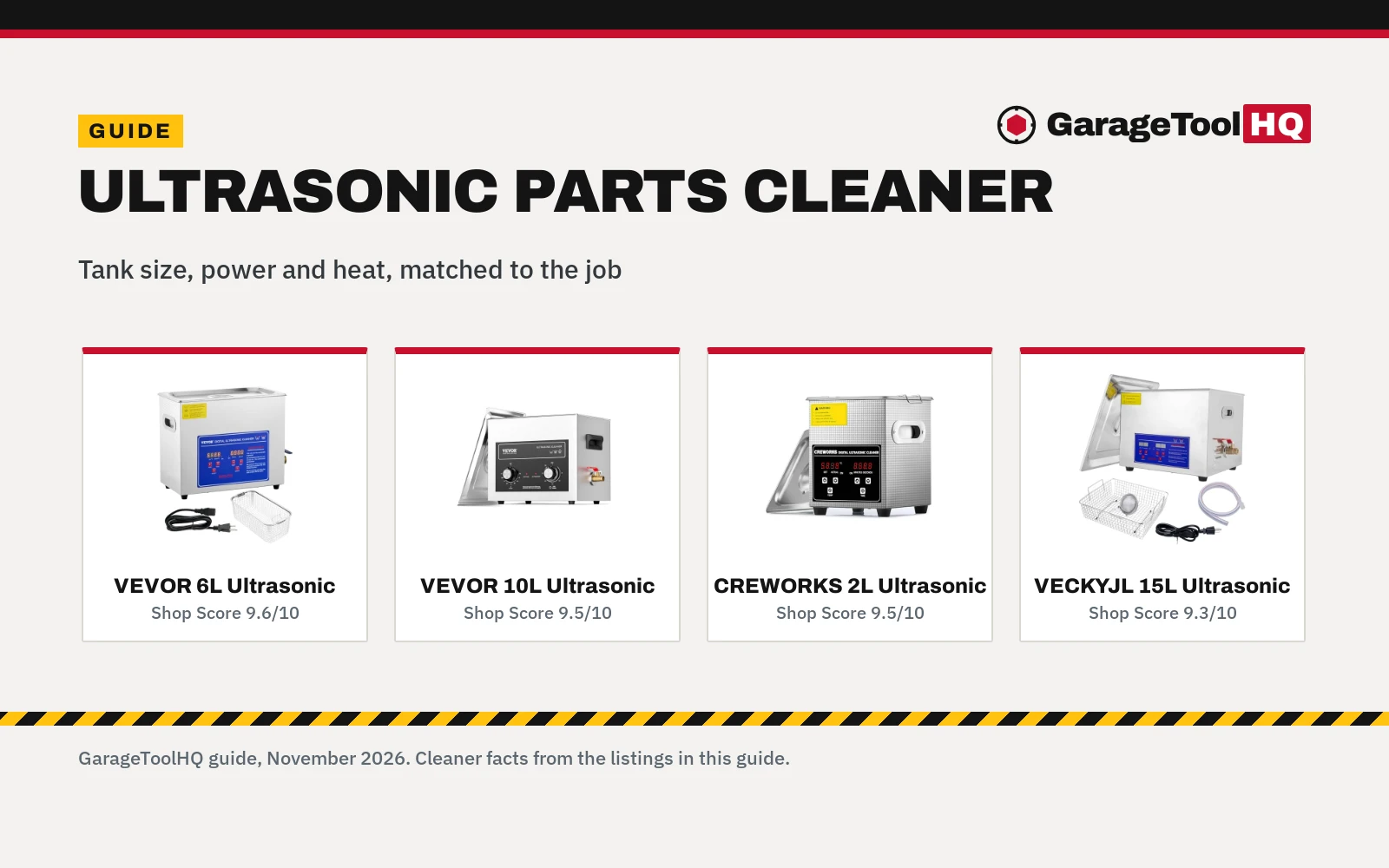
Match the fluid to the part first, then to the size of the job. A small bottle suits occasional jewelry cleaning, while a gallon of concentrate suits a shop that runs carburetor after carburetor through the tank. The guide to ultrasonic parts cleaners covers the machines themselves.
| Fluid | Suited to | Bottle | Mixed fluid |
|---|---|---|---|
| Jewelry and eyeglass concentrate | Gold, silver, diamond, watches, glasses | 8 oz bottle | One capful per use |
| Jewelry concentrate, 2-pack | Gold, silver, diamonds, gemstones | 8 oz bottles, 2-pack | Up to 72 sessions per 2-pack |
| Gun parts concentrate | Firearms, brass and small parts; steel, aluminum, polymer, brass | 1 gallon jug | 8 gallons |
| Carburetor and parts concentrate | Carburetors, engine parts, jets, valves; aluminum, brass, copper, steel | 1 gallon | 200 gallons |
| Jewelry concentrate, large bottle | Gold, silver, diamonds, gemstones, glasses, watches | 32 oz bottle | 50 gallons; 500 uses |
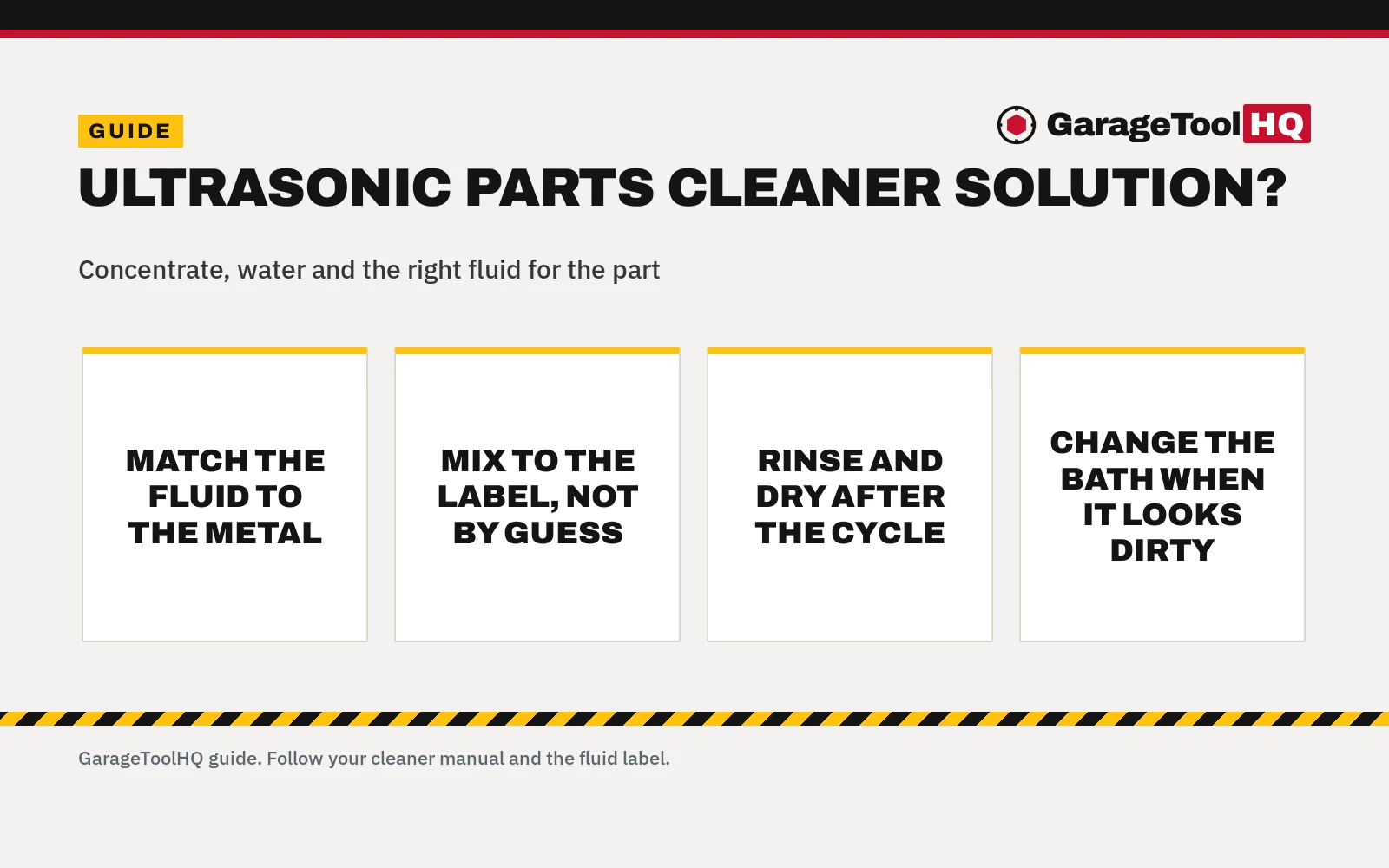
Read the label before buying. If the label does not name the metal on the part, choose a fluid that does. A fluid that names the metal and the soil is the right fluid, whatever the bottle size.
How to mix and use ultrasonic parts cleaner solution
- Read the label and the cleaner manual. The label states the metals, the soils and the mix. The manual states the tank size and the cycle.
- Fill the tank with water first, then add the concentrate in the amount the label states. Some fluids call for one capful per tank of warm water.
- Set the parts in the basket so the fluid can reach every face. Parts resting on the tank floor can block the sound waves.
- Run the cycle the manual calls for, then lift the basket out.
- Rinse the parts with clean water and dry with a lint-free cloth.
- Replace the mixture when visibly dirty. A dirty bath cleans slowly and can leave residue on the next batch.
Use one concentrate per bath, mixed to its own label. Mixing fluids in one tank can change how each one cleans, and the label of neither covers the mix.
Use rated jack stands on solid ground, wear eye protection with power and air tools, keep fuel-burning equipment out of a closed garage, and follow the manual for every tool. Read our Safety Disclaimer.
Ultrasonic cleaner solution vs plain water
Plain water carries the sound waves through the tank, but water alone does not cut oil or lift carbon the way a fluid made for the job does. The Samorillo gun fluid lifts carbon residue, powder buildup and oils from firearms and brass, and the iSonic jewelry fluid lifts oils, dirt and tarnish from gold, silver and diamond. For a part that is already clean and only dusty, water may be enough. For varnish in a carburetor jet or carbon on a bolt, a fluid made for that soil does the work.
For a machine built around this kind of cleaning, see the fuel injector ultrasonic cleaning machines.
What not to put in an ultrasonic cleaner
Leave out anything the fluid label does not cover. A jewelry fluid is made for gold, silver, diamond, watches and glasses, and the GemOro listing states plainly that its fluid is not a tarnish remover. A fluid made for engine parts does not claim to be safe on a watch crystal, and a fluid made for jewelry does not claim to cut engine varnish.
If a part has a coating, a stone or a finish the label does not name, clean it another way. The label names what the maker stands behind; anything outside that list is a guess, and a guess is a poor way to treat a part that took hours to remove.
FAQ: garage tools
What solution do I use in an ultrasonic cleaner for car parts?
Use a concentrate made for carburetors and engine parts. The Sylvan Hills carburetor and parts fluid suits aluminum, brass, copper and steel, and 1 gallon of concentrate makes 200 gallons of mixed fluid. Rinse the parts with clean water and dry them after the cycle.
How much concentrate do I mix with water?
Follow the label on the bottle, because the mix changes with the fluid. As a guide to bottle size, a 32 oz bottle of Sylvan Hills jewelry fluid makes 50 gallons of mixed fluid, and a 1 gallon jug of Samorillo gun fluid makes 8 gallons.
Can I clean gun parts in an ultrasonic cleaner?
Yes, with a fluid made for gun parts. Samorillo gun cleaning solution is made for firearms, brass and small parts, and its label names steel, aluminum, polymer and brass as safe. Rinse and dry the parts after the cycle.
How often do I change the cleaning solution?
Replace the mixture when visibly dirty. A fresh bath cleans better than a bath full of the soil from the last batch. One 32 oz bottle gives 500 uses, so a fresh mix for each session costs little in fluid.
Can I use dish soap in an ultrasonic cleaner?
None of the fluids in this guide names dish soap as a substitute. Use a concentrate made for ultrasonic machines and matched to the part, mixed to its label. A fluid made for the job also states the metals it suits, which dish soap does not.
Related: ultrasonic parts cleaner buying guide, the fuel injector ultrasonic cleaning machines and the engine cleaning additive guide.