Uses for a Combination Square in the Garage
A combination square marks right angles, checks depth and height, finds centers and sets angles for layout work in the garage.

On this page
Top picks at a glance
As an Amazon Associate I earn from qualifying purchases.
- 1
 Starrett Steel Combination Square with Square9.7/10View on Amazon
- 2
 Accusize Machinists Combination Square Set9.6/10View on Amazon
- 3
 iGaging Premium 4-Piece 12" 4R Combination Square9.6/10View on Amazon
- 4
 iGaging Square Set 4R Steel Blade High Precision9.5/10View on Amazon
A bracket needs a hole drilled square to its edge, a shelf needs a cut marked true, and a round bar needs its center found before it goes in the lathe. A combination square handles the marking jobs from the bench, and a center head finds the center of round bar, so uses for a combination square in the garage start with marking, checking and laying out work before any cutting begins. This guide walks through each use, then shows the squares that cover them.
GarageToolHQ earns a commission when you buy through links on our product pages, at no extra cost to you. Read the affiliate disclosure.
Starrett Steel Combination Square with Square
A 12in combination square with a cast iron square head, a hardened steel blade, a reversible lock bolt and a scriber, with 4R graduations.
Pros
- 12in hardened steel blade with 4R graduations in 8ths, 16ths, 32nds and 64ths
- Cast iron square head with a reversible lock bolt and a scriber
- Listed for scribing right angles and parallel lines, tri-squaring and mitering
- Listed for depth gauging, height gauging and levelling
Cons
- Square head only; no center head or protractor head is listed
- No metric graduations are listed
- No level vial is listed
- No warranty term is stated
Accusize Machinists Combination Square Set
A 12in/300mm 4-piece combination square set with a square head, a center head and a protractor head, with imperial and metric graduations.
Pros
- 4-piece set: blade, square head, center head and protractor head
- Imperial and metric graduations on both sides of the blade
- Square head includes a level vial and a scriber point
- Hardened and tempered blades with a satin chrome finish
Cons
- No warranty term is stated
- Four pieces need storage space on the bench
- Center and protractor heads stay unused for right-angle marking only
- Imperial and metric scales on one blade need a careful read
iGaging Premium 4-Piece 12" 4R Combination Square
A 12in 4-piece combination square with a fully hardened and tempered steel blade and satin chrome etched 4R graduations.
Pros
- 12in blade with 4R graduations in 8ths, 16ths, 32nds and 64ths
- Fully hardened and tempered steel blade
- Satin chrome finish with etched, machine-divided graduations
- 4-piece set for layout work
Cons
- No metric graduations are listed
- No level vial is listed
- No scriber is listed
- 12in blade only; no shorter blade is listed
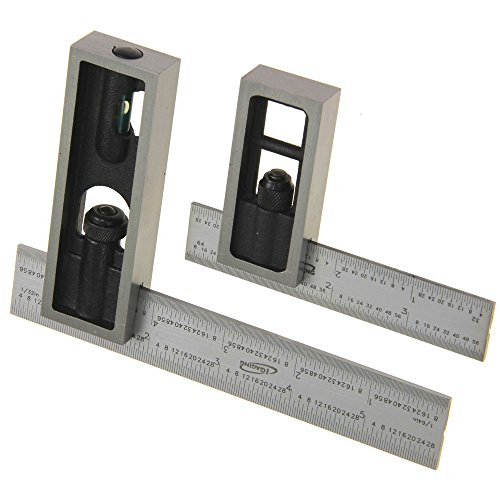
iGaging Square Set 4R Steel Blade High Precision
A set of 4in and 6in double squares with 4R steel blades for close layout work.
Pros
- Two blades, 4in and 6in, for smaller work
- 4R steel blades
- Shorter blades suit small parts and tight layout work
- Chrome finish
Cons
- No 12in blade is listed for long layout lines
- No center head or protractor head is listed
- No level vial or scriber is listed
- Double squares only; no square head with a lock bolt is listed
Uses for a combination square: marking right angles and parallel lines
A combination square starts as a marking tool. Slide the square head along the edge of a board or a bar, lock it in place, and the blade gives a straight edge for a pencil or scriber line at a right angle to that edge. The Starrett square head is listed for scribing right angles and parallel lines, measuring and tri-squaring, and its blade carries 4R graduations in 8ths, 16ths, 32nds and 64ths. The iGaging 12in blade carries the same 4R graduations, etched and machine divided.
Checking depth, height and centers
The blade slides through the head, so the square also works as a depth gauge and a height gauge. Set the head on the surface and slide the blade down to the bottom of the slot or hole. The Starrett square head is listed for depth gauging and height gauging, and the Accusize set covers height and depth checks. For round stock, the Accusize center head finds the center: place it against the round bar and mark a line, turn the bar and mark again, and the crossing lines mark the center.
Setting angles and checking level
The protractor head sets angles for layout work, and the level vial in the sliding square head checks level. The Accusize set includes a protractor head for angle set-ups, and its sliding square head includes a level vial and a scriber point, so level can be checked and layout lines marked with one tool. The Starrett square head is listed for mitering, which is angle work with the square head alone. The Accusize blade reads in 1/32in and 0.5mm on the front and 1/64in and 1mm on the back.
Which combination square to pick for garage work
Marking and depth checks use the square head, center finding needs the center head, and angle set-ups need the protractor head, so match the set to the jobs on the bench.
Read the manual before first use, wear eye protection, keep the work area clear and ventilated, and stay within every stated rating. Read our Safety Disclaimer.
FAQ: garage tools
Can a combination square check a cut for square?
Yes. Hold the square head against one face and the blade against the cut face, and look for a gap between the blade and the work. The Starrett square head is listed for tri-squaring, and the iGaging 12in blade gives a straight edge for the check.
How do I find the center of a round bar?
Use the center head from the Accusize set. Place the center head against the round bar and mark a line along the blade, turn the bar and mark a second line, and the crossing of the lines marks the center.
What does 4R mean on a combination square blade?
4R is a graduation type with 8ths, 16ths, 32nds and 64ths on the blade. The Starrett and the iGaging 12in blades both carry 4R graduations, and the Accusize blade reads in 1/32in and 0.5mm on the front and 1/64in and 1mm on the back.
Can a combination square measure depth?
Yes. Slide the blade through the square head until it touches the bottom of the slot or hole, then read the depth at the head. The Starrett square head is listed for depth gauging, and the Accusize set covers depth checks with its square head.
Related: the engine and shop equipment hub.