What Do OBD2 Codes Mean? Diagnostic Trouble Code Structure Explained
How OBD2 diagnostic trouble codes work, how code prefixes break down across P, B, C, and U systems, and how to interpret generic and manufacturer faults.

On this page
Top picks at a glance
As an Amazon Associate we earn from qualifying purchases.
- 1
 ANCEL FX2000-US OBD2 Scanner9.5/10View on Amazon
- 2
 OBD2 Scanner Diagnostic Tool9.3/10View on Amazon
- 3
 UMEIJA OBD2 Scanner with Upgrade Battery Tester9.2/10View on Amazon
What do OBD2 codes mean? OBD2 codes are standardized diagnostic trouble codes that identify specific vehicle malfunctions detected by onboard computer modules. The initial letter identifies the vehicle system, while subsequent digits indicate whether the fault is generic across all makes or specific to a vehicle manufacturer, identify the affected subsystem, and pinpoint the fault condition recorded by the control unit.
GarageToolHQ earns a commission when you buy through links on our product pages, at no extra cost to you. Read our affiliate disclosure.
Below: how the diagnostic trouble code structure breaks down character by character, what the system letters represent, how generic and manufacturer codes differ, and how to read fault codes with a scan tool.
What do obd2 codes mean? Diagnostic Trouble Code structure explained
Under the standardized second-generation onboard diagnostics standard, vehicles manufactured since 1996 share standardized diagnostic trouble codes and a common 16-pin connector interface. When an electronic control unit detects sensor values or operational readings outside acceptable factory limits, the computer records a Diagnostic Trouble Code (DTC) in memory and, for emissions-critical or active powertrain faults, illuminates the malfunction indicator lamp on the dashboard.
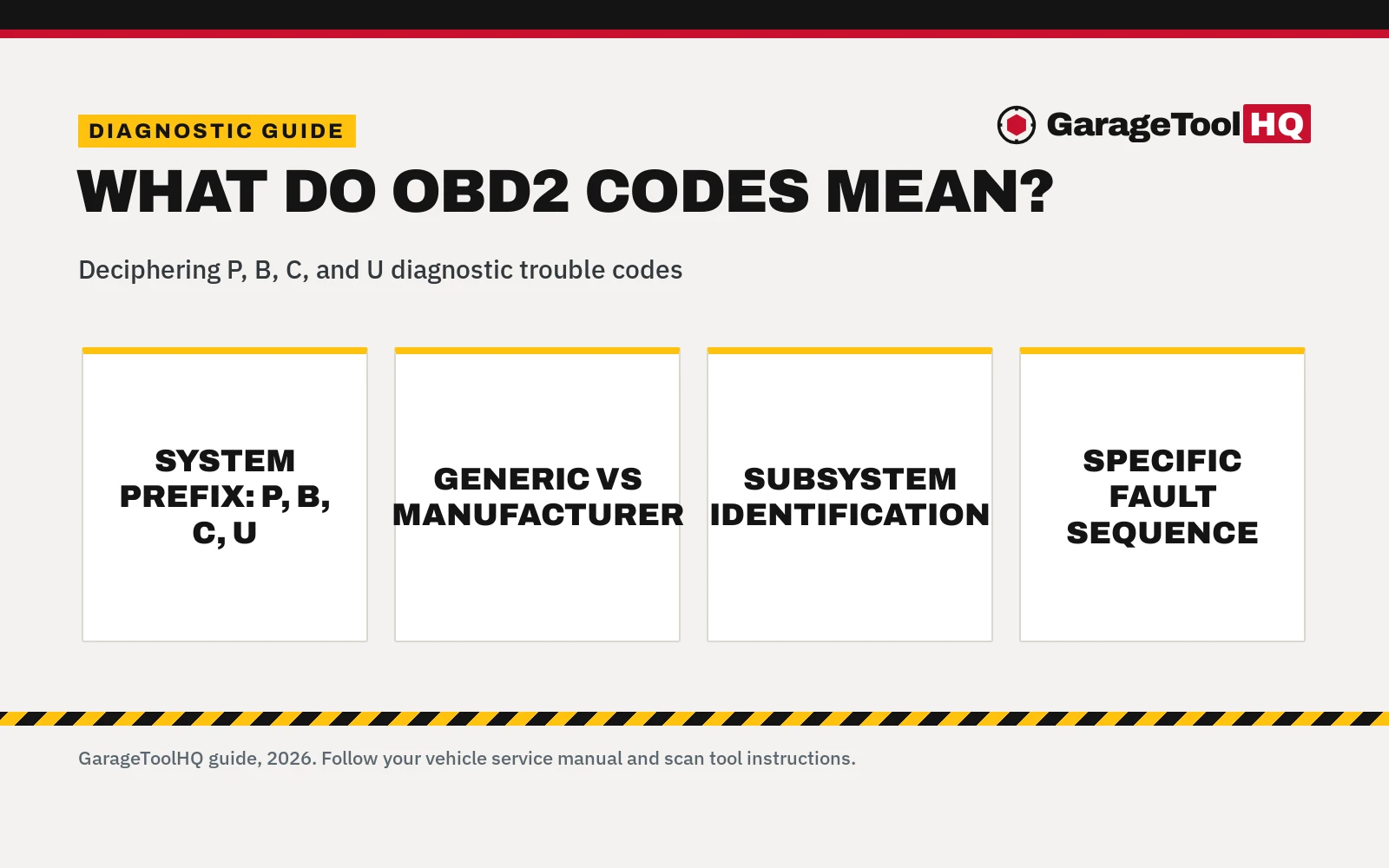
Every standard code follows a standardized 5-character alphanumeric sequence. Each position in that sequence delivers a specific diagnostic clue:
- First character (System identification letter): Identifies the primary vehicle system where the fault occurred. This letter is always P (Powertrain), B (Body), C (Chassis), or U (Network).
- Second character (Code type indicator): A digit indicating whether the trouble code is standardized across all automotive brands or tailored to a specific vehicle maker. In powertrain codes, a 0 typically designates a standardized generic SAE code, while a 1 designates an enhanced manufacturer-specific code.
- Third character (Subsystem group): A digit designating the specific vehicle subsystem involved, such as fuel metering, ignition components, auxiliary emissions controls, or transmission sensors.
- Remaining digits (Fault identification): Digits specifying the exact component, circuit, or operational failure detected by the vehicle computer module.
Understanding this sequence prevents misinterpreting dashboard warning lights. Rather than signaling an immediate component replacement, a code directs the technician or DIY owner toward the specific circuit or mechanical assembly requiring inspection.
OBD2 code types: P, B, C, and U system categories
The leading letter of every trouble code divides vehicle faults into distinct system categories. Automakers route fault data through designated controller modules connected via the 16-pin diagnostic link connector.
| System Letter | Category Name | Vehicle Systems Covered |
|---|---|---|
| P (Powertrain) | Engine, Transmission, and Drivetrain | Fuel delivery, air induction, ignition, emissions controls, transmission sensors, and exhaust systems |
| B (Body) | Passenger Compartment and Exterior Body | Airbags, climate control, power windows, interior lighting, door locks, and instrumentation |
| C (Chassis) | Mechanical Systems and Running Gear | Anti-lock braking (ABS), traction control, electronic stability, steering, and suspension components |
| U (Network) | Vehicle Integration and Communication | CAN bus wiring, module-to-module data exchange, sensor communications, and shared network nodes |
Powertrain codes are the most frequent reason for dashboard warning lights. Because powertrain malfunctions directly impact vehicle exhaust emissions and engine operation, federal standards require compliant scan tools to read and interpret P-series trouble codes.
Body, chassis, and network codes require scanners capable of accessing modules beyond the engine control unit. For instance, the BC BossComm listing notes that its scanner expands coverage across 9 critical systems, reading fault codes for powertrain, ABS, airbags, transmission, steering, and climate control across 60 vehicle brands. Similarly, the mucar listing for the CS6 specifies diagnostics across 6 systems, covering engine, transmission, ABS, airbags, body control modules, and tire pressure monitoring. Entry-level devices frequently restrict access strictly to powertrain codes; for example, the MOTOPOWER listing notes that its scanner operates across standard OBD2 protocols to display fault definitions on a 2.8-inch screen, but clarifies that it does not communicate with supplemental chassis and body systems such as ABS or airbag circuits.
Network communication codes represent data transfer failures between modules. When a transmission module cannot share vehicle speed information with the instrument cluster or stability controller, a U-series code flags the communication failure. The OHP diagnostic cable listing highlights protocol switching between MS-CAN and HS-CAN networks on 12V platforms, supporting bus speeds up to 500000 baud to interpret complex module communication faults.
How to read and interpret OBD2 codes: step-by-step checklist
Retrieving diagnostic data requires a structured procedure to preserve operational records before clearing vehicle memory. Follow this checklist when scanning trouble codes:
- Locate the diagnostic connection. Locate the 16-pin diagnostic link connector, typically positioned beneath the driver-side dashboard within reach of the steering column.
- Connect with the vehicle off. Plug the scan tool firmly into the 16-pin port before turning on vehicle electronics to prevent communication handshake errors.
- Turn the ignition to the run position. Turn the key or power button to the run position without cranking the engine, allowing onboard computers to power up and establish communication with the scan tool.
- Record active trouble codes. Active codes represent confirmed malfunctions that have occurred across consecutive driving cycles and triggered the malfunction indicator lamp.
- Check pending trouble codes. Pending codes represent intermittent faults detected during current or recent driving cycles that have not yet met the threshold to illuminate the dashboard light.
- Examine freeze frame records. When a fault occurs, the computer records operational parameters at that moment, including coolant temperature, vehicle speed, and engine RPM. Freeze frame records capture operational parameters at the exact moment a fault occurs, helping technicians replicate intermittent issues.
- Inspect live sensor streams. Sensor monitoring verifies whether readings fluctuate within normal limits. The OnRetul listing specifies tracking more than 20 live data parameters on its V119 model, including fuel pressure and coolant temperature.
- Address mechanical causes before resetting. Repair damaged wiring, replace faulty components, or clean contaminated sensors prior to erasing stored codes.
- Confirm monitor readiness. After clearing codes, drive the vehicle through manufacturer drive cycles to verify that emissions monitors achieve ready status. The OnRetul listing also notes support for verifying readiness status across 8 vehicle systems before state emissions checks.
Erasing active diagnostic trouble codes with a scan tool resets stored memory and may turn off the malfunction indicator lamp temporarily, but the onboard computer will illuminate the warning light again once system monitors detect the condition persists. Furthermore, permanent codes cannot be erased by a scan tool until the computer verifies repairs during drive cycles. Always address the underlying component failure before resetting trouble codes.
Use rated jack stands on solid ground, wear eye protection with power and air tools, keep fuel-burning equipment out of a closed garage, and follow the manual for every tool. Read our Safety Disclaimer.
Generic vs manufacturer-specific OBD2 codes
The second character in an OBD2 code identifies whether the fault definition is universal or unique to the vehicle manufacturer. While generic codes most commonly display a 0 as their second digit, automotive standards also reserve specific ranges (such as P2 codes) for standardized definitions across makes. Generic codes established by the Society of Automotive Engineers (SAE) share identical definitions across compliant vehicles. Conversely, codes displaying a 1 as their second digit represent manufacturer-specific faults, giving automakers flexibility to monitor proprietary vehicle components.
Decoding manufacturer-specific faults requires a tool equipped with an extensive internal lookup library or online database. The AFS QIORE listing features a 40,000+ DTC lookup database in its PX-801 scanner to translate definitions directly on a 2.8-inch color screen across 9 communication protocols. Similarly, the BLCKTEC listing notes that its 440 diagnostic tool connects directly to the 16-pin port of 1996 and newer 12V vehicles to provide fault code interpretations. For home mechanics seeking reliable diagnostic equipment, our guide to the best OBD2 scanner for DIY compares handheld code readers and advanced diagnostic tools. If your maintenance projects require sending active commands to vehicle components, review our guide explaining what is a bidirectional scan tool.
Understanding OBD2 powertrain subsystem digits
The third character in a powertrain trouble code indicates the specific automotive subsystem responsible for the fault. Because powertrain assemblies combine complex mechanical, electrical, and hydraulic elements, this intermediate digit narrows down the troubleshooting area:
- Fuel and air metering: Covers components governing intake airflow, throttle position sensors, manifold pressure, and fuel delivery circuits. Faults in this group frequently cause rough idling, stalling, or hesitation during acceleration.
- Fuel injection circuits: Isolates problems within fuel injectors, injection timing, and fuel pump electrical controls.
- Ignition systems and misfire detection: Identifies ignition coil failures, spark plug degradation, crankshaft position sensor errors, and cylinder misfire occurrences.
- Auxiliary emissions controls: Monitors the evaporative emission control (EVAP) system, secondary air injection, catalytic converter efficiency, and exhaust gas recirculation (EGR) valves.
- Vehicle speed controls and idle regulation: Evaluates idle air control valves, wheel speed sensors, and cruise control switches.
- Computer and auxiliary outputs: Tracks internal processor errors within the engine control unit, transmission control module, and related relay circuits.
- Transmission controls: Pinpoints automatic transmission solenoids, fluid temperature sensors, pressure switches, and torque converter clutch mechanisms.
The remaining digits provide the precise component code within that designated subsystem group. For example, within the misfire detection subsystem, the remaining digits designate whether a misfire is random or isolated to an individual cylinder. Always reference your vehicle service manual for wiring schematics, component locations, and specified electrical tolerances before replacing parts.
Frequently Asked Questions
Can I drive with an OBD2 code stored?
It depends on the malfunction indicator lamp status. A steady dashboard light indicates an active code that requires attention, but the vehicle is generally drivable for short distances to reach home or a repair facility. A flashing dashboard light indicates a severe condition, such as a severe engine misfire, that can cause unburned fuel to overheat and destroy the catalytic converter. Pull over safely and shut off the engine if the warning light flashes.
What is the difference between active, pending, and permanent codes?
Active codes represent confirmed malfunctions that have occurred repeatedly across multiple driving cycles, illuminating the malfunction indicator lamp. Pending codes represent faults detected during recent driving cycles that have not yet recurred frequently enough to activate the warning light. Permanent codes are stored in non-volatile memory and cannot be erased with a scan tool; they clear automatically only after the vehicle computer confirms through driving cycles that the fault has been resolved.
Does an OBD2 code tell you exactly what part to replace?
No. An OBD2 code identifies a circuit, sensor, or system reporting an out-of-range value, not necessarily the failing component itself. For instance, a sensor code can stem from a broken wiring harness, loose ground connection, vacuum leak, or faulty sensor. Replacing the indicated sensor without verifying wiring and operating conditions often fails to solve the root problem.
Will clearing an OBD2 code pass a state emissions inspection?
No. Clearing trouble codes also resets all internal readiness monitors to an unready state. State inspection facilities verify that internal emissions monitors have completed their evaluation cycles. If readiness monitors show unready status, the vehicle automatically fails the emissions inspection until driven through designated drive cycles.
Can a basic code reader access ABS and airbag codes?
Standard entry-level code readers access only powertrain trouble codes mandated for federal emissions compliance. Accessing body, chassis, and supplemental restraint modules requires an enhanced scan tool. As noted in the MOTOPOWER MP69033 Pro listing, basic tools read engine data but do not communicate with supplemental systems such as ABS or airbag modules.
Why do trouble codes return after being cleared?
Clearing a trouble code simply wipes the computer memory and turns off the dashboard light temporarily. If the mechanical or electrical malfunction persists, the vehicle onboard diagnostic monitor will detect the out-of-range parameter during subsequent driving cycles, setting the code again and relighting the dashboard lamp.
Related: our guide on how to choose an OBD2 scanner, our comparison of the best OBD2 scanner for DIY, our review of scan tools under 100, and the diagnostics and electrical hub.