1/4 vs 3/8 Torque Wrench: Which One Should You Buy?
When to use 1/4-inch vs 3/8-inch drive, how to read inch-pound ranges and accuracy, with three 1/4-inch click wrenches compared.

On this page
Top picks at a glance
As an Amazon Associate we earn from qualifying purchases.
- 1
 LEXIVON Torque Wrench 1/2-Inch Drive Click 10~1509.7/10View on Amazon
- 2
 CRAFTSMAN Torque Wrench9.7/10View on Amazon
- 3
 Matework 50PCS Inch Pound Torque Wrench Set9.6/10View on Amazon
- 4
 EPAuto 1/4-Inch Drive Click Torque WrenchView on Amazon
- 5
 LEXIVON Inch Pound Torque Wrench 1/4-Inch DriveView on Amazon
- 6
 Amazon Basics 1/4-Inch Drive Click Torque WrenchView on Amazon
- 7
 SUZUME 1/4 Digital Torque WrenchView on Amazon
- 8
 GEARWRENCH 1/4" Drive 120XP Flex Head Electronic Torque WrenchView on Amazon
- 9
 1/4 Inch Drive Torque Wrench 20-260 In-Lb for Bike RepairView on Amazon
Pick 1/4-inch drive for small fasteners torqued in inch-pounds; pick 3/8-inch drive for larger fasteners torqued in foot-pounds. That is the whole 1/4 vs 3/8 torque wrench decision: drive size follows the torque range of the job, not the other way around. The three wrenches below are all 1/4-inch click wrenches, with ranges spanning 20 to 200 inch-pounds between them, for the small-fastener end of the garage.
More options to compare
 EPAuto 1/4-Inch Drive Click Torque WrenchCheck price on Amazon
 LEXIVON Inch Pound Torque Wrench 1/4-Inch DriveCheck price on Amazon
 Amazon Basics 1/4-Inch Drive Click Torque WrenchCheck price on Amazon
 SUZUME 1/4 Digital Torque WrenchCheck price on Amazon
 GEARWRENCH 1/4" Drive 120XP Flex Head Electronic Torque WrenchCheck price on Amazon
 1/4 Inch Drive Torque Wrench 20-260 In-Lb for Bike RepairCheck price on Amazon
GarageToolHQ earns a commission when you buy through links on our product pages, at no extra cost to you. Read our affiliate disclosure.
1/4 vs 3/8 torque wrench: the short answer
A 1/4-inch torque wrench typically works in inch-pounds for small bolts: valve covers, intake manifolds, spark plugs, motorcycle fasteners and anywhere a larger wrench would be too coarse to read accurately. A 3/8-inch torque wrench typically works in foot-pounds for the middle of the job list: lug nuts, brake calipers, suspension bolts and engine work. If you can only own one, most home mechanics start with 3/8-inch because it covers the common car jobs; add 1/4-inch when you start rounding small fasteners or working on bikes.
The 1/4-inch gear, ranked
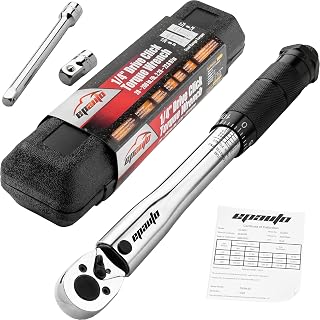
The EPAuto ST-013-1 leads on range: a 1/4-inch drive click wrench covering 20 to 200 inch-pounds (2.26 to 22.6 Nm), with a hardened chrome vanadium ratchet head, knurled non-slip handle, high-contrast dual-range scale and a stated accuracy of plus-or-minus 4 percent. A sturdy plastic storage case is included, and the click tells you when the preset torque is reached. Note the listing contradicts itself: the spec table says 3/8-inch drive against the 1/4-inch title and bullets; trust the title.
The Amazon Basics 35-200 inch-pound wrench comes next: 35 to 200 inch-pounds (3.95 to 22.5 Nm) with a hardened Cr-V steel alloy ratchet head, high-contrast dual-range scale and the same plus-or-minus 4 percent stated accuracy, in a sturdy plastic case. Its instructions add a care tip the others lack: unlock before adjusting, lock after, and return to the lowest value with the locking ring loosened after use. The spec table disagrees with the title on range (20-150 inch-pounds) and accuracy (plus-or-minus 3 percent); the title and bullets win.
The Amazon Basics 20-150 inch-pound wrench is the short-range pick: 20 to 150 inch-pounds (2.5 to 15 Nm), the same hardened Cr-V head, dual-range scale, plus-or-minus 4 percent accuracy and plastic case, at 10 inches long and 0.86 pounds. For the smallest fasteners, the lower starting point matters more than the top end: a wrench reads most accurately in the middle of its range, so the 20-150 covers delicate work the 35-200 cannot reach. See best torque wrench for motorcycles for where these small wrenches shine.
When 3/8-inch is the right call
None of the three listings here is 3/8-inch, so this is guidance rather than a product pick. Reach for 3/8-inch drive when the spec is in foot-pounds: lug nuts, caliper brackets, strut bolts and most engine fasteners. These 1/4-inch wrenches top out at 150 to 200 inch-pounds, far below lug nut territory. Using one on a lug nut means exceeding its rated range, which can damage the wrench and throw off its calibration. For the full range of choices, see the best torque wrench roundup.
Reading the specs: range, accuracy and drive
Range first: the EPAuto and the larger Amazon Basics both cover up to 200 inch-pounds, while the smaller Amazon Basics stops at 150. Starting points differ too: 20 inch-pounds on the EPAuto and the small Amazon Basics, 35 on the larger one. Pick the wrench whose middle covers your fasteners, since click wrenches are least accurate at the extremes of their range.
Accuracy second: all three listings state plus-or-minus 4 percent in their bullets, even where a spec table says 3 percent. That figure is the maker’s calibration claim; store the wrench at its lowest setting and never use it as a breaker bar, and it holds longer. Drive size third: all three are 1/4-inch drive for 1/4-inch sockets, the right pairing for inch-pound work. For engine assembly specifics, see best torque wrench for engine work.
Size, scales and storage
Range and accuracy get the attention, but the listings state more that matters at the bench. Start with size and weight: the EPAuto ST-013-1 lists 10.88 inches and 1.8 pounds with a knurled non-slip handle, while the smaller Amazon Basics (DS-DTW-1) lists a 10 in. (254mm) product length and a 0.86lbs (390g) net weight. A longer, heavier wrench gives a steadier pull, while the lighter 10-inch wrench reaches tighter spots like crowded engine bays.
Then the second scale. All three listings print a dual-range scale: the EPAuto covers 20-200 in.-lb. / 2.26~22.6 Nm, the larger Amazon Basics 35-200 in.-lb/3.95-22.5 Nm, and the smaller 20-150 in.-lb/2.5-15 Nm. If your manual specs newton-meters, read the metric side instead of converting in your head. The high-contrast printing the listings describe is a working feature, not decoration: a scale you can read at arm’s length is one you will actually use.
Then the ratchet head. The EPAuto spec table lists a 72-tooth ratchet head in hardened chrome vanadium steel with a corrosion-retardant satin finish, paired with 6-point sockets in standard and deep. Both Amazon Basics listings state a hardened Cr-V steel alloy ratchet head in a fixed square head style, with no tooth count given. More teeth mean a smaller swing arc between clicks in tight spots; where a listing is silent, treat it as unknown rather than a tie.
Finally, storage: all three listings include a sturdy plastic storage case. That matters because a click wrench holds its calibration longer when it lives cased at its lowest setting, exactly what the Amazon Basics instructions ask for. A wrench rolling loose in a drawer takes knocks that the plus-or-minus 4 percent claim did not budget for.
Use rated jack stands on solid ground, wear eye protection with power and air tools, keep fuel-burning equipment out of a closed garage, and follow the manual for every tool. Read our Safety Disclaimer.
Frequently Asked Questions
Can I use a 1/4-inch torque wrench on lug nuts?
No. Lug nuts need foot-pounds; these three top out at 150 to 200 inch-pounds. Use a 3/8-inch wrench for lugs; see best torque wrench for lug nuts.
What is the difference between the two Amazon Basics wrenches?
Range: one covers 35 to 200 inch-pounds, the other 20 to 150. Both state the same Cr-V head, dual-range scale, plus-or-minus 4 percent accuracy and plastic case. Pick by the fasteners you torque most.
Why does the EPAuto spec table say 3/8-inch drive?
It is a listing error. The title, bullets and model all say 1/4-inch drive with a 20-200 inch-pound range; the single spec-table line saying 3/8-inch drive contradicts everything else. Trust the title.
How do I keep a click wrench accurate?
Return it to the lowest setting after use, as the Amazon Basics instructions state, and never loosen fasteners with it. The plus-or-minus 4 percent claim assumes the wrench is treated this way.
Do I need both drive sizes?
Eventually, yes, if you do your own maintenance. A 3/8-inch wrench covers wheels, brakes and suspension; a 1/4-inch wrench covers the small fasteners a 3/8-inch cannot read accurately. Start with the jobs you do most.
Related: the best torque wrench for beginners guide and the best torque wrench for home mechanics roundup.