Where to Spray Starter Fluid on an Engine
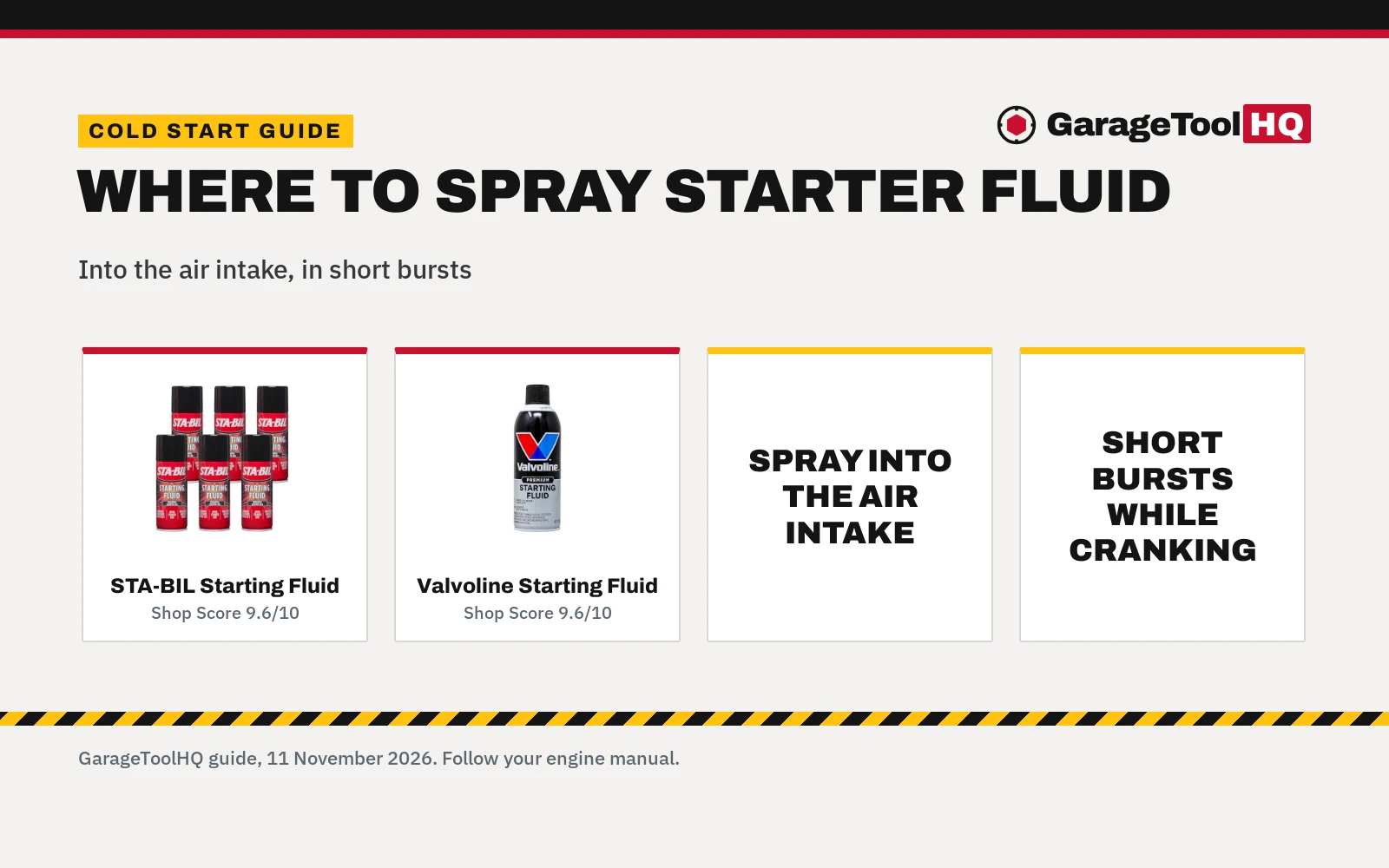
Spray starter fluid into the air intake in short bursts while the engine cranks, and let the fluid give the cold engine a charge it can light.

On this page
A cold morning, a key turn, and an engine that cranks without catching is a familiar garage job. Where to spray starter fluid is simple: into the air intake, ahead of the throttle body or carburetor, in short bursts while the engine cranks, so the fluid is drawn in with the air and gives the cold engine a charge it can light. Never spray it into a hot engine, and never spray near an open flame.
As an Amazon Associate I earn from qualifying purchases. GarageToolHQ earns a commission when you buy through links on our product pages, at no extra cost to you. Read our affiliate disclosure.
Below: where the spray goes, what to check before you spray, how to use the can, and a checklist for a cold engine that will not catch.

STA-BIL Starting Fluid, 11 oz, 6-Pack
An 11 oz can in a 6-pack that helps engines start quickly in cold weather while lubricating upper cylinders, with faster starts stated even in temperatures as low as -65°F.
Pros
- Faster starts stated even at -65°F
- 6-pack of 11 oz cans
- Upper cylinder lubricant and corrosion inhibitors in the formula
- Will not harm catalytic converters or oxygen sensors
Cons
- No warranty term is stated, only the word Warranty
- Sold as a 6-pack only in this listing
- No can dimensions are stated
- No storage or shelf-life detail is stated
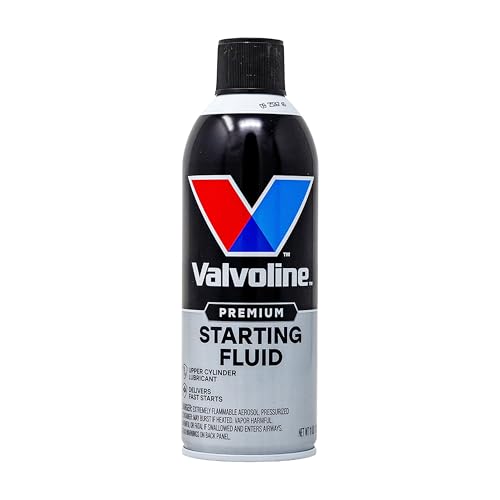
Valvoline Starting Fluid, 11 oz
An 11 oz can that helps engines start quickly in cold weather while lubricating upper cylinders, with a formula that also cleans the mass air flow sensor and intake valve.
Pros
- 11 oz can, 0.86 pounds
- Upper cylinder lubricant in the formula
- Formula also cleans the mass air flow sensor and intake valve
- Can dimensions stated: 7.9 x 2.6 x 2.6 inches
Cons
- No warranty term is stated
- No cold temperature limit is stated
- No engine list is stated
- Sold as an 11 oz can with no pack option in this listing
Where to spray starter fluid: into the air intake
The air intake is the path the engine breathes through, so the spray has to go in there. On most engines that means the air filter housing or the intake tube, ahead of the throttle body or carburetor, where the air is drawn in. Take the air filter cover off if the intake is behind it, give a short burst into the intake, put the cover back, and crank the engine. The fluid travels with the air into the cylinders, where the spark or the compression lights it. Spray into the intake only: never into the exhaust, never into a vent or a filler neck, and never onto a hot surface. Work with the garage door open or outside, and never run a fuel engine in a closed garage.
Starter fluid or not, never run a car, a generator or any gas engine in a closed garage, even with the door partly open. Work outside or with the door fully open and the air moving.
Before you spray: check the simple things
Starter fluid helps a cold engine catch. It does not fix a dead battery, an empty tank or a flooded engine, so check the simple things before you reach for the can. Look at the fuel gauge, listen to how the engine cranks, and check that the air filter is clean and dry. If the engine cranks slowly, the battery is the first thing to check, and a smart battery charger or a jump starter is the fix, not a spray. If the engine cranks well and still will not catch in the cold, the spray is worth a try. The deep cycle vs starting battery charger comparison explains the charger side of a slow crank.
Starter fluid for a cold engine
The can is the tool for the job above: a starter fluid spray gives the cold engine the charge it needs to catch, and the listings below state what each can offers.
Use rated jack stands on solid ground, wear eye protection with power and air tools, keep fuel-burning equipment out of a closed garage, and follow the manual for every tool. Read our Safety Disclaimer.
Short bursts, not a long spray
Use the can in short bursts, not a long spray. Give a short burst into the intake, crank the engine, and let it catch or settle before you spray again. A flooded intake washes the oil film off the cylinder walls and makes the next crank harder, so patience beats volume. If the engine catches and then dies, a short burst while it is still turning can keep it going until it warms up. If it will not catch after a few tries, stop and look for the cause instead of emptying the can into the intake.
When starter fluid is the wrong answer
Starter fluid is a cold-start aid, not a repair. If the engine is getting fuel and still will not catch, the fault is somewhere the spray cannot reach, and the manual for the engine is the next step. Never spray starter fluid into a hot engine or an engine that is already running rough, and never spray it near a heater, a pilot light or any open flame. Keep the can away from heat and out of direct sun, and store it upright where it cannot fall and leak.
A cold-start checklist
- Garage door open or working outside
- Fuel in the tank and a battery that cranks well
- Air filter clean and dry
- Spray into the air intake only
- Short bursts, crank, and let it catch
- Can stored upright, away from heat and flame
FAQ: garage tools
Can starter fluid go into the air filter?
Spray into the air intake, ahead of the throttle body or carburetor. If the air filter sits in the way, take the cover off, spray into the intake, and put the cover back before cranking. Do not soak the filter element itself.
How much starter fluid is enough?
A short burst is enough. Give a short burst into the intake, crank the engine, and let it catch before you spray again. If the engine will not catch after a few tries, stop and look for the cause.
Is starter fluid safe for diesel engines?
The STA-BIL listing states it is for gasoline and diesel engines, including cars, trucks, motorcycles, tractors, buses, marine engines, lawnmowers, snowmobiles, snow blowers and construction equipment. Check the manual for your engine before use.
Can starter fluid harm the catalytic converter or oxygen sensors?
The STA-BIL listing states it will not harm catalytic converters or oxygen sensors. The Valvoline listing makes no such statement, so check the can you hold before use.
Does starter fluid work in cold weather?
Yes. The STA-BIL listing states faster starts even in temperatures as low as -65°F, and the Valvoline listing states the spray activates stubborn engines swiftly even in extreme cold or humid environments. Keep the can at room temperature where you can, and store it away from heat.
Related: the carburetor cleaner picks, the battery charger for lead-acid batteries picks, and the engine and shop equipment hub.