How to Drain Engine Coolant Safely at Home
How to drain engine coolant at home: let the engine cool, catch the old coolant in a drain pan, and dispose of it properly, with the right pan size for the job.

On this page
The coolant change starts with a cold engine and a pan on the floor, not with a wrench. How to drain engine coolant comes down to letting the engine cool, opening the drain with a pan underneath, and catching every drop for disposal. This guide walks through each move, and the section below matches each pan to the job by the capacity its listing states.
As an Amazon Associate I earn from qualifying purchases. GarageToolHQ earns a commission when you buy through links on our product pages, at no extra cost to you. Read our affiliate disclosure.
Below: the steps in order, how to size the pan, and the drain pans in the listings.
| # | Product | Shop Score | Buy |
|---|---|---|---|
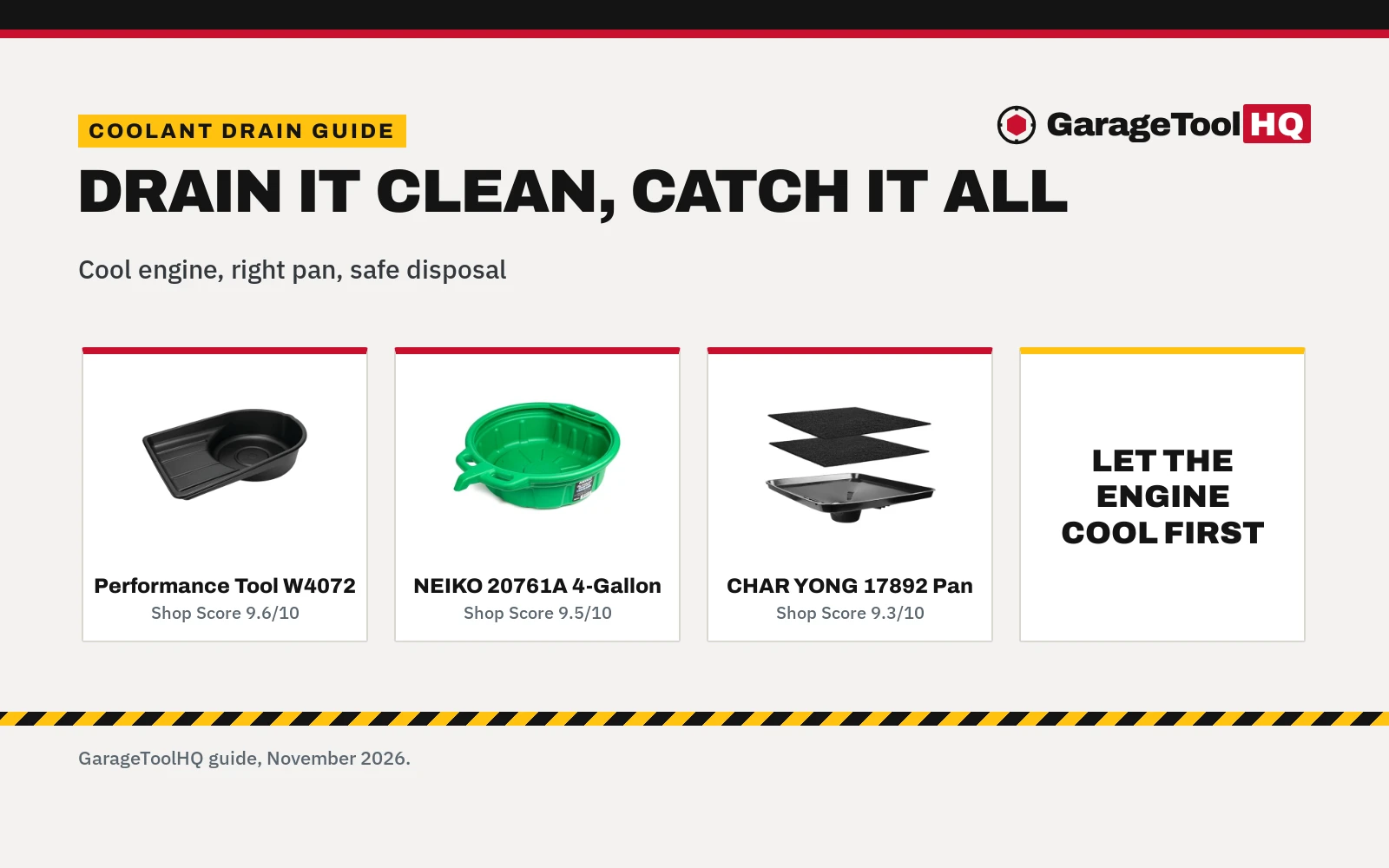
| 1 |  Performance Tool W4072 7.5 Gallon Polyethylene Oil | 9.6/10 | Buy on Amazon |
| 2 |  NEIKO 20761A 4 Gallon (16L) | 9.5/10 | Buy on Amazon |
| 3 |  17892 Transmission Drain Pan for Lisle Oil Drains | 9.3/10 | Buy on Amazon |
Performance Tool W4072 7.5 Gallon Polyethylene Oil
A 7.5-gallon (28.4 liter) polyethylene drain tub, 32.5 x 21.5 x 7.5 in, with a wide opening, a built-in parts basin and a molded spout.
Pros
- Largest capacity here, 7.5 gallons
- Built-in basin for washing small parts
- Molded spout for easy pouring
- 1 yr warranty on material and workmanship
Cons
- Largest footprint here, 32.5 x 21.5 in
- No handles stated
- No anti-splash lip stated
- No lid stated for transport or storage
NEIKO 20761A 4 Gallon (16L)
A 4-gallon (16 liter) anti-splash drain container, 20.0 x 19.5 x 6.38 in, with a curled anti-splash lip, grip handles and a non-spill pour spout.
Pros
- Anti-splash curled lip edge
- Non-spill pour spout
- Grip handles on both sides
- Thick-walled, rigid even with hot oil
Cons
- No concrete warranty term; Limited warranty only
- 4 gallons, smaller than the W4072
- Bullets say 18 in, spec table says 19.5 in
- No parts basin stated
17892 Transmission Drain Pan for Lisle Oil Drains
A catch pan and splash pad set for use with a lift drain: 1 pan at about 23.42 x 22.63 x 5.5 in and 2 splash pads at about 22 x 22 x 0.8 in.
Pros
- Pan plus 2 splash pads in one set
- Pads catch drips and keep the floor clean
- Stackable design saves shop space
- Suits oil, coolant, brake fluid and solvents
Cons
- No warranty; the listing states NO
- No capacity in gallons stated
- No spout for pouring
- Spec table dimensions do not match the bullets
How to drain engine coolant: the steps
- Let the engine cool. Never open a cooling system on a hot engine: the coolant is under pressure and will scald. Wait until the engine is cool to the touch.
- Set the pan under the drain. Slide the pan under the radiator drain plug, and check the pan sits level and covers the stream.
- Open the cap, then the drain. Open the radiator cap first, then the drain plug, so air can enter and the coolant flows out freely.
- Let it drain fully. Wait until the stream slows to a drip, then close the drain plug.
- Pour the old coolant into a sealed container. Use the pan’s spout, where the pan has one, to pour the coolant into a container with a lid, and wipe up any spill.
- Dispose of the coolant properly. Take the sealed container to a recycling center or an auto parts store that accepts coolant. Never pour coolant down a drain, on the ground, or into a storm drain, and keep it away from pets and children: coolant is toxic.
How to size the drain pan
| Pan | Capacity | Pan size | Spout |
|---|---|---|---|
| NEIKO 20761A 4-Gallon | 4 gallons (16 liters) | 20.0 x 19.5 x 6.38 in | Built-in spout |
| Performance Tool W4072 | 7.5 gallons (28.4 liters) | 32.5 x 21.5 x 7.5 in | Molded spout |
| CHAR YONG 17892 Pan | Not stated | 23.42 x 22.63 x 5.5 in (bullets) | Not stated |
The pattern is clear: the W4072 holds 7.5 gallons, the NEIKO holds 4 gallons, and the CHAR YONG states no capacity at all. Pick the pan by the capacity the listing states, and check the pan’s footprint against the space under the car. The CHAR YONG set is a catch pan and splash pads for use with a lift drain, not a standalone drain pan with a spout.
Drain pans worth a look
The pans below cover the drain step above: each card states the capacity, the size and the spout where the listing states them, so the pan can be matched to the job before the coolant comes out.
For more pan choices, see our best large oil drain pan roundup.
Common mistakes
- Opening the cooling system on a hot engine.
- Using a pan with no stated capacity and finding it overflows.
- Pouring old coolant down a drain or on the ground.
- Forgetting the splash: coolant that misses the pan ends up on the floor.
FAQ: garage tools
How much coolant will drain out?
It depends on the vehicle, and the listings here state pan capacities, not vehicle coolant volumes. The NEIKO holds 4 gallons and the W4072 holds 7.5 gallons. Have a sealed container ready for the old coolant.
Can I drain coolant without a drain pan?
Not cleanly. The coolant needs a pan underneath the drain, or it ends up on the floor. The NEIKO and the W4072 have spouts for pouring the old coolant into a sealed container, while the CHAR YONG set is a catch pan and splash pads for use with a lift drain.
What do I do with old coolant?
Pour it into a sealed container and take it to a recycling center or an auto parts store that accepts coolant. Never pour it down a drain, on the ground, or into a storm drain. Keep it away from pets and children, since coolant is toxic.
Do I need to flush the radiator too?
A drain and a flush are different jobs. Our radiator flush vs coolant change guide compares the two, and the best coolant flush kit for home garage roundup covers the kits for a flush.
What size drain pan do I need?
The NEIKO holds 4 gallons (16 liters) and the W4072 holds 7.5 gallons (28.4 liters). The CHAR YONG set states no capacity, so it suits catching drips under a lift drain rather than holding a full drain.
Related: how to change oil, the best coolant funnel for radiator and our engine and shop equipment hub.