How Does an Ultrasonic Cleaner Work and What to Buy
An ultrasonic cleaner uses sound waves, heat and cleaning solution to lift grease and grime out of carburetors, tools and small parts a brush cannot reach.

On this page
A carburetor comes off the engine caked in varnish, the jets clogged and the passages dark with old fuel residue. A brush reaches the outside, but the inside passages stay dirty, and soaking alone takes ages. How does an ultrasonic cleaner work? It sends high-frequency sound waves through a heated cleaning bath, and those waves make tiny bubbles that form and collapse against every surface of the part, lifting grease, carbon and grime out of holes and threads a brush cannot reach. The part rests in a basket in the tank while the machine does the scrubbing.
As an Amazon Associate I earn from qualifying purchases. GarageToolHQ earns a commission when you buy through links on our product pages, at no extra cost to you. Read our affiliate disclosure.
Below: how cavitation cleans, what the sizes and heater settings mean, and how to run a cycle.
How does an ultrasonic cleaner work? Cavitation, step by step
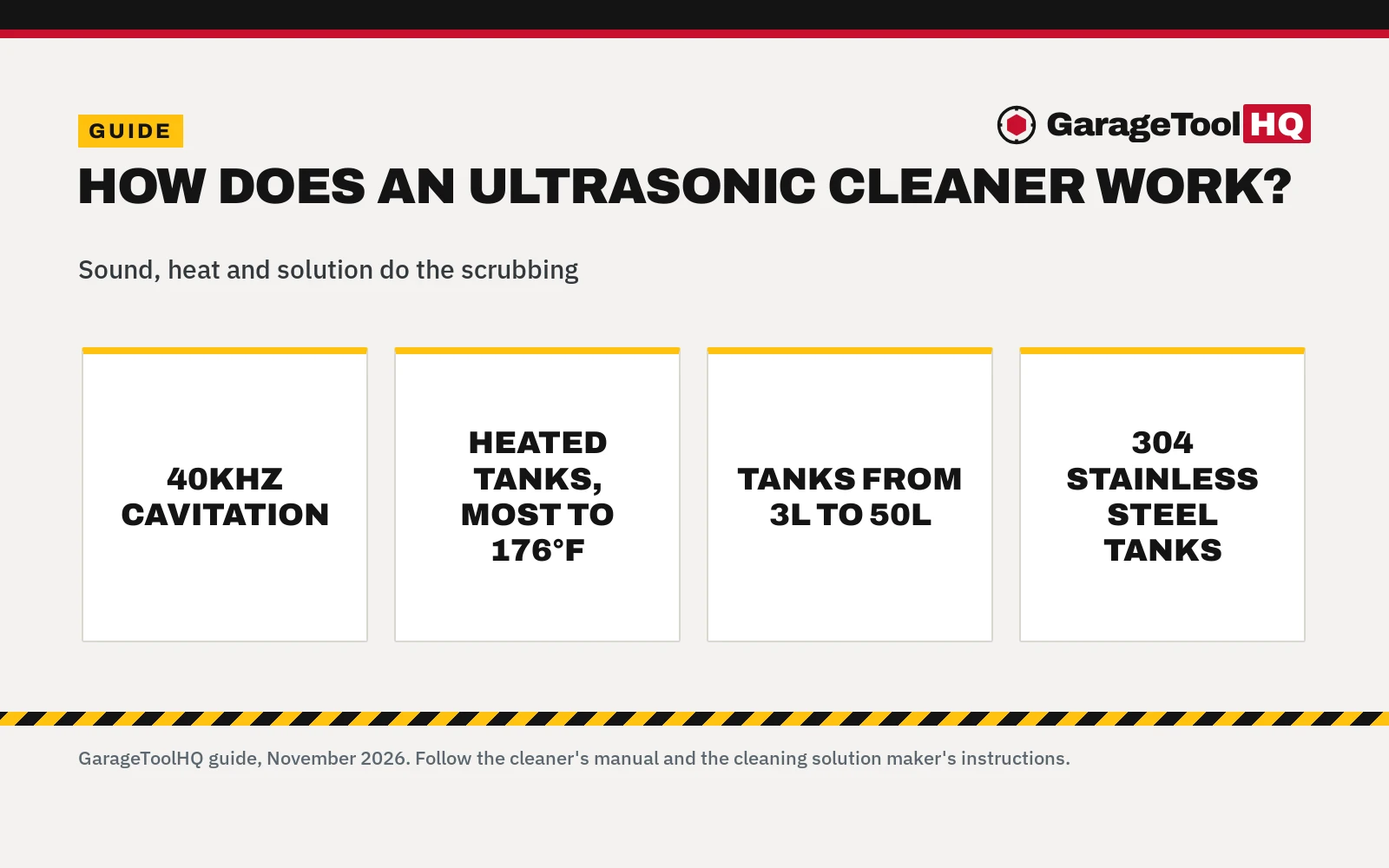
An ultrasonic cleaner has a steel tank, transducers fixed under the tank, a heater and a timer. The transducers turn electric power into sound waves at ultrasonic frequency. The listings that state a frequency run at 40kHz. The waves travel through the bath, making tiny bubbles form and collapse in rapid succession. Each collapse sends a small jet of liquid against the surface of the part, and millions of those jets together strip grease, carbon, varnish and loose rust from flat faces, blind holes and fine threads alike. The VEVOR 50L listing puts it in vivid terms: 40kHz waves generate 40,000 microbubbles per second, bursting like thousands of tiny brushes.
Heat and cleaning solution do the other half of the job. Warm solution dissolves grease faster than cold water, and the listings pair ultrasonic power with a heater: the VEVOR 15L pairs 360W of ultrasonic power with 400W of heating, the CREWORKS 10L pairs 240W with a heater of up to 300W, and the CREWORKS 30L pairs 600W with a 600W heater. Temperature settings vary by model: the CREWORKS listings run from 20 to 80°C, or 68 to 176°F, the VEVOR 15L ultrasonic cleaner (JPS-60A) lists 0 to 80°C, or 176°F, and the VEVOR 6L and 15L sonic cleaner models list 0 to 110°C. Timers on the listings that state one run for up to 30 minutes, and the CREWORKS 6L lists a timer from 1 to 30 minutes.
- The tank. A 304 stainless steel tank holds the bath, and the basket uses the same steel, which the makers describe as corrosion resistant and built to last.
- The transducers. These make the sound waves. The VEVOR 15L lists 6 advanced transducers, 6x60W, adding up to 360W of ultrasonic power, and the VEVOR 3L lists dual 60W transducers for a total of 120W.
- The heater. It warms the bath to the temperature the job needs, from a gentle warm bath for delicate items to the top of the range for heavy grease.
- The basket. It holds parts in place and keeps them off the tank floor, and several VEVOR listings note that it prevents scratches during cleaning.
- The drain valve. The CREWORKS 10L, 30L and 6L listings include a built-in drain valve for emptying the tank.
Tank sizes and power in the listings
| Model | Tank size | Ultrasonic power | Heater power |
|---|---|---|---|
| CREWORKS 3L | 3L, 0.8 gal | 120W | Up to 100W |
| VEVOR 3L | 3L, 0.8 gal | 120W | Not stated |
| CREWORKS 6L | 6L, 1.6 gal | 180W | Up to 200W |
| VEVOR 6L | 6L | 180W | Not stated |
| CREWORKS 10L | 10L, 2.6 gal | 240W | Up to 300W |
| VEVOR 15L (JPS-60A) | 15L | 360W | 400W |
| CREWORKS 30L | 30L, 7.9 gal | 600W | 600W |
| VEVOR 50L | 50L | 840W | Not stated |
Size is the first buying decision. The listings run from 3L to 50L, and the tank has to hold the part with room for the bath to move. The VEVOR 15L lists a tank size of 13 x 11.8 x 5.9 in and a maximum workpiece size of 10.6 x 8.7 x 4.1 in, so a part larger than that needs a bigger tank. Weight varies just as much: the VEVOR 3L lists 6.83 lb, the VEVOR 15L lists 21.4 lb, and the VEVOR 50L lists 53.79 lb and comes with wheels.
How to run an ultrasonic cleaner in the garage
- Set the tank on a solid bench near an outlet, where it cannot be knocked over. The CREWORKS listings note non-skid rubber feet that anchor the machine during use.
- Fill the tank with water and the cleaning solution the solution maker specifies for ultrasonic use. The CREWORKS 6L instructions say to fill the tank with water and any needful cleanser, place items in the basket, set the temperature and the timer, and press the power button.
- Put parts in the basket, not on the tank floor. Spread parts out so the bath reaches every face.
- Set the temperature and the timer. Use the range the listing states: 20 to 80°C on the CREWORKS models, 0 to 110°C on the VEVOR 6L and 15L sonic cleaner models. The VEVOR 6L and 15L sonic cleaner listings note a low-temperature mode that gently protects sensitive materials, so start at the low end for delicate items.
- Run the cycle, then lift the basket and inspect the parts. Run another cycle if grime remains. Rinse parts with clean water and dry them before they go back on the engine.
- Drain the tank through the drain valve where the model has one and wipe the tank dry.
The VEVOR 30L lists a dual-power degassing mode that removes air from the liquid, which the maker claims raises working efficiency by 30% and gives zero-angle precision cleaning of internal holes and crevices.
Use rated jack stands on solid ground, wear eye protection with power and air tools, keep fuel-burning equipment out of a closed garage, and follow the manual for every tool. Read our Safety Disclaimer.
Ultrasonic cleaner vs parts washer
An ultrasonic cleaner and a parts washer both clean greasy parts, but they work in different ways. A parts washer pumps solvent over the part while the part sits in a basin, which suits large parts. An ultrasonic cleaner works best on small parts with blind holes, threads and fine passages, where the bubbles reach and the brush cannot. For big castings and brackets, see the picks for the best parts washer for home garage, and for the matching buying guide, see the ultrasonic parts cleaner guide.
What to check before buying an ultrasonic cleaner
- Tank size and maximum workpiece size. Measure the largest part before buying. The VEVOR 15L lists a maximum workpiece size of 10.6 x 8.7 x 4.1 in, and anything larger needs a bigger tank.
- Ultrasonic power and frequency. The listings here run from 120W to 840W, and the ones that state a frequency run at 40kHz. More power and a bigger tank suit heavy grease and larger parts, while a small machine suits jewelry, glasses and small hardware.
- Heater and timer ranges. Check the temperature and timer ranges against the jobs in mind. The CREWORKS models list 20 to 80°C with a timer of up to 30 minutes, and the VEVOR 6L and 15L sonic cleaner models list 0 to 110°C.
- Basket, drain valve and handles. The CREWORKS listings include inset handles, and the 10L, 30L and 6L add a built-in drain valve, while several VEVOR listings include a portable handle and a drainage design.
- Certifications. The VEVOR 15L and VEVOR 3L listings state FCC, CE and RoHS certification, and the VEVOR 15L also lists UL certification.
- Weight and bench space. The listings run from 6.83 lb for the VEVOR 3L to 53.79 lb for the VEVOR 50L, so check the bench before buying.
FAQ: garage tools
How long does it take an ultrasonic cleaner to clean a carburetor?
It depends on how much varnish and carbon has built up. Timers on the listings here run for up to 30 minutes per cycle, so run a cycle, inspect the jets and passages, then run another if grime remains.
What liquid goes in an ultrasonic cleaner?
Water plus a cleaning solution made for ultrasonic use, mixed as the solution maker specifies. The CREWORKS 6L instructions say to fill the tank with water and any needful cleanser. Rinse parts with clean water after the cycle and dry them before they go back on the engine.
Can an ultrasonic cleaner damage a part?
Heat and the wrong solution are the risks, not the sound waves alone. The VEVOR 6L and 15L sonic cleaner listings note a low-temperature mode that gently protects sensitive materials, and the VEVOR 30L lists a gentle mode for delicate items. Check the part maker’s guidance before cleaning a coated part.
What size ultrasonic cleaner fits a carburetor?
Measure the carburetor first, then match it to the tank. The VEVOR 15L lists a maximum workpiece size of 10.6 x 8.7 x 4.1 in, which covers many small-engine carburetors. A large automotive carburetor may need the 30L or 50L size instead.
Does an ultrasonic cleaner need heat?
Heat helps. Warm solution dissolves grease faster than cold water, which is why the listings pair ultrasonic power with a heater. Heater power runs from up to 100W on the CREWORKS 3L to 600W on the CREWORKS 30L, and temperatures run to 176°F on most models and to 0 to 110°C on the VEVOR 6L and 15L sonic cleaner models.
How to pick between a 3L and a 30L ultrasonic cleaner?
Match the tank to the largest part that will go in it. A 3L machine suits jewelry, glasses, small hardware and single small parts. A 30L machine suits carburetors, batches of tools and machine parts, and the CREWORKS 30L pairs 600W of ultrasonic power with a 600W heater.
Related: ultrasonic parts cleaner buying guide, the best ultrasonic cleaner for carburetors, the best parts washer for home garage picks and the engine and shop equipment hub.