Low Cost Air Compressor: What to Buy for a Home Garage
A low cost air compressor is the smallest machine that runs the tools you already own: match the pressure and the flow to the hungriest tool, then check the noise and the power.

On this page
A low cost air compressor for a home garage is the smallest machine that runs the tools you already own, and nothing more. The low cost air compressor question is really a matching question: the compressor has to deliver the air the tool needs, at the pressure the tool needs, for as long as the job runs. This guide walks through the match step by step, from the tool list to the noise and the power, so the cheapest machine that fits is the one you buy.
As an Amazon Associate I earn from qualifying purchases. GarageToolHQ earns a commission when you buy through links on our product pages, at no extra cost to you. Read our affiliate disclosure.
Below: the tool list, the air the tool needs, the tank and the noise, and the checks to run before you buy.
Low cost air compressor: start with the tools
List the tools the compressor has to run, and the jobs they do. A tire inflator fills tires and balls, a blow gun clears dust from a bench, and an impact wrench or a spray gun needs far more air for far longer. The compressor has to match the hungriest tool on the list, not the easiest one.
Pressure and flow: the figures that matter
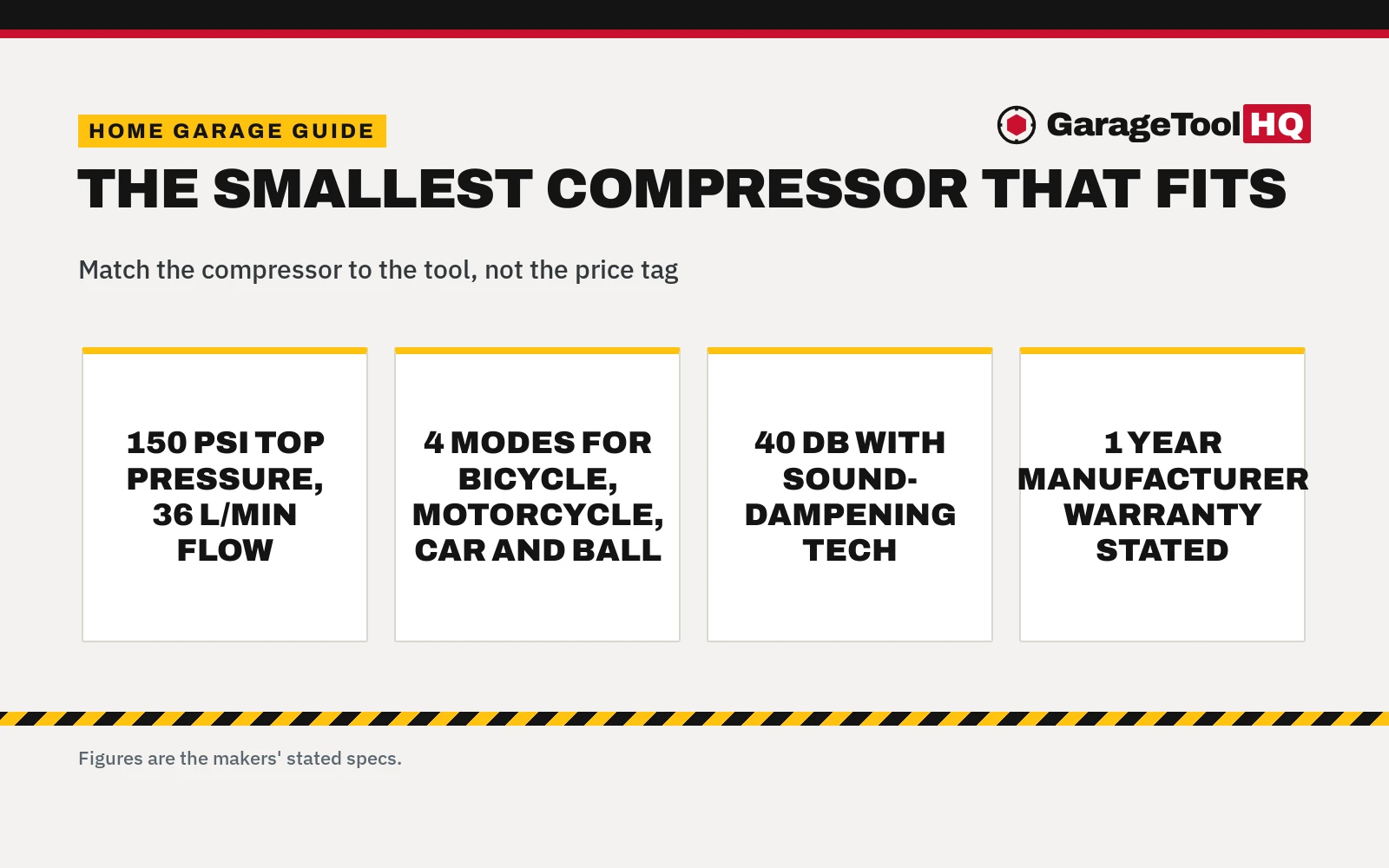
Most air tools state the pressure they need and the flow they need, and the compressor has to meet both at the same time. Pressure is the push, measured in PSI, and flow is the volume of air, measured in CFM or in liters per minute. The Hafuloky tire inflator lists 150 PSI at the top of its range and a flow of 36 L/min, with a manual range of 3 to 150 psi: that is the shape of the figures to look for, a top pressure and a flow rate, on any compressor. Check the tool’s figures against the compressor’s figures at the same pressure, because a flow figure stated at a lower pressure does not mean the same flow at the pressure the tool needs.
Tank or no tank: how long the air lasts
A tank stores air so the compressor can rest between bursts, and a tankless inflator runs whenever the tool needs air. A tire inflator with no tank, like the Hafuloky, fills a tire until the pressure hits the preset value, then stops. A tank compressor fills the tank, then the tool draws from the tank while the motor rests. The longer the job runs without a pause, the more the tank matters: a blow gun in short bursts needs less stored air than a spray gun that runs without stopping.
Noise, power and portability
Noise matters in a home garage, and the listing states it in decibels. The Hafuloky inflator lists 40 dB, with sound-dampening tech and a noise-suppressing framework. Power matters too: a battery inflator goes where the car is, while a mains compressor needs an outlet and a hose long enough to reach the job. Portability is the trade: a small battery inflator fits in a glove compartment or a saddlebag, and a tank compressor is heavier to move, so it usually stays in the garage.
The checks before you buy
- Match the tool. Write down the pressure and flow the hungriest tool needs, and buy a compressor that lists both figures at or above those needs.
- Check the range. A preset that stops the air at the target pressure saves the tire from overfilling: the Hafuloky stops automatically once the pressure hits the preset value, and its manual range runs from 3 to 150 psi.
- Read the noise figure. Compare decibel figures between listings, and remember that a lower figure means a quieter machine.
- Check the power. A battery machine needs charging, and a mains machine needs an outlet near the job.
- Check the warranty. The Hafuloky listing states a 1 Year Manufacturer warranty: read what the warranty covers before you buy.
- Check the extras. Valve adapters, a deflation function and LED lights help on the road, but they do not replace air delivery: the Hafuloky includes valve adapters for diverse tire styles, a deflation function and LED lights.
A high PSI figure does not mean the compressor can run a tool for long: flow is the figure that decides whether the tool keeps getting enough air, and a compressor with a high top pressure and a low flow will stall the tool mid-job. Match pressure and flow together, and check the duty cycle the maker states.
Drain the tank after use so water does not rust it from the inside, never exceed the tool's rated pressure, wear eye protection, and run 240V units on the circuit the manual calls for. Do not run a gas engine compressor in a closed garage. Read our Safety Disclaimer.
Low cost air compressor vs a bigger machine
If you are still choosing, compare these before buying:
- Tire inflator: small, battery powered and portable, for tires and balls. The Hafuloky lists 150 PSI and 36 L/min, with 4 preconfigured modes for bicycle, motorcycle, car and ball.
- Tank compressor: stores air for longer jobs and air tools, and usually stays in the garage.
- Running cost: a battery machine needs charging, and a tank machine needs power from an outlet. Compare the power the machine draws with the outlet you have.
See our air compressor vs tire inflator comparison and the air compressor types guide before you choose.
What a low cost compressor cannot do
A small inflator cannot run an air tool that needs a steady flow for a long job, and it cannot fill a large tank or run a spray gun. If the tool list grows past tires and balls, the compressor has to grow with it. Borrow or rent the bigger machine for the job, and buy the small inflator for the tires.
FAQ: garage tools
What PSI does a home garage compressor need?
It depends on the tool. The Hafuloky tire inflator lists a manual range of 3 to 150 psi, and its top figure is 150 PSI. Check the pressure the tool needs, and buy a compressor that lists that pressure or more.
What is the difference between PSI and CFM?
PSI is the pressure the air pushes with, and CFM, or liters per minute, is the volume of air the compressor moves. The Hafuloky lists 150 PSI and 36 L/min. A tool needs both figures met at the same time.
Do I need a tank for a home garage compressor?
Not for tires. A tankless inflator fills a tire until the pressure hits the preset value, then stops. A tank helps when the tool runs without a pause, because the tool draws from the tank while the motor rests.
How loud is a low cost air compressor?
Check the decibel figure on the listing. The Hafuloky inflator lists 40 dB, with sound-dampening tech. A lower figure means a quieter machine.
Can a tire inflator run air tools?
A tire inflator is made for tires and balls: the Hafuloky lists 4 preconfigured modes for bicycle, motorcycle, car and ball. Air tools need a steady flow for a long job, and the Hafuloky lists a flow of 36 L/min. Match the compressor to the tool.
What should I check before buying a low cost compressor?
The pressure and flow the tool needs, the noise figure, the power source and the warranty. The Hafuloky listing states a 1 Year Manufacturer warranty. Read the listing for each figure before you buy.
Related: the air compressor maintenance guide and our air compressors hub.