Types of Grease Gun: Workshop Guide for Home Garages
A garage guide to the main types of grease gun, how manual, cordless, pneumatic and mini models compare, and how to choose the right tool for your jobs.

On this page
Top picks at a glance
As an Amazon Associate we earn from qualifying purchases.
- 1
 Milwaukee 2646-20 M18 2-speed Grease Gun9.6/10View on Amazon
- 2
 DEWALT Grease Gun Kit 20V MAX with 4.0Ah Battery and Charger9.6/10View on Amazon
- 3
 DEWALT Grease Gun 20V MAX9.5/10View on Amazon
- 4
 LockNLube Locking Grease Gun CouplerView on Amazon
- 5
 Workforce Mini Grease GunView on Amazon
- 6
 Lincoln 1142 Lever Action Grease GunView on Amazon
- 7
 LockNLube 2-in-1 Pneumatic Grease Gun with Single Shot &View on Amazon
- 8
 Powerbuilt Mini Pistol Grip Grease Gun with 6 Inch ExtensionView on Amazon
- 9
 MILTON s-3102 Mini Pistol Grease GunView on Amazon
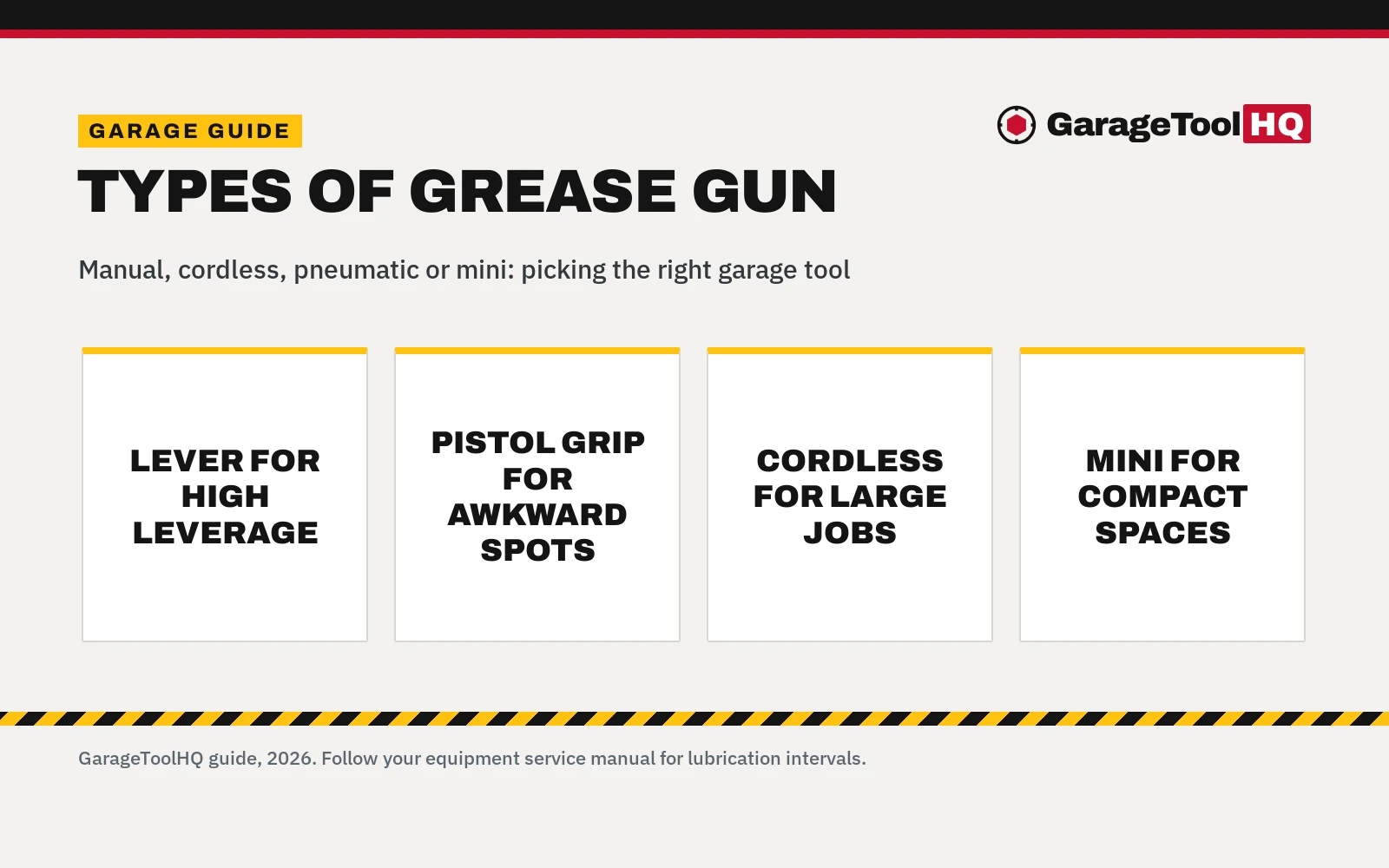
Crawling under a truck for a chassis lube or greasing steering tie-rod ends quickly reveals why picking the right tool matters. What are the main types of grease gun and how do they differ? The primary types of grease gun are manual lever guns, pistol-grip grease guns, cordless electric grease guns, pneumatic air grease guns, and mini grease guns. Manual lever tools provide high mechanical leverage for stubborn zerks, pistol-grip models allow one-handed pumping in cramped wheel wells, cordless battery units handle high-volume greasing without arm fatigue, pneumatic models tap into shop air lines, and mini grease guns fit tight clearances.
More options to compare
 LockNLube Locking Grease Gun CouplerCheck price on Amazon
 Workforce Mini Grease GunCheck price on Amazon
 Lincoln 1142 Lever Action Grease GunCheck price on Amazon
 LockNLube 2-in-1 Pneumatic Grease Gun with Single Shot &Check price on Amazon
 Powerbuilt Mini Pistol Grip Grease Gun with 6 Inch ExtensionCheck price on Amazon
 MILTON s-3102 Mini Pistol Grease GunCheck price on Amazon
GarageToolHQ earns a commission when you buy through links on our product pages, at no extra cost to you. Read our affiliate disclosure.
Below: how each mechanism operates, a comparison table, safety practices, manual versus cordless trade-offs, and a buyer checklist.
Types of grease gun: how each mechanism operates
Internal drive mechanisms determine working pressure, delivery speed, and required physical effort. Here is how the primary types of grease gun operate in home garages:
- Manual lever grease guns. A long side lever operates a piston inside the head assembly, delivering high mechanical leverage to free stuck zerk check balls and lubricate suspension joints. Operating a manual lever gun requires both of your hands (gripping the barrel with one hand while pumping the lever), meaning the coupler must grip the fitting securely.
- Pistol-grip grease guns. Pistol-grip tools use a squeeze handle mounted to the head, allowing one-handed pumping while your other hand guides the coupler onto awkward zerks. Because pumping relies on hand-grip strength rather than a long lever arm, mechanical leverage is lower and repetitive squeezing can tire forearm muscles during large jobs.
- Cordless electric grease guns. Battery models use an electric motor powered by rechargeable packs, such as 18V or 20V batteries, to cycle an internal piston pump. Reference listings from brands like CICZ, Ecarke, and Seesii publish ratings up to 12,000 PSI with delivery rates between 5.3 oz/min and 10 oz/min, eliminating manual pumping on multi-axle trailers, farm equipment, and fleet machinery.
- Pneumatic air-powered grease guns. Pneumatic guns connect to a garage air compressor line via quick-connect fittings. Compressed air cycles an internal reciprocating piston, providing steady grease flow without battery charging downtime, though working radius remains tethered to your shop air hose.
- Mini grease guns. Built with scaled-down barrels and compact pistol heads, mini grease guns suit small utility trailers, lawn tractors, and tight equipment spots. While full-sized grease guns use standard 14 oz cartridges, mini tools use compact tubes that fit portable tool boxes and trail kits.
Comparing grease gun designs: output, operation and shop fit
| Grease Gun Type | Pumping Method | Pressure and Output | Best Garage Use |
|---|---|---|---|
| Manual Lever | Manual lever stroke | High mechanical leverage; manual pumping pace | Chassis lubrication and stubborn zerks on a budget |
| Pistol Grip | Single-hand squeeze trigger | Moderate leverage; convenient one-handed pumping | Tight suspension spots, steering linkages and awkward zerks |
| Cordless Battery | Electric motor with trigger | Motor-driven high pressure; continuous flow | High-volume greasing, multi-axle trailers and eliminating fatigue |
| Pneumatic Air | Compressed shop air line | Continuous air-driven flow; steady line pressure | Dedicated service bays with accessible air lines |
| Mini Grease Gun | Compact squeeze grip | Light-duty delivery; compact cartridge capacity | Lawn equipment, small utility trailers and compact storage |
Selecting a grease gun depends on lubrication frequency and fitting access. For occasional chassis points during an oil change, an inexpensive manual gun suffices. For trailers, tractors, or commercial trucks with dozens of zerks, a cordless tool saves substantial time and effort.
How to use a grease gun safely: the garage checklist
- Wipe every zerk fitting clean before greasing. Road grime collects on grease nipples. Wiping each fitting with a clean shop rag prevents abrasive dirt from being forced into precision bearings or ball joints.
- Inspect the flexible hose and coupler. Heavy-duty cordless listings publish pressure ratings up to 12,000 PSI. Check flexible lines for surface cracks, kinks, or outer wear before connecting, and replace damaged hoses immediately.
- Align the coupler straight onto the nipple. Push the coupler squarely onto the zerk until internal jaws lock in place. Pumping at an angle forces grease out around the fitting rather than past the check ball.
- Watch the rubber dust boot during pumping. Pump slowly and watch the boot expand. Stop pumping as soon as the boot swells slightly or clean grease escapes at the relief point, avoiding blown seals.
- Relieve hydraulic line pressure before uncoupling. If a coupler sticks due to back-pressure, do not jerk the hose. Loosen the coupler sleeve or release line pressure before rocking the coupler free.
- Purge air pockets after reloading grease. Trapped air in the barrel causes the pump to lose prime. Open the head air bleeder valve while advancing the follower rod to purge air until solid grease emerges.
- Store the tool cleanly to prevent leaks. Store the grease gun in a dedicated carry case or hang it with the hose secured in a retainer clip to keep lubricant off shop floors.
Grease guns generate extreme fluid pressure, with heavy-duty cordless listings rated up to 12,000 PSI. Never point an active coupler at skin, never check for line leaks with bare fingers, and always relieve hydraulic line pressure before uncoupling from a jammed fitting.
Use rated jack stands on solid ground, wear eye protection with power and air tools, keep fuel-burning equipment out of a closed garage, and follow the manual for every tool. Read our Safety Disclaimer.
Manual vs cordless grease guns
Choosing between manual and cordless grease guns comes down to job volume, physical comfort, and budget:
- Pumping effort and user comfort: Manual lever and pistol-grip tools rely entirely on arm and hand force. Pumping stiff grease in cold weather tires forearm muscles. Cordless grease guns eliminate manual pumping, delivering steady lubrication at the pull of a trigger.
- Working pressure and resistance: Both manual lever guns and cordless models generate high pressure to overcome resistance in tight fittings. Cordless listings from brands like Seesii, Ecarke, and Funnywhale publish maximum ratings up to 12,000 PSI, pushing grease consistently through long lines and heavy joints without arm strain.
- Dispensing speed and grease flow: Manual guns dispense small amounts per stroke. Cordless models deliver rapid flow: reference listings specify 5.3 oz/min on CICZ and Enkreefi models, 8 oz/min on Ecarke and Funnywhale units, and 10 oz/min on Seesii tools.
- Power source and tool platforms: Manual tools work anytime without charging. Bare-tool cordless grease guns pair with existing batteries, including Milwaukee 18V packs on the Ecarke, DeWalt 20V batteries on the CICZ and Funnywhale, and Makita 18V-20V Max batteries on the Seesii.
- Tool weight and portability: Manual grease guns remain lightweight under vehicles. Cordless models carry added motor and battery weight. Stated item weights range from 5 pounds on the Enkreefi to 9.5 pounds on the Funnywhale, 10.12 pounds on the CICZ, and 10.6 pounds on the Ecarke, usually offset with shoulder straps.
For detailed model comparisons, read our guide to the best cordless grease gun picks, our review of the best electric grease gun options, or our round-up of the best small grease gun picks for compact equipment.
Couplers, hoses and grease loading options
Couplers, hose reach, and loading methods determine how clean and efficient lubrication jobs stay in the garage:
- Couplers and right-angle adapters: Standard jaw couplers slide onto open fittings, while lock-on couplers clamp securely to prevent leaks. For zerks hidden behind brake dust shields or steering linkages, listings from CICZ, Ecarke, Seesii, and Funnywhale include a 90° coupler adapter to enter tight spaces.
- Flexible hose reach: Rigid pipes limit access, while flexible hoses route around suspension arms. Reference listings provide flexible hose lengths from 16.4″ on the Funnywhale to 39″ or 39.4″ on the CICZ, Ecarke, and Enkreefi, and up to 48″ on the Seesii.
- Cartridge loading versus bulk grease: Most mechanics load standard 14 oz cartridges directly into the barrel for clean changes. Reference listings including Ecarke, Enkreefi, and Funnywhale feature dual-loading barrels supporting 14 oz cartridges or bulk grease from drums across NLGI #0, #1, and #2 grades.
Frequently Asked Questions
What are the primary types of grease gun?
The primary types are manual lever guns, pistol-grip guns, cordless electric guns, pneumatic air guns, and mini grease guns. Each uses a distinct mechanism suited to specific garage jobs, leverage requirements, access constraints, and equipment volume.
Which grease gun type is best for a home garage?
For basic passenger car maintenance, a manual pistol-grip or lever gun fits most home budgets. Pistol grips offer convenient one-handed pumping, while lever guns provide maximum mechanical leverage. For multi-vehicle fleets, trailers, or farm tractors, cordless grease guns eliminate arm fatigue.
What size grease cartridges do grease guns use?
Standard full-sized grease guns typically use 14 oz cartridges. Mini grease guns use smaller, compact grease tubes tailored to their narrow, scaled-down barrels.
How much pressure can a cordless grease gun produce?
Reference listings from brands including CICZ, Ecarke, Seesii, Enkreefi, and Funnywhale specify maximum working pressures up to 12,000 PSI, with flow rates ranging from 5.3 oz/min to 10 oz/min.
Can a grease gun clear a clogged zerk fitting?
High pressure often frees stuck check balls. However, if hardened grease or grit completely blocks the passage, unscrew the zerk fitting to clean or replace it rather than risking blown joint seals.
What does NLGI #2 mean on a grease cartridge?
NLGI #2 is the standard consistency rating for automotive chassis and bearing grease, defined by the National Lubricating Grease Institute. It pumps reliably through grease guns while adhering securely to moving suspension joints.
Related: our guide to the best cordless grease gun picks, our comparison of the best electric grease gun models, compact tools in the best small grease gun guide, and workshop equipment in our cordless tools hub. For shop lifting and underbody access, explore floor jack types and our guide to best jack stands.