High Torque vs Compact Impact Wrench: Which One Should You Buy?
High torque vs compact impact wrench: breakaway numbers against access and weight, with working torque, drive size and battery platform from the listings.

On this page
Top picks at a glance
As an Amazon Associate we earn from qualifying purchases.
- 1
 ARCCAPTAIN Cordless Impact Wrench9.7/10View on Amazon
- 2
 FLEX 24V Brushless Cordless 1/2-Inch 450 Ft-Lbs Torque9.5/10View on Amazon
- 3
 Seesii 3/8" Cordless Impact Wrench9.3/10View on Amazon
- 4
 Milwaukee 2767-20 M18 Fuel High Torque 1/2" Impact WrenchView on Amazon
- 5
 Milwaukee 2864-20 Fuel One-Key 3/4" High Torque ImpactView on Amazon
- 6
 Milwaukee ElectricView on Amazon
- 7
 Milwaukee 2962-20 M18 18V Fuel 1/2" Mid-torque Impact WrenchView on Amazon
- 8
 MILWAUKEE'S Mid-Torque Impact WrenchView on Amazon
- 9
 Hairich torque wrench 1/2View on Amazon
You are under the truck with a rusted axle nut that has not moved in a decade, and the high torque vs compact impact wrench question decides whether you win that fight. A high torque wrench brings the big breakaway numbers to crack rusted hardware loose; a compact wrench fits where the big gun cannot go and handles everyday fasteners with less weight. Buy the high torque gun for rust and heavy hardware, and the compact gun for daily driving work in tight bays. Most home garages end up wanting both, but buy the one that matches your worst job first.
More options to compare
 Milwaukee 2767-20 M18 Fuel High Torque 1/2" Impact WrenchCheck price on Amazon
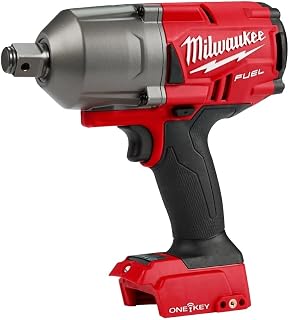 Milwaukee 2864-20 Fuel One-Key 3/4" High Torque ImpactCheck price on Amazon
 Milwaukee ElectricCheck price on Amazon
 Milwaukee 2962-20 M18 18V Fuel 1/2" Mid-torque Impact WrenchCheck price on Amazon
 MILWAUKEE'S Mid-Torque Impact WrenchCheck price on Amazon
 Hairich torque wrench 1/2Check price on Amazon
GarageToolHQ earns a commission when you buy through links on our product pages, at no extra cost to you. Read our affiliate disclosure.
High Torque vs Compact Impact Wrench: What Actually Differs
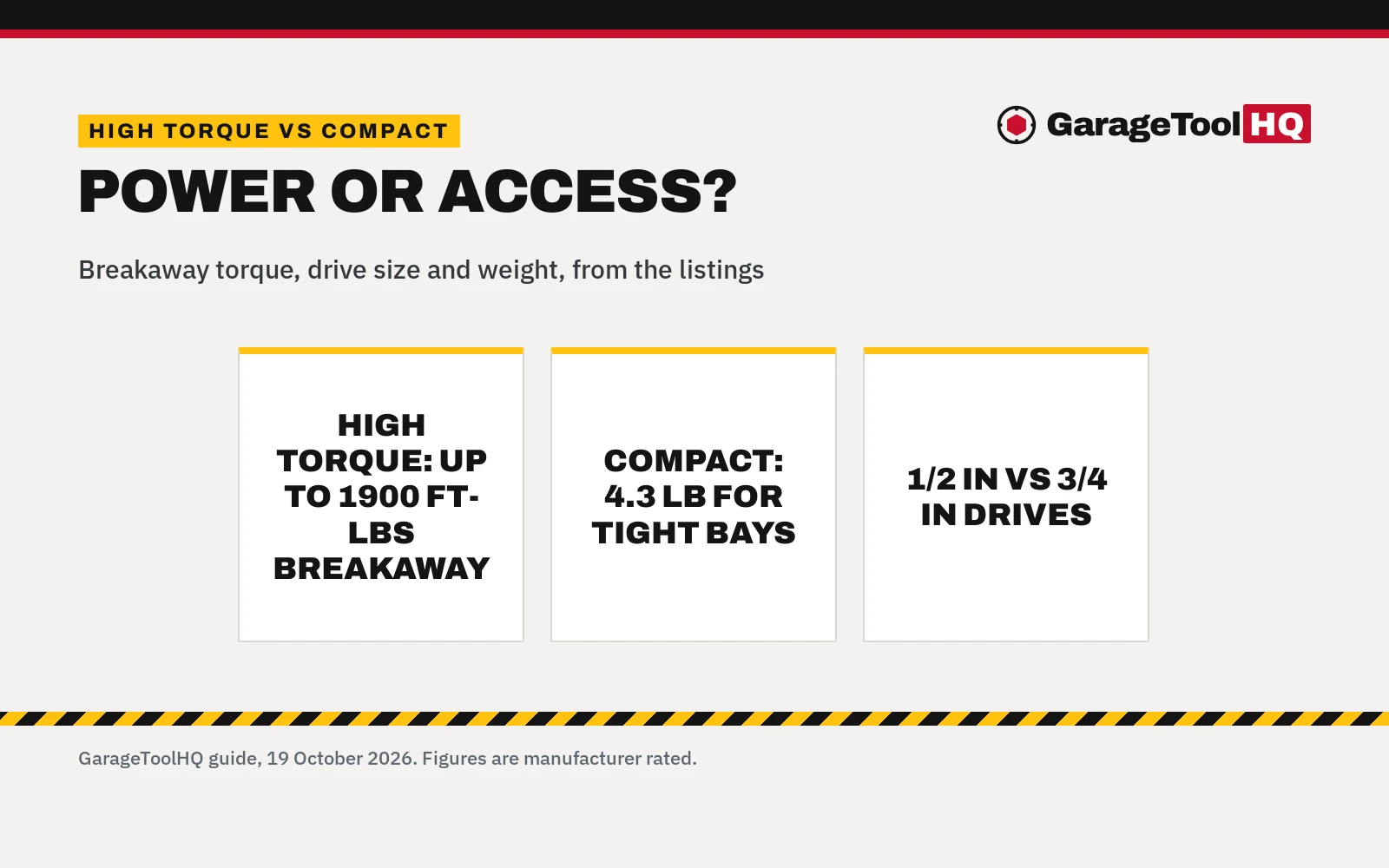
Torque is the headline difference, and the listings show the spread. On the high torque side, the Milwaukee 2767-20 lists 1000 ft-lbs of fastening torque and 1400 ft-lbs of nut-busting torque, and the DEWALT DCF964B 3/4 in lists 1420 ft-lbs of max fastening torque and 1900 ft-lbs of max breakaway torque. On the compact side, the DEWALT DCF891B lists 600 ft-lbs of max fastening torque and 800 ft-lbs of max breakaway torque in a compact, light design. The Muylux 1/2 in lists 320 ft-lbs (430 N.m), and the Seesii WH760 lists 738 ft-lbs (1000 N.m) of max breakaway torque with a 2400 rpm top speed.
Size and weight follow the torque. The compact DCF891B is 8.88 in long and 4.3 lb; the high torque Milwaukee 2767-20 is 9.65 in and 6 lb; the 3/4 in DCF964B is 9 lb. Drive size splits the same way: 1/2 in on the compacts and mid-torque models, 3/4 in on the big DEWALT and the Milwaukee 2864-20. Bigger drive, bigger sockets, bigger jobs.
Working Torque vs Breakaway Torque
Listings quote two torque numbers and they mean different things. Fastening torque, also called working torque, is what the wrench can drive a fastener to; breakaway or nut-busting torque is the peak it can hit to crack a stuck fastener loose. Breakaway is always the bigger number: 1000 fastening against 1400 nut-busting on the Milwaukee 2767-20, 600 against 800 on the DEWALT DCF891B, 1420 against 1900 on the DCF964B. Judge a wrench for rusted hardware by its breakaway figure and for assembly work by its fastening figure. The Milwaukee 2864-20 listing is thin here: its bullets state no torque at all, with 1500 ft-lb appearing only in the spec table, so treat that figure with care.
When High Torque Wins
High torque wins on rust, size and stubbornness. Axle nuts, crank bolts, suspension hardware and anything torqued by a decade of road salt want breakaway numbers in four figures, which is where the 1400 ft-lbs Milwaukee and the 1900 ft-lbs DEWALT live. The 3/4 in drive models, the DCF964B and the Milwaukee 2864-20, suit trucks and equipment where 1/2 in sockets run out of strength. If your worst job is a rusted fastener you cannot reach with a breaker bar, the big gun earns its weight. See best heavy duty impact wrench cordless for the class.
When Compact Wins
Compact wins on access, weight and control. Engine bays, wheel wells and under-dash work often have no room to swing a 9 lb gun, and the DCF891B at 4.3 lb with its LED work light is built for exactly that. Four speed settings plus a variable speed trigger, which the DCF891B lists, and precision wrench modes, which both DEWALTs list, keep small fasteners from snapping. For lug nuts, brake jobs and general assembly, 600 ft-lbs of fastening torque covers the work with far less fatigue. See 1/2 vs 3/4 impact wrench for the drive size call.
What the Listings Show
The 1/2 in listings cluster around cars and trucks: the Milwaukee 2767-20 (M18, 1000 and 1400 ft-lbs, 6 lb), the DEWALT DCF891B (20V MAX, 600 and 800 ft-lbs, 4.3 lb, LED light, belt clip), the Seesii WH760 (21V, 738 ft-lbs breakaway, three speeds, two 4.0Ah batteries and a fast charger in the box) and the Muylux (20V, 320 ft-lbs, 4.0Ah battery, 5 lb). The 3/4 in listings step up to heavy work: the DEWALT DCF964B (20V MAX XR, 1420 and 1900 ft-lbs, 9 lb, three speeds plus precision mode) and the Milwaukee 2864-20 (M18, 6.9 lb, bare tool). The RYOBI listing is an 18V brushless 4-mode 1/2 in tool at 5.1 lb, though its bullets talk about replacement parts rather than the wrench, so its torque goes unstated.
Battery platform matters as much as torque. The Seesii and Muylux include batteries; the Milwaukee 2864-20 and the RYOBI are bare tools. The listings run 18V, 20V MAX and 21V across brands, and batteries do not cross brands, so add the batteries and charger to any bare tool before you compare. See corded vs cordless impact wrench if you are still on the fence about batteries at all.
Frequently Asked Questions
What is the difference between fastening torque and breakaway torque?
Fastening torque is the working torque the wrench drives with; breakaway or nut-busting torque is the peak it hits to crack a stuck fastener. A listing like the Milwaukee 2767-20 gives both: 1000 ft-lbs fastening, 1400 ft-lbs nut-busting. Shop for rust by the breakaway number and for assembly by the fastening number.
Is 1/2 in or 3/4 in better for lug nuts?
1/2 in covers cars and light trucks; the 1/2 in listings here run 320 to 1000 ft-lbs of fastening torque, which handles lug nuts. 3/4 in is for heavy trucks and equipment, where the DCF964B lists 1420 ft-lbs fastening. Bigger drive also means bigger sockets.
Can a compact impact wrench remove rusted bolts?
Sometimes. The compact DCF891B lists 800 ft-lbs of breakaway torque, which cracks moderately rusted hardware. For the truly frozen stuff, the high torque listings go to 1400 and 1900 ft-lbs of breakaway. Penetrating oil and heat still help either gun.
Should I stay on one battery platform?
Yes, if you can. The listings span Milwaukee M18, DEWALT 20V MAX, RYOBI 18V and others, and none of those batteries fit another brand. The Seesii kit includes two 4.0Ah batteries and a fast charger; the Milwaukee 2864-20 and RYOBI are bare tools, so factor batteries into the real cost.
Will a high torque wrench snap small fasteners?
It can if you lean on the trigger. That is what the speed settings are for: the DCF891B lists four speeds and precision wrench control, and the DCF964B lists three speeds plus a precision mode, all meant to stop fastener run-off and overtightening. Start low, and finish critical fasteners with a torque wrench. See torque wrench size comparison.
Related: 1/2 vs 3/4 impact wrench, corded vs cordless impact wrench, best heavy duty impact wrench cordless and best lug nut socket set.