Best Air Body Saw for Auto Repair (2026): 5 Compared
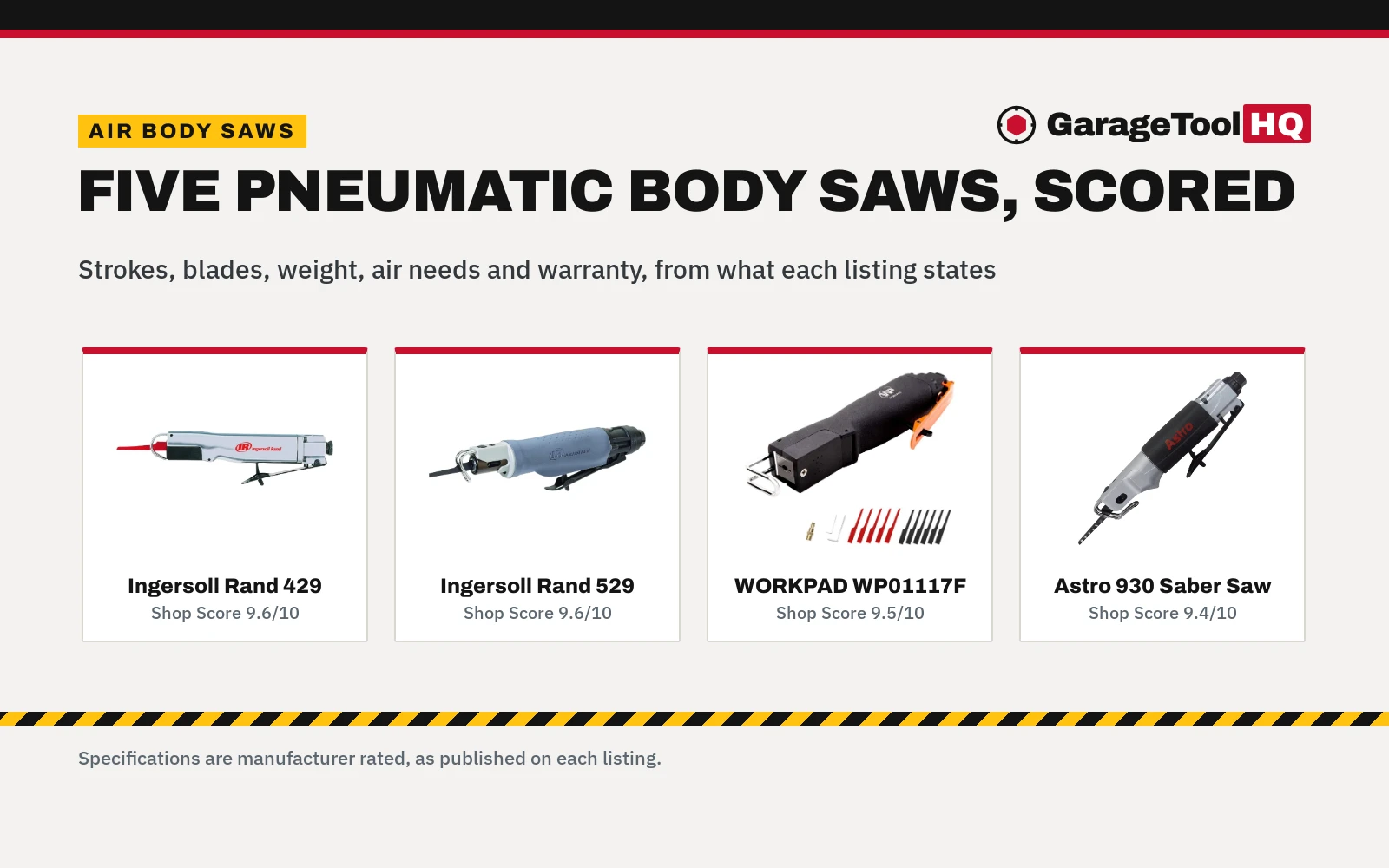
Five air body saws for auto repair compared on strokes per minute, blades, weight, air needs and warranty, from what each listing states.

On this page
Top picks at a glance
As an Amazon Associate we earn from qualifying purchases.
- 1
 Best OverallIngersoll Rand 4299.6/10View on Amazon
- 2
 Runner-UpIngersoll Rand 5299.6/10View on Amazon
- 3
 Most BladesWORKPAD WP01117F9.5/10View on Amazon
- 4
 CompactAstro 930 Saber Saw9.4/10View on Amazon
- 5
 Chicago Pneumatic CP7901View on Amazon
- 6
 AIRCAT 6350 Low Vibration Reciprocating Air SawView on Amazon
The rusted exhaust flange has to come off and there is no room to swing a full-size saw. That is the job the best air body saw is made for: a pneumatic reciprocating saw that cuts sheet metal, muffler pipe and body panels in tight spaces. This guide compares five on strokes per minute, blades, weight, air needs and warranty, from what each listing states.
GarageToolHQ earns a commission when you buy through links on this page, at no extra cost to you. Read our affiliate disclosure.
Quick picks
- Best Overall Ingersoll Rand 429: 10,000 SPM, 6 blades, lock-out lever and 8 CFM at 90 psi stated. Check price on Amazon
- Runner-Up Ingersoll Rand 529: 9,500 SPM with 6 blades, lock-out lever and 360-degree swivel inlet. Check price on Amazon
- Most Blades WORKPAD WP01117F: 10 blades included with a safety trigger and TPR grip. Check price on Amazon
- Compact Astro 930 Saber Saw: 12.32 oz bare tool for body shop and exhaust work. Check price on Amazon
The picks


Ingersoll Rand 429 3/8" Reciprocating Air Saw
A 10,000 SPM pneumatic body saw with 6 blades, lock-out lever and 8 CFM at 90 psi air needs.
Pros
- 10,000 strokes per minute, highest stated here
- 6 high-speed steel blades and 2 hex wrenches included
- Lock-out lever with spring-loaded latch
- Adjustable blade guide and positive blade retainer
Cons
- Warranty fields contradict: Limited Lifetime vs 1 year
- Spec table wrongly lists a lithium ion battery as required
- Air compressor not included
- 1.33 lb is light but inline only

Ingersoll Rand 529 3/8" Reciprocating Air Saw
A 9,500 SPM pneumatic body saw with 6 blades, lock-out lever and 360-degree swivel inlet.
Pros
- 9,500 strokes per minute stated
- 6 blades included with blade guide
- Lock-out lever with spring-loaded latch
- 360-degree swivel inlet for patterns
Cons
- Spec table lists 12 volts, wrong for a pneumatic tool
- Warranty text mentions battery and charger replacement
- 1.5 lb, heavier than the 429
- No air consumption figure stated
WORKPAD Air Reciprocating Saw Equipped
A 9,000 SPM pneumatic body saw with 10 blades, safety trigger and TPR grip.
Pros
- 10 blades: 5 each of 24T and 32T
- Safety trigger prevents accidental starts
- TPR grip reduces vibration
- 9,000 strokes per minute stated
Cons
- No warranty term is stated
- 1.8 lb, heaviest here
- Bare tool, no wrenches listed
- Spec table mislabels it as an air cut off tool

Astro Pneumatic Tool 930 Air Body Saber Saw
A 12.32 oz pneumatic saber saw with 5 blades for body shop and exhaust work.
Pros
- 12.32 oz, lowest weight here
- Adjustable blade guide increases blade life
- Cuts intricate shapes and tight radius curves
- 4 CFM air consumption stated
Cons
- No strokes-per-minute figure stated
- Only 5 blades, fewest here
- Warranty is limited with no term stated
- Bare tool, no accessories

Air Reciprocating Saw Pneumatic body saws tool
A 9,000 SPM pneumatic body saw with 6 blades and aluminum alloy body.
Pros
- 9,000 strokes per minute stated
- Aluminum alloy body
- Less than 96 dB stated
- 2 air nipples and 2 hex wrenches included
Cons
- Bullets say 6 blades, included components say 5
- Spec table lists 88 teeth and aluminum blades, both wrong
- No warranty term is stated
- 1.5mm sheet metal capacity is the only capacity figure
More options to compare
 Chicago Pneumatic CP7901Check price on Amazon
 AIRCAT 6350 Low Vibration Reciprocating Air SawCheck price on Amazon
Compare the picks
| Model | Shop Score | Strokes/min | Blades | Weight | Air | Warranty |
|---|---|---|---|---|---|---|
| Ingersoll Rand 429 | 9.6/10 | 10,000 | 6 | 1.33 lb | 8 CFM at 90 psi | 1 year* |
| Ingersoll Rand 529 | 9.6/10 | 9,500 | 6 | 1.5 lb | Not stated | 1 year |
| WORKPAD WP01117F | 9.5/10 | 9,000 | 10 | 1.8 lb | Not stated | None stated |
| Astro 930 Saber Saw | 9.4/10 | Not stated | 5 | 12.32 oz | 4 CFM | None stated |
| SDRTOP Air Saw | 9.4/10 | 9,000 | 6 | 1.5 lb | Not stated | None stated |
Specifications are manufacturer rated, as published on each listing and collected 19 October 2026.
How we scored them
Each saw is scored out of 10 on performance, build, value, safety and warranty, with the weights published on our How We Pick page. Three listings state safety hardware, a lock-out lever or safety trigger, and two state a 1-year warranty term; the rest state neither, so the ranking leans on strokes, blades and build.
| Product | Shop Score | Perf. /35 | Build /25 | Value /25 | Safety /10 | Warranty /5 |
|---|---|---|---|---|---|---|
| Ingersoll Rand 429 | 9.6 | 32 | 22 | 21 | 4 | 2 |
| Ingersoll Rand 529 | 9.6 | 30 | 22 | 20 | 4 | 2 |
| WORKPAD WP01117F | 9.5 | 27 | 20 | 20 | 4 | 0 |
| Astro 930 Saber Saw | 9.4 | 27 | 20 | 20 | 0 | 0 |
| SDRTOP Air Saw | 9.4 | 26 | 19 | 20 | 0 | 0 |
Scores run from 9.2 to 9.8: each product’s point total is placed on that range, so more points always means a higher score.
What the listings tell you
We read 5 air body saw listings. Four state strokes per minute, from 9,000 to 10,000; the Astro states none. Blade counts run 5 to 10 where stated, all high-speed steel. Weights run 12.32 ounces to 1.8 pounds. Two listings state air figures: 8 CFM at 90 psi for the Ingersoll Rand 429 and 4 CFM for the Astro 930. Two state a 1-year warranty term; none states a safety certification. Three spec tables carry obvious data errors, noted in the reviews.
Buying guide: best air body saw for the home garage
Strokes and blades
Stated speed runs 9,000 to 10,000 strokes per minute where stated at all. Blade counts run 5 to 10, in 24 TPI or 24T and 32T mixes. For muffler and exhaust work, the tooth count matters more than raw speed: finer teeth for thin sheet, coarser for thicker cuts. See what CFM air tools need before you size the compressor.
Blades
Blade counts run 5 to 10, all high-speed steel where stated. Tooth mixes are 24 TPI on the Astro, 24T and 32T on the SDRTOP and WORKPAD, and 24 teeth on both Ingersoll Rands. Finer teeth suit thin sheet metal and exhaust pipe; the WORKPAD 10-blade box gives the most spares. Check the blade length against the cut: the 429 lists 8-inch blades, the SDRTOP 3.6-inch.
Air needs
Only two listings state air figures: the Ingersoll Rand 429 needs a minimum of 8 CFM at 90 psi, the Astro 930 states 4 CFM consumption. The other three state nothing, so check your compressor against the 8 CFM figure as the high end. Air tools drink air; an undersized compressor means a saw that stalls mid-cut.
Weight and handling
Weights run 12.32 ounces to 1.8 pounds. The Astro is the featherweight for overhead exhaust work; the WORKPAD is the heavyweight. Inline configurations like the 429 fit tight spaces; check the length, 9.5 to 12 inches here, against the spot you need to reach.
Safety hardware
Three listings state it: lock-out levers with spring-loaded latches on both Ingersoll Rands, a safety trigger on the WORKPAD. A lock-out keeps the throttle from tripping in the toolbox. Oil the tool per the maker: see how to oil air tools.
Wear eye protection with every air tool, use impact-rated sockets on impact wrenches, disconnect the air line before changing accessories, and finish lug nuts with a torque wrench to the vehicle's spec. See OSHA eye and face protection. Read our Safety Disclaimer.
Garage Fit Check
- All five are pneumatic; none includes a compressor. The 429 needs 8 CFM at 90 psi minimum.
- Blade changes need the included hex wrenches on the 429 and SDRTOP; the others do not state the method.
- Lengths run 9.5 to 12 inches; measure the work area before you buy.
- Ear protection is wise: the SDRTOP states under 96 dB, the others state no noise figure.
- Check the warranty on arrival: the 429 listing contradicts itself between Limited Lifetime and 1 year.
What to check before you buy
Compressor math
Only two listings state air figures, and they bracket the decision. The Ingersoll Rand 429 needs a minimum of 8 CFM at 90 psi; the Astro 930 states 4 CFM consumption. If your compressor cannot hold 8 CFM at 90 psi, cross the 429 off your list no matter how good it looks. The other three state no air figure, so treat the 8 CFM figure as the high-water mark: size the compressor to it, not to wishful thinking. A small tank that cannot keep up means a saw that stalls mid-cut, and stalling in a rusted flange is how blades snap.
Blade economics
Blade counts run 5 to 10, and the tooth mixes differ. The WORKPAD ships 10 blades, five 24T and five 32T, the most spares in the box; the Astro ships 5 in 24 TPI; the SDRTOP bullets say 6 in 24T and 32T while its components list says 5. Blade length matters too: the 429 lists 8-inch blades, the SDRTOP 3.6-inch, so check the length against the panel or pipe you plan to cut. Three listings state an adjustable blade guide, on the 429, the 529 and the Astro, which spreads wear across the teeth and stretches each blade. For thin exhaust pipe, finer teeth win; for thicker sheet, the coarser set.
Read the listing like a mechanic
Three of these five listings carry spec-table errors, and they are all in the included-components or features rows, not the titles. The 429 spec table lists a lithium ion battery as required, wrong for a pneumatic tool; the 529 lists 12 volts and a battery and charger warranty, also wrong; the WORKPAD is mislabeled as an air cut off tool with a 3-inch disc set listed; the Astro lists brushless under special features; the SDRTOP lists 88 teeth and aluminum blade material, both contradicted by its own title. The titles and bullets are the reliable half of each listing. The same split judgment applies to warranties: the 429 listing says Limited Lifetime in one field and 1 year from date of purchase in another, so take the 1 year as the figure that would actually govern a claim. When a listing contradicts itself, the narrower, more specific statement wins.
What comes in the box
The box contents decide how fast you start working. The 429 ships 6 blades and 2 hex wrenches; the SDRTOP ships 2 air nipples and 2 hex wrenches; the 529 ships 6 blades with its blade guide; the WORKPAD ships its 10-blade stash; the Astro 930 ships as a bare tool with 5 blades and no accessories. None ships a compressor, and none ships oil or fittings beyond the SDRTOP nipples. Plan a supply run for air fittings and blade oil if the box does not include them.
Frequently Asked Questions
What is an air body saw used for?
Cutting sheet metal, muffler and exhaust pipe, and body panels in tight spaces. The listings name auto repair, body shop work, muffler and exhaust jobs.
How much air does a body saw need?
The Ingersoll Rand 429 states a minimum of 8 CFM at 90 psi; the Astro 930 states 4 CFM consumption. The other three listings state no air figure.
Air body saw vs reciprocating saw: what is the difference?
An air body saw is a small pneumatic reciprocating saw built for tight spaces and sheet metal. Full-size reciprocating saws are bigger, often electric, and made for demolition rather than body work.
Can I cut exhaust pipe with a body saw?
Yes, that is core body saw work: the Astro, WORKPAD and SDRTOP listings all name muffler and exhaust jobs. Use a fine-tooth blade on thin pipe and let the saw feed without forcing it.
Do these saws come with blades?
Yes, all five include blades: 6 on the 429, 6 on the 529, 10 on the WORKPAD, 5 on the Astro 930, and 6 per the SDRTOP bullets. All are high-speed steel.
Which air body saw weighs the least?
The Astro 930 at 12.32 ounces, then the Ingersoll Rand 429 at 1.33 pounds. The WORKPAD is heaviest at 1.8 pounds.
Related: straight vs angled die grinder and pneumatic vs cordless die grinder.