Engine Stand vs Engine Hoist: Which One Should You Buy?
Engine stand vs engine hoist explained for engine work, with three rotating engine stands ranked.

On this page
Top picks at a glance
As an Amazon Associate we earn from qualifying purchases.
- 1
 VEVOR Engine Stand9.5/10View on Amazon
- 2
 SPECSTAR 1100 Lbs Engine Support Bar Transverse Hoist Motor9.7/10View on Amazon
- 3
 VEVOR Engine Support Bar 1100 Lbs Capacity Engine Transverse9.7/10View on Amazon
- 4
 VEVOR Engine StandView on Amazon
- 5
 Pro 1000lb Steel Rotating Engine Stand Motor Hoist AutomotiveView on Amazon
- 6
 Heavy Duty Foldable Engine Stand 2000LBS CapacityView on Amazon
- 7
 Geared Rotating Engine Stand [1500 lb. Capacity] AdjustableView on Amazon
- 8
 Big RED AT23401BR Engine StandView on Amazon
Engine stand vs engine hoist is a shop tool question, not a choice: the hoist lifts the engine out of the bay, the stand holds it while you work. You buy the hoist when you need to move an engine; you buy the stand when you need to turn it, strip it and rebuild it. All three picks below are rotating engine stands, ranked by capacity and what each listing states.
More options to compare
 VEVOR Engine StandCheck price on Amazon
 Pro 1000lb Steel Rotating Engine Stand Motor Hoist AutomotiveCheck price on Amazon
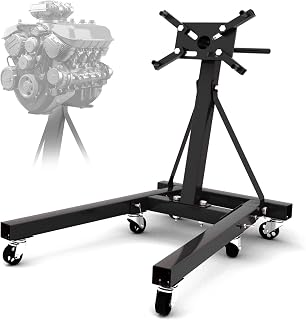 Heavy Duty Foldable Engine Stand 2000LBS CapacityCheck price on Amazon
 Geared Rotating Engine Stand [1500 lb. Capacity] AdjustableCheck price on Amazon
 Big RED AT23401BR Engine StandCheck price on Amazon
GarageToolHQ earns a commission when you buy through links on our product pages, at no extra cost to you. Read our affiliate disclosure.
The difference in one paragraph
An engine hoist is a lifting crane: it picks the engine up, swings it over the bench or the bay, and sets it down. An engine stand is a holding fixture: you bolt the block to its mounting arms and rotate it 360 degrees to reach the bottom, the back and the pan. The hoist does the moving, the stand does the holding, and a real engine job uses both. See our engine hoist safety guide for the lifting half.
When you need a stand
- Rebuilding. Rotating the block to reach the crank, the pan and the rear seal beats crawling under it.
- Detail work. Honing, cam swaps and gasket jobs want the engine at bench height, locked in place.
- Storage between sessions. A stand with lockable casters parks the engine out of the way.
When you need a hoist
- Pulling the engine. Only a hoist gets the block out of the bay and back in.
- Heavy moves. A stand holds an engine, it does not lift one off the pallet.
- Note. None of the three picks here is a hoist; see our how to choose an engine hoist guide for the lifting side.
Engine stand vs engine hoist: three stands, ranked
1. VEVOR 1300 lbs Rotating Stand
The VEVOR 1300 lbs (3/5 Ton) is the highest-capacity stand here: a rotating engine stand with a 360 degree adjustable head, cast iron body, 4 adjustable arms with 1.1 in hex head bolts, a 20 in extended handle and 6 location holes. It rolls on 4 universal 360 degree casters, 2 with brakes, on an upgraded U-shaped base, at 50.7 lb and 36.2 x 27.6 x 36.6 in. No warranty term is stated. Who it suits: a mechanic who works on big blocks and wants the most stated capacity.
2. TUFFIOM 1000 lbs Chevy Stand
The TUFFIOM is a rolling engine cradle customized for Chevrolet engines, stated 1,000-pound capacity in the bullets and a 1,100-pound load capacity in the table; trust the lower figure. It is a high-strength steel structure with wear-resistant powder coating and universal wheels, at 16.4 lb and 24.1 x 19.7 x 18.6 in, with modular assembly. It states a 1 Year Manufacturer warranty. Who it suits: Chevy owners who want a light stand with a stated warranty.
3. VEVOR 750 lbs Rotating Stand
The VEVOR 750 lbs (3/8 Ton) is the smaller sibling of the 1300 lbs stand: a rotating engine stand with a 360 degree adjustable head, cast iron body, 4 adjustable arms, a 20 in extended handle and 6 location holes. It rolls on 2 fixed wheels and 2 universal 360 degree casters, 1 with a brake, on an H-shaped base, at 41.4 lb and 33.3 x 27.6 x 33.3 in. No warranty term is stated. Who it suits: a home shop working on smaller engines who wants the rotating head.
What to check before you buy
Match capacity to the block: 1300 lbs on the big VEVOR, 750 lbs on the small one, and 1,000 lbs stated on the TUFFIOM against 1,100 in its own table. Check rotation and locking: both VEVORs list a 360 degree head with a 20 in handle and 6 location holes. Only the TUFFIOM states a warranty, 1 Year Manufacturer. And remember the split: a stand holds the engine, a hoist lifts it, so budget for both if you are pulling the engine yourself.
Stand safety. Bolt the block to every mounting arm and follow each listing’s own hardware: the VEVORs name 1.1 in hex head bolts on 4 adjustable arms. Keep the weight balanced before you rotate, lock the casters, and never exceed the stated capacity. A top-heavy stand tips; keep children and pets clear.
Choosing between the three stands
Start with capacity and the work you do. The VEVOR 1300 lbs stand is the only one here rated above 1,000 lbs, so it is the pick for big blocks; the 750 lbs VEVOR covers smaller engines; the TUFFIOM sits in the middle at a stated 1,000 lbs in the bullets (1,100 in its table, so plan to the lower figure). All three ratings are manufacturer stated, and none of the listings gives a safety margin, so match the stand to the dressed weight of your engine with room to spare.
Then look at how each one moves and locks. Both VEVORs rotate the block on a 360 degree head with a 20 in handle and 6 location holes, which is what you want for bottom-end work like the crank, pan and rear seal. The TUFFIOM is a rolling cradle, not a rotating stand: no rotation is stated, so it suits holding and moving a Chevy block rather than turning it. On casters, the 1300 lbs VEVOR rolls on 4 universal 360 degree wheels with 2 brakes, the 750 lbs VEVOR mixes 2 fixed wheels with 2 universal wheels and 1 brake, and the TUFFIOM lists universal wheels with no brake count stated. The VEVORs also name their base shapes: an H-shaped base on the 750 and a U-shaped base on the 1300, each stated as an upgrade over the traditional T-shaped base for stability.
Finish and fit matter for the long haul. The VEVORs use electrostatic spraying stated against rust on a cast iron body with alloy steel arms; the TUFFIOM uses a wear-resistant powder coating on high-strength steel and is customized for Chevrolet engines, with modular assembly that needs no professional tools. Footprints are stated too: the 1300 is 36.2 x 27.6 x 36.6 in at 50.7 lb, the 750 is 33.3 x 27.6 x 33.3 in at 41.4 lb, and the TUFFIOM is the most compact at 24.1 x 19.7 x 18.6 in and 16.4 lb. Only the TUFFIOM states a warranty: 1 Year Manufacturer.
Frequently Asked Questions
Do I need both a stand and a hoist?
For a full pull and rebuild, yes: the hoist lifts the engine out, the stand holds it while you work. A stand cannot lift an engine.
Which stand here holds the most?
The VEVOR 1300 lbs stand. Then the TUFFIOM at a stated 1,000 lbs, and the VEVOR 750 lbs stand.
Which of these state a warranty?
Only the TUFFIOM, a 1 Year Manufacturer warranty. The two VEVOR listings state no warranty term.
Do these stands rotate?
The two VEVORs list a 360 degree adjustable head with a 20 in handle and 6 location holes. The TUFFIOM is a rolling cradle with no rotation stated.
Related: the best engine stand roundup, our engine hoist safety guide and our how to choose an engine hoist guide.