Best Automotive Multimeter for Beginners (2026): 5 Picks
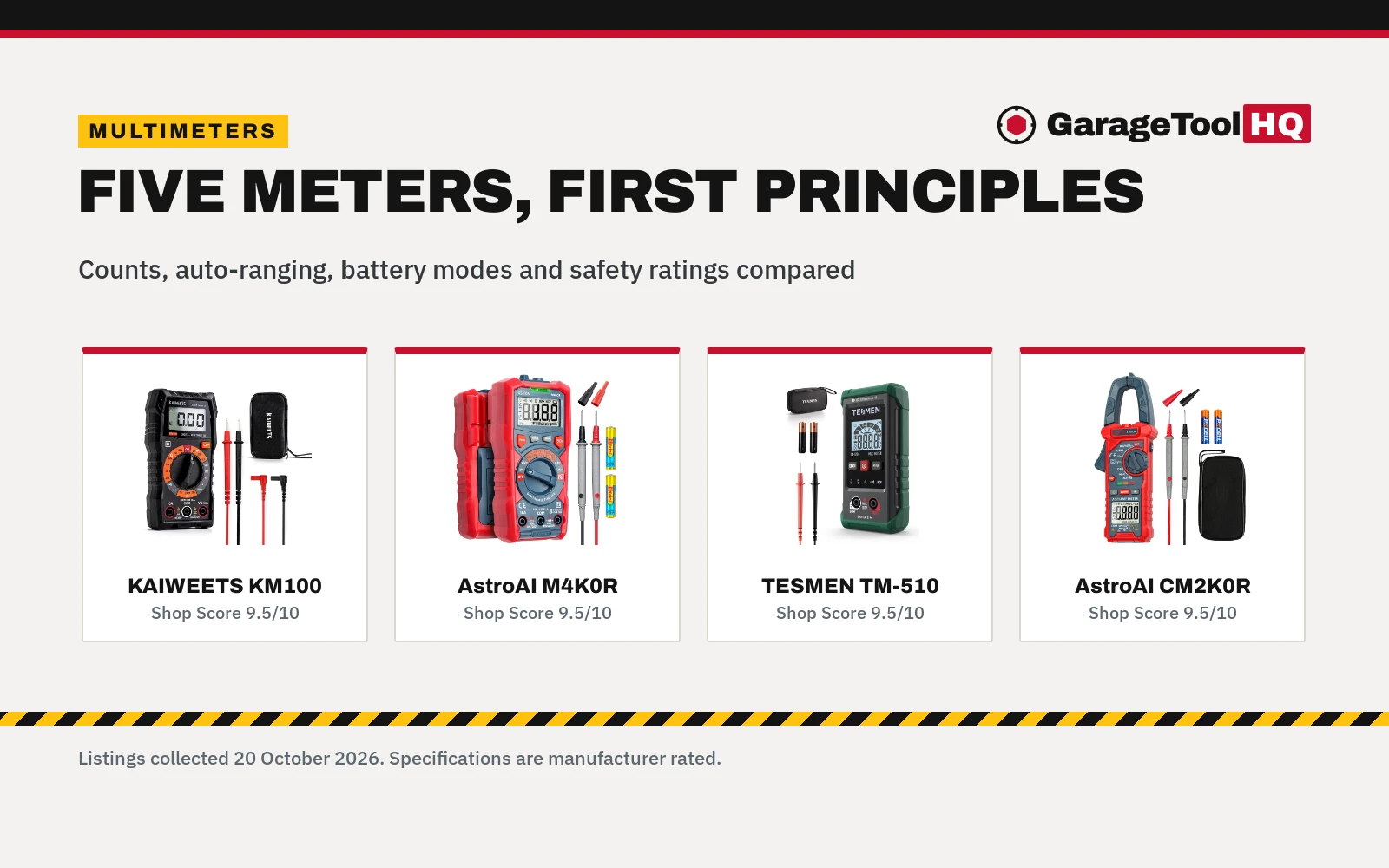
Five beginner-friendly automotive multimeters compared on counts, auto-ranging, battery modes, non-contact voltage detection and stated safety ratings.

On this page
Top picks at a glance
As an Amazon Associate we earn from qualifying purchases.
- 1
 Top pickAstroAI M4K0R9.5/10View on Amazon
- 2
 Easiest pickTESMEN TM-5109.5/10View on Amazon
- 3
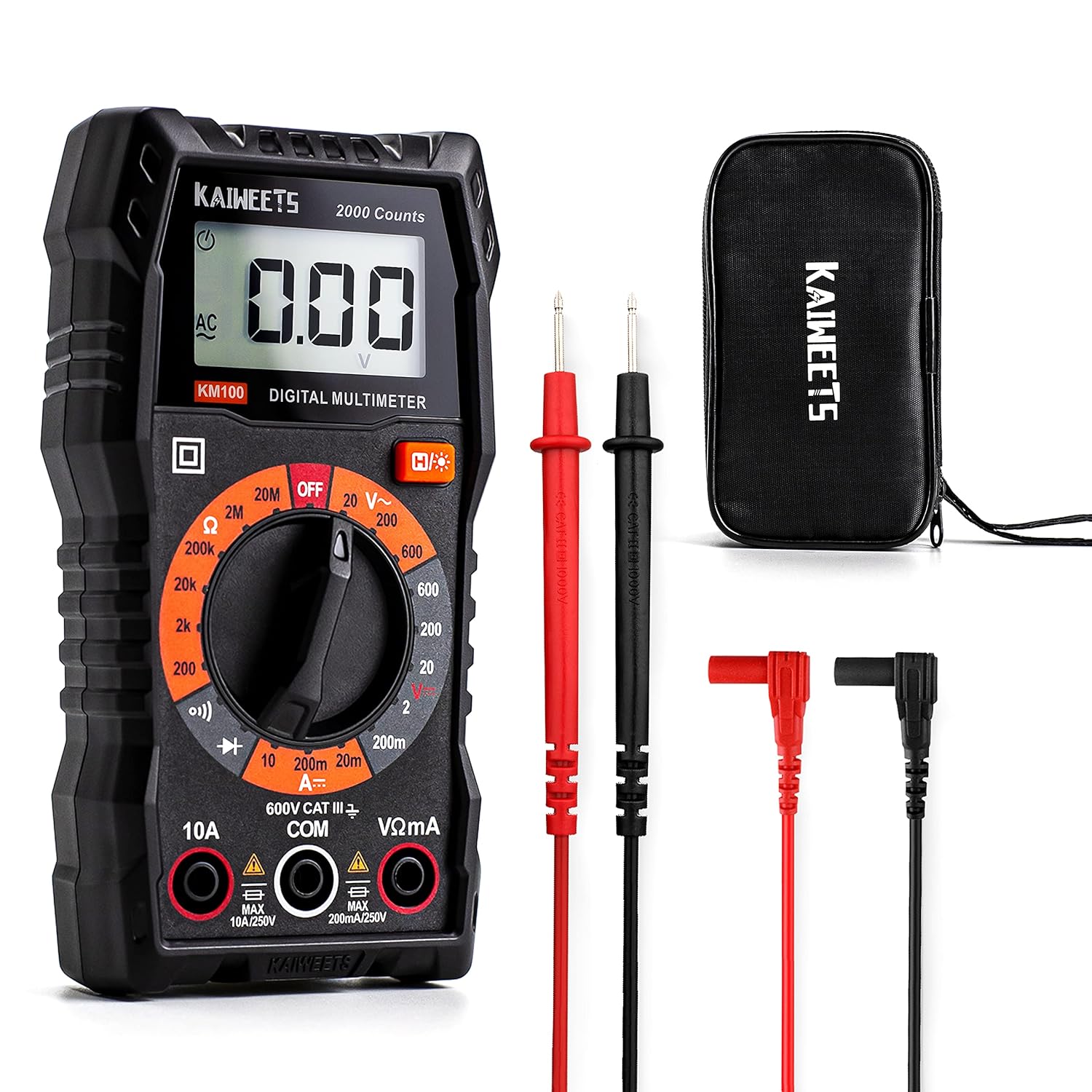 Value pickKAIWEETS KM1009.5/10View on Amazon
- 4
 Clamp pickAstroAI CM2K0R9.5/10View on Amazon
- 5
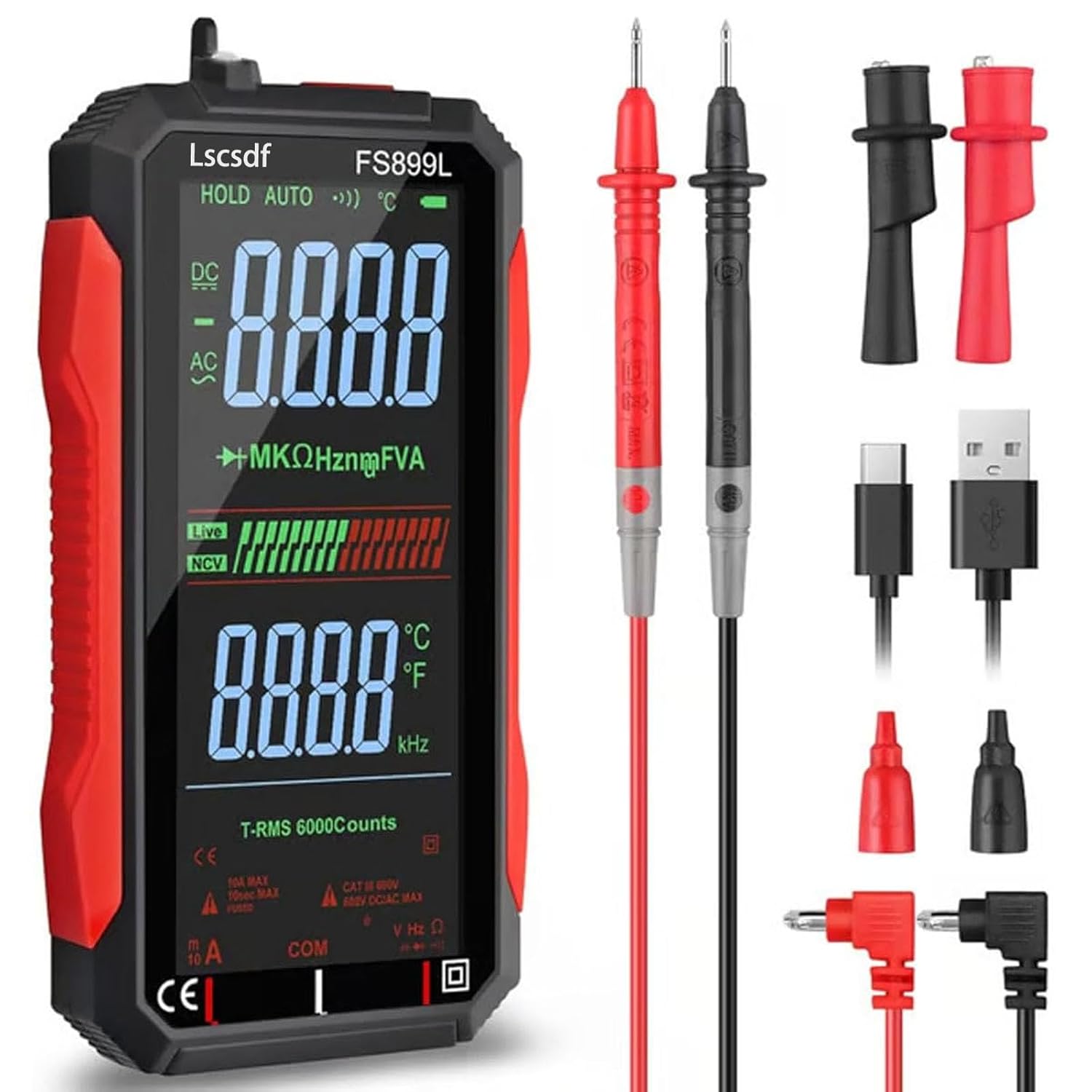 USB Rechargeable Digital Multimeter 6000 Counts Large ColorView on Amazon
- 6
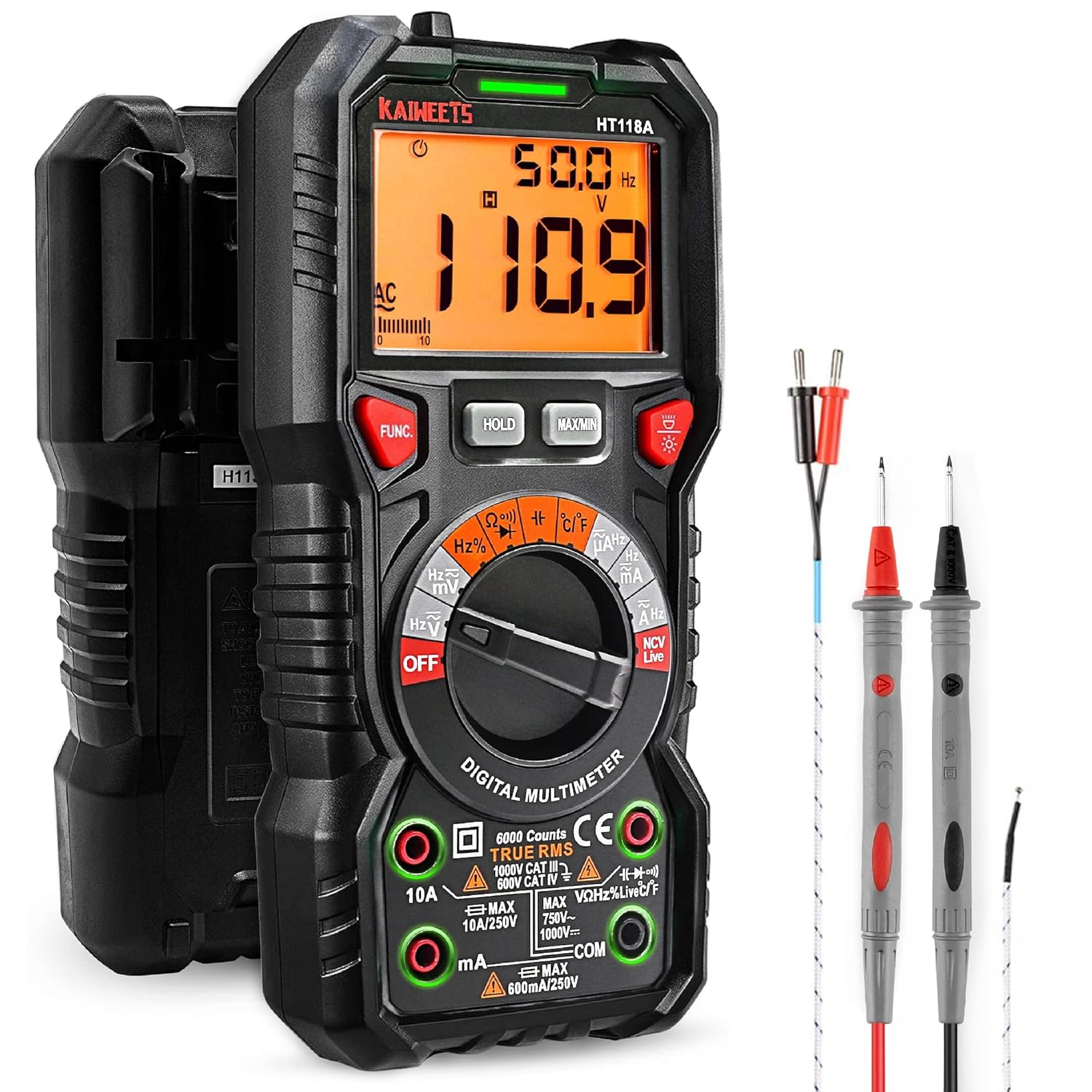 KAIWEETS Digital Multimeter Automotive TRMS Tester 6000View on Amazon
- 7
 AstroAI Digital MultimeterView on Amazon
- 8
 FNIRSI 2C53T 3-in-1 50MHz 2CH Oscilloscope Multimeter DDSView on Amazon
- 9
 Innova 3340 Professional Automotive Digital MultimeterView on Amazon
A dead battery, a blown fuse, a sensor wire with no signal: the best automotive multimeter for beginners answers all three without a learning curve. This guide compares five meters on counts, auto-ranging, battery modes, non-contact voltage detection and safety ratings, using only what each listing states.
GarageToolHQ earns a commission when you buy through links on this page, at no extra cost to you. Read our affiliate disclosure.
Quick picks
- Top pick AstroAI M4K0R: TRMS, 4000 counts, battery modes and CAT III 600V. Check price on Amazon
- Easiest pick TESMEN TM-510: Smart auto mode, NCV and 4000 counts for beginners. Check price on Amazon
- Value pick KAIWEETS KM100: CAT III 600V, case and leads included, lifetime service. Check price on Amazon
- Clamp pick AstroAI CM2K0R: Clamp AC current plus full probe functions, CAT III. Check price on Amazon
The picks
KAIWEETS Digital Multimeter Voltmeter with Case
A CAT III 600V manual-ranging multimeter with double fuses, a carrying case and 48 in leads.
Pros
- CAT III 600V, CE and RoHS with double fuses
- Carrying case and 2 AAA batteries included
- 48 in copper and PVC leads
- Lifetime after-sale service and support stated
Cons
- Manual ranging only, dial must match the job
- No counts stated
- Cannot measure AC current
- No counts stated in the listing
AstroAI Digital Multimeter, TRMS 4000 Counts
A TRMS 4000-count auto-ranging multimeter with 1.5V/9V/12V battery modes, NCV and a CAT III 600V rating.
Pros
- TRMS with 4000 counts, the sharpest here
- 1.5V/9V/12V battery modes with red/green light
- Double ceramic fuse, anti-burn
- CAT III 600V with silicone cover
Cons
- No warranty term is stated
- 219 g, heavier than the 166 g LJPXHHU
- Manual needed to learn the battery modes
- No clamp for current measurement
TM-510 Digital Multimeter, 4000 Counts
A 4000-count smart multimeter with an auto mode that picks the range, NCV and a silicone cover.
Pros
- Smart auto mode, no range selection needed
- 4000 counts with NCV and alarms
- CAT II 600V, CE and RoHS with overload protection
- Flashlight, backlight and auto shutdown
Cons
- CAT II 600V, a step below the CAT III picks
- No current measurement function stated
- No capacitance or diode functions stated
- No warranty term is stated
AstroAI Digital Clamp Meter Multimeter 2000 Counts
A 2000-count clamp meter for AC current plus full probe functions, NCV and a CAT III 600V rating.
Pros
- Clamp measures AC current without breaking the circuit
- AC/DC voltage, capacitance and live-wire functions
- NCV with sound and light alarms
- CAT III 600V with 24-hour support stated
Cons
- Cannot measure DC current, stated plainly
- 2000 counts, fewer than the 4000-count picks
- 415 g, the heaviest here
- No warranty term is stated

Digital Multimeter Voltmeter Battery Voltage Multi
A simple 2000-count multimeter with a 2.7 in backlit display, fold-out stand and a stated 2-year guarantee.
Pros
- 2-year quality guarantee stated
- 2.7 in backlit LCD with data hold
- Fold-out stand and rubber drop cover
- 9V battery, leads and manual included
Cons
- Only 2000 counts
- No CAT rating stated, only safety standards met
- No NCV function stated
- No capacitance function stated
More options to compare
 USB Rechargeable Digital Multimeter 6000 Counts Large ColorCheck price on Amazon
 KAIWEETS Digital Multimeter Automotive TRMS Tester 6000Check price on Amazon
 AstroAI Digital MultimeterCheck price on Amazon
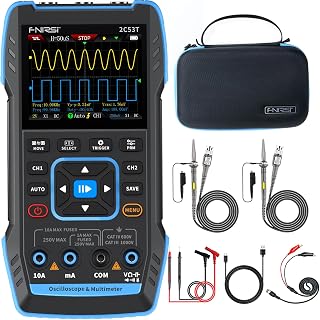 FNIRSI 2C53T 3-in-1 50MHz 2CH Oscilloscope Multimeter DDSCheck price on Amazon
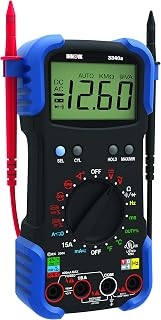 Innova 3340 Professional Automotive Digital MultimeterCheck price on Amazon
Compare the picks
| Model | Verdict | Counts | Key functions | Safety | Warranty |
|---|---|---|---|---|---|
| AstroAI M4K0R | Top pick | 4000 | TRMS, battery modes, NCV | CAT III 600V | Not stated |
| TESMEN TM-510 | Easiest pick | 4000 | Smart auto, NCV | CAT II 600V | Not stated |
| KAIWEETS KM100 | Value pick | Not stated | Manual ranging, case | CAT III 600V | Lifetime service |
| AstroAI CM2K0R | Clamp pick | 2000 | Clamp AC current, NCV | CAT III 600V | Not stated |
| LJPXHHU XL830L | Simple pick | 2000 | Stand, backlight | Not stated | 2 years |
Specifications are manufacturer rated, as published on each listing and collected 20 October 2026. “Not stated” means the listing does not give the figure.
How we scored them
Each meter is scored on performance, build, value, safety and warranty. Four of the five state a CAT safety rating, which lifts their safety scores; only the LJPXHHU states a warranty term, so it is the only one scoring on warranty.
| Product | Shop Score | Perf. /35 | Build /25 | Value /25 | Safety /10 | Warranty /5 |
|---|---|---|---|---|---|---|
| KAIWEETS KM100 | 9.5 | 28 | 19 | 19 | 7 | 3 |
| AstroAI M4K0R | 9.5 | 32 | 21 | 21 | 7 | 0 |
| TESMEN TM-510 | 9.5 | 30 | 20 | 20 | 7 | 0 |
| AstroAI CM2K0R | 9.5 | 28 | 18 | 18 | 7 | 0 |
| LJPXHHU XL830L | 9.3 | 27 | 18 | 16 | 0 | 3 |
Scores run from 9.2 to 9.8: each product’s point total is placed on that range, so more points always means a higher score.
What the listings tell you
We read the five multimeter listings aimed at beginners. Two state 4000 counts and two state 2000, while the KAIWEETS states no count. Three of the five state auto-ranging or a smart auto mode; the KAIWEETS and the LJPXHHU ask you to turn a dial. Safety ratings run CAT II 600V to CAT III 600V on four listings, with CE and RoHS marks on three. Only the AstroAI M4K0R states dedicated 1.5V, 9V and 12V battery modes with a red/green indicator, and only the clamp meter measures current without touching the wire, though it states it cannot measure DC current.
Buying guide: best automotive multimeter for beginners
Counts and auto-ranging
Counts set the resolution: 4000 counts (TESMEN, AstroAI M4K0R) reads finer than 2000 (clamp meter, LJPXHHU). For a beginner, auto-ranging matters more than counts: the TESMEN’s smart auto mode picks the range for you, while the KAIWEETS and LJPXHHU need the rotary switch on the right range. If you have never used a meter, start with an auto-ranging one.
Battery modes and NCV
Car work is mostly battery and wiring checks. The AstroAI M4K0R is the only one here with stated 1.5V, 9V and 12V battery modes and a red/green voltage light, which makes battery checks nearly foolproof. Non-contact voltage detection, stated on the TESMEN, the clamp meter and the M4K0R, finds live AC wires with a light and beep before you touch anything, a genuinely useful beginner feature.
Safety ratings, plainly
CAT III 600V (both AstroAI meters, KAIWEETS) is a higher overvoltage category than CAT II 600V (TESMEN); the LJPXHHU states only that safety standards are met. For 12V car work any of these is plenty, but the rating tells you about build seriousness. Double fuses or a double ceramic fuse, stated on the KAIWEETS and the M4K0R, add burn protection if you probe the wrong jack.
Clamp or probes
The AstroAI CM2K0R clamp meter measures AC current by closing its jaw around one wire, no circuit-breaking needed, plus full probe functions for voltage, resistance and capacitance. The catch, stated plainly in its listing: it cannot measure DC current, and car circuits are DC. For a beginner’s first meter, probes plus a battery mode beat a clamp; add the clamp later for household AC work. Our automotive multimeter roundup covers more options.
Leads, batteries and what is in the box
A beginner kit should work out of the box, and all five do: every listing includes batteries. The KAIWEETS comes with 2 AAA batteries pre-installed, a carrying case and two 48-inch copper and PVC leads; the TESMEN includes 2 AAA batteries, two leads, a storage bag and a manual; the AstroAI M4K0R ships with two 1.5V AAA batteries, a pair of leads and a manual; the clamp meter includes two 1.5V AAA batteries, a pair of leads, a manual and a storage bag; and the LJPXHHU includes a 9V battery, leads and a manual. Lead length matters when the battery is at the front of the car and you are reading at the fender: only the KAIWEETS states a length, 48 inches, so treat the others as standard short leads. Two listings go further on protection: the KAIWEETS and the M4K0R both state double fuses with anti-burn overload protection, which is the feature that saves the meter when a beginner probes the wrong jack. The KAIWEETS spec table adds that its leads fit most multimeters, a useful detail if you ever replace a lost lead.
Size, weight and reading in a dark engine bay
Stated weights run from 166 g on the LJPXHHU to 415 g on the clamp meter, with the M4K0R at 219 g, the TESMEN at 0.1 kg and the KAIWEETS at 8.05 ounces in between. Dimensions follow the same spread: the clamp meter is the tallest at 2.68 by 1.14 by 7.67 inches, while the four handhelds sit around five inches long. Every listing states a backlit display, and all five state data hold, so reading a value in a dark engine bay and freezing it on screen is covered whichever you pick. Three listings add a flashlight (TESMEN, M4K0R, clamp meter), and three add a protective cover or case: the KAIWEETS hard case, the TESMEN silicone cover and the M4K0R silicone cover, with the LJPXHHU adding a fold-out stand and a removable rubber shell. For a first meter that lives in a glove box, small and light wins; for bench learning at home, the extras matter more.
What the listings do not tell you
Three of the five listings state no warranty term at all (both AstroAI meters and the TESMEN), so buy those on features, not on promised support. The LJPXHHU states a 2-year quality guarantee and the KAIWEETS states lifetime after-sale service, the only two support promises here. No listing states a calibration certificate or an accuracy percentage beyond counts, so treat 4000 counts as resolution, not as a lab-grade claim. Only the clamp meter’s listing names a support team with a 24-hour response; the KAIWEETS and LJPXHHU listings state their own service promises, and the other two state no support terms at all.
Use rated jack stands on solid ground, wear eye protection with power and air tools, keep fuel-burning equipment out of a closed garage, and follow the manual for every tool. Read our Safety Disclaimer.
Frequently Asked Questions
What should I check first with a new multimeter?
The car battery: set a DC voltage range or a battery mode and read across the terminals. The AstroAI M4K0R’s stated 12V battery mode with its red/green light makes this a one-step check. Next, fuses: the continuity beeper, stated on all five, tells you in a second whether a fuse is blown.
Do I need a True-RMS meter for car work?
Not for basic 12V checks, fuses and continuity. True-RMS, stated only on the AstroAI M4K0R here, matters more for AC waveforms in household and shop wiring. It is a nice extra, not a beginner requirement for automotive use.
What is non-contact voltage detection good for?
Finding a live AC wire without touching it: hold the meter near the wire and it lights up and beeps. The TESMEN, the clamp meter and the M4K0R all state it. It is a household-wiring feature rather than a car feature, but handy around the garage.
Can a multimeter damage my car?
Measuring voltage and continuity the normal way is safe on a 12V system. Current measurement is the one that needs care, since the meter goes in series with the circuit and a wrong jack can blow the meter’s fuse. Start with voltage and continuity, and follow the manual before measuring current.
Clamp meter or regular multimeter for a beginner?
A regular multimeter first. The clamp here measures AC current without breaking the circuit, but it states it cannot measure DC current, which limits it on car circuits. Probes, a battery mode and continuity cover nearly everything a beginner does on a car.
Related: our automotive multimeter roundup, the battery charger maintainer guide and what OBD2 codes mean.