1/2 vs 3/8 Socket Set: Which One Should You Buy?
1/2 vs 3/8 socket set compared: torque, access and which drive to buy first, with four 1/2-inch sets as examples.

On this page
Top picks at a glance
As an Amazon Associate we earn from qualifying purchases.
- 1
 Performance Tool W2989 12V Cigarette Lighter Alternator9.2/10View on Amazon
- 2
 DAYUAN Professional Petrol Engine Compression Tester Kit Set9.5/10View on Amazon
- 3
 Engine Cylinder Leak Down Tester Kit9.5/10View on Amazon
- 4
 Neiko 02476A 1/2" Impact Socket SetView on Amazon
- 5
 MIXPOWER 11-Piece 1/2-Inch Drive Deep Impact Socket SetView on Amazon
- 6
 DEWALT DWMT73813 Drive Socket SetView on Amazon
- 7
 EACELIY 29pcs 1/2" Socket SetView on Amazon
- 8
 TEKTON 1/2 Inch Drive 6-Point Socket SetView on Amazon
- 9
 1/2 29PC Socket Set ShallowView on Amazon
1/2 vs 3/8 socket set: which drive size should you buy? For home mechanics, the 1/2-inch drive is the stronger choice for lug nuts, suspension bolts and anything torqued hard, while the 3/8-inch drive is lighter and better for engine bay work. This guide explains the difference and shows four 1/2-inch sets that cover the heavy side of the answer.
More options to compare
 Neiko 02476A 1/2" Impact Socket SetCheck price on Amazon
 MIXPOWER 11-Piece 1/2-Inch Drive Deep Impact Socket SetCheck price on Amazon
 DEWALT DWMT73813 Drive Socket SetCheck price on Amazon
 EACELIY 29pcs 1/2" Socket SetCheck price on Amazon
 TEKTON 1/2 Inch Drive 6-Point Socket SetCheck price on Amazon
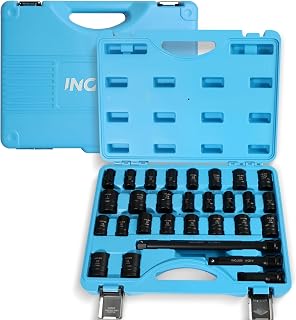 1/2 29PC Socket Set ShallowCheck price on Amazon
GarageToolHQ earns a commission when you buy through links on this page, at no extra cost to you. Read our affiliate disclosure.
1/2 vs 3/8 socket set: the short answer
Buy the 1/2-inch drive for torque and the 3/8-inch drive for access. The 1/2-inch drive handles higher torque: lug nuts, axle nuts, suspension hardware and rusted bolts. The 3/8-inch drive is lighter, thinner and fits tighter spaces: intake manifolds, brackets and most engine bay fasteners. If you buy one set first, make it 1/2-inch; add 3/8-inch when you start working under the hood regularly.
What the drive size actually changes
The drive size is the square that connects the ratchet to the socket. A 1/2-inch square is thicker and takes more torque before something gives; a 3/8-inch square is thinner and keeps the tool head smaller. The sockets themselves follow: 1/2-inch drive sockets run larger (the four sets here span 3/8 inch to 1-1/2 inches between them), while 3/8-inch drive sockets cover the smaller fasteners you meet in the engine bay.
Four 1/2-inch sets as examples
The NEIKO 02476A is a 14-piece 1/2-inch drive impact set in 6-point SAE from 3/8 inch to 1-1/4 inches, in drop-forged chrome vanadium steel with deep sockets. The MIXPOWER is an 11-piece 1/2-inch drive deep impact set in metric 10 to 24 mm, in heat-treated chrome vanadium with a black phosphate finish and a radius corner design.
The DEWALT DWMT73813 is a 23-piece 1/2-inch drive set with a 72-tooth quick-release ratchet, 6-point SAE sockets from 7/16 to 1 inch, metric sockets from 13 to 24 mm and a 5-inch extension. The VEVOR is a 19-piece 1/2-inch drive deep impact set from 3/8 inch to 1-1/2 inches in alloy steel with a storage cage.
When 1/2-inch wins
Anything you lean on: lug nuts, caliper bracket bolts, control arm bolts, axle nuts. The 1/2-inch drive ratchets have longer handles for leverage, and the sockets are thicker-walled. All four sets here are impact-rated except the DEWALT, so they pair with an impact wrench for rusted hardware. If your work is brakes, suspension and wheels, 1/2-inch is the answer.
When 3/8-inch wins
Anything in a tight space: the 3/8-inch drive head is noticeably smaller, and the ratchet is lighter for overhead work. Engine bays, interior trim fasteners and small brackets are 3/8-inch territory. A 3/8-inch set cannot safely take the torque a 1/2-inch set can, so do not use adapters to force it; buy the right drive.
What to check before you buy
Check the socket range against your fasteners: the NEIKO covers SAE 3/8 to 1-1/4 inches, the MIXPOWER covers metric 10 to 24 mm, the DEWALT covers both SAE and metric, and the VEVOR covers 3/8 inch to 1-1/2 inches. Check whether you need impact-rated (the NEIKO, MIXPOWER and VEVOR are) or a ratchet included (only the DEWALT states one). For deep versus shallow, see our shallow vs deep sockets guide.
6-point sockets and why they matter here
All four sets are 6-point. The NEIKO states a 6-point hex design that prevents round-off on nuts and bolts under high torque and hammering stress from an impact wrench. The MIXPOWER states a 6-point opening with a radius corner design that reduces wear and increases torque by placing force on the fastener walls rather than the corners. The VEVOR states a 6-point high-torque design that grips the stronger flat sides of the nut or bolt head, not the weaker corners. The DEWALT lists 6pt sockets in both SAE and metric.
Impact-rated vs standard
Three of the four state impact rating. The NEIKO states drop-forged chrome vanadium steel with a black phosphate coating to withstand extreme torque changes against fasteners. The MIXPOWER states drop-forged and heat-treated chrome vanadium (50BV30) with a black phosphate finish, meeting or exceeding ANSI performance standards, with a 1 year quality guarantee. The VEVOR states alloy steel and chrome vanadium sockets that will not easily crack under high pressure. The DEWALT does not state impact rating; its material is listed as a blend with a brushed finish, so treat it as a hand-tool set.
Markings and storage
The NEIKO states high-contrast laser etched markings on all pieces and a heavy-duty custom case with a size index. The MIXPOWER states high-contrast laser etched size markings readable even in low light. The VEVOR includes a sturdy storage case, described as a storage cage, for organization and transport. The DEWALT 23-piece set centers on its 72-tooth quick-release ratchet with a 5-inch extension rather than a socket case.
SAE vs metric: what each set actually covers
The NEIKO covers SAE only, 14 deep sockets from 3/8 to 1-1/4 inches. The MIXPOWER covers metric only, 11 deep sockets from 10 to 24 mm, skipping 15, 18, 20 and 23. The DEWALT covers both: SAE 7/16 to 1 inch and metric 13 to 24 mm, 23 pieces including the ratchet and extension. The VEVOR covers the widest single range, 19 deep sockets from 3/8 inch to 1-1/2 inches. Match the set to the fasteners on your vehicles before you buy.
Weight
The NEIKO set weighs 9.8 pounds in its case. The DEWALT spec table lists 16 ounces. The MIXPOWER and VEVOR state no set weight. Heavier here means more steel, which is what you want in an impact set.
Use rated jack stands on solid ground, wear eye protection with power and air tools, keep fuel-burning equipment out of a closed garage, and follow the manual for every tool. Read our Safety Disclaimer.
Frequently Asked Questions
Can I use 3/8-inch sockets on a 1/2-inch ratchet?
Only with an adapter, and only for light torque. Forcing high torque through an adapter risks breaking the adapter or the socket.
Which drive for lug nuts?
1/2-inch. Lug nuts are torqued hard and the 1/2-inch drive takes it. The sets here run the right sizes.
Are the sets here impact-rated?
The NEIKO, MIXPOWER and VEVOR state impact-rated. The DEWALT does not state impact rating.
Which set includes a ratchet?
The DEWALT DWMT73813 states a 72-tooth quick-release ratchet and a 5-inch extension. The others state sockets only.
Which covers both SAE and metric?
The DEWALT states SAE and metric. The NEIKO is SAE, the MIXPOWER is metric, and the VEVOR states 3/8 inch to 1-1/2 inches.
What does 6-point mean?
The socket has six contact points that grip the flat sides of the fastener. The NEIKO, MIXPOWER and VEVOR all state 6-point designs that reduce round-off and put force on the fastener walls rather than the corners, which matters at high torque.
Related: best socket set for motorcycles, socket set vs nut driver and best impact wrench for mechanics.