Beam vs Click Torque Wrench: Which One Should You Buy?
A beam torque wrench shows torque on a live scale and holds calibration; a click wrench signals the set value with a click but needs care in storage and recalibration: which suits which garage jobs.

On this page
Top picks at a glance
As an Amazon Associate we earn from qualifying purchases.
- 1
 POKISEED Rechargeable LED Headlamp9.5/10View on Amazon
- 2
 LEXIVON Torque Wrench 1/2-Inch Drive Click 10~1509.7/10View on Amazon
- 3
 Matework 50PCS Inch Pound Torque Wrench Set9.6/10View on Amazon
- 4
 Neiko 03727A 1/4-Inch-Drive Beam Torque WrenchView on Amazon
- 5
 Tooluxe 03703L Dual Drive Beam Style Torque WrenchView on Amazon
- 6
 MILMUMU 1/4" Drive Beam Torque Wrench Precision InstrumentView on Amazon
- 7
 ARES 70214 3/8-In Drive Beam Torque WrenchView on Amazon
- 8
 Powerbuilt 1/4" Drive Beam Torque WrenchView on Amazon
- 9
 Powerbuilt 1/2-Inch Drive Needle Torque WrenchView on Amazon
Beam vs click torque wrench: which should you buy? Buy the beam if you want the simplest honest tool. It shows torque on a live scale as you pull, has no spring to wear out, and, per one maker’s listing, a beam deflection wrench does not come out of calibration the way a click wrench can. Buy the click if you set one torque value and repeat it. Dial it in, pull until it clicks, and move to the next fastener. For most home garages the honest answer is that a beam wrench covers occasional precise work while a clicker earns its keep on jobs with many fasteners at the same setting, like a set of lug nuts.
More options to compare
 Neiko 03727A 1/4-Inch-Drive Beam Torque WrenchCheck price on Amazon
 Tooluxe 03703L Dual Drive Beam Style Torque WrenchCheck price on Amazon
 MILMUMU 1/4" Drive Beam Torque Wrench Precision InstrumentCheck price on Amazon
 ARES 70214 3/8-In Drive Beam Torque WrenchCheck price on Amazon
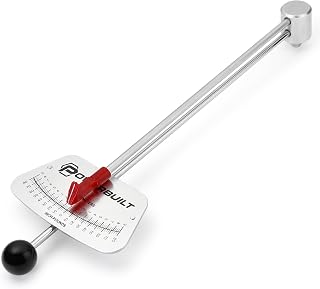 Powerbuilt 1/4" Drive Beam Torque WrenchCheck price on Amazon
 Powerbuilt 1/2-Inch Drive Needle Torque WrenchCheck price on Amazon
GarageToolHQ earns a commission when you buy through links on our product pages, at no extra cost to you. Read our affiliate disclosure.
Below: how each type actually works, the differences that matter in the garage, three beam wrenches from current listings to anchor the choice, and answers to the questions we hear most.
How a beam torque wrench works
A beam torque wrench is the oldest design and the simplest. A long steel beam bends a tiny amount as you pull, and a pointer fixed to the head moves across a scale on the handle. You watch the pointer while you pull and stop at the number you want. There is nothing to set, no spring inside, and no batteries.
The three listings in our gear picks show the range of the type. The NEIKO 03727A is a 1/4-inch-drive beam wrench that reads 0 to 80 in/lb in 1 in/lb increments and 0 to 9 Nm in 0.25 increments, with a stated accuracy within +/- 4%. The Tooluxe 03703L is a dual-drive beam wrench with 3/8-inch and 1/2-inch anvils that reads 0 to 150 ft-lb and 0 to 20 meter-kilograms on a 17-inch shaft. The Venzo VZ-F33-054 is a compact 1/4-inch driver set that covers 2 to 10 Nm and ships with hex, Phillips and Torx bits.
Two details matter when you read one. Read the scale straight on: the Tooluxe listing includes a graduated tip to prevent parallax error, the shift you get when you read a pointer at an angle. And take the stated accuracy for what it is: the NEIKO listing states calibration accuracy within +/- 4%, which is the maker’s stated figure.
How a click torque wrench works
A click torque wrench works the other way around. You set the target torque on the handle first, usually by twisting the grip against a scale, then pull. Inside, a spring-loaded cam holds until the set torque is reached, then snaps over with a click you feel and hear. That click is the signal to stop.
The trade is convenience against upkeep. Setting one value and repeating it across many fasteners is fast, which is why click wrenches own jobs like lug nuts and engine assembly. But the spring is the weak point: the Tooluxe listing notes that a click torque wrench must be recalibrated, while a beam deflection wrench does not come out of calibration. The usual advice is to wind a clicker back to its lowest setting for storage, so the spring does not sit loaded.
Beam vs click torque wrench: the differences that matter
| Beam | Click | |
|---|---|---|
| How you know the torque | Live scale and pointer: you watch the number rise as you pull | A click you feel and hear at the set value |
| Calibration | Beam deflection does not come out of calibration, per the Tooluxe listing | The spring can drift; a clicker must be recalibrated, per the Tooluxe listing |
| Reading the value | Watch the scale during the pull; read straight-on to avoid parallax | Set the value before the pull; no watching needed |
| Best for | Occasional precise work and low-torque fasteners | Repeated fasteners at one setting, like a set of lug nuts |
| What you give up | Slower across many fasteners; you must watch the scale | Upkeep: storage position and recalibration matter |
The table compares the types in general. None of the three listings in our gear picks is a click wrench, so the click column describes the type, not a specific model.
Three beam wrenches for the home garage
Our gear picks for this guide are all beam wrenches, ordered by what their listings state, from the widest range to the most compact.
Tooluxe 03703L: the wide-range beam
Dual 3/8-inch and 1/2-inch drives on a 17-inch shaft, reading 0 to 150 ft-lb and 0 to 20 meter-kilograms, in alloy steel with a mirror-chrome finish at a stated 1.3 lb. The listing’s big claim is that beam deflection wrenches provide precise readings every time and do not come out of calibration the way a click torque wrench must be recalibrated. This is the pick when your jobs span from smaller automotive fasteners up to the bigger stuff.
NEIKO 03727A: the precision small-fastener beam
A 1/4-inch-drive beam wrench reading 0 to 80 in/lb in 1 in/lb increments and 0 to 9 Nm in 0.25 increments, with stated accuracy within +/- 4%. Stainless steel, 11 inches long, bidirectional for clockwise and counterclockwise work, with a ball detent that holds sockets. One note: the spec table lists an item weight of 0.28 g, which is plainly a listing error for an 11-inch steel wrench, so treat that figure as missing. The pick for bicycles, small engines and delicate automotive fasteners.
Venzo VZ-F33-054: the compact 2 to 10 Nm driver set
A 7-inch 1/4-inch driver covering 2 to 10 Nm, listed for mountain, road and motorcycle work: handlebars, stems, seat posts and brake brackets. It ships with hex Allen keys from 2 to 8 mm plus PH2, T10 and T25 bits, and the listing offers a 2-year warranty. The pick for a saddle bag or a small drawer where a full-size wrench will not go.
Use rated jack stands on solid ground, wear eye protection with power and air tools, keep fuel-burning equipment out of a closed garage, and follow the manual for every tool. Read our Safety Disclaimer.
Frequently Asked Questions
Do beam torque wrenches need calibration?
Per the Tooluxe listing, no: beam deflection wrenches provide precise readings every time and do not come out of calibration like a click torque wrench that must be recalibrated. The NEIKO listing states its accuracy as within +/- 4%. If a beam wrench takes a hit hard enough to bend the beam, replace it: a bent beam reads wrong.
Can I use a beam torque wrench left-handed or in reverse?
On these listings, yes. The NEIKO is designed for both left and right hands and turns clockwise or counterclockwise, and the Tooluxe scale is calibrated in both directions from 0 to 150 ft-lb. That matters for left-hand-thread fasteners and for checking torque in both directions.
What torque range do I need for a home garage?
Match the wrench to the fasteners, not the other way around. Smaller fasteners on bikes and small engines live in the inch-pound and single-digit newton-meter world: the NEIKO covers 0 to 80 in/lb and 0 to 9 Nm, and the Venzo covers 2 to 10 Nm. Bigger automotive work needs foot-pounds: the Tooluxe reads 0 to 150 ft-lb. One wrench rarely covers both ends well, which is why many garages end up with two.
How do I read a beam scale without parallax error?
Read it straight on, with your eye directly above the pointer. Viewed at an angle, the pointer appears to sit at a different mark than it really does. The Tooluxe listing fits a graduated tip to prevent parallax error, but the habit matters on any beam wrench: square your eye to the scale before you call the number.
Can a beam wrench also loosen bolts?
Yes, within reason. The NEIKO listing describes its beam wrench as bidirectional, for tightening or loosening fasteners including hard-to-reach ones. Do not use any torque wrench as a breaker bar on seized fasteners, though: that is how beams get bent and click mechanisms get broken.
Related: our best torque wrench for beginners, the best torque wrench for lug nuts, click vs digital torque wrench, 3/8 vs 1/2 torque wrench, split beam vs micrometer torque wrench, socket set vs torque wrench and the best torque wrench for engine work.