Garage Door Insulation Kit vs Foam Board: Which One Should You Buy?
Pre-cut kits sized to standard garage doors versus rigid foam board you cut and fit yourself: what each gives you, how they differ, and three listed kits on stated specs.

On this page
Top picks at a glance
As an Amazon Associate we earn from qualifying purchases.
- 1
 BEEST FULLSTOP Garage Door Insulation Kit9.7/10View on Amazon
- 2
 NASA TECH White Reflective Foam Core 2 Car Garage Door9.7/10View on Amazon
- 3
 NASATECH White9.6/10View on Amazon
- 4
 Matador EP1323054_02 SGDIK002 Garage Door Insulation KitView on Amazon
- 5
 16P Garage Door Insulation Kit Panels 6MM 16x8FT for DoubleView on Amazon
- 6
 16P Garage Door Insulation Kit Panels 6MM 18x6.8FT for DoubleView on Amazon
- 7
 24P Garage Door Insulation Kit Panels 6MM 24x8FT for TripleView on Amazon
- 8
 2 Car Garage Door Insulation KitView on Amazon
- 9
 BEEST FULLSTOP Garage Door Insulation KitView on Amazon
Garage door insulation kit vs foam board: which one should you buy? A garage door insulation kit gives you panels sized for standard garage doors plus the fixing method in the box, so the weekend job is mostly measure, fit and stick. Foam board means buying rigid sheets yourself, cutting every piece to size and holding them in place with your own fixings. Both add a layer of insulation to the door’s metal skin; the difference is who does the cutting, measuring and hardware sourcing: the kit maker or you. This guide compares the two approaches, then ranks the three listed kits from their published specs.
More options to compare
 Matador EP1323054_02 SGDIK002 Garage Door Insulation KitCheck price on Amazon
 16P Garage Door Insulation Kit Panels 6MM 16x8FT for DoubleCheck price on Amazon
 16P Garage Door Insulation Kit Panels 6MM 18x6.8FT for DoubleCheck price on Amazon
 24P Garage Door Insulation Kit Panels 6MM 24x8FT for TripleCheck price on Amazon
 2 Car Garage Door Insulation KitCheck price on Amazon
 BEEST FULLSTOP Garage Door Insulation KitCheck price on Amazon
GarageToolHQ earns a commission when you buy through links on our product pages, at no extra cost to you. Read our affiliate disclosure.
Below: the short answer, the three kits ranked by their stated specs, how to measure and fit either option, and answers to the questions readers ask most.
Garage door insulation kit vs foam board: the short answer
Pick a garage door insulation kit when you want the job to be a single afternoon’s work with no extra shopping. The maker has already matched the panel size to common doors and worked out the fixing method, and the listing tells you which door sizes it covers. Pick foam board when your door is an odd size, you want a specific thickness the kits do not offer, or you are comfortable measuring, cutting and fastening every panel yourself. The trade is work, not parts: the kit removes the fitting work, while foam board leaves every number on the fit to you.
| Option | What you get | Fit | Fixings |
|---|---|---|---|
| Garage door insulation kit | Panels pre-sized for standard doors, sized and counted in the listing | Match the listing’s stated door sizes to your door before ordering | In the box: tape or a friction fit, depending on the listing |
| Rigid foam board | Sheets you choose by material and thickness | You measure each door section and cut every piece | Your choice: adhesive, tape or mechanical fasteners, plus trimmed edges |
One caution applies to both routes. Any insulation adds weight to the door, and a heavier door changes the balance the springs and opener were set for. Read the door and opener maker’s manual before you add weight, and have a pro re-check the balance if the door feels heavy or the opener strains.
The three kits from the listings, ranked
These are the only three kits in the listings. We ranked them by what their listings actually state: stated coverage, stated insulation values, stated install method and stated specs.
1. US Energy Products reflective foam core kit
This is the only listing that states both a coverage area and an insulation rating, which is why it tops the ranking. The listing states it covers an 18 ft wide x 8 ft high two-car garage door and also fits an 18 x 7 door. The stated R value is 8.0. The core is polyurethane foam with a white reflective face, and the kit includes heavy-duty double-sided tape for fitting. The listing describes the kit as suited to insulating and soundproofing garage doors. What is not stated: panel count, panel thickness and any warranty term.
2. Matador SGDIK001 garage door insulation kit by Atlas EPS
The Matador SGDIK001 from Atlas EPS takes the second spot on stated detail. The listing states 8 high-impact polystyrene laminate panels, each 20.25 in high x 54 in wide x 1.25 in thick, and states they fit most standard pan-style 8-foot and 9-foot garage doors. Installation is described as 3 steps with no tapes, glues or pins required, and the panels are scored for fitting with no special tools required. The listed item weight is 5 pounds and the color is white. The warranty line in the listing reads “Warranty” with no term given, so no concrete warranty term is stated.
3. MYFAMIREA bubble reflective insulation kit
The MYFAMIREA kit is a 16-panel set of aluminum foil over a polyethylene bubble core, with tape included. The listing states 16 panels at 48 in long x 24 in wide, with 8 square feet of coverage per panel, and the maker calls the sheets waterproof and weatherproof. One contradiction to flag: the bullets state the thickness as 6 mm while the spec table states 0.24 in. The title and bullets win over the spec table, so treat this as a 6 mm product and confirm the thickness from the listing before ordering. The wide application list (garage doors, attics, walls, pipes) reads as marketing, not as stated garage-door coverage, which is why it ranks third.
How to fit either option to your door
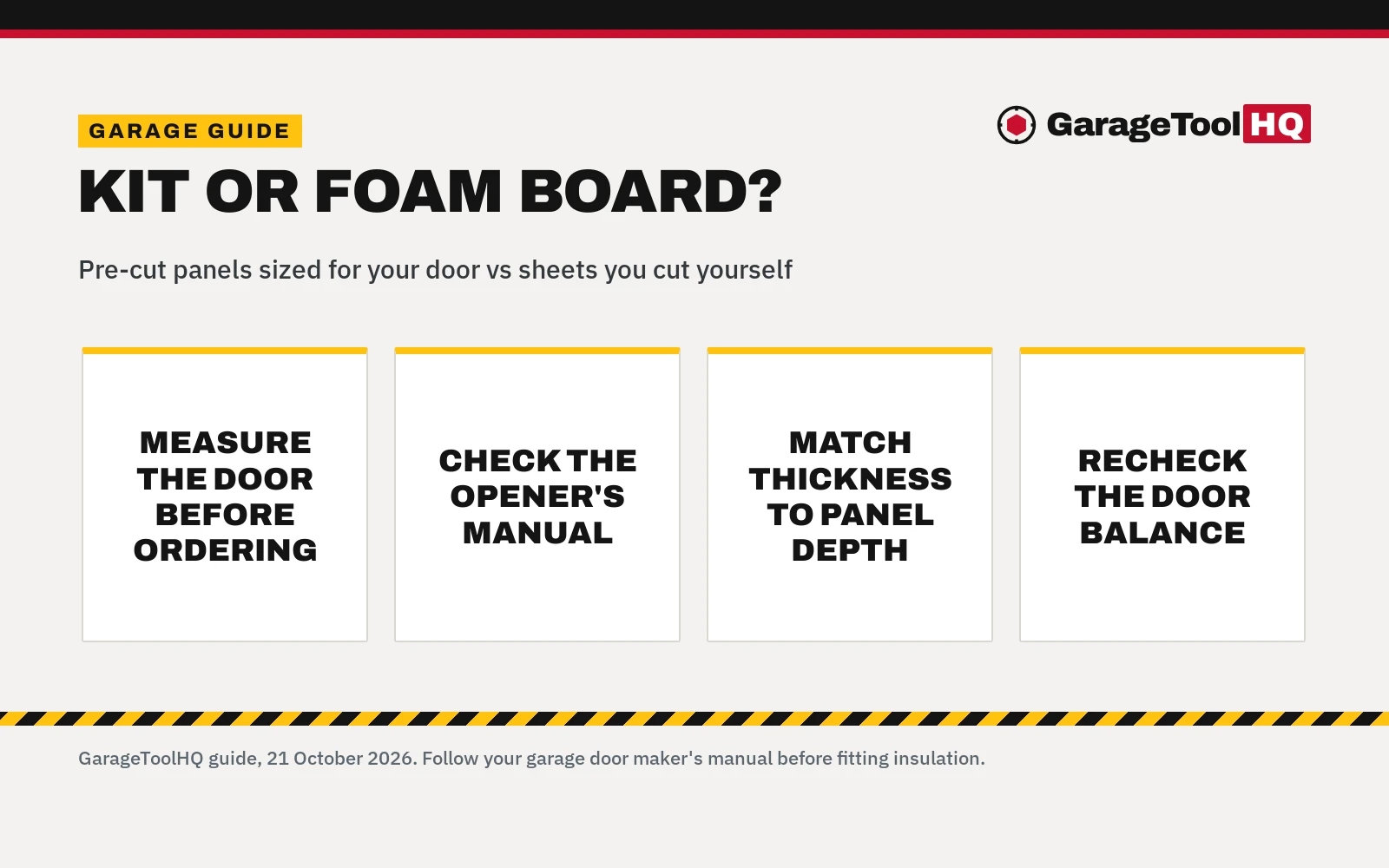
- Measure the door. Measure the height and width of each panel section, not just the whole door. Kits state the door sizes they fit; compare those stated sizes to your tape measure before ordering.
- Match thickness to panel depth. Foam panels sit inside the door’s recessed sections. A panel thicker than the recess will push against the sections as the door bends over the tracks.
- Cut clean and leave edges square. Score-and-snap against a straightedge or a sharp utility knife usually gives cleaner edges than sawing. Square edges seal better against the door skin, which is where the insulation does its work.
- Fix panels so they stay put. Follow the kit’s stated method: tape or friction fit. Panels that sag will rattle and can jam the sections. If you cut your own foam board, support it the way the listing or your fastener maker specifies.
- Recheck the balance. After fitting, disconnect the opener and lift the door by hand. If it will not stay put halfway, the added weight has changed the balance: call a garage door pro to re-check the springs. Springs under tension are not a DIY job.
Insulation adds pounds to a door that was balanced for its bare weight. The Matador kit above lists 5 pounds; other listings do not state a weight. Whatever you fit, watch the opener’s strain and the door’s balance for the first few days, and keep the opener maker’s manual handy.
Use rated jack stands on solid ground, wear eye protection with power and air tools, keep fuel-burning equipment out of a closed garage, and follow the manual for every tool. Read our Safety Disclaimer.
Frequently Asked Questions
Does a garage door insulation kit really change the garage temperature?
Insulation slows heat moving through the door skin, which is the claim the listings make: blocking summer heat and winter cold, and cutting the load on heating and cooling. How much you feel it depends on the rest of the garage. An uninsulated wall, an open vent or a door with gaps will still lose heat, so treat the door kit as one part of the job, alongside sealing gaps and, in winter, sizing a heater to the space.
Will adding insulation make my garage door too heavy for the opener?
It adds weight, full stop. One listed kit states 5 pounds; the others do not state a weight. Check the door and opener maker’s manual for any weight guidance, then do the halfway balance check above. If the door does not balance, a garage door pro re-checks the springs. Never adjust torsion springs yourself.
Can I use rigid foam board instead of a kit?
Yes. Measure each panel section, choose a thickness that fits the recess depth, cut the sheets to size and fasten them with adhesive, tape or mechanical fasteners. The trade is labor for flexibility: you pick the material and thickness, but every measurement and cut is on you, and the edges are only as square as you cut them.
What R value do the listed kits state?
Only one does. The US Energy Products kit states an R value of 8.0. The Matador and MYFAMIREA listings state no R value. If the insulation rating matters to you, that is the listing to read most closely.
Do I need special tools to install a kit?
Per the listings: the Matador kit states no special tools are required and the panels are scored for fitting; the US Energy kit includes heavy-duty double-sided tape; the MYFAMIREA kit includes tape and asks you to cut the films to size, so a knife and a tape measure are the sensible minimum. Anything beyond that is not stated.
Will insulation quiet the door?
The listings suggest so, as the maker’s claim rather than a measured result: the US Energy listing describes the kit as suited to insulating and soundproofing, and the MYFAMIREA listing says the sheets prevent sound and vibration. A snug fit against the door skin is what keeps both heat loss and rattle down.
Related: our picks for the best garage door insulation kit, the best garage door threshold seal for the gap under the door, our guide to what size garage heater you need, and the garage upgrades hub.