Best Reciprocating Saw for Exhaust Work (2026)
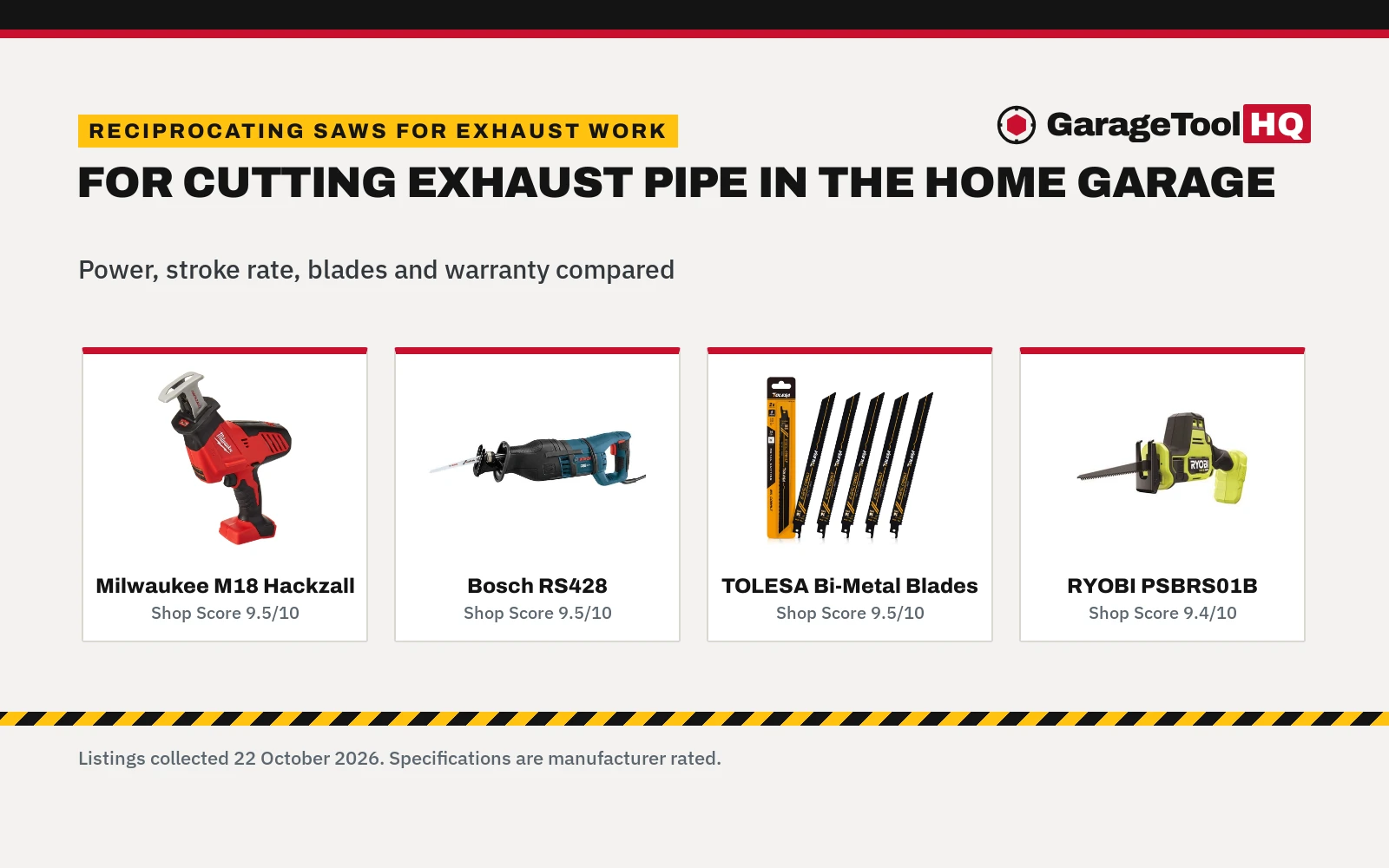
Four saws and a blade set for cutting exhaust pipe, ranked by the listings' stated power, handling, blade system and warranty.

On this page
Top picks at a glance
As an Amazon Associate we earn from qualifying purchases.
- 1
 Best OverallMilwaukee M18 Hackzall9.5/10View on Amazon
- 2
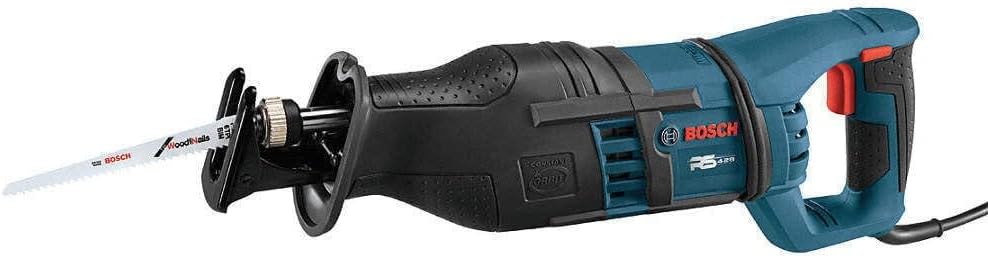 Most PowerBosch RS4289.5/10View on Amazon
- 3
 Best Blade UpgradeTOLESA Bi-Metal Blades9.5/10View on Amazon
- 4
 Lightest CordlessRYOBI PSBRS01B9.4/10View on Amazon
- 5
 AIRCAT 6350 Low Vibration Reciprocating Air SawView on Amazon
- 6
 Skil 9206-02 7.5-Amp Variable Speed Reciprocating SawView on Amazon
- 7
 DEWALT Reciprocating SawView on Amazon
- 8
 Ingersoll Rand 429 3/8" Reciprocating Air Saw Features up toView on Amazon
- 9
 SKIL 13 Amp Corded Reciprocating Saw with Buzzkill TechnologyView on Amazon
An exhaust job rarely starts at the workbench. It starts under the car, on a creeper, staring at a rusted flange that will not unbolt or a section of pipe that has to come out before the new parts go in. A compact reciprocating saw with a proper metal blade turns that fight into a short cutting session. This guide covers the best reciprocating saw for exhaust work, with each pick ranked by what its listing states about power, stroke rate, blade changes, weight and warranty.
GarageToolHQ earns a commission when you buy through links on this page, at no extra cost to you. Read our affiliate disclosure.
Quick picks
- Best Overall Milwaukee M18 Hackzall: One-handed 18V brushless saw, anti-vibration handle, LED light and 5-year warranty. Check price on Amazon
- Most Power Bosch RS428: 14 amp corded saw, 1680 watts, vibration control, orbital action and 1-year warranty. Check price on Amazon
- Best Blade Upgrade TOLESA Bi-Metal Blades: Five 9-inch 14 TPI bi-metal blades, 8% cobalt edge, 1/2 in shank, for pipe under 7 in. Check price on Amazon
- Lightest Cordless RYOBI PSBRS01B: 18V brushless one-handed saw at 3.8 lb, up to 3,000 SPM, tool-free blade change. Check price on Amazon
The picks


Milwaukee 2625-20 M18 18-Volt Lithium-Ion Cordless
An 18V brushless one-handed reciprocating saw with an anti-vibration handle, LED work light and quick-lock tool-free blade clamp, sold as a bare tool.
Pros
- 18V brushless motor in a compact one-handed body for tight spots
- Anti-vibration handle and built-in LED work light
- Quick-lock clamp for tool-free blade changes
- 5-year tool warranty stated on the listing
Cons
- Bare tool: battery and charger are separate purchases
- No stroke rate stated on the listing
- No weight figure stated on the listing
- One-handed grip gives less leverage than a full-size saw
BOSCH RS428 14 Amp Reciprocating Saw,Blue
A 14 amp corded reciprocating saw with vibration control, orbital action and a 3-position adjustable foot, backed by a 1-year warranty.
Pros
- 14 amp, 1680-watt corded motor, the strongest power here
- Counterbalance vibration control with anti-vibration handle
- Orbital action and 3-position adjustable foot
- 1-year warranty plus 30-day money-back guarantee
Cons
- Corded: needs a 120V outlet within reach of the car
- Weight is 8 lb in the bullets but 8.7 lb in the spec table
- Full-size body is harder to fit in tight under-car spots
- No stroke rate stated on the listing
TOLESA Bi-Metal Reciprocating Saw Blades
A 5-pack of 9-inch 14 TPI bi-metal reciprocating saw blades with an 8% cobalt edge and 1/2-inch universal shank, made for cutting metal pipe and profiles.
Pros
- 9-inch 14 TPI bi-metal blades with 8% cobalt edge for metal pipe
- Rated for pipe under 7 in in diameter and sheet from 0.1 to 0.3 in
- 1/2 in shank fits the major saw brands the listing names
- Five blades per pack; thin 0.9 mm wall for less heat buildup
Cons
- Blades only: a reciprocating saw is still required
- No warranty term stated on the listing
- 14 TPI is the only tooth count in the pack
- Made for metal, not for wood or demolition work
RYOBI ONE+ HP 18V Brushless Compact One-Handed
An 18V brushless compact one-handed reciprocating saw reaching 3,000 strokes per minute, with a rapid tool-free blade change, sold as a tool only.
Pros
- Up to 3,000 strokes per minute from a brushless 18V motor
- Compact one-handed body at 3.8 lb for tight spots and overhead cuts
- Rapid tool-free blade change system
- Fits the ONE+ system of over 300 batteries
Cons
- Tool only: battery and charger sold separately
- No warranty term stated on the listing
- No blade details stated on the listing
- ABS plastic body rather than metal

Fanttik R11 Pro Cordless Mini Reciprocating Saw
A compact cordless mini reciprocating saw with a 160W brushless motor, 0 to 2200 SPM variable speed, Type-C charging and a 5-blade kit.
Pros
- Compact 8.92 by 2.4 by 1 in body for very tight spots
- Built-in 14.8 Wh battery with Type-C fast charging
- 0 to 2200 SPM variable speed with LED battery and speed display
- 5-blade kit of 4-inch blades included
Cons
- 160W motor is the weakest power here; listed for wood and PVC
- Takes T-shank jigsaw blades, not standard reciprocating saw blades
- Maximum 3/4 in cutting thickness per the listing's note
- No warranty term stated on the listing
More options to compare
 AIRCAT 6350 Low Vibration Reciprocating Air SawCheck price on Amazon
 Skil 9206-02 7.5-Amp Variable Speed Reciprocating SawCheck price on Amazon
 DEWALT Reciprocating SawCheck price on Amazon
 Ingersoll Rand 429 3/8" Reciprocating Air Saw Features up toCheck price on Amazon
 SKIL 13 Amp Corded Reciprocating Saw with Buzzkill TechnologyCheck price on Amazon
Compare the picks
| Model | Shop Score | Power | Stroke rate | Blade change | Weight | Blade | Warranty |
|---|---|---|---|---|---|---|---|
| Milwaukee M18 Hackzall | 9.5/10 | 18V cordless, brushless | Not stated | Quick-lock, tool-free | Not stated | 4-inch high-speed steel | 5 years |
| Bosch RS428 | 9.5/10 | 14 amp corded, 1680 watts | Not stated | Not stated | 8 lb (bullets), 8.7 lb (table) | Not stated | 1 year; 30-day money back |
| TOLESA Bi-Metal Blades | 9.5/10 | Blades, not a saw | Not applicable | 1/2 in universal shank | 0.14 kg | 9-inch, 14 TPI | Not stated |
| RYOBI PSBRS01B | 9.4/10 | 18V cordless, brushless | Up to 3,000 SPM | Rapid, tool-free | 3.8 lb | Not stated | Not stated |
| Fanttik R11 Pro | 9.3/10 | 160W, built-in 14.8 Wh battery | 0 to 2200 SPM | Tool-free | Not stated | Five 4-inch blades | Not stated |
*Power, stroke rate, weight and warranty are the figures each listing states; “Not stated” means the listing gives no figure. Specifications are manufacturer rated, as published on each listing and collected 21 October 2026.
How we scored them
Each saw is scored on performance, build, value, safety and warranty, with the weights published on the How We Pick page. A stated safety certification earns safety points, and none of these listings states one. Warranty points need a concrete term on the listing.
| Product | Shop Score | Perf. /35 | Build /25 | Value /25 | Safety /10 | Warranty /5 |
|---|---|---|---|---|---|---|
| Milwaukee M18 Hackzall | 9.5 | 30 | 21 | 19 | 0 | 4 |
| Bosch RS428 | 9.5 | 32 | 21 | 19 | 0 | 2 |
| TOLESA Bi-Metal Blades | 9.5 | 28 | 21 | 21 | 0 | 0 |
| RYOBI PSBRS01B | 9.4 | 29 | 20 | 19 | 0 | 0 |
| Fanttik R11 Pro | 9.3 | 21 | 18 | 20 | 0 | 0 |
Scores run from 9.2 to 9.8: each product’s point total is placed on that range, so more points always means a higher score.
What the listings tell you
Four saws and one blade set were compared. Three of the saws run on batteries and one runs on a cord. Two listings state a stroke rate, two state a weight, and two state a warranty term. The blade set is the only pick that fully describes its teeth, length and the pipe sizes it handles, which is more cutting detail than most of the saws give about blades. Compatibility is spelled out only on the blade set, which names Bosch, DeWalt, Milwaukee, Makita and other brands its 1/2 in shank fits.
Buying guide: the best reciprocating saw for exhaust work
Exhaust pipe is thin-wall steel that rusts, so the setup matters as much as the saw: enough power, a blade made for metal, and a body that fits where the pipe runs. The sections below follow only what the listings publish.
Corded or cordless
Three picks here run on batteries and one on a cord. The corded Bosch lists 14 amps and 1680 watts, the strongest power figure in the group, but it needs an outlet within reach of the car. The 18V Milwaukee is a bare tool and the 18V RYOBI is tool only, so each needs a battery and charger bought separately unless one is already on the shelf. The Fanttik carries its own 14.8 Wh battery and charges over Type-C. The Bosch is the only pick that lists both its voltage, 120 volts, and its draw, 1680 watts, in the spec table. Under a car, cordless wins on movement; corded wins on sustained power.
Stroke rate and control
Two listings state a stroke rate: the RYOBI at up to 3,000 strokes per minute and the Fanttik at 0 to 2200 SPM with variable speed. A higher stroke rate cuts faster in thin metal, and variable speed helps start the cut without the blade skating across the pipe. One-handed designs like the Milwaukee and the RYOBI trade leverage for control in tight spots. The Milwaukee lists an anti-vibration handle and the Bosch lists a counterbalance vibration control system. Where a listing states no figure, this guide does not guess one.
Blade choice for exhaust pipe
The blade does the cutting. The TOLESA set is the only pick that describes its blades in full: 9-inch, 14 TPI, bi-metal with an 8% cobalt edge and a 0.9 mm thin wall, rated for sheet metal from 0.1 to 0.3 in and solid pipe under 7 in in diameter. Fine teeth like 14 TPI suit thin-wall exhaust tubing, and the set teeth with the thin wall are made to keep heat down. Its 1/2 in shank fits the saws from Bosch, DeWalt, Milwaukee, Makita and the other brands the listing names, which covers every saw here except the Fanttik. The Fanttik clamp takes T-shank jigsaw blades instead of standard reciprocating saw blades, which narrows blade choice for metal work.
Blade changes
Under a car, a blade change should take seconds and no tools. The Milwaukee quick-lock clamp and the RYOBI rapid blade change system are both described as tool-free, and the Fanttik is tool-free as well. The Bosch listing does not describe its blade change, so no claim is made for it. The Fanttik clamp gap is 1.4 mm and takes blades 3 to 4 in long, worth checking before buying blades for it.
Weight and reach
Two listings state a weight: the RYOBI at 3.8 lb and the Bosch at 8.7 lb in its spec table, 8 lb in its bullets. A lighter saw is easier to hold overhead, which is the position exhaust work often demands; a heavier saw leans into the cut, which suits steady work on a removed section. Stated lengths run from 8.92 in on the Fanttik to 18.4 in on the Bosch, so measure the space around the section to cut before choosing.
Use rated jack stands on solid ground, wear eye protection with power and air tools, keep fuel-burning equipment out of a closed garage, and follow the manual for every tool. Read our Safety Disclaimer.
Garage Fit Check
- Space: the Fanttik measures 8.92 by 2.4 by 1 in and the Milwaukee and RYOBI are one-handed and compact, all suited to tight spots; the Bosch is a full-size saw at 18.4 by 4 by 6.3 in.
- Power: the Milwaukee is a bare tool and the RYOBI is tool only, so plan on an 18V battery and charger for each; the Bosch needs a 120V outlet; the Fanttik charges over Type-C with its built-in 14.8 Wh battery.
- Storage: the Bosch and the Fanttik both include a bag, while the other listings describe no case.
- Before the first cut: match the blade to the clamp, 1/2 in shank blades for the standard clamps and T-shank jigsaw blades 3 to 4 in long for the Fanttik, and choose a metal blade such as the 14 TPI set for exhaust pipe.
Frequently Asked Questions
What blade should I use to cut exhaust pipe?
A bi-metal blade with fine teeth made for metal, like the 14 TPI set here: 9-inch blades with an 8% cobalt edge and a 0.9 mm thin wall, rated for pipe under 7 in in diameter. The 1/2 in shank fits the standard clamps on the saws in this guide except the Fanttik, which takes T-shank jigsaw blades.
Is a cordless reciprocating saw strong enough for exhaust work?
For thin-wall exhaust tubing, yes. The 18V Milwaukee and RYOBI saws are brushless and compact, and the RYOBI lists up to 3,000 strokes per minute. The corded Bosch lists 14 amps and 1680 watts for heavier or badly rusted sections where sustained power helps. No listing states a cutting capacity for exhaust pipe, so match the saw to the thickest section expected.
How heavy are these saws?
The RYOBI lists 3.8 lb and the Bosch lists 8.7 lb in its spec table, 8 lb in its bullets. The Milwaukee and Fanttik listings state no weight figure. Lighter saws are easier to hold overhead; heavier saws sit steadier for straight cuts.
Do these saws come with batteries and blades?
The Milwaukee is a bare tool and the RYOBI is tool only, so both need a battery and charger bought separately. The Fanttik has a built-in 14.8 Wh battery and ships with five 4-inch blades. The Bosch listing includes a bag, and neither the Bosch nor the RYOBI listing describes an included blade.
What warranties do these picks carry?
The Milwaukee listing states a 5-year tool warranty, and the Bosch states a 1-year warranty with a 30-day money-back guarantee. The TOLESA, RYOBI and Fanttik listings state no warranty term.
Related: the best cordless reciprocating saw, the best corded reciprocating saw, corded vs cordless reciprocating saw and air body saw vs reciprocating saw.