Air Body Saw vs Reciprocating Saw (2026): Which to Buy
Air body saw vs reciprocating saw: two pneumatic saws compared on speed, weight, blades and extras, the Berkling 7102 against the Chicago Pneumatic CP7900.

On this page
Top picks at a glance
As an Amazon Associate we earn from qualifying purchases.
- 1
 Astro Pneumatic Tool 930 Air Body Saber Saw with 5pc 24 Teeth9.4/10View on Amazon
- 2
 Ingersoll Rand 429 3/8" Reciprocating Air Saw Features up to9.6/10View on Amazon
- 3
 Air Reciprocating Saw Pneumatic body saws tool with 6pc 24T &9.4/10View on Amazon
- 4
 Chicago Pneumatic CP7901View on Amazon
- 5
 Ingersoll Rand 529 3/8" Reciprocating Air Saw Features up to 9View on Amazon
- 6
 AIRCAT 6350 Low Vibration Reciprocating Air SawView on Amazon
- 7
 Skil 9206-02 7.5-Amp Variable Speed Reciprocating SawView on Amazon
- 8
 DEWALT Reciprocating SawView on Amazon
- 9
 SKIL 13 Amp Corded Reciprocating Saw with Buzzkill TechnologyView on Amazon
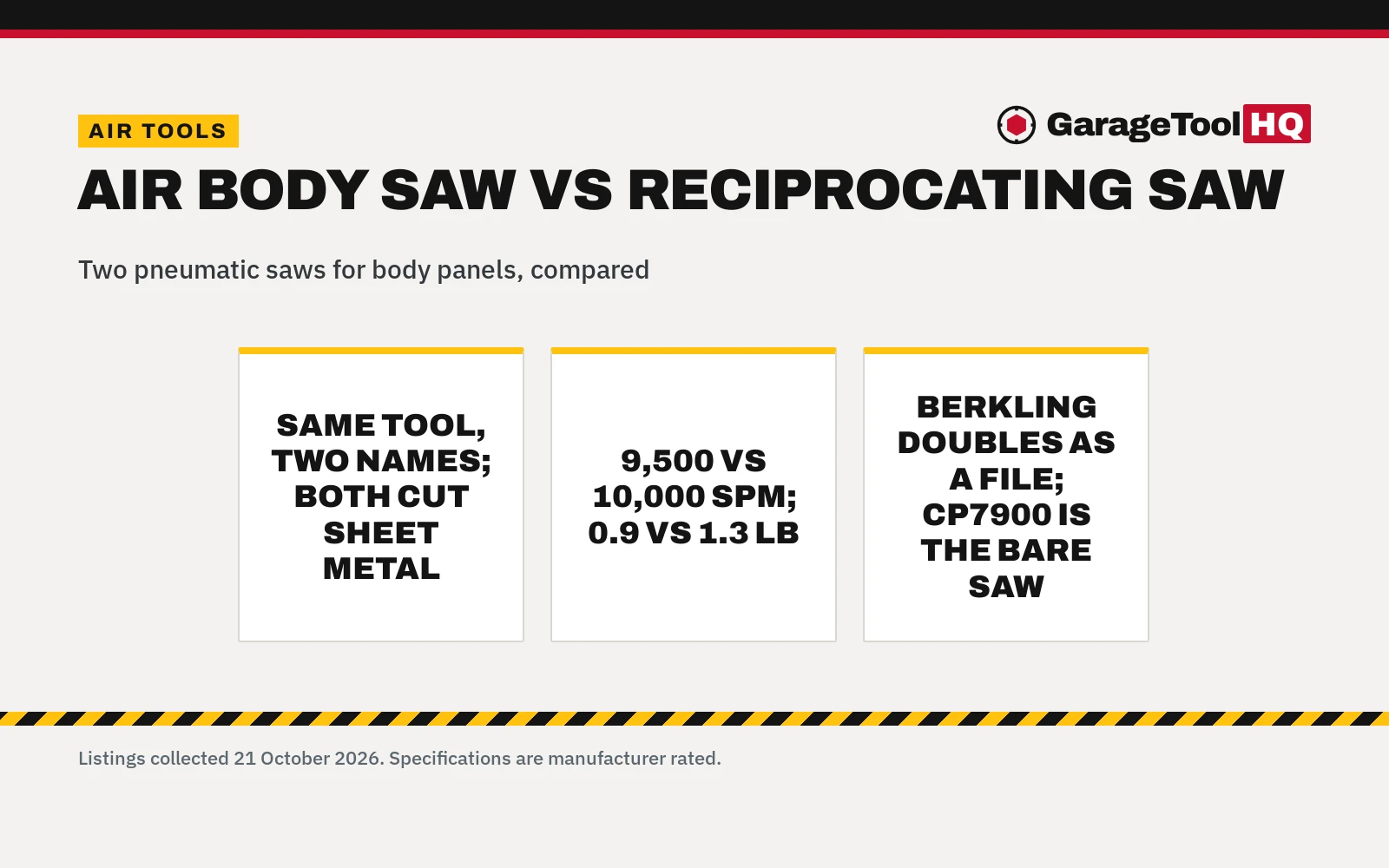
An air body saw vs reciprocating saw choice is simpler than it sounds: in the pneumatic world they are the same tool wearing two names: an air-powered saw that cuts sheet metal with a short, fast stroke. Body shops say “body saw” for the pneumatic version; “reciprocating saw” is the broader term that also covers electric and cordless saws. Of the two picks here, the Berkling 7102 runs at 9,500 SPM and doubles as a precision file, while the Chicago Pneumatic CP7900 runs at 10,000 SPM as a dedicated saw for body, exhaust and muffler work.
More options to compare
 Chicago Pneumatic CP7901Check price on Amazon
 Ingersoll Rand 529 3/8" Reciprocating Air Saw Features up to 9Check price on Amazon
 AIRCAT 6350 Low Vibration Reciprocating Air SawCheck price on Amazon
 Skil 9206-02 7.5-Amp Variable Speed Reciprocating SawCheck price on Amazon
 DEWALT Reciprocating SawCheck price on Amazon
 SKIL 13 Amp Corded Reciprocating Saw with Buzzkill TechnologyCheck price on Amazon
GarageToolHQ earns a commission when you buy through links on this page, at no extra cost to you. As an Amazon Associate I earn from qualifying purchases. affiliate disclosure.
The two picks: air body saw vs reciprocating saw
The Berkling 7102 is the dual-function pick: an air reciprocating saw and file in one body, at 9,500 SPM and 0.9 lb, that cuts sheet metal up to 3 mm (0.12 in). It ships with an 8-piece blade kit: three bi-metal reciprocating blades in 18T, 24T and 32T, plus five specialized files, with an Allen wrench and safety trigger included. The listing states vibration under 3 m/s2 and 88 dBA noise, with a rear exhaust that keeps air away from the work zone.
The Chicago Pneumatic CP7900 is the dedicated saw: 10,000 SPM, 1.3 lb, with a 3/8 in (10 mm) stroke length, aimed at body, exhaust and muffler work plus fiberglass, woodworking and demolition per the title. It includes one each of 18T, 28T and 32T replacement blades and ships as a bare tool. The spec table lists a one-year limited warranty.
Speed and cutting capacity
The CP7900 runs faster at 10,000 SPM against 9,500 for the Berkling. Only the Berkling states a cutting capacity: sheet metal up to 3 mm, stated as 0.12 in. The CP7900 states a 3/8 in (10 mm) stroke length instead; stroke length and cutting capacity are different figures, so do not read one as the other. For auto body panels, either speed gets the job done; the Berkling’s stated 3 mm capacity is the only hard limit published here.
Weight and handling
The Berkling is the lighter tool at 0.9 lb against 1.3 lb for the CP7900. The Berkling listing pairs that with an ergonomic rubberized grip and reduced vibration technology at 3 m/s2, aimed at longer cutting sessions. The CP7900 lists an ergonomic design for comfort and easy handling, with no vibration figure stated. In tight spots like wheel wells, the lighter tool with the lower stated vibration is easier to hold steady; the listings give the Berkling both edges.
Blades and extras
Blade count favors the Berkling: three bi-metal blades (18T, 24T, 32T) plus five files, against three blades (18T, 28T, 32T) on the CP7900. The Berkling’s file function is the real differentiator: after the cut, the same tool shapes and smooths the edge. The Berkling includes an integrated Allen wrench for quick blade changes; the CP7900 listing states no blade-change tool. The Berkling adds a safety trigger against accidental starts; the CP7900 listing states no trigger.
Warranty
Both listings state a one-year limited warranty: the Berkling spec table lists a manufacture one-year limited warranty, and the CP7900 lists a one-year limited warranty in both the spec table and the manufacturer description. Neither listing states more than that, so warranty does not separate them.
Which should you buy
Buy the Berkling 7102 if you want the file function and the lighter tool: 0.9 lb, vibration stated under 3 m/s2, eight blades and files in the box, and a safety trigger. It is the only pick here that shapes the edge after the cut. Buy the Chicago Pneumatic CP7900 if you want the dedicated saw with the higher stroke rate: 10,000 SPM and a 3/8 in stroke for steady cutting, from a maker whose listing targets body shops. Both carry a one-year limited warranty, so the decision comes down to the file function and weight against the extra speed. Neither listing states air consumption, so confirm your compressor against the manual before the first cut.
Either way, the name on the box matters less than the air behind it. Both are pneumatic, both cut sheet metal, and both ship with the blades to start. Match the tool to the work: filing and shaping favors the Berkling, pure cutting favors the CP7900.
Wear eye protection with every air tool, use impact-rated sockets on impact wrenches, disconnect the air line before changing accessories, and finish lug nuts with a torque wrench to the vehicle's spec. See OSHA eye and face protection. Read our Safety Disclaimer.
Frequently Asked Questions
What is the difference between an air body saw and a reciprocating saw?
In the air-tool world, mostly the name. “Body saw” is the auto-body shop term for a pneumatic reciprocating saw used on sheet metal. Note that “reciprocating saw” on its own is broader: it also covers electric and cordless saws, which are different tools. Both picks here are air-powered reciprocating saws.
Which of these cuts faster?
The Chicago Pneumatic CP7900 at 10,000 SPM against 9,500 for the Berkling 7102. Only the Berkling states a cutting capacity: sheet metal up to 3 mm (0.12 in).
Which is lighter?
The Berkling 7102 at 0.9 lb, against 1.3 lb for the CP7900. The Berkling also states vibration under 3 m/s2; the CP7900 states no vibration figure.
Which includes more blades?
The Berkling: three bi-metal reciprocating blades (18T, 24T, 32T) plus five files. The CP7900 includes three blades (18T, 28T, 32T).
Do these need an air compressor?
Yes. Both are pneumatic tools, per the listings, so they run off a shop air supply. Neither listing states an air consumption figure, so check the manual against your compressor. See what size air compressor for air tools.
What blades do they use?
Both use short reciprocating blades. The Berkling ships three bi-metal blades in 18T, 24T and 32T plus five files; the CP7900 ships 18T, 28T and 32T blades. Higher tooth counts suit thinner sheet; the listings do not state a blade length beyond the Berkling’s 6 in blade length in the spec table.
Related guides
See the best air body saw picks and our corded vs cordless reciprocating saw comparison. Also see the air tools hub.
More picks: air body saws, how to oil air tools and cordless reciprocating saws.