What Size Air Compressor Do I Need for Air Tools?
How to choose the right air compressor size for your pneumatic tools by matching airflow delivery at operating pressure, tank volume, and duty cycle.

On this page
Top picks at a glance
As an Amazon Associate we earn from qualifying purchases.
- 1
 California Air Tools 20020 2.0 HP Ultra Quiet and Oil-Free9.6/10View on Amazon
- 2
 ECOMAX 6 Gal Pancake Air Compressor 175PSI9.6/10View on Amazon
- 3
 Quiet Oil-Free Air Compressor9.5/10View on Amazon
- 4
 QWORK Air Compressor Pressure Switch for Pneumatic ToolsView on Amazon
- 5
 Klutch 60-Gallon Vertical Air CompressorView on Amazon
- 6
 NorthStar Quiet Electric Air CompressorView on Amazon
- 7
 Metabo HPT Portable Pancake Air CompressorView on Amazon
- 8
 Makita MAC2400 2.5 HP* Big Bore™ Air CompressorView on Amazon
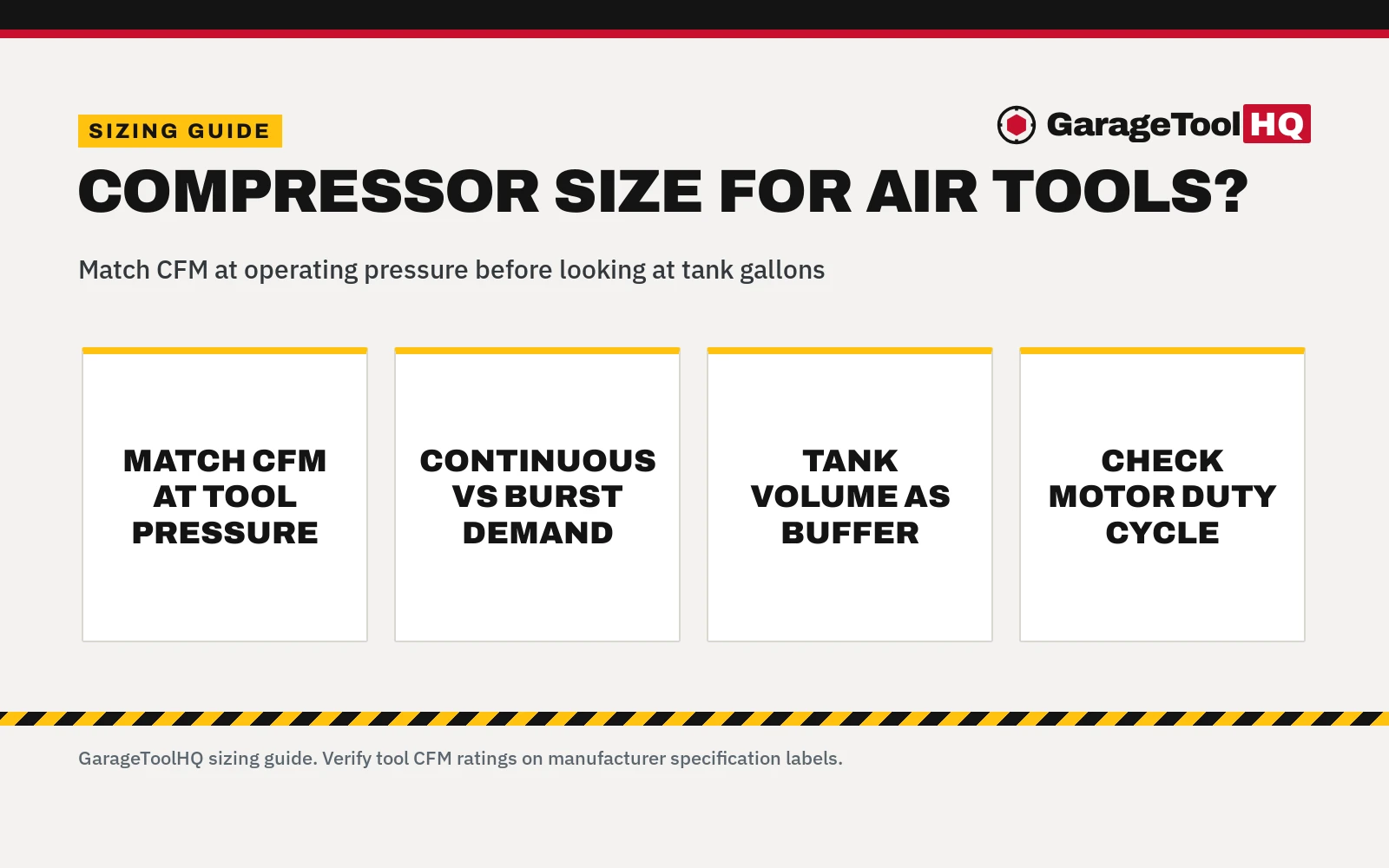
What size air compressor do I need for air tools? The right compressor size depends on the cubic feet per minute (CFM) requirement of your highest-demand tool at its operating pressure, rather than the tank volume alone. A small portable unit easily powers intermittent tools such as brad nailers or tire inflators, but continuous-demand tools like grinders, sanders, and paint sprayers require much greater airflow and larger receiver tanks. To choose the right compressor, match the tool’s required CFM at operating pressure, confirm the pressure in pounds per square inch (PSI), and select a compressor pump that exceeds that consumption rate.
More options to compare
 QWORK Air Compressor Pressure Switch for Pneumatic ToolsCheck price on Amazon
 Klutch 60-Gallon Vertical Air CompressorCheck price on Amazon
 NorthStar Quiet Electric Air CompressorCheck price on Amazon
 Metabo HPT Portable Pancake Air CompressorCheck price on Amazon
 Makita MAC2400 2.5 HP* Big Bore™ Air CompressorCheck price on Amazon
GarageToolHQ earns a commission when you buy through links on our product pages, at no extra cost to you. Read our affiliate disclosure.
Below: how airflow delivery and pressure ratings dictate compressor sizing, how continuous and intermittent air tools differ, a step-by-step sizing checklist, and essential workshop electrical and pressure safety requirements.
What size air compressor do I need for air tools? Why airflow delivery matters most
Many garage owners assume that tank volume determines what air tools a compressor can run. In reality, the pump’s airflow delivery rate, measured in cubic feet per minute (CFM), dictates whether a tool functions or stalls. Tank storage acts as a temporary buffer, but once you deplete that stored volume, your tool relies entirely on the output of the pump.
Air tools consume air at specific operating pressures, almost always measured in pounds per square inch (PSI). Because air compresses under load, a pump produces fewer CFM as tank pressure rises. Sizing a compressor requires balancing several key specifications:
- Airflow delivery (CFM at operating pressure). Pneumatic tools specify their air consumption at a rated pressure, commonly 90 PSI for mechanical shop equipment or 40 PSI for paint guns. For example, the Limodot air compressor listing states an airflow delivery of 2.8 CFM at 90 PSI and 4 CFM at 40 PSI, illustrating how delivery volume falls as working pressure climbs.
- Operating pressure (PSI). Most automotive air tools require sustained pressure between 80 and 120 PSI to deliver full rated performance. If line pressure dips below the tool’s minimum requirement, impact wrenches lose torque and pneumatic ratchets slow down.
- Tank receiver capacity. Tank volume, measured in gallons, buffers brief surges in air demand. For example, the Limodot listing features a 5-gallon tank, which provides an adequate air reserve for short fastener runs or inflation jobs, but empties rapidly under steady consumption.
- Duty cycle and pump recovery. Consumer compressor pumps generate significant heat during compression. A pump’s recovery time dictates how quickly it restores pressure between cycles. The Limodot listing publishes an 80 seconds refill time from empty to full pressure and a 25 seconds recovery time during cyclical operation.
Air tool categories and their compressor sizing demands
Pneumatic tools fall into distinct categories based on their air consumption patterns. Matching your compressor to your shop workflow requires identifying whether your primary tools run intermittently or continuously.
| Tool Category | Air Consumption Pattern | Compressor Sizing Requirement |
|---|---|---|
| Fastening tools (brad nailers, framing nailers, staple guns) | Intermittent, single-shot bursts with recovery intervals between cycles | Small portable compressor with modest CFM output and small tank volume |
| Intermittent automotive tools (impact wrenches, pneumatic ratchets) | Short bursts during fastener loosening and installation | Moderate CFM delivery matching tool rating at 90 PSI; mid-sized buffer tank |
| Continuous rotary tools (die grinders, cut-off tools, orbital sanders) | Steady, uninterrupted air consumption while the throttle remains depressed | High sustained CFM delivery exceeding tool demand; large receiver tank |
| Surface prep and spraying (HVLP paint guns, industrial blow guns) | High-volume continuous air draw requiring constant pressure | High continuous CFM output; large stationary compressor setup |
High-volume air accessories demonstrate why continuous tools demand substantial compressor capacity. For example, the JASTIND high-volume air blow gun listing specifies an airflow rating of 17.7 CFM at an 80 to 120 PSI suggested working pressure, with a maximum pressure of 110 PSI. Running a tool with such high air demand on a small portable compressor exhausts the tank buffer within moments, causing line pressure to drop immediately.
How to size an air compressor for your tools: the step-by-step checklist
- Check your tool’s data plate for CFM. Locate the manufacturer specification plate on your air tool or review the technical specifications in the manual. Find the required CFM rating and the pressure at which it is measured.
- Identify your highest-demand tool. List every air tool you plan to operate. Sizing your compressor around your tool with the largest airflow demand ensures your entire tool collection functions properly.
- Classify the tool demand as intermittent or continuous. Determine whether the tool operates in short bursts, such as an impact wrench or nailer, or runs continuously, such as a die grinder, orbital sander, or paint spray gun.
- Compare compressor CFM delivery at 90 PSI. Verify that the compressor pump delivers more CFM at 90 PSI than your highest-demand tool requires. As shown on the Limodot compressor listing, pump delivery drops as pressure increases, making the 90 PSI figure the essential benchmark.
- Select an adequate receiver tank volume. Choose a tank size that provides a steady air buffer for your operating habits. Intermittent tools work well with smaller tanks, while continuous tools require larger receiver volumes to prevent rapid pressure dips.
- Check the motor duty cycle rating. Standard consumer compressors often carry a limited duty cycle, meaning the pump must rest between run periods. Ensure the compressor capacity prevents the motor from running nonstop during heavy work sessions.
- Inspect air hoses and quick-connect fittings. Compressed air lines and fittings create restriction. For example, the WYNNsky listing provides 1/4-inch fittings and a 25-foot line rated for up to 200 PSI, which suits light to medium air demands without excessive pressure drop.
- Plan workshop electrical capacity. Review the compressor voltage and amp draw on the product label. Sizing electrical circuits for high-draw shop machinery requires proper wire gauge and breaker protection; hire a licensed electrician to install dedicated shop wiring.
Every pressurized air receiver tank requires an operational ASME safety pressure relief valve. Never tamper with, adjust, plug, or bypass this valve to increase tank pressure. A stuck or altered valve creates an explosion hazard if the pressure switch fails to shut off the motor.
Drain the tank after use so water does not rust it from the inside, never exceed the tool's rated pressure, wear eye protection, and run 240V units on the circuit the manual calls for. Do not run a gas engine compressor in a closed garage. Read our Safety Disclaimer.
CFM delivery vs tank volume: which matters more?
When selecting workshop equipment, buyers frequently debate whether to prioritize pump airflow or tank storage. Understanding how these components interact helps prevent buyer regret:
- CFM determines continuous capability. If you operate continuous tools like sanders or grinders, the motor and pump must keep up with air consumption in real time. A large tank will only delay the inevitable pressure drop if the pump produces less CFM than the tool draws.
- Tank volume determines buffer capacity. For intermittent tools like a heavy-duty air impact wrench or a compact air ratchet, a larger tank provides a steady cushion that absorbs short, aggressive bursts of air without cycling the motor on and off repeatedly.
- Pump horsepower drives air generation. Motor horsepower directly influences pump output. For example, the Limodot compressor listing pairs a 1.2 HP motor with a 5-gallon tank to produce its 2.8 CFM at 90 PSI rating. In commercial and heavy garage compressors, larger motors generate substantially higher airflow.
- Duty cycle limits run time. Compressors with lower duty cycles require extended cool-down periods. Running an undersized compressor continuously to power high-demand tools overheats the pump seals and causes premature motor failure.
If you plan to run multiple automotive air tools or tackle frequent vehicle repairs, explore our comprehensive guide to the best air compressor for home garage setups, where we review matched systems designed for home mechanics.
Electrical power supply and pressure vessel safety
Air compressors are among the most demanding electrical loads in a residential garage. Electric motors draw substantial starting inrush current when kicking on against tank pressure. Sizing electrical circuits correctly ensures reliable operation and protects your home from electrical hazards:
- Dedicated circuits: Small portable compressors often operate on standard 110-volt circuits, as indicated on the Limodot listing specifying 110 volts alternating current. However, larger shop compressors require dedicated high-voltage electrical service. Always consult a licensed electrician to evaluate your panel capacity and install dedicated wiring rather than attempting DIY electrical modifications.
- Extension cord hazards: Never use long, undersized extension cords with an air compressor. Undersized cords cause voltage drop, which starves the motor, trips thermal overload switches, and can ruin motor windings. If you need extended reach, run longer air hoses rather than longer electrical cords.
- Tank pressure safety: Compressors store air under high pressure. Ensure the tank bears an ASME certification stamp indicating pressure vessel compliance. Never operate a tank beyond its maximum rated pressure, such as the 120 PSI limit stated on the Limodot listing or the 110 PSI maximum pressure on the JASTIND blow gun listing.
- Moisture management: Compressing atmospheric air causes ambient humidity to condense inside the tank. Drain the bottom tank valve daily after shop use. Accumulated water reduces internal air volume and corrodes steel tank walls from the inside out.
- Pressure gauge ratings: Always verify that tire inflators and accessory gauges match shop pressure ranges. The Spurtar tire inflator listing specifies a working range of 10 to 120 PSI, while the AZUNO digital inflator listing handles up to 200 PSI. For general shop use, the Hausse accessory kit listing features a dial spanning 0 to 220 PSI while recommending a maximum operating pressure of 140 PSI.
Frequently Asked Questions
Can a 5-gallon air compressor run air tools?
Yes, for intermittent tools and inflation tasks. The Limodot listing illustrates a 5-gallon compressor delivering 2.8 CFM at 90 PSI, which easily supports brad nailers, staplers, tire inflators, and short blow gun clean-up. However, a 5-gallon tank cannot keep up with continuous tools like die grinders, orbital sanders, or paint guns, which drain small tanks within seconds.
What is the difference between CFM at 90 PSI and CFM at 40 PSI?
CFM measures airflow volume, while PSI measures air pressure. Because air compresses under load, pumps deliver more air volume at lower pressures. For example, the Limodot listing delivers 4 CFM at 40 PSI but drops to 2.8 CFM at 90 PSI. Most mechanical air tools specify airflow demand at 90 PSI, while paint spray equipment typically rates at 40 PSI.
Does a larger tank size increase compressor CFM?
No. Tank size only determines how much compressed air you store before line pressure drops. The compressor motor and pump determine airflow delivery (CFM). A larger tank delays motor startup during short tool runs, but once depleted, the pump must produce enough CFM to sustain the tool’s operating requirements.
What size air compressor do I need to run an air impact wrench?
Sizing depends on the specific tool rating in the manufacturer manual. Because impact wrenches fire in short bursts during fastener removal, a compressor that meets or exceeds the tool’s CFM rating at 90 PSI with a moderate receiver tank provides reliable operation. For continuous shop work, choose a setup with ample CFM reserve and tank capacity.
Why does an air compressor run continuously while using tools?
A compressor runs continuously when tool consumption exceeds the pump’s CFM delivery rate, or when air leaks bleed pressure from hoses and fittings. When tool demand outpaces pump capacity, tank pressure drops below the cutoff threshold, preventing the pressure switch from shutting off the motor and risking pump overheating.
What electrical circuit does a shop air compressor require?
Electrical requirements depend on the compressor motor rating. While compact models operate on 110-volt household circuits, larger shop units draw substantial amperage and require dedicated high-voltage lines. Always verify electrical requirements on the product specification plate and hire a licensed electrician to install dedicated shop circuits.
Related: how to choose an air compressor, our air compressors hub, the air tools category, and our guide to the best air compressor for impact wrench applications.