How to Choose an Air Compressor: What Size Do You Need?
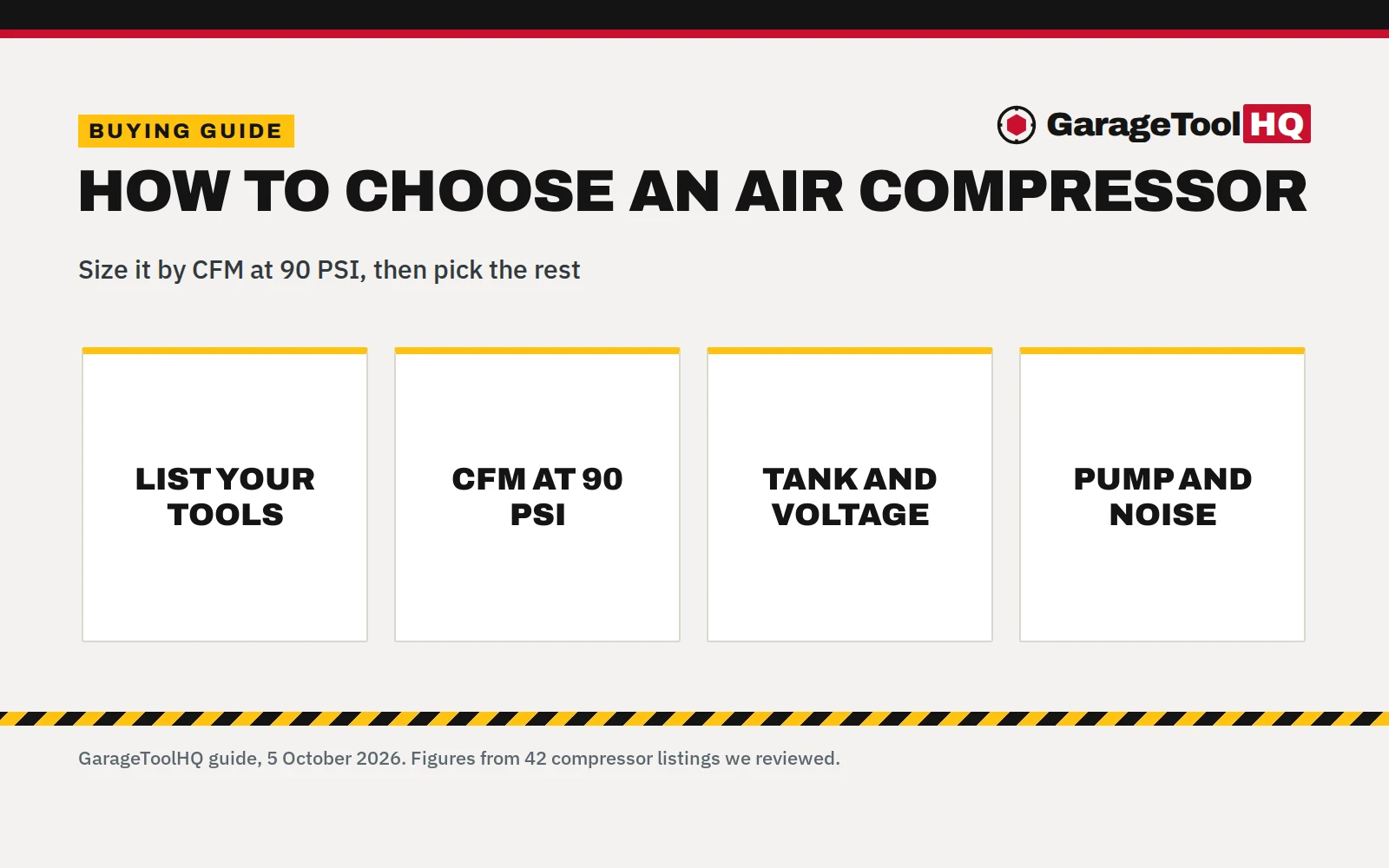
A step-by-step way to size an air compressor for your garage: list your tools, match CFM at 90 PSI, then choose tank, pressure, voltage, pump type and noise.

On this page
Top picks at a glance
As an Amazon Associate we earn from qualifying purchases.
- 1
 Stealth Air Compressor 2 Gallon9.7/10View on Amazon
- 2
 Ingersoll Rand P1.5IU-A9 2 HP Single-Stage Air Compressor9.7/10View on Amazon
- 3
 Campbell Hausfeld 80-Gallon Vertical Electric Air Compressor9.7/10View on Amazon
- 4
 Metabo HPT Portable Pancake Air CompressorView on Amazon
- 5
 Makita MAC2400 2.5 HP* Big Bore™ Air CompressorView on Amazon
- 6
 DEWALT Air Compressor for TrimView on Amazon
- 7
 VEVOR 5HP Air Compressor Electric MotorView on Amazon
- 8
 Klutch 20-Gallon Air CompressorView on Amazon
- 9
 Stark USA 3.5HP 10 Gallons Air Compressor Tank Ultra QuietView on Amazon
Most people pick an air compressor by tank size or horsepower. Both mislead. The number that decides whether a compressor keeps up with your tools is CFM at 90 PSI, and everything else, tank, voltage, pump type, follows from it. This guide walks through the decisions in the order that saves money, using what we found reading 42 compressor listings, and links to the guide that fits each answer.
More options to compare
 Metabo HPT Portable Pancake Air CompressorCheck price on Amazon
 Makita MAC2400 2.5 HP* Big Bore™ Air CompressorCheck price on Amazon
 DEWALT Air Compressor for TrimCheck price on Amazon
 VEVOR 5HP Air Compressor Electric MotorCheck price on Amazon
 Klutch 20-Gallon Air CompressorCheck price on Amazon
 Stark USA 3.5HP 10 Gallons Air Compressor Tank Ultra QuietCheck price on Amazon
GarageToolHQ earns a commission when you buy through links on our product pages, at no extra cost to you. Read our affiliate disclosure.
Step 1: List the tools you will run
Write down every air tool you own or plan to buy, and note whether it runs in short bursts or continuously. Typical air use at 90 PSI:
| Tool | Typical CFM @ 90 PSI | Use |
|---|---|---|
| Tire inflator, brad nailer | 0.3 to 2 | Bursts |
| Blow gun | 2.5 to 4 | Bursts |
| 3/8 in air ratchet | 2.5 to 4.5 | Bursts |
| 1/2 in impact wrench | 4 to 5 | Bursts |
| Die grinder, cut-off tool | 4 to 6 | Continuous |
| DA sander | 6 to 13 | Continuous |
| HVLP spray gun | 7 to 13 | Continuous |
| Sandblaster | 10 to 20 | Continuous |
These are general ranges. Your tool’s manual gives its exact figure, and that is the number to use.
Step 2: Size by CFM at 90 PSI, plus margin
Take the hungriest tool you will run (or add tools together if two run at once) and add a safety margin of about 25 percent for hoses, fittings and wear. That is the CFM at 90 PSI to shop for. The calculator below does the math.
Listings often lead with CFM at 40 PSI, which is always higher. Of the 42 listings we read, 26 stated CFM at 90 PSI; some smaller units gave only horsepower and tank size. Compare only the 90 PSI figure.
Step 3: Choose the class of compressor
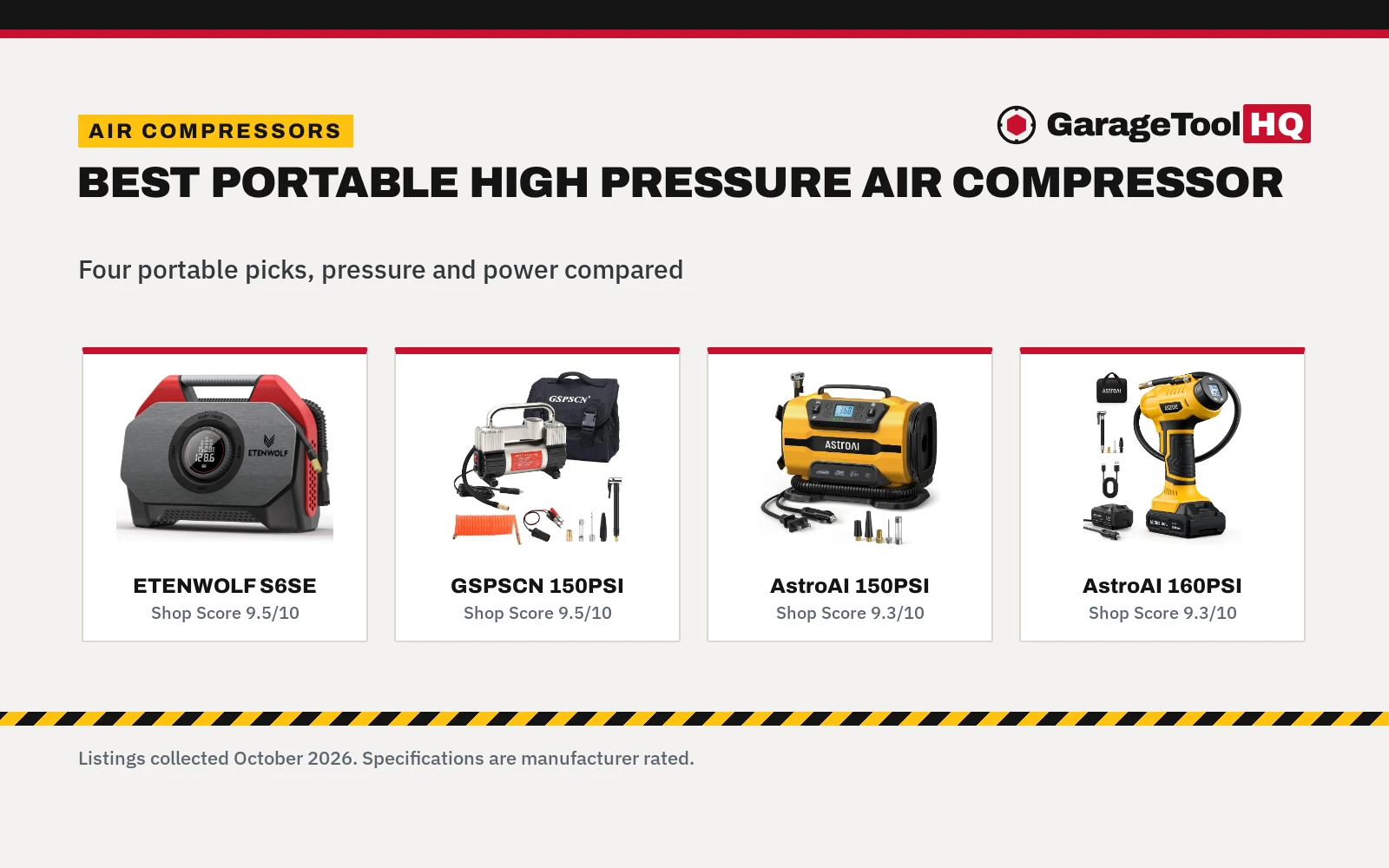
- Up to about 4 CFM: a pancake or compact portable for tires, nailers and blow guns. See the best portable air compressor under $300.
- About 4.5 to 6 CFM: a 20 to 30 gallon 120V unit for impact wrenches and ratchets. See the best air compressor for an impact wrench.
- 10 to 16 CFM: a 60 to 80 gallon 240V stationary compressor for sanders, spray guns and blasting. See the best air compressor for a home garage.
Step 4: Tank size and maximum pressure
The tank stores air; it does not make more. A bigger tank lets burst tools run longer before the pump starts, and a higher maximum pressure (175 to 200 PSI instead of 125 to 150) stores more usable air in the same tank. For continuous tools, tank size cannot make up for a pump that is too small.
Step 5: 120V or 240V
In the listings we read, 120V compressors topped out around 5 to 5.3 CFM at 90 PSI and drew up to about 15 amps, so give them a dedicated circuit. Every 60 and 80 gallon unit ran on 208 to 240V. If you need more than about 6 CFM, plan for a 240V circuit before you buy.
Step 6: Oil-free or oil-lubricated
Oil-free pumps need no oil and suit occasional use, but they run hotter and louder and wear faster under long duty. Oil-lubricated cast-iron pumps cost more and need oil changes but last far longer; two stationary units we reviewed are rated for 100 percent continuous duty. Two-stage pumps reach 175 PSI and store more air; single-stage is enough for most home garages.
Step 7: Noise
Stated noise in our listings ran from 68 dB for quiet-series 20 gallon units to 86 dB for big stationary compressors. Every 10 dB sounds roughly twice as loud, which matters in an attached garage.
Step 8: Hose, fittings and placement
Use a 3/8 in hose for impact wrenches and anything air hungry, high-flow couplers, and a water separator before a spray gun. Put a stationary compressor on level concrete with room around it to cool, and check its height: some stand 7 feet tall.
Red flags on a listing
- Only CFM at 40 PSI, or “displacement” CFM, with no 90 PSI figure.
- “Peak” horsepower with no CFM at all.
- No warranty term. Only a minority of the listings we read stated a clear one.
- Conflicting figures between the title, the bullet points and the specification table.
Not every job needs air. For tire changes alone, a cordless impact wrench skips the compressor entirely.
Drain the tank after use so water does not rust it from the inside, never exceed the tool's rated pressure, wear eye protection, and run 240V units on the circuit the manual calls for. Do not run a gas engine compressor in a closed garage. Read our Safety Disclaimer.
Frequently Asked Questions
What size air compressor do I need for a home garage?
For tires and nailers, a 6 gallon pancake with 2.5 to 4 CFM at 90 PSI. For impact wrenches, a 20 to 30 gallon unit with about 5 CFM at 90 PSI. For sanders and painting, a 60 to 80 gallon 240V compressor with 10 to 16 CFM at 90 PSI.
Is a bigger tank better?
Only for burst tools. A bigger tank means fewer pump cycles, but CFM at 90 PSI decides whether a compressor can keep up with continuous tools.
How much CFM do I need for an impact wrench?
A 1/2 in impact wrench typically uses about 4 to 5 CFM at 90 PSI. With a 25 percent margin, look for about 6 CFM at 90 PSI.
Can I run a DA sander on a 20 gallon compressor?
Only briefly. DA sanders use about 6 to 13 CFM continuously, more than any 120V compressor we reviewed can supply for long. A 60 gallon 240V unit is the right match.
What does duty cycle mean?
The share of time a compressor can run without overheating. Many oil-free units are meant for intermittent use; some oil-lubricated stationary units are rated for 100 percent continuous duty.
Related: the best portable air compressor under $300, the best air compressor for an impact wrench, the best air compressor for a home garage, our air compressor hub and the CFM calculator.