1.6 vs 2.0 GPM Pressure Washer: Which One Should You Buy?
1.6 or 2.0 GPM? Flow decides rinsing speed, foam work and water use at equal pressure. Three 2.0 GPM electric washers for car care compared.

On this page
Top picks at a glance
As an Amazon Associate we earn from qualifying purchases.
- 1
 Westinghouse ePX3100v Electric Pressure Washer9.8/10View on Amazon
- 2
 Greenworks 3000 PSI9.7/10View on Amazon
- 3
 Westinghouse ePX3500 Electric Pressure Washer9.6/10View on Amazon
- 4
 Active 2.0 GPM Electric High-Pressure WasherView on Amazon
- 5
 Greenworks 1600 PSIView on Amazon
- 6
 CRAFTSMAN Electric Pressure WasherView on Amazon
- 7
 AgiiMan Pressure Washer PumpView on Amazon
- 8
 Greenworks 2000 PSIView on Amazon
- 9
 Greenworks 1500 PSI 1.2 GPM Pressure WasherView on Amazon
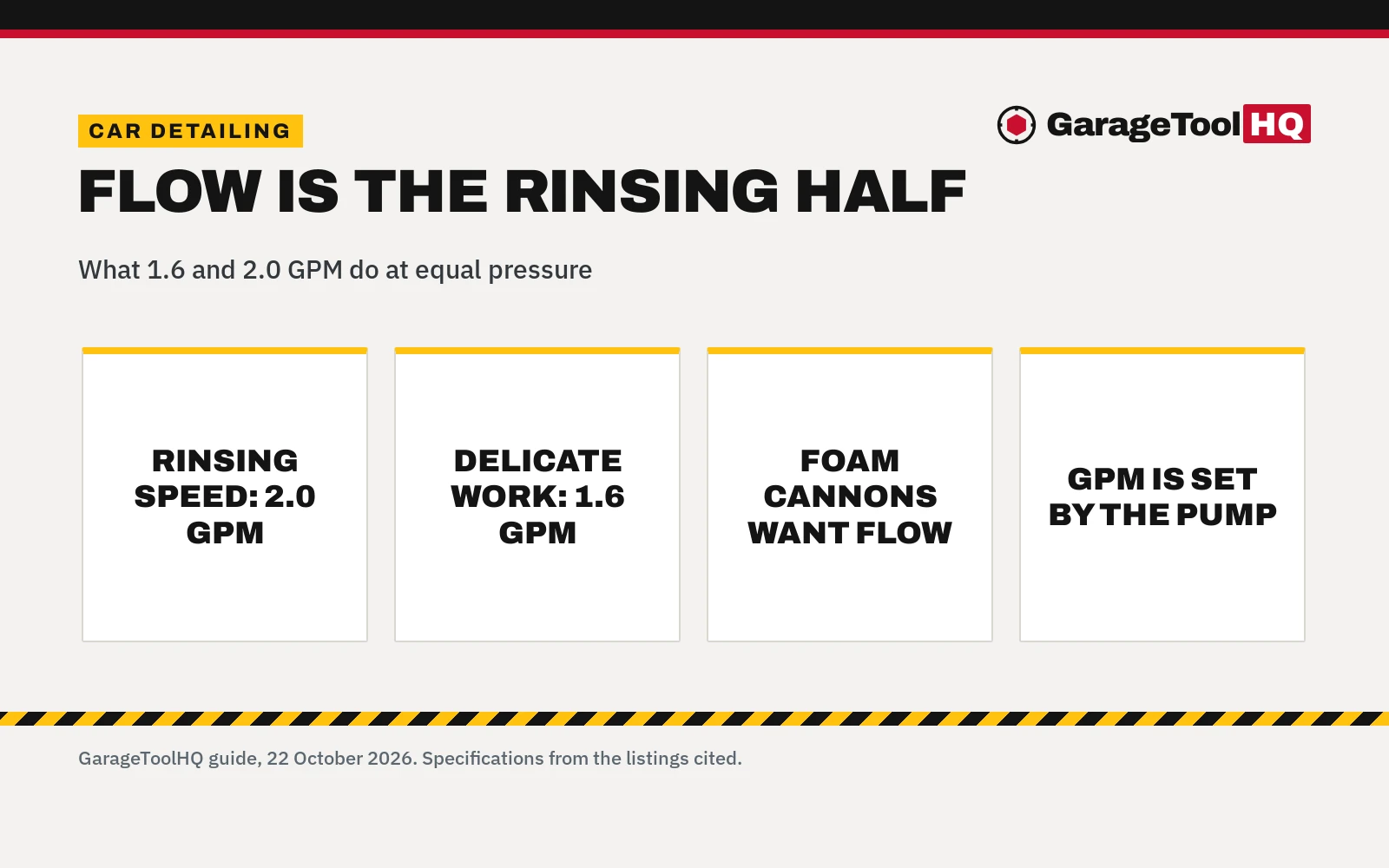
1.6 vs 2.0 GPM pressure washer: which flow rate should you buy? Buy 2.0 GPM if you rinse whole cars, driveways and patios and want foam and dirt to move fast. Buy 1.6 GPM if your work is smaller, slower and closer: bikes, patio furniture, delicate surfaces, and homes where water use matters. GPM is the water volume the machine moves per minute, and it is the rinsing half of the cleaning equation; PSI is the pressure half, and the two are not interchangeable.
More options to compare
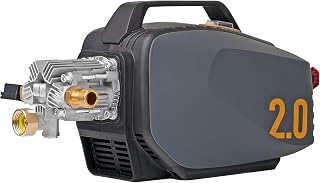 Active 2.0 GPM Electric High-Pressure WasherCheck price on Amazon
 Greenworks 1600 PSICheck price on Amazon
 CRAFTSMAN Electric Pressure WasherCheck price on Amazon
 AgiiMan Pressure Washer PumpCheck price on Amazon
 Greenworks 2000 PSICheck price on Amazon
 Greenworks 1500 PSI 1.2 GPM Pressure WasherCheck price on Amazon
GarageToolHQ earns a commission when you buy through links on our product pages, at no extra cost to you. Read our affiliate disclosure.
Below: what the flow difference does in practice, where each rate wins, the three electric washers in the current listings (all of them 2.0 GPM machines), and the questions buyers ask before choosing.
1.6 vs 2.0 GPM pressure washer: what flow actually does
Pressure knocks dirt loose; flow carries it away. A washer’s GPM rating is how much water passes through the pump each minute at its rated pressure, and it decides how fast a panel rinses clean, how well a foam cannon lays and lifts foam, and how quickly a driveway sheds its slurry. At equal PSI, the 2.0 GPM machine moves a quarter more water than the 1.6, so the same rinse takes fewer passes. The cost of that speed is water: the higher-flow machine empties its supply faster and asks more of a weak well or a long garden hose run.
| 1.6 GPM | 2.0 GPM | |
|---|---|---|
| Rinsing speed | Slower; more passes on large panels | Faster; sheets water and foam off in fewer passes |
| Foam cannon work | Works, with thinner foam dwell | Feeds a foam cannon at full flow for thicker foam |
| Water use | Less water per minute of trigger time | More water per minute; faster jobs offset some of it |
| Feel on the wand | Gentler, easier to hold on small work | Stronger push and quicker coverage |
| Best work | Bikes, furniture, screens, delicate washing | Cars, driveways, patios, RVs and fences |
Where 1.6 GPM wins
- Small and delicate jobs. Motorcycles, bicycles, outdoor furniture and screens want rinsing, not blasting; lower flow is easier to meter at close range.
- Water-limited homes. Wells, long hose runs and drought rules all favor the machine that sips rather than gulps.
- Short sessions. A quick wash of one car panel or a set of wheels does not repay the bigger machine’s flow; the job ends before the speed matters.
Where 2.0 GPM wins
- Whole-car washing and detailing. Rinsing is half the wash, and 2.0 GPM is the flow the detailing listings below are built around, the CAT’s gun-mounted foam blaster included.
- Flatwork. Driveways, patios and walkways are all rinse work: pressure breaks the film loose, but flow is what carries the slurry off, so the rinse half of the job runs at the speed of the water leaving the nozzle.
- Bigger vehicles. RVs, trucks and fences present more square feet per job, and flow is what turns area into time saved.
The gear: three 2.0 GPM electric washers
No 1.6 GPM machine is in the current listings; all three are 2.0 GPM electrics, ranked by what they state.
1. CAT Electric Pressure Washer, 2.0 GPM
The fullest kit here. The listing states a patented 5-piston pump with a Total Stop System that halts the pump on trigger release, a 600mL detergent bottle that mounts on the gun as a foam blaster, four spray tips (0, 15, 25 and 40 degrees) on an M22-15mm connection, a 20 foot hose, a 35 foot power cord with an integrated GFCI plug, 8 inch wheels and a folding handle, at 1800 PSI and 13 amps. CAT states a 2-year residential warranty covering the unit and all accessories, and the table lists CSA as the specification met. Who it fits: a detailer who wants the foam blaster, the tip set and the long GFCI cord in one box.
2. Active 2.0, Full Kit (AP_PW)
The same Active unit as the pick below, sold as the complete kit: the listing states it arrives with all included hoses, nozzles and accessories for immediate use. The shared machine is a 2.0 GPM, 1800 peak PSI, 15 amp washer on a patented 5-piston pump, with universal threading (3/4 inch GHA on the garden side, M22-14mm on the pressure side) for aftermarket hoses and tools, in a compact 16 by 9 by 8 inch body. The warranty is a stated 2-year residential use warranty. Note the ratings split: the bullets headline 1800 peak PSI while the spec table gives a maximum pressure of 1500 psi, so plan around the table figure. Who it fits: a car-care buyer who wants the detailing brand’s kit complete on day one.
3. Active 2.0 (AP_PW)
The base listing of the same AP_PW machine: 2.0 GPM, 1800 peak PSI in the bullets and 1500 psi maximum in the table, 15 amps, the 5-piston pump with swap-friendly internals, the same universal connections, a 20 foot hose and a stated weight of 24 pounds. The 2-year residential warranty is stated here too. Against the full kit above, the difference is the bundle, not the washer: this listing is the unit and its standard fittings. Who it fits: a buyer who already owns nozzles, a foam cannon and hoses, and wants the pump itself.
Can you change a washer’s GPM with a different nozzle?
No, not in the way the rating means. A machine’s GPM is set by its pump at its rated pressure; nozzle tips change the spray pattern and the pressure at the surface, and an undersized tip can throttle flow down, but no tip turns a 1.6 GPM pump into a 2.0. Buy the flow you need in the machine, then tune the pattern with tips, like the four tips in the CAT kit.
Keep electric pressure washers on a GFCI outlet, never point the wand at people or pets, wear eye protection with polishers and chemicals, and read the label before mixing any cleaning products. Read our Safety Disclaimer.
Frequently Asked Questions
Is 2.0 GPM too much for washing a car?
No. The three listings here are 2.0 GPM machines sold for car care and detailing, and both Active listings call the unit paint-safe. Flow is not what damages paint; pressure at close range is, which the fan tips and working distance control.
Which matters more, GPM or PSI?
They do different halves of the job: PSI breaks dirt loose and GPM rinses it away. For car washing and flatwork, flow is usually the felt difference, because the pressure of home electrics clusters in a narrow band (1800 peak PSI across all three listings here) while flow is what separates a 1.6 GPM machine from a 2.0 GPM one.
Does 2.0 GPM use a lot more water?
Per minute of trigger time, yes, a quarter more than 1.6 GPM by the ratings themselves. Per job, less than that suggests, because the rinse finishes in fewer passes; the trigger time is shorter on the same car or driveway.
Can a 1.6 GPM washer run a foam cannon?
Yes, with less flow through the cannon than a 2.0 GPM machine gives it, so foam lays thinner and rinses sooner. The CAT listing here pairs its 2.0 GPM machine with a gun-mounted 600mL foam blaster, which is the combination the detailing listings are built around.
What warranty do these washers carry?
All three listings state a 2-year residential warranty: CAT’s covers the full unit and all accessories, and both Active listings state a 2-year residential use warranty.
Related: our best electric pressure washer for cars, the best foam cannon for a pressure washer and the car detailing hub.