Flap Disc vs Sanding Disc: Which One Should You Buy?
Flap disc vs sanding disc compared by tool fit, grit range, abrasive and dust control, with one flap disc and two sanding disc examples from the listings.

On this page
Top picks at a glance
As an Amazon Associate we earn from qualifying purchases.
- 1
 Flap Discs 4 1/2 Inch 5-Pack9.6/10View on Amazon
- 2
 SHALL Right Angle Die Grinder9.5/10View on Amazon
- 3
 100Pcs 5 Inch Sanding Discs Hook & Loop 8-Hole Wet Dry9.6/10View on Amazon
- 4
 EZARC Zirconia Flap Discs 40 GritView on Amazon
- 5
 100PCS 6 Inch 150mm 6 Hole Sanding Discs Sandpaper Mixed GritsView on Amazon
- 6
 EXKRAEFT Flap Discs 4 1/2 for Angle GrinderView on Amazon
- 7
 6-Inch PSA Sanding DiscsView on Amazon
- 8
 S SATC 20PCS Flap Discs 4 1/2 for Angle Grinder 40/60/80/120View on Amazon
- 9
 Flap Discs 4 1/2 for Angle GrinderView on Amazon
Verdict: Choose a flap disc if you grind welds, bevel edges or strip metal on an angle grinder and want aggressive stock removal. Choose a sanding disc if you sand and polish with a random orbital sander and want fine grits and a smooth finish.
Both take material off, but they mount on different tools and work in different ways. This flap disc vs sanding disc comparison covers both sides: a flap disc is overlapping abrasive flaps on a rigid backing for an angle grinder, while a sanding disc is a hook-and-loop paper disc for a random orbital sander. Then we look at one flap disc and two sanding disc examples from the listings reviewed.
GarageToolHQ earns a commission when you buy through links on this page, at no extra cost to you. Read our affiliate disclosure.
Flap Discs 4 1/2 Inch 5-Pack,4.5" x 7/8" Premium
A 5-pack of 4.5 in Type 29 zirconia flap discs in 40, 60, 80 and 120 grit, with a 7/8 in arbor and a 13,300 RPM rating for angle grinders.
Pros
- Zirconia abrasive stated for strength and life
- Type 29 bevel for contours and weld blending
- 13,300 RPM rating stated
- 4 grits in one 5-pack
Cons
- No warranty term stated
- Coarsest finish of the three at 120 grit
- 4.5 in size fits grinders only
- 2 of the 5 discs are 40 grit

S SATC 72 PCS 5 Inch 8 Hole Hook and Loop Adhesive
Seventy-two 5 in 8-hole hook-and-loop sanding discs in 40 to 320 grit, aluminum oxide with a stearate anti-clog coating, for random orbital sanders.
Pros
- 72 discs with a clear grit breakdown
- 40 to 320 grit range stated
- Stearate coating resists clogging
- 8-hole dust extraction stated
Cons
- No warranty term stated
- Spec table lists Grit Number 800, contradicting the 40-320 title
- No max speed stated
- Aluminum oxide, not zirconia

165 PCS 5 Inch Sanding Discs Random Orbital Sander
One hundred sixty-five 5 in 8-hole hook-and-loop sanding discs in 40 to 600 grit, aluminum oxide, for random orbital sanders and rotary tools.
Pros
- 165 discs, the largest count here
- 40 to 600 grit range stated
- 8-hole dust extraction stated
- Aluminum oxide, clog-resistant stated
Cons
- No warranty term stated
- Grit breakdown garbled; spec table says 120, title says 40-600
- No max speed stated
- 5 in size fits sanders only
More options to compare
 EZARC Zirconia Flap Discs 40 GritCheck price on Amazon
 100PCS 6 Inch 150mm 6 Hole Sanding Discs Sandpaper Mixed GritsCheck price on Amazon
 EXKRAEFT Flap Discs 4 1/2 for Angle GrinderCheck price on Amazon
 6-Inch PSA Sanding DiscsCheck price on Amazon
 S SATC 20PCS Flap Discs 4 1/2 for Angle Grinder 40/60/80/120Check price on Amazon
 Flap Discs 4 1/2 for Angle GrinderCheck price on Amazon
Flap disc vs sanding disc: side by side
| Flap disc | Sanding disc | Notes | |
|---|---|---|---|
| Example | PRVEW 4.5 in 5-pack | S SATC 5 in 72-pack | Both from the listings |
| Mounting | 7/8 in arbor, angle grinder | Hook and loop, orbital sander | Per each listing |
| Grits | 40/60/80/120 | 40 to 320 | POTUINOM runs 40 to 600 |
| Abrasive | Zirconia | Aluminum oxide | As stated |
| Max speed | 13,300 RPM stated | Not stated | Flap disc example only |
| Disc size | 4.5 in | 5 in | Per each listing |
| Pack count | 5 | 72 | POTUINOM holds 165 |
Example figures are manufacturer rated, as published on each listing and collected 21 October 2026.
How each one works
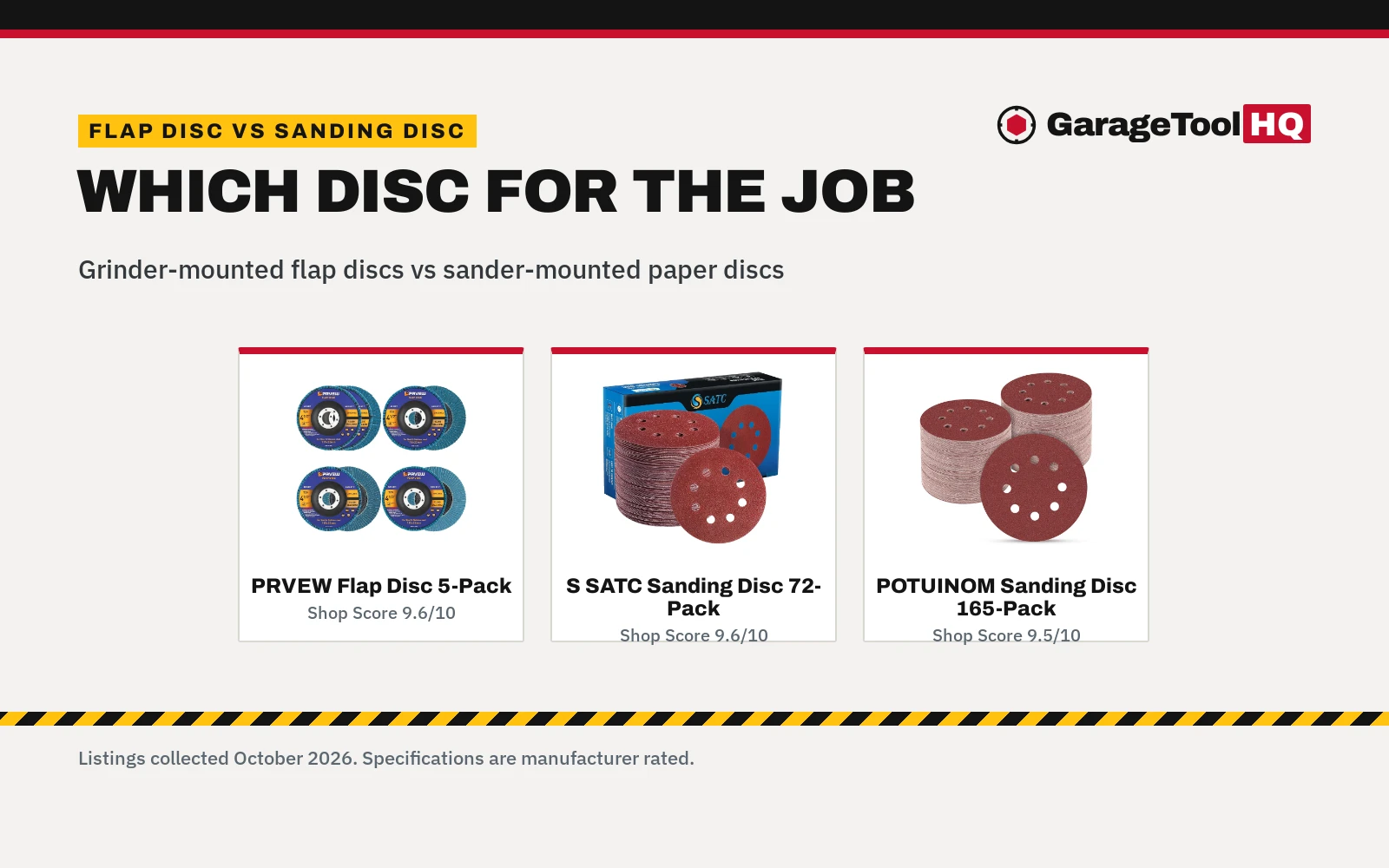
A flap disc mounts on an angle grinder by its arbor. The PRVEW example is a 4.5 in disc with a 7/8 in arbor, Type 29 bevel, rated up to 13,300 RPM. Overlapping zirconia flaps grind at a working angle of 5 to 15 degrees, which the listing says suits contours, edges, weld blending and radius grinding. It is the aggressive choice: grinding, deburring and weld cleanup.
A sanding disc sticks to a random orbital sander with hook-and-loop backing. The S SATC example is a 5 in 8-hole disc in grits from 40 to 320, and the POTUINOM example is a 5 in 8-hole disc in grits from 40 to 600. The sander moves the disc in small orbits while it spins, which leaves an even scratch pattern for sanding and polishing. It is the finishing choice: smoothing, polishing and surface prep.
Grit range
The flap disc example comes in 40, 60, 80 and 120 grit, with 2 discs at 40 and 1 each of the rest in the 5-pack. Both sanding disc examples go much finer: the S SATC runs 40, 60, 80, 120, 180, 240 and 320, and the POTUINOM runs 40, 60, 80, 120, 150, 240, 320, 400 and 600. Coarse grits remove material; fine grits refine the finish. If the job ends at 120 grit, either side works; if it ends at 600, only the sanding disc side gets there.
Grit count matters too. The flap disc 5-pack is a starter set for one tool, while the sanding disc packs are built for volume: 72 discs in the S SATC pack and 165 in the POTUINOM pack. A grinder eats discs fast on heavy weld cleanup, and an orbital sander goes through them on a big flat panel, so the pack size should match the size of the job, not just the grit.
Tool match
The flap disc example fits all 4.5 in grinders with a 7/8 in arbor. The sanding disc examples suit most 5 in random orbital sanders, and the POTUINOM listing also names die grinders, air grinders and electric drills. Do not cross the streams: a flap disc will not mount on an orbital sander, and a hook-and-loop paper disc will not survive an angle grinder. Buy the disc that fits the tool on the bench.
Dust and finish
The S SATC listing states an open coat for an even scratch pattern and a stearate coating to resist clogging and pilling. The POTUINOM listing states 8-hole dust extraction that removes dust during sanding. The flap disc listing states no dust control, which is normal for angle grinder work: it throws sparks and dust, so the work area and the lungs need protection either way.
Pack counts and abrasive grain
Zirconia vs aluminum oxide
The PRVEW flap disc uses premium zirconia abrasive, which the listing says gives strength, durability and extended life and holds up to high temperatures and pressure. Both sanding disc listings use aluminum oxide: the S SATC describes top aluminum oxide grain that is durable and anti-static, and the POTUINOM describes hard, high-quality aluminum oxide abrasives that cut quickly and give a smooth finish. The grain follows the format: zirconia on the grinding disc, aluminum oxide on the sanding discs. Judge the disc by its format, grit and tool first; the grain is secondary.
Count the discs per grit before you buy
The S SATC 72-pack breaks down as 12 discs at 40 grit and 10 each at 60, 80, 120, 180, 240 and 320. The POTUINOM 165-pack lists 20 each of 60, 80, 120, 150, 240, 320, 400 and 600 plus an extra 5 of 40 grit in the bullets, though that breakdown is garbled, so treat its totals loosely. The PRVEW 5-pack holds 2 discs at 40 grit and 1 each at 60, 80 and 120. The listing also maps grits to jobs: 40-100 grit is coarse for rough processing and 120-320 is for conventional polishing. Coarse discs wear fastest on weld cleanup, so check the coarse count against the work: the S SATC gives 12 discs at 40 grit, the clearest coarse count here.
Choose a flap disc if
- You grind welds, bevel edges or strip metal on an angle grinder
- You want aggressive stock removal in coarse grits
- Your grinder takes a 4.5 in disc with a 7/8 in arbor
- You work metal, concrete or stone as well as wood
Choose a sanding disc if
- You sand and polish with a random orbital sander
- You need fine grits up to 320 or 600 for the finish
- You want hook-and-loop changes and dust extraction
- You work wood, plastic, glass or painted surfaces
Example discs
For more choices, see the best flap disc for rust removal and the best sanding discs for auto body.
Use rated jack stands on solid ground, wear eye protection with power and air tools, keep fuel-burning equipment out of a closed garage, and follow the manual for every tool. Read our Safety Disclaimer.
Frequently Asked Questions
Can I use a flap disc on a random orbital sander?
No. The flap disc example mounts by a 7/8 in arbor on an angle grinder, while the sanding disc examples use hook-and-loop backing for a random orbital sander. The mounts are not interchangeable.
What grit should I start with?
Start coarse and work finer. The PRVEW flap disc pack includes 40, 60, 80 and 120 grit; the S SATC sanding discs run 40 to 320; the POTUINOM run 40 to 600. Match the starting grit to how much material has to come off.
Do flap discs work on wood?
The PRVEW listing names metal or wood working, plus concrete grinding and stone smoothing. The sanding disc listings name wood, plastic, glass, rubber, leather and more. Either side handles wood; the flap disc is the faster, rougher option.
How do I keep sanding discs from clogging?
The S SATC listing states a stearate coating to maximize resistance to clogging and pilling, and the POTUINOM listing states 8-hole dust extraction that removes dust during sanding. The flap disc listing states no clogging resistance, so expect to change discs on gummy material.
What speed can a flap disc run at?
The PRVEW example is rated up to 13,300 RPM. Match the disc rating to the grinder, and never exceed the stated maximum.
Related: the best flap disc for rust removal, the best sanding discs for auto body, the bench grinder vs angle grinder comparison and the best air die grinder for weld cleanup.