HVLP vs Conventional Spray Gun: Which One Should You Buy?
HVLP vs conventional spray gun: how the two atomize paint differently, what air supply each wants, and four HVLP guns from the listings ranked.

On this page
Top picks at a glance
As an Amazon Associate we earn from qualifying purchases.
- 1
 REFINE Spray Paint Gun HVLP Air Spray Guns 1.0/1.4/1.7mm9.6/10View on Amazon
- 2
 InoKraft D1 LVLP Air Spray Gun Premium Kit Easy to Use9.7/10View on Amazon
- 3
 BANG4BUCK Professional HVLP Gravity Feed Air Spray Gun9.6/10View on Amazon
- 4
 HomeRight Super Finish Max HVLP Paint and Stain SprayerView on Amazon
- 5
 Fuji Spray 2203G Semi-PRO 2View on Amazon
- 6
 Fuji Spray 2202 Semi-PRO 2View on Amazon
- 7
 Fuji Spray 5175GView on Amazon
- 8
 Fuji Spray 9600-GView on Amazon
- 9
 HVLP Air Spray Gun with 1.4/1.7/2mm Nozzles & Air CompressorView on Amazon
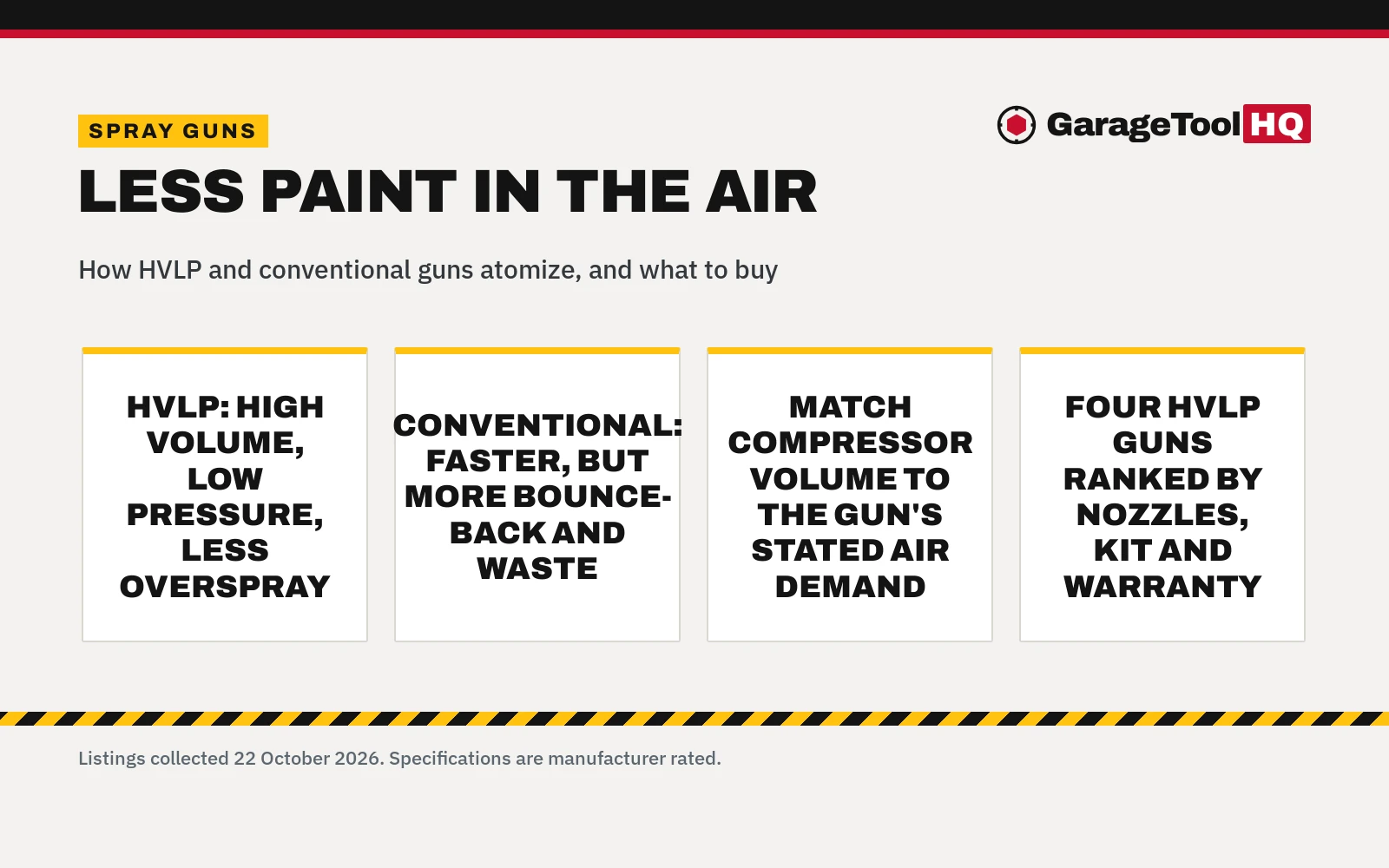
HVLP vs conventional spray gun: which should you buy? Buy an HVLP gun if you want less overspray and better paint savings on body panels and furniture; a conventional gun lays paint on faster at the cost of more bounce-back and waste. HVLP runs high air volume at low pressure, so more paint lands on the panel. Conventional guns run higher pressure for faster coverage, at the cost of more bounce-back and waste.
More options to compare
 HomeRight Super Finish Max HVLP Paint and Stain SprayerCheck price on Amazon
 Fuji Spray 2203G Semi-PRO 2Check price on Amazon
 Fuji Spray 2202 Semi-PRO 2Check price on Amazon
 Fuji Spray 5175GCheck price on Amazon
 Fuji Spray 9600-GCheck price on Amazon
 HVLP Air Spray Gun with 1.4/1.7/2mm Nozzles & Air CompressorCheck price on Amazon
GarageToolHQ earns a commission when you buy through links on our product pages, at no extra cost to you. Read our affiliate disclosure.
Below: what HVLP and conventional actually mean, a side-by-side table, what air supply each type wants, and four HVLP guns from the listings, ranked.
HVLP vs conventional spray gun: what the terms mean
HVLP stands for high volume, low pressure. The gun moves a lot of air at low pressure through the air cap, which atomizes the paint gently and keeps it moving toward the panel instead of bouncing off it. Two listings here put a number on that: both the GATTLELIC and the Fulchron claim 65 percent paint utilization, meaning about two thirds of the paint the maker says lands on the work instead of in the air. Both also claim about 20 percent paint savings over a conventional setup, stated as the maker’s claim.
A conventional gun works the other way: higher atomizing pressure, faster paint delivery, and a lot more overspray. The Fuji listing pairs a non-bleed design, which the maker says blows around less shop dust, with a high-efficiency air cap for even less overspray. If you have only ever used rattle cans, either gun is a step up; the question is how much paint you are willing to lose to the booth filter.
Side by side: HVLP vs conventional
| Factor | HVLP | Conventional |
|---|---|---|
| How it atomizes | High air volume at low pressure through the air cap | Higher pressure for faster atomization |
| Overspray | Less; makers here claim 65 percent paint utilization | More bounce-back and waste |
| Speed | Slower passes, more control | Faster coverage per pass |
| Air demand | Volume matters: 275 L/min and 280 L/min stated on two guns | Pressure matters more than volume |
| Best for | Basecoat, clear coat and detail work in a home garage | Production speed where paint cost is secondary |
Air supply: what the listings actually ask for
HVLP guns are thirsty for air volume, not pressure. The GATTLELIC lists 275 L/min air consumption at 2.5 to 3.5 bar working pressure; the REFINE lists an average 9.9 cfm (280 L/min) at 43.5 psi (3 bar); the Fulchron also lists 2.5 to 3.5 bar. Compare that against your compressor’s rated output at working pressure before you buy: a small pancake compressor that keeps up with a nail gun may not keep up with an HVLP gun on a long panel. See what CFM air tools need for how to read those figures.
The GATTLELIC, the Fulchron and the REFINE ship a regulator in the box, which is the right place to set working pressure at the gun. Set it with the trigger pulled so the reading is under flow, not static.
Four HVLP guns from the listings, ranked
All four products in this guide are HVLP guns, ranked by stated specs and what ships in the box.
1. Fulchron 5-nozzle kit: the versatile one
The Fulchron ships five stainless nozzles, 1.4, 1.7, 2.0, 2.5 and 3.0 mm, with the 1.4 mm pre-installed. The listing maps the small end to primers and topcoats and the 2.5 and 3.0 mm nozzles to underbody coatings, bed liners and heavy-duty industrial paints. The Teflon-coated body resists paint buildup, the working pressure is 2.5 to 3.5 bar across a 240 mm spray pattern, and the box includes a 600 ml cup, 10 disposable liners, a regulator and a cleaning kit. The spec table states a 1 year warranty.
2. GATTLELIC 3-nozzle kit: the complete starter
The GATTLELIC covers the automotive core with 1.4, 1.7 and 2.0 mm nozzles: 1.4 mm installed for topcoats, 1.7 mm for primers, 2.0 mm for large areas. It lists 275 L/min air consumption, a 170 to 240 mm spraying distance, a 600 cc cup with 10 disposable cups and lids, a brass 15-hole air cap, a 1/4 in NPT inlet with quick adapter, and a filter regulator in the box. The maker claims 65 percent paint utilization and 20 percent paint savings.
3. REFINE RS8808G: the adjustable one
The REFINE runs three nozzle sets, 1.4, 1.8 and 2.0 mm, with a 360-degree directional nozzle and three adjustment knobs, a Teflon-treated die-cast aluminum body and an 11-hole brass air cap. Air pressure adjusts from 2 to 4 bar; the listing gives 43.5 psi (3 bar) and 9.9 cfm (280 L/min) average consumption. The packing list is long: 600 cc cup, regulator, three 1/4 in NPS inlet connectors, mesh filters, brushes, wrenches and Teflon tape. The spec table lists 2.6 lb.
4. Fuji Spray 9600-G: the pro gun
The Fuji is the professional pick of the four: a gravity gun with a 400 cc cup, a pattern control knob for fan size, 100 percent stainless steel fluid components, an insulated handle the maker says never gets hot, and a non-bleed design with a high-efficiency air cap for less overspray and less disturbed shop dust. The spec table states a 24 months parts and labor warranty, the longest term here. It ships the fewest accessories, which is normal for a pro gun: you buy the gun, not the kit.
Wear eye protection with every air tool, use impact-rated sockets on impact wrenches, disconnect the air line before changing accessories, and finish lug nuts with a torque wrench to the vehicle's spec. See OSHA eye and face protection. Read our Safety Disclaimer.
Spraying paint in a garage: safety notes
Atomized paint is a lung and fire hazard. Wear a respirator rated for paint vapors, not a dust mask, and ventilate the space. Keep ignition sources, pilot lights and the water heater away from the spray area, and never spray near an open flame. Check the paint maker’s safety sheet for the product you are spraying.
Frequently Asked Questions
Is HVLP better than conventional for a home garage?
For most home garage work, yes. The lower overspray means less paint in the air and on everything near the car, and the 65 percent utilization the makers here claim stretches each cup further. A conventional gun is faster, but speed matters less when you are painting one car.
What nozzle size do I need for primer and topcoat?
The listings agree on the pattern: 1.4 mm for topcoats and clear, 1.7 or 1.8 mm for primers, 2.0 mm for larger areas, and 2.5 to 3.0 mm for thick materials like bed liner. Change the needle with the nozzle as a matched pair, per the GATTLELIC and Fulchron listings, to avoid leaks.
Will my compressor run an HVLP gun?
Check volume, not just pressure. Two guns here state 275 and 280 L/min consumption at around 3 bar working pressure. If your compressor cannot sustain that at the gun, the pattern starves. A regulator at the gun, included with three of these kits, lets you set pressure under flow.
What is transfer efficiency?
The share of paint that lands on the panel instead of drifting past it. Both the GATTLELIC and Fulchron claim 65 percent for their guns, stated as the maker’s claim. Higher transfer efficiency means less paint bought for the same job.
Are disposable cups worth it?
Two of these kits, the GATTLELIC and the Fulchron, include disposable cup systems, and the makers say they cut paint waste and cleanup solvent use versus washing a traditional cup. If you spray small batches or switch colors often, they save real time.
Can I spray with a conventional gun instead?
You can, and production shops still do for speed. Expect more overspray, more masking and more paint used per panel. For a home garage painting one vehicle, the HVLP trade of slower passes for less waste usually wins.
Related: the best HVLP spray gun for automotive paint, what CFM air tools need, the best DA sander for auto body for prep work, and the best air compressor hose reel.