Best DA Sander for Auto Body: 4 Sanders Compared (2026)
Four sanders for auto body preparation and spot repair, compared by pad size, free speed, air consumption, regulators, weight, listing and warranty.

On this page
Top picks at a glance
As an Amazon Associate we earn from qualifying purchases.
- 1
 Best OverallGedu GAOA124-1-US9.6/10View on Amazon
- 2
 Best for Spot RepairZFE ARPS3SET9.4/10View on Amazon
- 3
 Best Accessory KitAutolock Lzbd-399.4/10View on Amazon
- 4
 Low noise 6 Inch DA Sander for Auto BodyView on Amazon
- 5
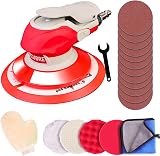 5/6 Inch Pneumatic Orbital Air Sander High-Speed DA SanderView on Amazon
- 6
 Autolock 6 Inches Air Random Orbital SanderView on Amazon
- 7
 5" Professional Orbital SanderView on Amazon
Choosing the best da sander for auto body work comes down to matching your shop air supply with the right pad size and speed control. A dual action pneumatic sander combines rotational and orbital motion to feather paint edges and smooth body filler without leaving deep swirl marks. For broad panels, a 5 in or 6 in palm sander with a built-in speed regulator provides steady control, while smaller spot sanders handle tight curves and localized rust repair. This guide compares five sanders across air demand, operating speed, pad configuration and published warranties.
GarageToolHQ earns a commission when you buy through links on this page, at no extra cost to you. Read our affiliate disclosure.
Quick picks
- Best Overall Gedu GAOA124-1-US: A 5 in palm DA sander rated at 12,000 RPM with an average air consumption of 10.5 CFM at 90 PSI, built-in regulator and rear exhaust. Check price on Amazon
- Best for Spot Repair ZFE ARPS3SET: A 15,000 RPM mini pneumatic sander with 1, 2 and 3 in backing plates, 15 buffing pads and 18 sandpapers for tight auto body areas. Check price on Amazon
- Best Accessory Kit Autolock Lzbd-39: A 5 in palm sander reaching 12,000 RPM with a 26 piece accessory set including pads, microfiber cloths and sandpaper. Check price on Amazon
The picks


Professional Air Random Orbital Palm Sander
A 5 in pneumatic dual action palm sander rated at 12,000 RPM and 10.5 CFM at 90 PSI with a rear exhaust and built-in speed regulator.
Pros
- 12,000 RPM free speed with a built-in speed regulator
- Publishes concrete air demand: 10.5 CFM at 90 PSI
- Compact palm grip profile at 2.6 lb with rear exhaust
- Standard 5 in hook and loop pad with 1/4 in air inlet
Cons
- Requires a compressor that can deliver 10.5 CFM at 90 PSI
- No warranty term on the listing
- Spec table contradicts listing by claiming 10 A amperage
- No sanding discs or accessories included in the box
1/2/3 Inch Random Orbital Air Sander
A 15,000 RPM mini pneumatic random orbital sander with 1, 2 and 3 in backing plates, 15 buffing pads and 18 sandpapers.
Pros
- High speed 15,000 RPM pneumatic motor for quick material removal
- Includes 1, 2 and 3 in backing plates for tight contours
- Generous kit with 15 buffing pads and 18 sanding discs
- Lightweight 2.3 lb cylindrical body for spot repairs
Cons
- Air consumption in CFM is not stated on the listing
- No warranty term on the listing
- Spec table contradicts air power by listing 4 A amperage
- Small disc sizes are not suited for broad car panels

Autolock 5 Inches Air Random Orbital Sander
A 5 in pneumatic dual action sander rated up to 12,000 RPM with a built-in regulator and a 26 piece accessory kit.
Pros
- 12,000 RPM motor with built-in regulator for speed control
- 26 piece accessory set includes sponge pads, cloths and discs
- Includes trachea quick connector and 3 silencer cotton pieces
- Standard 5 in hook and loop pad for auto body sanding
Cons
- Spec table contradicts listing by claiming corded electric 110V
- Table gives speed as 10000 RPM while bullets claim 12,000 RPM
- Air consumption in CFM is not stated on the listing
- No warranty term on the listing

PROSHI 6“ Random Orbit Air Sanders
A 6 in pneumatic random orbital sander operating up to 10,000 RPM with a built-in speed regulator and 1/4 NPT connector.
Pros
- Broad 6 in pad covers larger auto body panels quickly
- Built-in air regulator allows on-tool speed adjustment
- 10,000 RPM motor with standard hook and loop pad backing
- Includes 1/4 NPT quick connector and service wrench
Cons
- Weight and body dimensions are not stated on the listing
- Air consumption in CFM is not stated on the listing
- No warranty term on the listing
- Spec table contradicts air power by listing 8 A amperage
More options to compare
 Low noise 6 Inch DA Sander for Auto BodyCheck price on Amazon
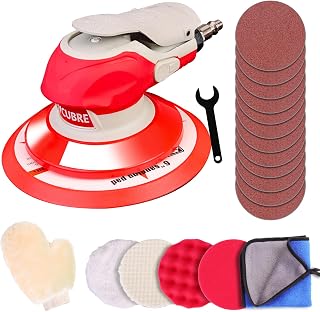 5/6 Inch Pneumatic Orbital Air Sander High-Speed DA SanderCheck price on Amazon
 Autolock 6 Inches Air Random Orbital SanderCheck price on Amazon
 5" Professional Orbital SanderCheck price on Amazon
Compare the picks
| Model | Shop Score | Power Source | Pad Size | Speed | Air Demand | Weight | Warranty |
|---|---|---|---|---|---|---|---|
| Gedu GAOA124-1-US | 9.6/10 | Air-powered | 5 in | 12,000 RPM | 10.5 CFM @ 90 PSI | 2.6 lb | Not stated |
| ZFE ARPS3SET | 9.4/10 | Air-powered | 1, 2 and 3 in | 15,000 RPM | Not stated | 2.3 lb | Not stated |
| Autolock Lzbd-39 | 9.4/10 | Air-powered | 5 in | 10,000 or 12,000 RPM | Not stated | 1.39 kg | Not stated |
| PROSHI 6-Inch | 9.3/10 | Air-powered | 6 in | 10,000 RPM | Not stated | Not stated | Not stated |
*Specifications are manufacturer rated, as published on each listing and collected 10 October 2026.
How we scored them
Each sander is scored on performance, build, value, safety and warranty, with the weights published on our How We Pick page. Clear specifications such as published CFM requirements, reliable speed regulators and balanced palm-grip bodies earn higher ratings, while contradictions in manufacturer listings lower the score.
| Product | Shop Score | Perf. /35 | Build /25 | Value /25 | Safety /10 | Warranty /5 |
|---|---|---|---|---|---|---|
| Gedu GAOA124-1-US | 9.6 | 32 | 22 | 22 | 0 | 0 |
| ZFE ARPS3SET | 9.4 | 29 | 20 | 22 | 0 | 0 |
| Autolock Lzbd-39 | 9.4 | 27 | 16 | 22 | 0 | 0 |
| PROSHI 6-Inch | 9.3 | 27 | 16 | 19 | 0 | 0 |
Scores run from 9.2 to 9.8: each product’s point total is placed on that range, so more points always means a higher score.
What the listings tell you
Reviewing these four sander listings highlights sharp differences in published data. Only one pneumatic model, the Gedu palm sander, publishes its required air consumption figure of 10.5 CFM at 90 PSI. Three other pneumatic listings omit CFM data entirely, leaving buyers to guess their air demand. Several spec tables contain significant errors, such as listing electrical amperage ratings on pneumatic tools or classifying a round sander as rectangular.
Buying guide: best da sander for auto body
Air compressor requirements
Pneumatic sanders consume a continuous volume of compressed air that quickly drains small tanks. While an impact wrench runs in brief bursts, a dual action sander operates continuously across entire vehicle panels. The Gedu sander publishes an average demand of 10.5 CFM at 90 PSI, which requires a substantial workshop compressor to maintain without pressure drops. Before connecting an air sander, check what CFM do air tools need to ensure your compressor can keep up during extended sanding sessions.
Pad size and panel coverage
Selecting pad size depends on the vehicle surface you are preparing. Standard 5 in and 6 in pads are ideal for hoods, doors, and fenders, providing a flat sanding plane that prevents gouging. For localized rust repair, panel recesses, and weld seams, mini sanders with 1 in, 2 in and 3 in backing plates allow precise access without abrading surrounding clean paint. Hook and loop pad faces make changing between coarse and fine grit paper quick and straightforward.
Dual action motion and speed control
A dual action mechanism spins the pad on an eccentric spindle, creating a random scratch pattern that prevents orbital swirl marks from showing through primer and automotive basecoats. Built-in regulators allow you to dial back rotation speed for delicate feathering or increase speed up to 10,000 RPM or 15,000 RPM for rapid material removal. Learn more about operating differences in our comparison of a DA sander vs orbital sander.
Pneumatic vs corded electric sanders
Pneumatic palm sanders remain the standard in auto body shops because their compact air motors stay cool under constant use and weigh less than electric alternatives. However, for home garages without a high-output stationary air compressor, a corded electric model provides variable-speed random orbital action directly from a standard 120V outlet. For cleaner shop air, consider pairing your tools with dust extraction as detailed in our guide to a DA sander with vacuum.
Air line setup and tool lubrication
Air motors rely on clean, dry air and consistent lubrication to prevent internal vane wear and corrosion. Water condensed inside compressor tanks can ruin sanding finishes and damage internal bearings. Drain compressor moisture daily, install an air dryer or filter, and learn how to oil air tools properly to keep pneumatic motors running smoothly over long restoration projects.
Wear eye protection with every air tool, use impact-rated sockets on impact wrenches, disconnect the air line before changing accessories, and finish lug nuts with a torque wrench to the vehicle's spec. See OSHA eye and face protection. Read our Safety Disclaimer.
Frequently Asked Questions
What CFM compressor do I need for a DA sander?
Dual action air sanders require continuous airflow. For example, the Gedu model specifies an average air consumption of 10.5 CFM at 90 PSI. Running a pneumatic sander continuously without losing operating speed typically requires a large workshop compressor with a high CFM rating.
What is the difference between a DA sander and an orbital sander?
A standard orbital sander moves only in tight concentric circles, which can leave visible swirl rings on metal panels. A dual action sander combines orbital oscillation with pad rotation, producing a random scratch pattern that blends paint edges smoothly for painting.
Can I use an electric random orbital sander for auto body work?
Yes, corded electric random orbital sanders can handle body filler shaping, primer leveling, and paint scuffing.
How often should I oil a pneumatic DA sander?
Pneumatic tools require regular lubrication. Adding pneumatic air tool oil directly into the 1/4 in air inlet before every work session lubricates the motor vanes, clears internal moisture, and protects the cylinder from premature wear.
What pad size is best for auto body work?
A 5 in or 6 in pad is standard for broad panels such as doors, roofs, and quarter panels. Smaller 1 in, 2 in and 3 in discs are suited for spot repairs, bumper recesses, headlight restoration, and curved trim areas.
Related: the best air compressor for home garage, our air tools hub and our garage safety notes. Also see our guide to a DA sander vs orbital sander. Also see our picks for a DA sander with vacuum. Also see our shop guide on how to oil air tools. Also see our advice on what size air compressor do I need for air tools. Also see our guide on what size air hose for impact wrench. Also see our review of the best air die grinder. Also see our roundup of the best HVLP spray gun for automotive paint. Also see our guide on the best air compressor dryer for garage. Also see our review of the best blow gun for garage.