Battery Checker vs Multimeter: Which One Should You Buy?
Battery checkers and digital multimeters compared for a home garage: how each checks voltage, ease of use, electrical diagnostics, and real examples of each tool.


On this page
Top picks at a glance
As an Amazon Associate we earn from qualifying purchases.
- 1
 Schumacher Electric 6A Car Battery Charger & Maintainer9.7/10View on Amazon
- 2
 KAIWEETS Digital Multimeter 20000 Counts Auto-Range Voltmeter9.8/10View on Amazon
- 3
 Klein Tools MM325 Multimeter9.4/10View on Amazon
- 4
 TOPDON BT100 12V Car Battery TesterView on Amazon
- 5
 Tenergy T-333 Universal Battery TesterView on Amazon
- 6
 MOTOPOWER MP0515A 12V Car Battery Tester Automotive 100-2000View on Amazon
- 7
 Schumacher Electric Battery Load TesterView on Amazon
- 8
 Digital Multimeter Voltmeter Battery Voltage Multi TesterView on Amazon
- 9
 TOPDON BT200 Car Battery TesterView on Amazon
Verdict: In the battery checker vs multimeter comparison, choose a battery checker if you want a fast, direct way to check loose household cells and button batteries without configuring dial settings. Choose a multimeter if you need to troubleshoot automotive wiring, measure AC outlets, check fuses, or diagnose complex electrical systems.
Both instruments evaluate electrical power, but they serve different roles in a home garage. A dedicated consumer battery checker evaluates the condition and charge level of individual cells using contacts or slots. A digital multimeter is a versatile diagnostic instrument designed to measure voltage, current, resistance, and continuity across circuits, components, and appliances. This comparison covers how both tool categories operate, followed by concrete examples from the listings we reviewed.
GarageToolHQ earns a commission when you buy through links on this page, at no extra cost to you. Read our affiliate disclosure.
| # | Product | Shop Score | Buy |
|---|---|---|---|
| 1 |  Dlyfull Battery Tester for AA AAA C D 9V | 9.6/10 | Buy on Amazon |
| 2 |  AstroAI Digital Multimeter | 9.5/10 | Buy on Amazon |
| 3 | Klein Tools MM325 Multimeter | 9.4/10 | Buy on Amazon |
| 4 |  1Pcs Battery Tester for AA AAA C D 9V 1.5V | 9.3/10 | Buy on Amazon |
Dlyfull Battery Tester for AA AAA C D 9V
A compact battery checker with an LCD rating bar that checks cylindrical and button cells, with an AAA battery included.
Pros
- Checks wide range of cylindrical cells (AA, AAA, C, D, 9V, N) and button cells
- LCD rating bar shows poor, weak, or good voltage status quickly
- Anti-slip chassis weighing 115 g with dimensions of 5.2 x 3.46 x 0.94 inches
- Includes one AAA battery and an 18-month warranty
Cons
- Does not check or recharge rechargeable battery chemistries (stated)
- Limited to battery checks, cannot measure AC/DC circuits or resistance
- No probe leads for checking installed automotive or household wiring
- Requires one AAA battery for operation rather than passive draw
AstroAI Digital Multimeter
A True RMS 6000 counts auto-ranging multimeter measuring AC/DC voltage, current, resistance, continuity and temperature.
Pros
- True RMS 6000 counts auto-ranging for voltage, current, resistance and frequency
- Double ceramic explosion-proof fuses rated F400mA/600V and F10A/600V
- Large backlit LCD screen with data hold, auto shut-off and built-in kickstand
- Includes 9V 6F22 battery, pair of leads and multi-function socket
Cons
- No UL, ETL or CSA agency safety certification stated in the listing
- No warranty term is stated in the listing (notes 24-hour response support)
- Larger and heavier than dedicated battery checkers at 492 g
- Requires manual lead placement and dialing rather than instant slot insertion
Klein Tools MM325 Multimeter
A manual-ranging digital multimeter measuring up to 600V AC/DC, 10A DC current, resistance, continuity and batteries.
Pros
- Measures AC/DC voltage up to 600V and DC current up to 10A
- Lead-Alert protection illuminates LEDs to guide correct lead placement
- Features dedicated battery check mode, continuity, and diode checks
- Includes backlit LCD display, rear lead holders and kickstand
Cons
- Spec table lists model MM320KIT and description for a kit rather than MM325
- No concrete warranty term is stated (listing directs to manufacturer website)
- No UL, ETL or CSA safety certification stated in the listing
- Manual-ranging with resistance capped at 2MΩ
1Pcs Battery Tester for AA AAA C D 9V 1.5V
An analog battery checker with a color-coded needle that checks AA, AAA, C, D, 9V and 1.5V button cells without batteries.
Pros
- Requires no internal battery, drawing operating power directly from the cell
- Color-coded analog needle display shows good, low, and replace or recharge
- Checks common household sizes: AA, AAA, C, D, 9V and 1.5V button cells
- Compact footprint measuring 4.13 x 1.57 x 0.78 inches
Cons
- Spec table contains erroneous data listing 33ft/100 LED string light features
- Bullets state it evaluates voltage rather than detecting precise capacity
- No warranty term is stated in the listing
- No safety certification stated in the listing
More options to compare
 TOPDON BT100 12V Car Battery TesterCheck price on Amazon
 Tenergy T-333 Universal Battery TesterCheck price on Amazon
 MOTOPOWER MP0515A 12V Car Battery Tester Automotive 100-2000Check price on Amazon
 Schumacher Electric Battery Load TesterCheck price on Amazon
 Digital Multimeter Voltmeter Battery Voltage Multi TesterCheck price on Amazon
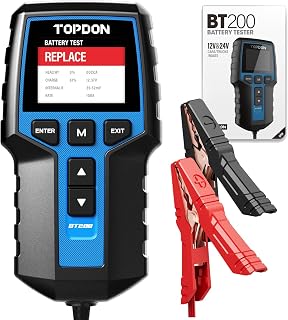 TOPDON BT200 Car Battery TesterCheck price on Amazon
Side by side
| Battery checker | Multimeter | Takeaway | |
|---|---|---|---|
| Primary role | Dedicated battery condition and charge checks | General electrical troubleshooting and circuit diagnostics | Multimeters diagnose complete circuits; checkers assess single cells |
| What it measures | Battery voltage status (needle scale or LCD rating bar) | AC/DC voltage, DC current, resistance, continuity, diodes | Multimeters provide exact values; checkers show good or replace |
| Connection method | Molded slots and adjustable sliders for standard cells | Two probe leads connected to contact points or terminals | Checkers use direct cell slots; multimeters use flexible leads |
| Ease of use | Direct insertion, immediate visual status | Select dial mode and range, read numeric display | Checkers require no configuration; meters require dial setup |
| Supported batteries (examples) | Cylindrical and button cells (such as AA, AAA, C, D, 9V) | Any accessible DC battery terminals within rated voltage | Checkers fit standard cell sizes; meters reach any battery terminals |
| Wiring and outlets | Not designed for wiring or AC circuits | Measures household AC outlets, fuses and automotive wiring | Multimeters inspect wiring and outlets; checkers do not |
| Power source (examples) | Operates on cell under check (VTECHOLOGY) or one AAA (Dlyfull) | Runs on 9V battery (AstroAI) or battery powered (Klein Tools) | Meters need internal batteries; some checkers run on the checked cell |
| Example weight | 115 g (Dlyfull B2); VTECHOLOGY weight not stated | 492 g (AstroAI AST-6000-D), 13.92 ounces (Klein Tools MM325) | Checkers are pocket-sized; multimeters are heavier with protective cases |
| Example dimensions | 5.2 x 3.46 x 0.94 in (Dlyfull), 4.13 x 1.57 x 0.78 in (VTECHOLOGY) | 7.48 x 3.54 x 1.38 in (AstroAI), 9.33 x 5.08 x 3.82 in (Klein Tools) | Checkers take minimal drawer space; meters need bench or toolbox space |
Example figures are manufacturer rated, as published on each listing and collected 9 October 2026.
Battery checker vs multimeter: how they differ
The central difference between a dedicated battery checker and a multimeter lies in design intent. A battery checker is engineered for one dedicated purpose: determining whether a battery has sufficient charge to power a device. Most compact checkers feature labeled slots or sliding arms that grip common consumer cells, displaying a simple status indicator such as an analog needle or an LCD rating bar.
A multimeter is a versatile diagnostic instrument. Rather than limiting checks to standalone cells, a multimeter uses two probe leads to measure electrical parameters across complete circuits. DIY mechanics use multimeters to check alternator output, locate parasitic battery drains, verify switch continuity, and check sensor voltage. When checking battery terminal voltage, a multimeter displays a numerical voltage reading that you interpret, with auto-ranging models selecting the scale automatically while manual-ranging meters require selecting the proper dial position.
Measurement capabilities and electrical range
A standard battery checker reads voltage under limited conditions. For example, the Dlyfull B2 listing indicates it checks whether cylindrical and button cells fall into poor, weak, or good voltage brackets. It does not measure AC voltage, DC current, or circuit resistance. Similarly, the VTECHOLOGY BT-168 listing notes that it assesses voltage to indicate status but does not measure precise capacity.
Multimeters provide substantially wider measurement capabilities. In the listings reviewed, the AstroAI AST-6000-D measures AC and DC voltage up to 600V, AC and DC current up to 10A, resistance, capacitance, frequency, duty cycle, temperature, and diodes. The Klein Tools MM325 measures AC and DC voltage up to 600V, DC current up to 10A, and resistance up to 2MΩ, alongside continuity, diode modes, and a dedicated battery check mode. This range allows a multimeter to evaluate vehicle starter circuits, alternators, relays, and home electrical panels that a dedicated battery checker cannot touch.
Ease of use and setup
For quick checks around the home or shop, a battery checker offers immediate convenience. Inserting an AA, AAA, or 9V cell into the designated slot provides an instant visual readout. The VTECHOLOGY model requires no setup and operates without an internal battery, drawing its minimal operating power directly from the cell under check. The Dlyfull model runs on one included AAA battery and displays a clear LCD rating bar.
A multimeter requires more manual configuration. For voltage checks, you plug the black lead into the common jack, connect the red lead to the voltage jack (never the current jack, which creates a short circuit across a power source), select the proper function on the rotary dial, and position the probe tips securely against the terminals. Auto-ranging models like the AstroAI AST-6000-D select the measurement scale automatically, whereas manual-ranging units like the Klein Tools MM325 require selecting the appropriate scale manually. Models like the Klein Tools example feature lead-alert indicator lights to guide proper lead socket selection.
Automotive diagnostics versus loose cell sorting
In a garage environment, the two tools serve distinctly different troubleshooting tasks. If your primary goal is organizing bins of household batteries, remote control cells, or checking small button cells, a dedicated checker is fast and practical. It quickly identifies depleted cells so you can discard them without hassle.
For automotive maintenance, a multimeter is indispensable. Checking an automotive battery involves measuring resting voltage across the top posts, observing voltage drop during engine cranking, and measuring charging voltage while the engine runs. Beyond the battery itself, a multimeter traces broken wires, checks blown fuses, evaluates ground connections, and reads sensor signals. A compact consumer battery checker cannot perform any of these vehicle diagnostic tasks.
Form factor, weight, and power
The battery checker examples reviewed here are lightweight, compact tools. The Dlyfull B2 listing states an item weight of 115 g with dimensions of 5.2 x 3.46 x 0.94 inches, while the VTECHOLOGY BT-168 listing gives dimensions of 4.13 x 1.57 x 0.78 inches. Both fit easily into a drawer or tool tray.
Digital multimeters are larger and heavier instruments. In the listings reviewed, the AstroAI example weighs 492 g with dimensions of 7.48 x 3.54 x 1.38 inches, including a kickstand. The Klein Tools example weighs 13.92 ounces with dimensions of 9.33 x 5.08 x 3.82 inches. Multimeters also require internal batteries for operation: the AstroAI model includes a 9V 6F22 battery, while the Klein Tools unit is battery powered.
Choose a battery checker if
- You primarily check household cylindrical and button cells
- You want an instant good or replace visual indicator
- You prefer a compact tool that needs minimal setup
- You want a lightweight device for drawers and toolboxes
Choose a multimeter if
- You diagnose automotive electrical circuits, fuses, and alternators
- You need exact voltage, current, and resistance numeric values
- You work on home wiring, switches, appliances, and outlets
- You want one versatile instrument for comprehensive shop diagnostics
Example tools
For more electrical diagnostic options, see the best automotive multimeter and the cheap battery checker.
Lead-acid batteries can release hydrogen while charging, so charge in a ventilated space away from sparks and flames, connect positive first and negative last, set the charger to the battery type (flooded, AGM, gel, lithium), and wear eye protection. Read our Safety Disclaimer.
Frequently Asked Questions
Is a multimeter a battery checker?
A multimeter can check battery voltage by measuring DC volts across the battery terminals, but it is not solely a dedicated battery checker. A multimeter displays a numerical voltage reading that you interpret, whereas a dedicated battery checker provides a direct visual rating of cell condition.
Do I need a battery checker if I have a multimeter?
If you already own a multimeter and know how to read DC voltage, you may not need a separate battery checker. However, dedicated checkers make sorting loose AA, AAA, and button cells faster because they use molded slots and sliders rather than probe leads.
How does a battery checker work compared to a multimeter?
A dedicated battery checker uses fixed slots and sliding contacts to read cell voltage quickly, presenting the result on a simple colored needle or LCD bar. A multimeter uses dual probe leads connected to a meter circuit, measuring voltage, current, or resistance based on rotary dial settings.
Can a multimeter check battery health?
Standard DC voltage mode on a multimeter measures open-circuit resting voltage across battery terminals. While resting voltage indicates basic charge state, an aging battery may show normal voltage until placed under an active circuit load. Some meters, such as the Klein Tools MM325 example, include a dedicated battery check setting to evaluate cells, while specialized shop load checkers assess heavy automotive batteries during draw.
Which tool is safer for a home garage?
Both tools are safe when used according to their manuals. Dedicated consumer checkers operate at very low voltages on small cells. Multimeters handle higher voltages up to 600V; always ensure leads are placed into the correct input jacks to prevent blowing internal fuses or creating short circuits.
Related: the best automotive multimeter, the cheap battery checker, the jump starter vs battery charger, the best car battery charger, and our diagnostics and electrical hub.