Best Battery Checker for Cars: 5 Load Analyzers Compared
Five battery checkers and analyzers for cars, compared by voltage support, CCA range, display type, system checks, safety features and warranty.

On this page
Top picks at a glance
As an Amazon Associate we earn from qualifying purchases.
- 1
 Best OverallANCEL BA1019.6/10View on Amazon
- 2
 Best 12V and 24VTOPDON BT2009.6/10View on Amazon
- 3
 Most CompactTOPDON BT1009.4/10View on Amazon
- 4
 Longest WarrantyMOTOPOWER MP0515A9.4/10View on Amazon
- 5
 Car Battery Tester 6V 12V 24V Battery Voltage TesterView on Amazon
- 6
 TOPDC 100A Battery Load TesterView on Amazon
- 7
 12V Car Battery TesterView on Amazon
- 8
 FOXWELL BT705Plus Car Battery Tester 24V 12V Load TesterView on Amazon
- 9
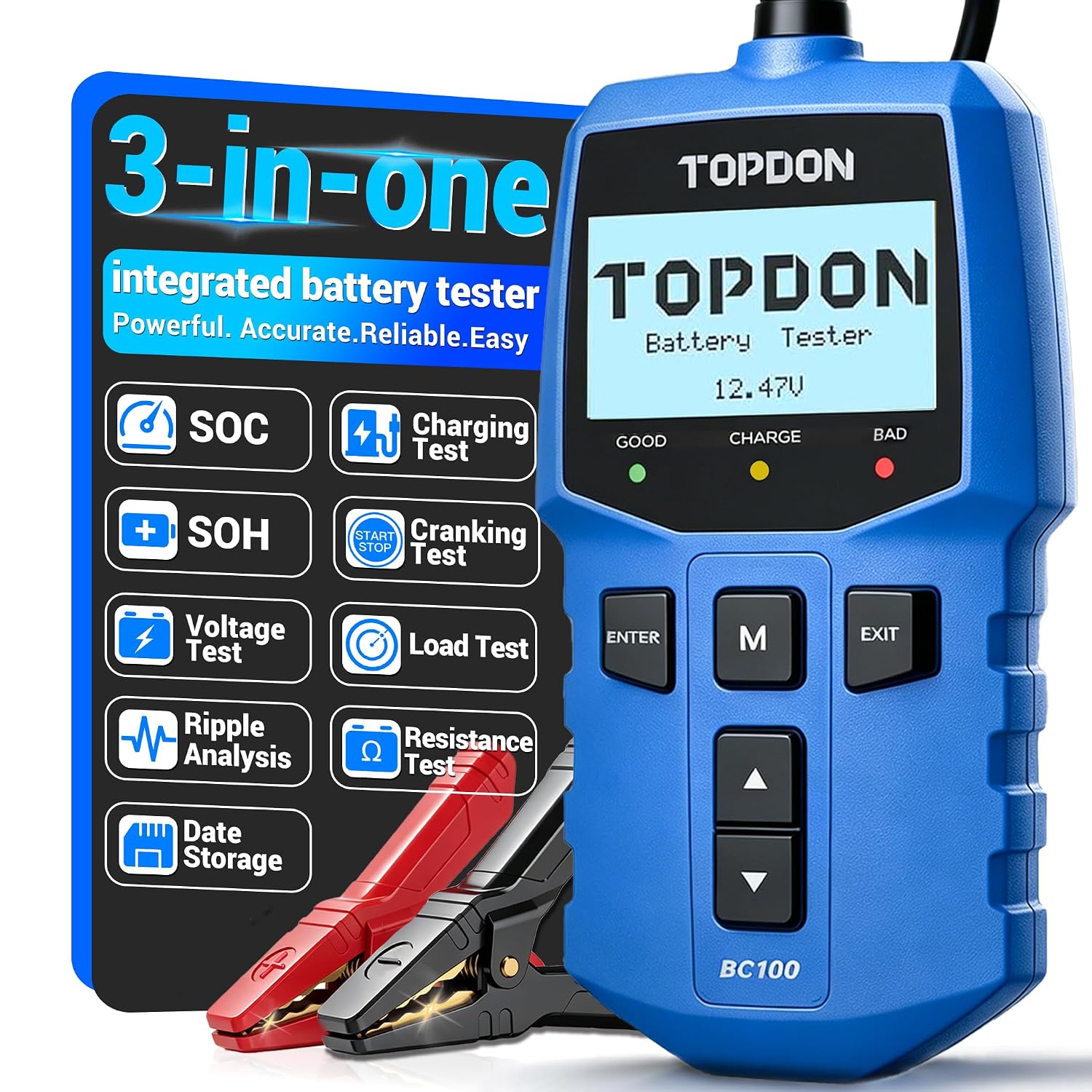 TOPDON BC100 Car Battery Tester 12V Automotive 100-2000 CCAView on Amazon
Finding the best battery checker for cars means choosing a diagnostic tool that identifies weak cells before a cold morning leaves you stranded. Modern digital analyzers check cold cranking amps (CCA), starter draw and alternator output directly through the battery terminals without requiring internal batteries. This guide compares five automotive checkers by voltage compatibility, CCA range, display clarity, stated safety protections and warranty terms.
GarageToolHQ earns a commission when you buy through links on this page, at no extra cost to you. Read our affiliate disclosure.
Quick picks
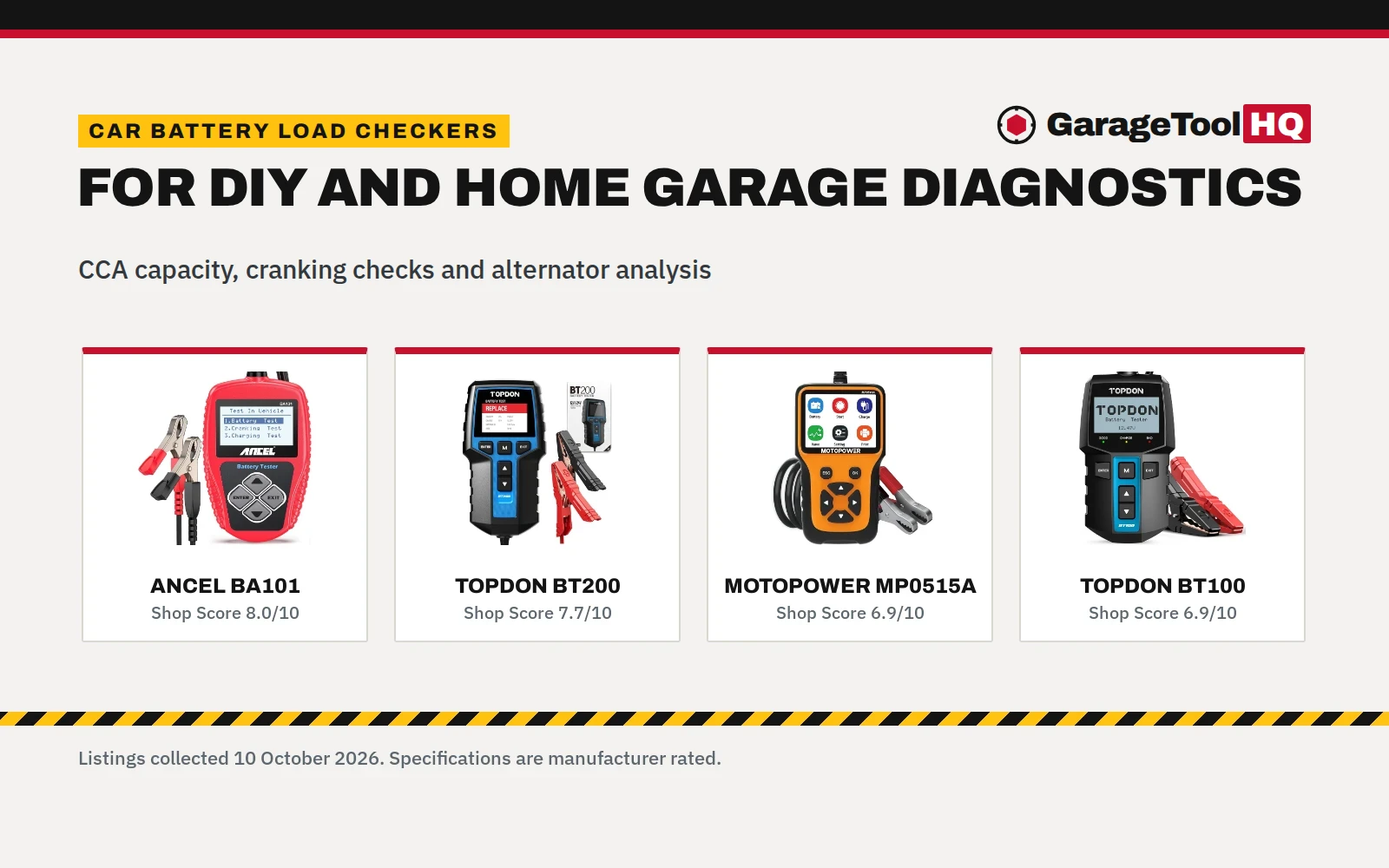
- Best Overall ANCEL BA101: 100-2000 CCA range with 4-in-1 electrical protection, multi-standard support and a 12-month warranty. Check price on Amazon
- Best 12V and 24V TOPDON BT200: Supports 12V and 24V batteries with a 2.4-inch sunlight-readable color screen and -4°F to 140°F operating range. Check price on Amazon
- Most Compact TOPDON BT100: Glove-box sized at 9 ounces with 100-2000 CCA range, spark-proof clamps and 3 LED status lights. Check price on Amazon
- Longest Warranty MOTOPOWER MP0515A: 2 year manufacturer warranty with 100-2000 CCA analysis, data print capability and included storage bag. Check price on Amazon
The picks

ANCEL BA101 Car Battery Tester
A 12V digital battery analyzer rated for 100-2000 CCA with 4-in-1 electrical protection, copper crocodile clips and a backlit display.
Pros
- 100-2000 CCA rating with 220AH capacity support
- Built-in 4-in-1 protection against reverse polarity, shorts, overcurrent and overvoltage
- Backlit monochrome screen with adjustable contrast for bright sun or dim light
- 3x reinforced ABS housing with copper crocodile clips
Cons
- Does not support 6V, 8V or 24V batteries, or lithium chemistries
- Motorcycle use limited to batteries rated over 30Ah
- No independent electrical safety listing like UL or ETL
- Listed package dimensions of 9.5 x 7 x 2 inches describe shipping box, not unit alone
TOPDON BT200 Car Battery Tester, 12V/24V
A dual-voltage 12V and 24V battery and alternator analyzer with a 2.4-inch color screen, memory recall and 100-2000 CCA rating.
Pros
- Works on both 12V and 24V battery systems from 100 to 2000 CCA
- 2.4-inch color LCD readable in direct sunlight with clear status prompts
- Operates in temperatures from -4°F to 140°F (-20°C to 60°C)
- Memory function recalls previous check data; 1-year warranty included
Cons
- Heavier than basic checkers at 15.52 ounces
- No electrical safety certification like UL, ETL or CE stated
- No reverse polarity protection feature explicitly stated in the listing text
- Listing bullets claim 99.9% accuracy without citing the verification protocol
MOTOPOWER MP0515A 12V Car Battery Tester
A 12V automotive battery and alternator analyzer rated for 100-2000 CCA with data print capability and a 2 year manufacturer warranty.
Pros
- 2 year manufacturer warranty, the longest coverage in this comparison
- Rated for 100-2000 CCA battery and alternator health analysis
- Data print capability included for documenting vehicle records
- Includes dedicated storage bag and compact 5.91 x 0.91 x 3.35 inch body
Cons
- Listing provides no bullet points detailing features or clamp construction
- Spec table categorizes device as a Multimeter rather than dedicated analyzer
- No safety features or reverse-polarity protections stated on the listing
- No electrical certification like UL, ETL or CE stated

TOPDON BT100 12V Car Battery Tester
A pocket-sized 12V battery analyzer rated at 100-2000 CCA with spark-proof copper clamps, reverse polarity protection and three LED indicators.
Pros
- Covers 100-2000 CCA across regular flooded, AGM, EFB and GEL batteries
- Copper clamps feature polarity reverse prevention and spark-proof design
- Three colored LED status lights alongside menu screen for quick health checks
- Compact 5.3 x 3 x 1 inch frame weighs only 9 ounces for easy glove-box storage
Cons
- No formal warranty term stated beyond 30-day return and 12-month customer service
- No UL, ETL or CE electrical certification stated
- Monochrome screen without the color graphics of the BT200
- Limited to 12V systems; does not evaluate 24V commercial vehicles

MOTOPOWER MP0514A 12V Digital Car Battery Tester
A compact 12V digital voltmeter and alternator analyzer reading 4 to 20V DC with 8 LED indicators, CE marking and 30A alligator clips.
Pros
- CE certified with reverse connection and over-voltage protection
- Digital LCD provides voltage readings down to 0.01 volts across 4 to 20V DC
- Eight colored LED indicators visually signal battery charge and alternator condition
- Lightweight 150 gram body with black rubber paint grip and 50cm lead
Cons
- Spec table incorrectly claims OBD2 connection and engine fault code erase
- Does not evaluate CCA, internal resistance or cranking load capacity
- Alligator clips rated at 30A are lighter than heavy-duty analyzer clamps
- Limited to basic voltage and alternator charging indication
More options to compare
 Car Battery Tester 6V 12V 24V Battery Voltage TesterCheck price on Amazon
 TOPDC 100A Battery Load TesterCheck price on Amazon
 12V Car Battery TesterCheck price on Amazon
 FOXWELL BT705Plus Car Battery Tester 24V 12V Load TesterCheck price on Amazon
 TOPDON BC100 Car Battery Tester 12V Automotive 100-2000 CCACheck price on Amazon
Compare the picks
| Model | Shop Score | Voltage | CCA Range | Display | System Checks | Safety Features | Warranty |
|---|---|---|---|---|---|---|---|
| ANCEL BA101 | 9.6/10 | 12V | 100-2,000 | Backlit LCD | Health, cranking, charging | 4-in-1 protection | 12 Months |
| TOPDON BT200 | 9.6/10 | 12V / 24V | 100-2,000 | 2.4 in color LCD | Health, cranking, charging | Not stated | 1 year |
| TOPDON BT100 | 9.4/10 | 12V | 100-2,000 | LCD with 3 LEDs | Health, cranking, charging | Reverse polarity, spark proof | Not stated |
| MOTOPOWER MP0515A | 9.4/10 | 12V | 100-2,000 | LCD | Health, cranking, charging | Not stated | 2 year manufacturer |
| MOTOPOWER MP0514A | 9.4/10 | 4 to 20V DC (12V) | Not stated (voltmeter) | 4-digit LCD with 8 LEDs | Voltage, alternator status | CE listed, reverse protection | 1 year manufacturer |
*Specifications are manufacturer rated, as published on each listing and collected 9 October 2026.
How we scored them
Each battery checker is scored out of 10 on performance, build, value, safety and warranty, with the weights published on our How We Pick page. Stated electrical certifications or built-in reverse-polarity protections earn safety points; formal manufacturer warranty terms earn warranty points.
Performance scoring focuses on supported voltage systems, cold cranking amp range, and dedicated diagnostic routines for starting and charging circuits. Build scoring evaluates clamp materials, housing reinforcement, and display visibility under direct garage lighting or bright sunlight. Value assesses included diagnostic functions relative to stated specifications, while safety and warranty reward verified third-party listings and formal manufacturer coverage terms.
| Product | Shop Score | Perf. /35 | Build /25 | Value /25 | Safety /10 | Warranty /5 |
|---|---|---|---|---|---|---|
| ANCEL BA101 | 9.6 | 30 | 21 | 21 | 4 | 3 |
| TOPDON BT200 | 9.6 | 33 | 21 | 20 | 0 | 3 |
| MOTOPOWER MP0515A | 9.4 | 27 | 19 | 20 | 0 | 3 |
| TOPDON BT100 | 9.4 | 28 | 19 | 21 | 3 | 0 |
| MOTOPOWER MP0514A | 9.4 | 19 | 18 | 20 | 5 | 3 |
Scores run from 9.2 to 9.8: each product’s point total is placed on that range, so more points always means a higher score.
What the listings tell you
We evaluated five automotive battery checker listings. Four state 100 to 2000 CCA coverage for 12V lead-acid batteries, while one is a 4 to 20V DC voltmeter and alternator monitor. Three listings detail multi-point safety protections or CE certification, and four publish a manufacturer warranty term. One budget listing includes a notable contradiction: its spec table claims an OBD2 connection and engine fault code scanning, though its title, bullets and photos show standard alligator clamps for 12V battery terminals. Another listing omits bullet points entirely and categorizes the unit as a multimeter.
The listings also show significant variation in documentation quality. While some brands publish detailed lists of supported rating standards including JIS, EN, DIN, SAE, BCI, GB, CA, MCA and IEC, others provide minimal technical information. Clamp construction ranges from heavy copper jaws to lighter thirty-amp alligator clips, and stated weights vary from compact five-ounce units to rugged fifteen-ounce analyzers.
Buying guide: best battery checker for cars
CCA rating and battery capacity
Cold cranking amps measure how much current a 12V battery can deliver at zero degrees Fahrenheit. Four models here evaluate batteries from 100 up to 2000 CCA across flooded, AGM, EFB and GEL constructions. Matching the rated CCA on your battery label ensures accurate diagnostic feedback.
Always locate the rated CCA on your vehicle battery label before starting an evaluation. Inputting an inaccurate rating leads to incorrect health calculations, as the analyzer compares real-time conductance against that baseline number.
Conductance analysis versus basic voltage
A standard voltmeter measures surface charge, which can look normal even on a degraded battery. Conductance analyzers send a low-frequency AC signal through the plates to calculate internal resistance and State of Health (SOH) without draining the cell.
Passive conductance technology operates safely without drawing heavy current from the battery. Unlike older resistance heaters that produced significant heat and required cool-down periods, modern digital analyzers run quick diagnostic sweeps without depleting remaining charge.
Cranking and alternator checks
Starting problems stem from weak batteries, worn starter motors or failing alternators. A cranking check measures voltage drop while turning the ignition to verify starter demand. A charging check verifies that the alternator regulator and diodes maintain proper voltage while the engine idles and runs under load.
During a cranking assessment, the tool records the lowest voltage dip while the starter motor engages. If voltage drops significantly below normal operating thresholds, the starter may draw excessive amperage. Alternator checks evaluate charging current and diode ripple to confirm the charging system keeps the battery fully replenished during driving.
Clamp safety and reverse polarity protection
Car batteries generate substantial short-circuit current. Look for insulated copper clamps with polarity reverse prevention and spark-proof construction to prevent electrical arcing if clamps touch or connect to the wrong terminals.
Heavy copper clamps deliver lower contact resistance, which is essential for accurate low-voltage analytical readings. Spark-proof designs and reverse connection prevention protect sensitive vehicle electronics and prevent accidental arcing near battery vents.
Display visibility and temperature ranges
Winter conditions often trigger battery failures. Look for screens readable in direct sunlight, such as backlit displays or color LCDs, alongside stated operating temperature ratings down to freezing or below.
When troubleshooting warning lights or onboard charging faults alongside electrical checks, our guide on how to choose an OBD2 scanner explains handheld scan tools.
Lead-acid batteries can release hydrogen while charging, so charge in a ventilated space away from sparks and flames, connect positive first and negative last, set the charger to the battery type (flooded, AGM, gel, lithium), and wear eye protection. Read our Safety Disclaimer.
Frequently Asked Questions
What is CCA and why does it matter for car batteries?
Cold cranking amps indicate the discharge current a fresh battery can sustain for thirty seconds at 0 degrees Fahrenheit without dropping below cut-off voltage. A low CCA reading against your battery label confirms the battery is losing starting capability. As lead-acid plates age, internal resistance rises and usable CCA drops, making the battery prone to failure during cold weather starts.
Can a simple voltmeter show if a car battery is weak?
A voltmeter shows resting voltage, but surface charge can mask sulfated plates or lost capacity. A conductance checker evaluates internal resistance under simulated starting demand, providing a far more dependable health reading.
What does a cranking check tell you about the starting system?
A cranking check records minimum voltage while the engine turns over. If voltage plummets excessively during cranking despite a healthy charge, the starter motor may be pulling excessive amperage or dragging. This helps separate starter motor mechanical wear from a failing battery.
Do these diagnostic tools need internal batteries to operate?
No. All five units here draw passive operating power directly through their clamps once connected to the vehicle battery terminals, eliminating internal battery replacements.
Can I check AGM or GEL batteries with these units?
Four of the five picks evaluate AGM flat plate, AGM spiral, GEL, EFB and standard flooded lead-acid batteries. Always select the correct chemistry in the tool menu for proper algorithm calculations.
How do passive battery analyzers draw operating power?
These handheld diagnostic tools rely on passive circuitry that draws minimal power directly from the connected 12V or 24V vehicle battery terminals through the clamps. Because they contain no internal dry cells, there are no internal batteries to charge, maintain, or replace over time.
Related: the battery checker vs multimeter guide, the budget battery checker comparison, our diagnostics and electrical hub, the best car battery charger and the best battery charger maintainer. Also see our guide on why car batteries fail in cold weather. Also see our comparison on the best jump starter for cold weather. Also see our guide on charging time calculations. Also see our picks for the best automotive multimeter.