How to Use Foam Cannon: Step-by-Step Detailing Guide
How to use a foam cannon for car detailing: pressure washer setup, soap dilution, nozzle adjustments, and a safe step-by-step pre-wash routine.

On this page
Top picks at a glance
As an Amazon Associate we earn from qualifying purchases.
- 1
 Westinghouse ePX3100v Electric Pressure Washer9.8/10View on Amazon
- 2
 1L Wide Mouth Foam Cannon for Pressure Washer Foam Sprayer9.6/10View on Amazon
- 3
 Westinghouse ePX3050 Electric Pressure Washer9.6/10View on Amazon
- 4
 Blackline Foam Cannon PRO for Pressure WashersView on Amazon
- 5
 TriNova Foam Cannon for Pressure WashersView on Amazon
- 6
 Pressure WasherView on Amazon
- 7
 McKillans Foam Cannon for Pressure WasherView on Amazon
- 8
 Adam's Polishes Premium Foam CannonView on Amazon
- 9
 Sooprinse Foam CannonView on Amazon
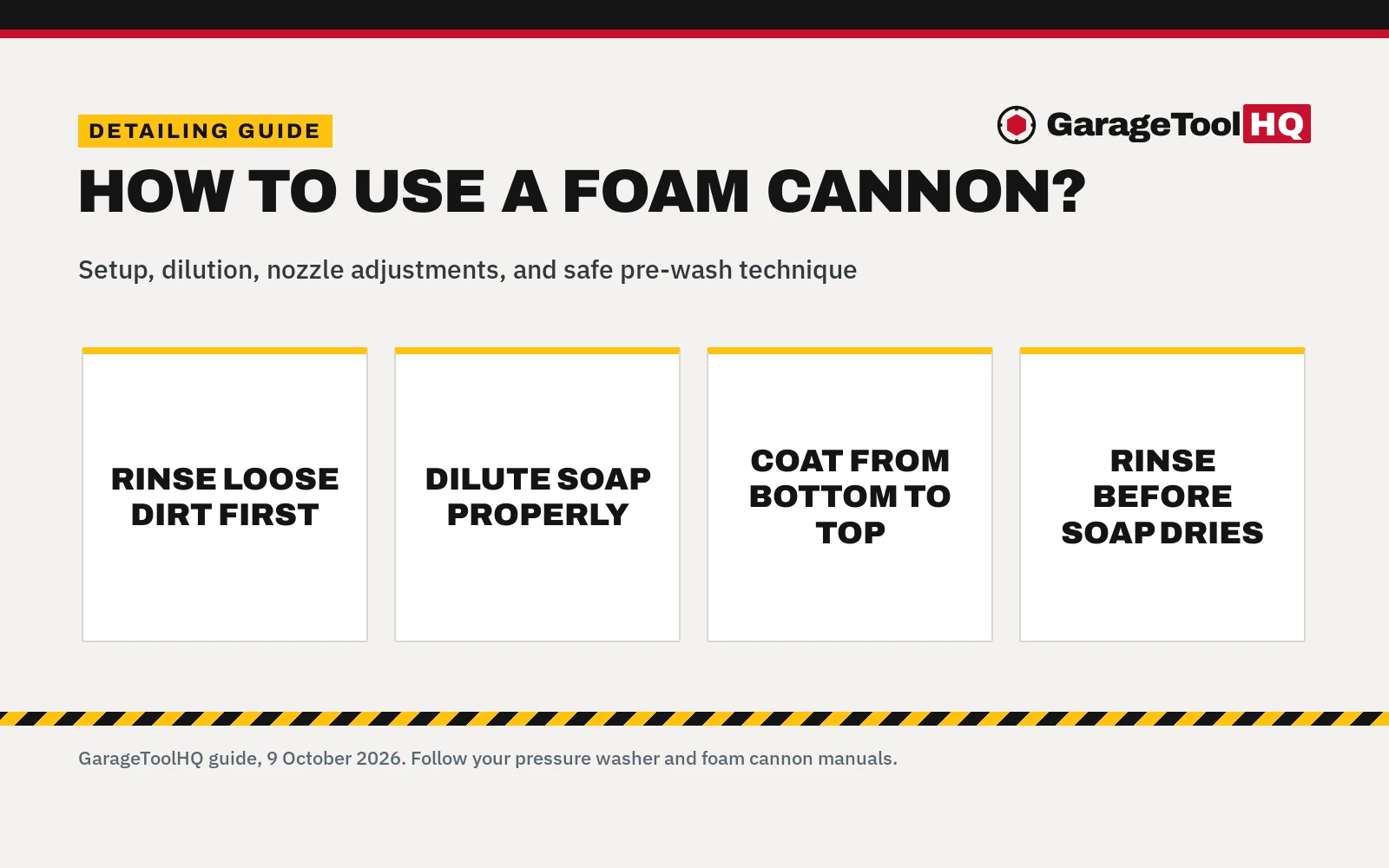
How to use foam cannon equipment comes down to a straightforward process: fill the bottle with water and car wash soap, connect the lance to your pressure washer wand with the quick connector, adjust the top dial for thick suds, and spray the vehicle from bottom to top before rinsing. The foam clings to exterior paint, encapsulates abrasive road dirt, and lubricates surface contaminants so they rinse away without scratching the clear coat. Operating the cannon properly before any hand contact reduces swirl marks and prepares the vehicle for a safe hand wash.
More options to compare
 Blackline Foam Cannon PRO for Pressure WashersCheck price on Amazon
 TriNova Foam Cannon for Pressure WashersCheck price on Amazon
 Pressure WasherCheck price on Amazon
 McKillans Foam Cannon for Pressure WasherCheck price on Amazon
 Adam's Polishes Premium Foam CannonCheck price on Amazon
 Sooprinse Foam CannonCheck price on Amazon
GarageToolHQ earns a commission when you buy through links on our product pages, at no extra cost to you. Read our affiliate disclosure.
Below: why the foaming step protects clear coat finishes, how pressure cannons compare with hose sprayers, a step-by-step wash routine, and how to maintain the hardware to prevent clogs.
How to use foam cannon gear: why the pre-wash step matters
Hand washing a dirty car without pre-soaking pushes road grit across the clear coat, creating micro-scratches and circular swirl marks. Applying a thick blanket of snow foam before touching the vehicle changes how soap interacts with grime on vertical panels and contours across distinct cleaning actions:
- Dirt encapsulation. Foaming soap surrounds abrasive road grit and softens dried mud, breaking their grip on the clear coat before any wash mitt makes contact.
- Surface lubrication. The thick blanket of suds creates a slippery layer over vehicle panels, ensuring that any subsequent hand wiping encounters minimal friction.
- Touch-free debris removal. Allowing foam to dwell and rinsing it away removes a substantial portion of loose road contamination without mechanical agitation.
- Extended dwell time. Unlike bucket water that runs off vertical fenders immediately, dense lather clings to sheet metal, allowing cleaning agents extended time to dissolve traffic film.
Pressure washer foam cannon vs garden hose foam gun
| Feature | Pressure washer foam cannon | Garden hose foam gun |
|---|---|---|
| Water source | Connects to a pressure washer spray wand | Connects directly to a standard outdoor garden hose |
| Operating pressure | High pressure driven by an electric or gas washer pump | Standard municipal water pressure from an outdoor spigot |
| Foam density | Dense, shaving-cream consistency that clings to paint | Soapy, aerated suds that slide down panels quickly |
| Primary purpose | Pre-wash soak to encapsulate dirt before hand washing | Quick maintenance washing and soap application |
Choosing between these wash tools depends on your available equipment. A garden hose gun works with household spigot pressure: SwiftJet lists 6 adjustable foam settings on its hose sprayer, and Seese lists 3 spray modes for rinsing and foaming without special machinery. When deeper pre-wash cleaning is needed, a true foam cannon paired with a pressure washer produces far thicker lather: FENG PAI lists a working pressure of 1000 to 4000 PSI for high-pressure foaming.
How to use foam cannon equipment safely: the step-by-step checklist
Follow this sequence from setup through rinsing to achieve maximum suds and protect automotive paint from swirl marks:
- Put on eye protection and inspect fittings. Always wear safety glasses or protective goggles before operating high-pressure equipment. Never point a pressure washer spray wand or foam cannon at people or animals. Check all O-rings and quick-connect couplings to verify that connections seat securely without leaks.
- Assess whether an initial rinse is needed. If the vehicle is caked in thick mud or heavy abrasive debris, use a wide pressure washer fan pattern to rinse away heavy clumps beforehand. For routine road dust and light grime, applying foam directly to dry paint helps the suds cling longer without sliding off wet surfaces.
- Fill the reservoir bottle with warm water. Pour clean, warm water into the canister before adding soap. Adding water prior to detergent prevents excess lather from bubbling out of the neck while filling.
- Add dedicated car wash soap concentrate. Pour in high-foaming car wash shampoo following the detergent maker’s bottle instructions. Swirl the bottle gently in a circular motion to mix the solution thoroughly without shaking violently.
- Select the correct orifice nozzle for your machine. Foam cannons rely on an internal brass orifice jet to create suds: DANCINGBOAR and Raincovo include a 1.1 mm orifice nozzle for machines operating below 1500 PSI, Blackline lists an included 1.1 mm orifice, and The Rag Company includes 1.1 mm and 1.25 mm orifices to match different pump flow rates. Installing a 1.1 mm orifice on lower-pressure electric washers increases vacuum suction to produce rich foam.
- Attach the foam cannon to the spray wand. Push the male fitting firmly into your pressure washer spray handle: DANCINGBOAR and Blackline use a standard 1/4-inch quick connector, while DANCINGBOAR and FENG PAI also list M22 14 mm and 15 mm adapter fittings for direct pump and hose connections. Pull back on the quick-connect collar to confirm the lance locks into place.
- Adjust the top dilution knob. Turn the top control dial toward the setting that increases soap concentrate for thicker lather, or toward higher water dilution for a lighter lather.
- Set the front fan nozzle pattern. Rotate the adjustable front spray blades to produce a wide, vertical fan pattern for broad body panels, or a narrower stream for wheel wells.
- Cover the vehicle from bottom to top and rinse. Spray overlapping horizontal passes, starting at the lower rocker panels and working upward toward the roof. Covering the bottom sections first prevents falling suds from masking dirty areas. Allow the foam to dwell on the surface to dissolve grime, but rinse the vehicle thoroughly with clean water from top to bottom before the soap dries. When switching to a rinse nozzle, CAKKAGAMA lists pressure washer spray nozzle tips with spray angles of 0, 15, 25, 40, and 65 degrees; for vehicle clear coats, use a wider fan angle rather than a concentrated 0-degree pinpoint jet.
Always wash your vehicle in shaded conditions or during cooler parts of the day. If car wash lather dries on clear coat, it leaves concentrated surfactant residue and stubborn water mineral spots that require extra polishing to eliminate.
Keep electric pressure washers on a GFCI outlet, never point the wand at people or pets, wear eye protection with polishers and chemicals, and read the label before mixing any cleaning products. Read our Safety Disclaimer.
Orifice sizing, pressure ratings, and bottle designs
Achieving thick, clinging lather depends on balancing water flow with internal airflow. Pressure washer foam cannons rely on a narrow orifice jet and an internal stainless steel mesh filter to blend air, water, and concentrated car shampoo. When an electric pressure washer operates at lower pressure, swapping to a smaller internal orifice increases suction velocity to pull soap into the mixing chamber.
Canister construction also impacts ease of use during a wash session. DANCINGBOAR and CAKKAGAMA list a 1-liter bottle capacity, which FENG PAI lists as 0.26 gallon, providing enough solution volume to coat an entire vehicle without stopping for refills. Wide-mouth designs make filling mess-free: Blackline lists a 42 mm wide mouth opening that allows pouring soap directly without funnels. For detailed model comparisons, read our guide to the best foam cannon options, or review our picks for the best electric pressure washer for cars to find a compatible pump setup.
Proper care and maintenance to prevent nozzle clogs
The primary cause of foam cannon failure is dried soap residue clogging the internal stainless steel mesh aerator. After finishing a wash session, detach the canister, rinse it with clean water, and reattach the bottle filled only with fresh water. Spray fresh water through the cannon for several seconds until clear liquid exits the nozzle. Flushing residual soap prevents detergent from solidifying inside the mesh filter between car washes.
Inspect the rubber O-rings on the quick-connect plug and bottle threads regularly. If an O-ring cracks or shifts out of place, air leaks into the water stream, causing the spray to pulse or spit watery bubbles. Store the clean foam lance indoors away from freezing temperatures and direct sunlight to protect the plastic canister and brass fittings. To build out your complete wash setup, browse our guide to the best car detailing kit and explore options for the best foam cannon for water hose connections.
Frequently Asked Questions
Do you rinse the vehicle before applying foam?
It depends on the level of dirt. For light to moderate road film, spraying foam onto dry paint allows the suds to cling longer and break down grime without sliding off a wet clear coat. If the vehicle carries heavy, caked mud or coarse grit, perform a pre-rinse beforehand to knock off heavy debris before applying foam.
How to use a foam cannon without scratching car paint?
Apply thick snow foam over a cool vehicle in the shade, let the suds dwell to soften grime, and rinse the lather away before touching the paint with a wash mitt. When hand washing afterward, use dedicated wash mitts and separate rinse buckets fitted with grit guard inserts to trap abrasive particles at the bottom.
Why is my foam cannon spraying watery suds instead of thick lather?
Watery output typically stems from insufficient soap concentrate in the bottle, the control dial adjusted for excess water dilution, low pressure washer flow, or a clogged internal mesh aerator. On lower-pressure electric pressure washers, installing a smaller orifice nozzle increases vacuum suction to pull more soap into the stream.
Can you use regular household dish soap in a foam cannon?
No. Household dish detergent is formulated to strip grease and will strip protective wax, sealant, and ceramic coatings from automotive finishes. Always use dedicated automotive car wash shampoo formulated with foaming agents and paint-safe lubricating polymers.
Where to buy a foam cannon and replacement parts?
Where to buy a foam cannon comes down to major online retailers and specialty automotive detailing supply distributors. Online retailers offer complete lance kits, while dedicated detailing suppliers stock replacement mesh filters, O-ring rebuild kits, and alternate orifice sizes.
How do you clean a clogged foam cannon mesh filter?
If flushing with warm water fails to clear a clog, disassemble the front nozzle barrel to access the cylindrical stainless steel mesh aerator. Soak the mesh filter in warm water mixed with mild vinegar or specialty cleaner to dissolve mineral deposits and dried soap scale, then rinse thoroughly before reassembly.
Related: best foam cannon picks, the best foam cannon for water hose, our best electric pressure washer for cars, and the car detailing hub. Also see our guide to the best car detailing kit.