How to Organize a Tool Chest: Step-by-Step Drawer Organization
How to organize a tool chest using a top-to-bottom drawer layout, modular organizer trays, non-slip liners and labeled tool drawer organization.

On this page
Top picks at a glance
As an Amazon Associate we earn from qualifying purchases.
- 1
 NattyDot Power Tool Organizer Cart with Charging Station9.3/10View on Amazon
- 2
 ALVOROG 3 Tier Metal Rolling Utility Cart with Pegboards9.5/10View on Amazon
- 3
 SHOPMAX 41″ 16-Drawer Tool Chest and Rolling Cabinet Combo9.8/10View on Amazon
- 4
 13-Drawer Rolling Tool Chest with Double DoorsView on Amazon
- 5
 WORKPRO 52" x 20" Rolling Tool ChestView on Amazon
- 6
 CRAFTSMAN Tool Chest Combo with Drawer Liner RollView on Amazon
- 7
 CRAFTSMAN VERSASTACK 30 Gallon Quick-Access Rolling Tool ChestView on Amazon
- 8
 INTERGREAT 8 Drawers Tool ChestView on Amazon
- 9
 Geinxurn 8-Drawer Red Tool BoxView on Amazon
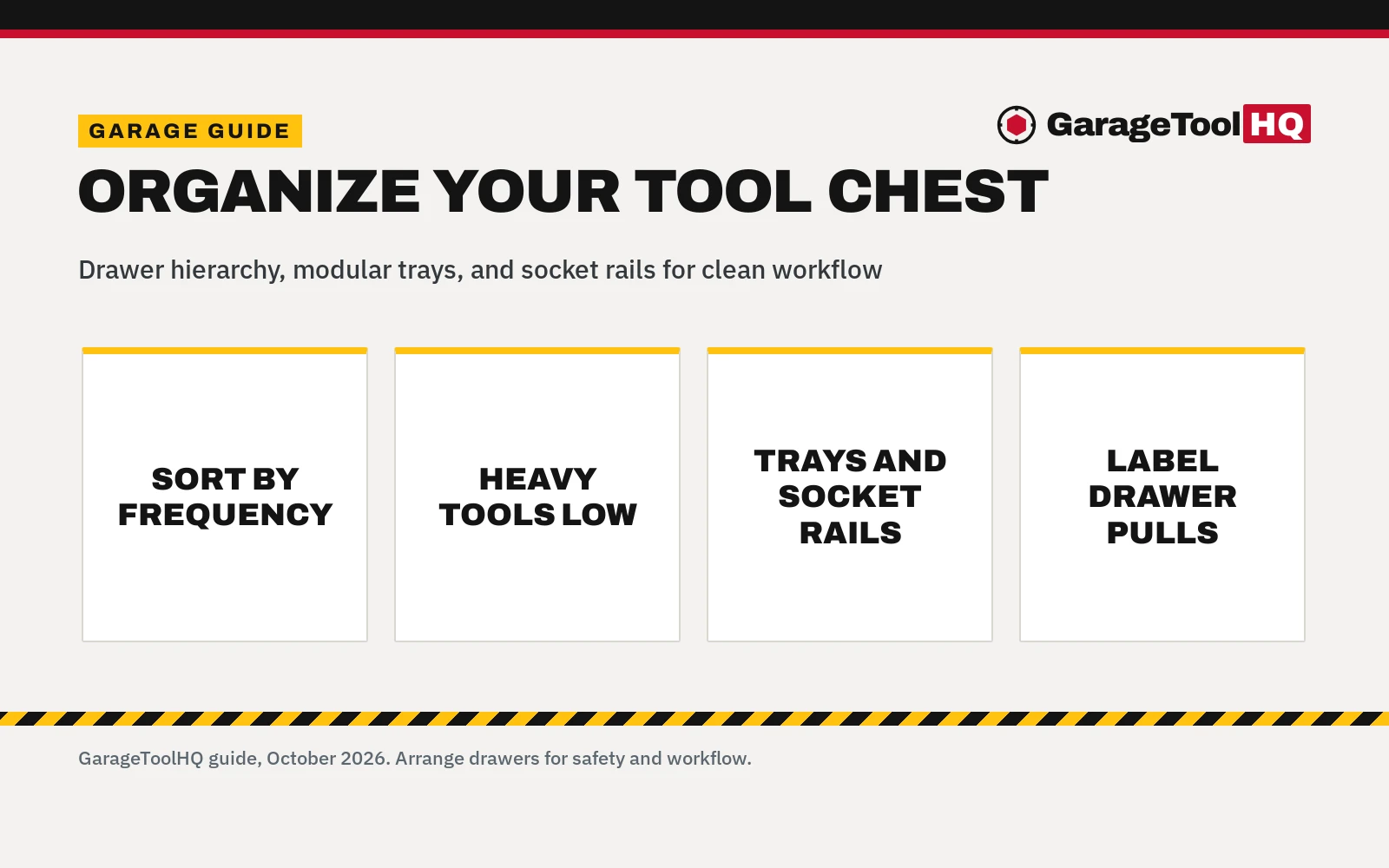
How to organize a tool chest comes down to drawer hierarchy, vertical organization, and keeping related tools together. Start by sorting tools by frequency of use: place daily hand tools in shallow top drawers, medium tools in middle drawers, and heavy equipment or power tools in deep bottom drawers. Line drawers with non-slip mats, add modular organizer trays and socket rails to stop tools from shifting, and label drawer pulls so tools have a clear, permanent home.
More options to compare
 13-Drawer Rolling Tool Chest with Double DoorsCheck price on Amazon
 WORKPRO 52" x 20" Rolling Tool ChestCheck price on Amazon
 CRAFTSMAN Tool Chest Combo with Drawer Liner RollCheck price on Amazon
 CRAFTSMAN VERSASTACK 30 Gallon Quick-Access Rolling Tool ChestCheck price on Amazon
 INTERGREAT 8 Drawers Tool ChestCheck price on Amazon
 Geinxurn 8-Drawer Red Tool BoxCheck price on Amazon
GarageToolHQ earns a commission when you buy through links on our product pages, at no extra cost to you. Read our affiliate disclosure.
Below: how to plan your drawer layout by frequency, essential organizer trays and socket rails, a step-by-step organization checklist, and how to distribute weight safely across your cabinet.
How to organize a tool chest: layout by drawer frequency
A disorganized tool chest wastes shop time and leads to duplicate tool purchases when missing items hide under clutter. Effective tool drawer organization relies on frequency of access. When you stand in front of your rolling chest during a repair, your hands naturally reach for the top drawers without bending down. Placing your most common mechanics tools in those prime upper slots keeps your workflow smooth and prevents rummaging.
Tool chests function best when divided across distinct operational tiers:
- Top tier (daily mechanics tools). Shallow drawers at the top should hold ratchets, extensions, standard sockets on upright rails, screwdrivers, and magnetic bit drivers. Standard-depth sockets easily clear shallow drawer ceilings on vertical rails, while deep sockets can lay flat in magnetic trays or sit in deeper drawers.
- Middle tier (specialty hand tools and gripping tools). Intermediate drawers hold combination wrenches, adjustable wrenches, locking pliers, slip-joint pliers, diagonal cutters, snap ring pliers, and wire strippers. Grouping gripping tools separately from turning tools prevents drawer clutter.
- Bottom tier (heavy tools and power equipment). Deep lower drawers accommodate heavy cordless impact wrenches, rotary hammers, drill drivers, battery charging docks, blow-molded specialty diagnostic cases, and pry bars.
Keeping each drawer dedicated to a distinct mechanical category ensures you can spot a missing tool before closing your shop for the evening.
Tool chest drawer layout: comparing drawer tiers
| Drawer Tier | Recommended Tool Categories | Storage and Layout Method |
|---|---|---|
| Top drawers (shallow) | Ratchets, sockets, extensions, screwdrivers, precision bits | Socket rails, magnetic bit trays, and shallow modular divider bins |
| Middle drawers (medium depth) | Combination wrenches, pliers, wire strippers, hex keys, adjustable wrenches | Angled wrench racks, vertical plier organizers, and interlocking utility trays |
| Bottom drawers (deep) | Cordless impact wrenches, power drills, chargers, diagnostic cases, pry bars | Heavy blow-molded cases, wide storage bins, or standing battery racks |
Overall cabinet load ratings and dimensions determine how much equipment a tool chest can safely support. For smaller garages, TUFFIOM lists a 5-drawer rolling cabinet with an overall dimension of 24.4 x 13 x 29.5 inches, an item weight of 54.2 pounds, and an overall maximum weight capacity of 220 pounds riding on 4 wheels with 2 wheel brakes. Compact units of this scale require disciplined sorting so that heavy hand tools do not crowd shallow drawers.
Larger workshops often select wide rolling workbenches that combine storage with an overhead work surface. WORKPRO lists a 52 x 20 inch rolling tool chest with 5 drawers, 1 door, a solid wood 1-3/8-inch wooden top, an overall item weight of 187.4 pounds, and a maximum load capacity of 1000 lbs. For extensive mechanics collections with numerous small specialty tools, Sormols lists a 2 in 1 detachable tool chest combo measuring 24.4 x 13 x 43.3 inches that provides 13 drawers split into 7 large drawers and 6 small drawers, along with 2 doors, 6 hooks on the side, and universal wheels that rotate 360 degrees.
How to organize a tool chest step by step
- Empty every drawer completely. Clear your garage workbench and pull everything out of the chest. Sort through the pile to discard broken tools, wipe down greasy handles, and eliminate duplicate sockets that take up unnecessary space.
- Clean drawer interiors and lay non-slip liners. Wipe away metal shavings, dust, and spilled oil from drawer bottoms. Lay textured foam or rubber liners across drawer bases to keep metal tools from sliding and scratching the finish during drawer movement.
- Group hand tools by mechanical function. Place turning tools together, striking tools together, and electrical diagnostic equipment in their own dedicated pile. Keep household or specialty fixtures separated from automotive hand tools so your primary mechanics set remains easy to navigate.
- Fit modular organizer trays and socket rails. Arrange shallow interlocking organizer bins in top and middle drawers. Position socket rails along drawer depth so socket size labels face upward toward your line of sight.
- Store heavy equipment in bottom drawers. Place bulky cordless tools, battery chargers, hammers, and heavy diagnostic cases into deep lower compartments to establish a stable low center of gravity for the cabinet.
- Label drawer pulls clearly. Affix legible labels to the exterior handle of drawer pulls indicating contents, such as Sockets and Ratchets, Wrenches, or Pliers. Clear labeling prevents opening multiple drawers while searching for a tool.
- Return tools to their designated spots immediately. End each garage repair session with a rapid tool sweep. An organized chest only stays organized if every socket and wrench clicks back into its assigned tray before you turn off the shop lights.
Never pull out multiple heavily loaded drawers at the same time. Shifting center of gravity forward can cause a rolling cabinet to tip forward onto the floor. Open only a single drawer at a time, and always engage caster wheel brakes when your tool chest is parked in its garage bay.
Use rated jack stands on solid ground, wear eye protection with power and air tools, keep fuel-burning equipment out of a closed garage, and follow the manual for every tool. Read our Safety Disclaimer.
Modular plastic trays vs custom foam organizers
Mechanics generally choose between modular interlocking plastic trays and custom cut foam inserts. Both methods prevent hand tools from rolling together into a tangled heap, but they suit different shop workflows.
Modular plastic trays offer flexibility as your tool collection expands. You can rearrange individual compartments, swap tray positions between drawers, and wipe them clean with shop rags when grease accumulates. Tray dimensions vary across listings. For example, ALIKZO lists a 70-piece toolbox organizer tray divider set in 5 sizes, including 2 XL, 4 L, 8 M, 20 S, and 36 XS bins with a uniform height of 1.77 inches (4.5 cm), an item weight of 1.87 kg, and 140 round EVA dots plus 36 square pads. FLYVOLE lists a 60-piece organizer set in 5 graduated sizes with a uniform height of 1.77 inches and a maximum weight recommendation of 10 pounds. For larger hand tools, inihpocv lists 6 extra-large trays measuring 12 x 6 x 2 inches with 25 EVA non-slip pads, while ONREVA lists a 6-piece tray divider set across 3 sizes with a height of 2 inches and a maximum weight recommendation of 10 pounds. Vexercisehoop lists a 47-piece set in red and black with an item weight of 3.7 pounds, 107 pads across 7 sheets, and a uniform height of 1.77 inches. For heavy storage abuse, A-LuGei lists an 80-piece tray divider set in 6 sizes with a 1.8 inches height, stating that thick walls hold 220 lbs without cracking, alongside a 46-piece set across 5 sizes with an item weight of 1.41 kg.
Custom foam inserts (often called shadow foam or Kaizen foam) provide a dedicated cutout for every individual tool. Foam shows missing tools at a glance because the contrasting base color shows through whenever a slot is empty. However, foam cutouts lock you into a rigid layout. When you purchase a new ratchet or upgrade your combination wrench set, you must cut a completely new foam sheet. For most home garages and DIY mechanics, interlocking plastic trays provide the best balance of structure, adaptability, and easy cleaning.
Maximizing vertical drawer space with socket rails and wrench racks
Loose sockets and combination wrenches consume more drawer surface area than almost any other tools. Laying sockets flat in a drawer swallows square inches quickly and makes reading size stamps difficult. Using vertical socket rails or magnetic socket trays lets you stand standard sockets upright, turning wasted vertical drawer height into usable storage space, while deep sockets can lay flat or stand in intermediate drawers that offer adequate vertical clearance. For dedicated drawer organizers, compare options in our guide to the socket organizer for tool box drawer.
Combination wrenches similarly benefit from angled or vertical organizers. Angled wrench racks hold wrenches in ascending order from smallest to largest, allowing you to grab the exact metric or SAE size on your first reach. Review our guide to the best wrench organizer for tool box to compare rack profiles and drawer clearances. If your tool collection has outgrown your current cabinet, explore our overview of the best rolling tool chest under 1000 or learn how to evaluate drawer depth and gauge in our guide on how to choose a tool chest. For heavy mobile setups with integrated work surfaces, check our review of the mobile workbench with tool storage.
Frequently Asked Questions
What tools should go in the top drawer of a tool chest?
Top drawers should hold your most frequently reached hand tools, primarily ratchets, standard sockets, extensions, universal joints, and screwdrivers. Placing these high-rotation tools in shallow top drawers allows you to grab them quickly while standing upright without bending over.
How do I stop tools from sliding around inside tool chest drawers?
Line drawer bottoms with non-slip textured foam or rubber liners. Liners create friction that prevents steel tools from sliding when drawers open and close. Complement liners with interlocking modular trays or magnetic organizer bases that hold sockets and wrenches securely in place.
Should I organize sockets by drive size or by fastener type?
Organize sockets primarily by drive size on separate rails, and then divide them by fastener standard (metric versus SAE) and fastener head style (such as standard hex, Torx, or external drive profiles). Grouping by drive size ensures that your ratchets and extensions match the rail immediately, while separating metric and SAE onto distinct, labeled rails prevents grabbing the wrong socket while working under a vehicle.
What is the safest way to load a rolling tool chest?
Always load the heaviest equipment in the bottom compartments and lighter hand tools in the upper drawers. This creates a low center of gravity that keeps the rolling cabinet stable. Open only a single drawer at a time, and always engage wheel caster brakes when the chest is parked.
Are modular organizer trays better than custom foam cutouts?
Modular plastic trays are better for evolving tool collections because you can reconfigure, add, or remove trays as you buy new tools. Custom foam cutouts offer superior tool protection and visual accountability, but they require recutting whenever you change your tool set.
How much weight can a rolling tool chest support?
Total weight capacity varies widely by cabinet build and materials. Check the manufacturer listing for stated ratings. For example, TUFFIOM lists an overall maximum weight capacity of 220 pounds for its compact 5-drawer cabinet, while WORKPRO lists a maximum load capacity of 1000 lbs for its 52 x 20 inch heavy-duty rolling workbench. Individual drawer slide capacities are often not stated on retail listings, so distribute heavy tools into lower compartments rather than overloading single drawers.
Related: our guide to how to choose a tool chest, tool chest sizes and dimensions, and the tool storage hub.