How to Oil Air Tools: Step-by-Step Shop Guide
How to oil air tools properly: where to add oil, step-by-step lubrication steps, choosing the right pneumatic oil, and everyday maintenance habits for your garage.

On this page
Top picks at a glance
As an Amazon Associate we earn from qualifying purchases.
- 1
 Lucas Oil 10216 Air Tool Lubricant & Tool Box Buddy9.5/10View on Amazon
- 2
 Premium Air Tool Lubricant9.4/10View on Amazon
- 3
 AEROPRO TOOLS 1/2-Inch Aluminum Air Impact Wrench9.7/10View on Amazon
- 4
 Ingersoll Rand 10P Edge Series Premium Air Tool OilView on Amazon
- 5
 Milton Industries High Performance Air Tool Oil 1001-4View on Amazon
- 6
 CRAFTSMAN Air Tool OilView on Amazon
- 7
 Freeman PTTO Air Tool OilView on Amazon
- 8
 California Air Tools 2010A 1.0 HP Ultra Quiet and Oil-FreeView on Amazon
- 9
 Ultra Quiet Air CompressorView on Amazon
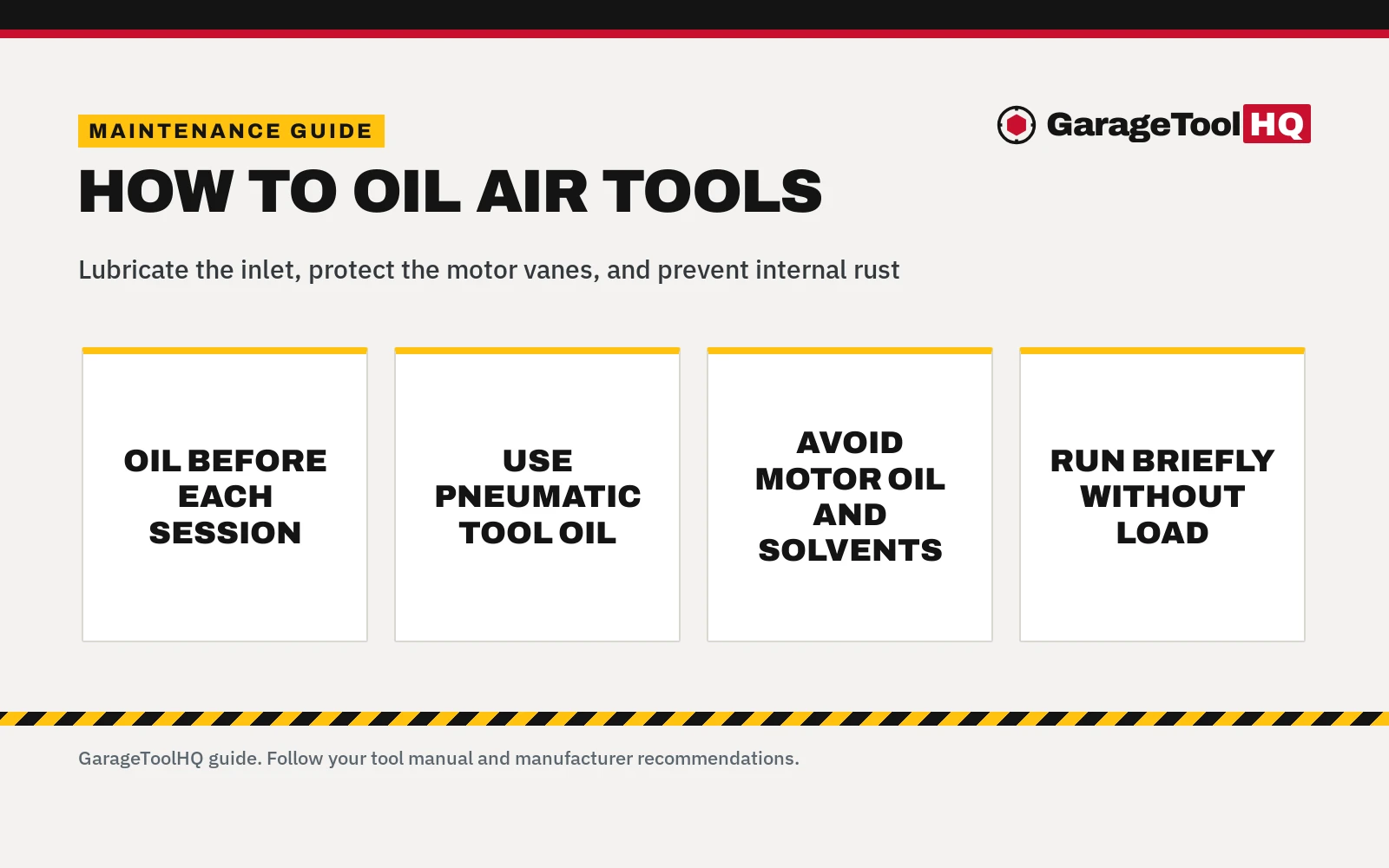
How to oil air tools properly: add pneumatic air tool oil directly into the air inlet fitting before each session, connect the air line, and run the tool briefly without load to circulate lubricant through the motor. Regular lubrication prevents internal corrosion from line moisture and keeps rotor vanes sliding freely against cylinder walls. Skipping oil leads to sluggish operation, seized cylinders, and premature motor failure.
More options to compare
 Ingersoll Rand 10P Edge Series Premium Air Tool OilCheck price on Amazon
 Milton Industries High Performance Air Tool Oil 1001-4Check price on Amazon
 CRAFTSMAN Air Tool OilCheck price on Amazon
 Freeman PTTO Air Tool OilCheck price on Amazon
 California Air Tools 2010A 1.0 HP Ultra Quiet and Oil-FreeCheck price on Amazon
 Ultra Quiet Air CompressorCheck price on Amazon
GarageToolHQ earns a commission when you buy through links on our product pages, at no extra cost to you. Read our affiliate disclosure.
Below: why pneumatic motors require lubrication, oil viscosity comparisons, a step-by-step walkthrough, and shop maintenance practices.
How to oil air tools: why pneumatic motors need daily lubrication
Most rotary pneumatic tools like air impact wrenches, ratchets, die grinders, and cut-off tools rely on a vane motor. Compressed air expands against sliding rotor vanes spinning at high speed against the cylinder wall. Tight mechanical clearances generate friction and heat without constant lubrication.
Compressed air also carries water vapor from compressor tanks into tool inlets. Without a protective oil film, internal steel rotors, cylinder sleeves, and bearing races oxidize quickly, causing rust and sticking vanes.
- Vane wear and power loss. Friction abrades sliding vanes, allowing air to bypass the rotor without generating torque.
- Moisture and internal rust. Water vapor in air lines oxidizes internal steel parts when tools sit idle.
- O-ring degradation and leaks. Rubber seals dry out without oil, causing air leaks around valves and exhaust ports.
- Sludge buildup. Air contaminants combine with heat to create sticky gum deposits unless dissolved by fresh lubricant.
Pneumatic tool oils compared: viscosity and specifications
Pneumatic tool oil is a lightweight non-detergent lubricant formulated for air-powered machinery. Quality formulas include rust inhibitors to combat line moisture and gum-dissolving additives to keep vanes free. Unlike thick engine oil, pneumatic lubricant atomizes efficiently in the air stream without causing viscous drag.
Pneumatic lubricants are categorized by ISO ratings and SAE grades. Coilhose Pneumatics specifies an ISO 22 mineral and synthetic blend for its ATL016 lubricant for direct inlet application and line lubricators. Milton lists an SAE 10W viscosity grade alongside an ISO 32 rating for its 1001-4 air tool oil, stating an upper temperature rating of 150 °F. Ingersoll Rand provides its 10P Edge Series lubricant rated at SAE 0W in a 0.5L bottle (stated as 1 pints in its specification table), while its 10Z4 lubricant lists an SAE 10W viscosity grade with an upper temperature rating of 150 °C. STANIOS INDUSTRIAL SUPPLY packages a 6-pack of 4 oz bottles totaling 24 fluid ounces; its specification table lists a 5w-30 viscosity grade, though pneumatic motors require dedicated light tool oil rather than multi-grade engine oil.
Container sizes match different garage needs. CRAFTSMAN lists its CMPCPO100 pneumatic tool oil in a 4 fluid ounces bottle with package dimensions of 5 x 1.5 in. Milton and 3-IN-ONE package oil in 4 fluid ounces containers, with 3-IN-ONE stating a flash point of 302 °F. Ingersoll Rand lists a 4-ounce bottle (stated as 0.12 liters) for 10Z4. Coilhose Pneumatics packages ATL016 in a 16 fluid ounces bottle, and Lucas Oil lists its 10216 lubricant in a 16 Fluid Ounces bottle (stated as 473 ml). For bulk supply, CLIsyntec lists a 64 fluid ounces jug of LS-2 64FL with a flash point of 177 °C, and a 128 fluid ounces container of LS-2 with an item weight of 8 pounds. Milton lists a 1 yr warranty on material and workmanship for 1001-4, while the remaining listings do not publish a specific duration.
| Brand and Model | Stated Viscosity | Container Volume | Stated Temperature or Flash Point |
|---|---|---|---|
| Milton 1001-4 | SAE 10W, ISO 32 | 4 fluid ounces | Upper temperature rating 150 °F |
| Coilhose Pneumatics ATL016 | ISO 22 | 16 fluid ounces | Not stated |
| Ingersoll Rand 10P | SAE 0W | 0.5L (1 pints) | Not stated |
| Ingersoll Rand 10Z4 | SAE 10W | 4-ounce (0.12 liters) | Upper temperature rating 150 °C |
| 3-IN-ONE 120049 | Appropriate for pneumatic tools | 4 fluid ounces | Flash point 302 °F |
| CRAFTSMAN CMPCPO100 | Not stated | 4 fluid ounces | Not stated |
| Lucas Oil 10216 | SAE 10W | 16 Fluid Ounces (473 ml) | Not stated |
| CLIsyntec LS-2 64FL | Not stated | 64 fluid ounces | Flash point 177 °C |
| CLIsyntec LS-2 | Not stated | 128 fluid ounces | Not stated |
| STANIOS INDUSTRIAL SUPPLY 080-6PK | 5w-30 (listing spec table) | 24 fluid ounces (6-pack) | Not stated |
Automotive engine motor oil and penetrating sprays must never replace pneumatic tool oil. Motor oil contains detergents that create foam, degrade rubber O-rings, and swell internal seals. Penetrating sprays dissolve existing oil films, evaporate quickly, and leave bare metal exposed to friction. Always use dedicated pneumatic tool oil.
How to oil air tools step by step
Oiling an air tool takes only moments before each work session:
- Disconnect the tool from the air supply line. Detach the quick-connect coupler from the tool inlet before adding oil to prevent accidental triggering.
- Clean debris around the air inlet fitting. Wipe road grime and dust away from the fitting and threads so abrasive grit does not enter the motor chamber.
- Add pneumatic oil directly into the air inlet. Hold the tool upright with the inlet facing up, and dispense a small amount of pneumatic tool oil into the fitting opening.
- Reconnect the air hose to the tool fitting. Push the quick-connect coupler firmly onto the tool inlet until the collar snaps forward.
- Cycle the trigger briefly without mechanical load. Point the exhaust away from your face and workpieces. Wrap a towel loosely around the exhaust deflector and feather the trigger in short, low-speed pulses to distribute oil across rotor vanes, cylinder walls, and bearings.
- Wipe away exhaust blow-by. Excess oil atomizes and exits through the exhaust port during initial spin. Wipe the housing clean before putting the tool to work under operating pressure.
Never add air tool oil to a paint spray gun inlet. Spray guns require clean, dry air free of oil mist. Oil droplets in the air line ruin paint finishes, causing fish eyes and adhesion failure. Always maintain a dedicated, unlubricated air hose reserved strictly for painting and tire inflation.
Wear eye protection with every air tool, use impact-rated sockets on impact wrenches, disconnect the air line before changing accessories, and finish lug nuts with a torque wrench to the vehicle's spec. See OSHA eye and face protection. Read our Safety Disclaimer.
Manual oiling vs inline air line lubricators
Maintaining air tool lubrication can be handled manually or with automated inline equipment depending on your garage setup and workload.
- Daily manual oiling: Adding oil directly to the tool inlet before each session suits home garages. It requires no plumbing and keeps primary hoses clean for non-lubricated tasks.
- Tool-mounted mini lubricators: Compact lubricators attach directly between the tool inlet and hose coupler, feeding oil automatically as air flows. However, they add weight and bulk in tight spaces.
- Stationary inline lubricators: Installed on a dedicated rigid pipe drop, an inline lubricator injects oil mist into the air stream for tools that run continuously.
- Dedicated hose lines: Once an air hose carries lubricated air, oil coats the inner lining permanently. Never use an oiled hose for tire inflation, dusting, or paint spraying. Clearly mark lubricated lines.
Proper operation also requires matched airflow and dry delivery. Learn how tool consumption matches supply in our guide to what CFM air tools need. To plan a dependable layout, see how to plumb compressed air lines in a garage, and remove line moisture with our guide on how to drain water from an air compressor tank.
Air tool oil vs grease: lubricating impact mechanisms and gearboxes
Adding oil through the air inlet lubricates only the pneumatic motor cylinder, rotor vanes, and motor bearings. Mechanical drive components in front of the motor require separate, specialized lubrication.
In an air impact wrench, the motor drives a heavy hammer frame and anvil assembly inside the front nose cone. This hammer mechanism requires heavy-duty impact grease rather than thin air tool oil. Adding thin oil into the hammer case dissolves and washes away impact grease, while packing heavy grease into the air inlet clogs motor vanes. Many impact wrenches include a grease port or threaded plug on the hammer case for service.
Pneumatic ratchets similarly use grease in their planetary gear reduction and drive yoke assembly. Lubricating both the motor and drive mechanism ensures long service life. For proper operation, read our guide on how to use an air impact wrench, and compare pneumatic models in our roundup of the best air impact wrenches. For tight engine bay work, see our guide to the best air ratchets.
Frequently Asked Questions
How often should you oil air tools?
Oil pneumatic tools before each work session. During extended continuous use, add a few drops of pneumatic oil periodically. Adding oil after finishing a job also protects internal surfaces against condensation and corrosion during storage.
Can you use penetrating spray to oil air tools?
No. Multi-purpose penetrating spray is a solvent-based penetrant, not a lubricant. It strips existing oil films, evaporates quickly, and leaves bare metal vanes and cylinder walls vulnerable to friction and seizing.
Can automotive motor oil be used in pneumatic air tools?
No. Automotive motor oil is too thick for high-speed pneumatic motors, creating viscous drag that robs speed and torque. Engine oil detergents also cause foaming and deteriorate internal rubber O-rings and seals.
What happens if an air tool is never oiled?
Running dry causes friction between rotor vanes and the cylinder wall, leading to rapid vane wear, torque loss, and overheating. Line moisture also causes internal rust, seizing the rotor and damaging bearings.
How much oil should you put in an air tool?
A few drops of pneumatic oil in the air inlet is sufficient for handheld air tools. Excess fluid blows out through the exhaust port, creating oil mist and messy tool surfaces.
Do pneumatic impact wrenches and air ratchets use the same oil?
Yes, all rotary pneumatic motors use the same lightweight pneumatic tool oil in their air inlets. However, impact hammer cases and ratchet planetary gear heads require specialized grease rather than air tool oil.
Related: comprehensive air compressor maintenance, selecting the best air compressor oil for pump crankcases, choosing the best air hammer for heavy shop tasks, our complete air tools hub, and our guide to how to use an air impact wrench.