Husky vs Craftsman Tool Chest: Which One Should You Buy?
When choosing between Husky and Craftsman tool chests, cabinet depth, drawer slide action, and mobile workbench layouts determine the best fit for your garage.

On this page
Top picks at a glance
As an Amazon Associate we earn from qualifying purchases.
- 1
 HuskyTools Workbench9.4/10View on Amazon
- 2
 SHOPMAX 41″ 16-Drawer Tool Chest and Rolling Cabinet Combo9.8/10View on Amazon
- 3
 ShopMax 27 in. 8 Drawer Tool Chest and Rolling Cabinet Combo9.7/10View on Amazon
- 4
 CRAFTSMAN VERSASTACK 30 Gallon Quick-Access Rolling Tool ChestView on Amazon
- 5
 WORKPRO 52" x 20" Rolling Tool ChestView on Amazon
- 6
 Garvee 60 in Rolling Tool ChestView on Amazon
- 7
 CRAFTSMAN Tool Chest Combo with Drawer Liner RollView on Amazon
- 8
 Craftsman 3-Drawer Metal Portable Chest Toolbox RedView on Amazon
When comparing a husky vs craftsman tool chest, the choice comes down to cabinet depth, storage format, and workshop layout. Husky is generally the better option for homeowners and DIY mechanics who want wide rolling workbenches, deep drawers, and integrated solid wood work surfaces. Craftsman is well-suited for users who prefer classic red steel chest-and-cabinet combos, standard-depth vertical storage, and matching portable utility boxes. Both brands produce dependable steel tool storage for home garages, but Husky emphasizes deep mobile workbench capacity, while Craftsman offers balanced traditional rolling towers and versatile shop storage.
More options to compare
 CRAFTSMAN VERSASTACK 30 Gallon Quick-Access Rolling Tool ChestCheck price on Amazon
 WORKPRO 52" x 20" Rolling Tool ChestCheck price on Amazon
 Garvee 60 in Rolling Tool ChestCheck price on Amazon
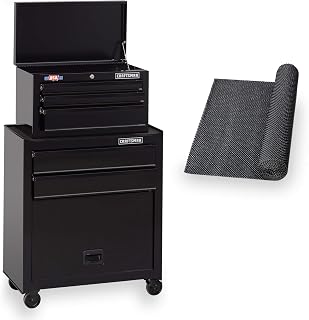 CRAFTSMAN Tool Chest Combo with Drawer Liner RollCheck price on Amazon
 Craftsman 3-Drawer Metal Portable Chest Toolbox RedCheck price on Amazon
GarageToolHQ earns a commission when you buy through links on our product pages, at no extra cost to you. Read our affiliate disclosure.
Below: the core differences between Husky and Craftsman tool storage, how their cabinet builds and drawer hardware compare, and a practical checklist to help you choose the right brand for your garage.
Husky vs craftsman tool chest: key differences for garage owners
Both Husky and Craftsman have served garage mechanics for decades, yet each brand approaches workshop storage with different priorities. Understanding how they compare across construction quality, drawer hardware, mobility, and security helps you select the right cabinet for your workspace.
- Cabinet construction and steel gauge. Tool chest rigidity depends on sheet metal gauge and frame reinforcement. Heavier steel frames resist racking when rolled across uneven expansion joints or loaded with dense automotive equipment. Both brands offer reinforced steel construction, with premium lines featuring heavier side panels and welded corners for increased rigidity.
- Drawer slide hardware and action. Ball-bearing slides ensure drawers glide smoothly under load. Premium storage tiers from both manufacturers feature soft-close mechanisms with hydraulic dampers that gently pull drawers shut in the final inch of travel, preventing drawers from slamming and stopping hand tools from shifting. Standard lines use ball-bearing slides with detent retention, which holds drawers firmly in their closed position so they resist rolling open when working around the cabinet.
- Cabinet depth and usable volume. Cabinet depth determines how much drawer space you gain per linear foot of garage wall. Husky frequently emphasizes deeper cabinet designs and wide workbench formats that accommodate large blow-molded tool cases and long pry bars. Craftsman standard cabinets maintain a traditional depth suited for compact garages where floor clearance around parked cars is limited.
- Mobility and caster design. Rolling cabinets require durable casters that roll smoothly over garage floor seams, dropped fasteners, and stray cords. Swivel casters with integrated locking toe brakes keep the chest firmly positioned during maintenance work, while side-mounted push handles allow controlled maneuvering around the shop.
- Locking security and key style. Securing valuable hand tools and diagnostic equipment is essential in home garages. Tool chests use internal locking bars that engage the back of drawer slides to prevent drawers from opening when locked. Modern heavy-duty cabinets frequently use tubular barrel locks that offer enhanced resistance to picking and key wear compared with basic stamped-metal flat keys.
Husky or Craftsman: how their storage lineups compare
| Feature | Husky Tool Storage | Craftsman Tool Storage |
|---|---|---|
| Primary focus | Rolling workbenches and deep garage storage | Traditional rolling chest combos and workshop storage |
| Work surfaces | Integrated solid wood and stainless bench tops | Recessed metal top trays and optional wood work surfaces |
| Drawer slide style | Ball-bearing slides with soft-close mechanisms | Ball-bearing slides with soft-close or detent retention |
| Locking security | Internal locking bars with tubular barrel keys | Internal locking bars with keyed cylinder locks |
| Specialty storage | Wide mobile workbench cabinets with power outlets | Portable utility boxes and modular hardware organizers |
| Primary retailer | Home Depot and authorized online distribution | Lowe’s and authorized hardware retailers |
The primary division between the two brands lies in their cabinet formats. Husky specializes in heavy mobile workbenches that combine multi-drawer steel cabinets with thick hardwood tops and integrated power strips, creating a dedicated area for assembling parts, servicing equipment, and charging cordless tool batteries. Craftsman focuses on traditional vertical chest combinations, offering modular flexibility where a top chest sits cleanly on a rolling cabinet, alongside a broad selection of portable utility organizers.
How to choose between Husky and Craftsman: buyer checklist
- Measure available garage floor space. Clear floor area along garage walls, allowing clearance for open drawers and walking room around parked vehicles. Check ceiling and shelf clearance if adding a top chest.
- Evaluate drawer depth requirements. Long pry bars, socket sets, and power tools benefit from deeper cabinet drawers. Shallow drawers suit wrenches, pliers, screwdrivers, and precision measuring tools.
- Check drawer slide action. Smooth ball-bearing drawer slides prevent binding when drawers are loaded with heavy hand tools. Look for soft-close dampers if you want drawers to close smoothly without slamming, or detent slides if you prefer a positive mechanical hold when drawers are pushed shut.
- Decide on workbench top requirements. If you need a flat working area for assembling parts or servicing equipment, prioritize a mobile workbench cabinet with a solid wood top. If you already have dedicated workbenches, a standard vertical chest-and-cabinet combo saves floor space.
- Review locking hardware. Internal latch bars secured by keyed cylinders protect tools against tampering in shared garages. Verify whether the cabinet uses a tubular key or standard cylinder, and check that all drawers engage cleanly with the lock mechanism.
- Verify mobility and caster quality. Heavy-duty casters with locking toe brakes keep rolling cabinets stationary during maintenance work. Ensure caster diameter rolls smoothly over concrete seams and floor thresholds without catching.
Rolling tool chests become top-heavy when loaded drawers are opened. Always engage caster brakes on level concrete, never extend multiple loaded drawers simultaneously, and place heavy equipment like floor jacks and air tools in bottom drawers to maintain a low center of gravity.
Use rated jack stands on solid ground, wear eye protection with power and air tools, keep fuel-burning equipment out of a closed garage, and follow the manual for every tool. Read our Safety Disclaimer.
Rolling cabinets vs modular portable tool boxes
Choosing between a rolling metal cabinet and portable storage depends on whether your tools stay in the garage or travel to jobsites. When planning your garage storage setup, read our guide on how to choose a tool chest to evaluate drawer layouts, overall dimensions, and weight ratings before purchasing.
Craftsman publishes concrete ratings across individual portable and specialty storage listings. For lightweight portable hand tool carrying, the Craftsman 13 in. lockable tool box specifies a maximum weight recommendation of 16 pounds with 2 compartments. For bulky utility transport, the Craftsman VERSASTACK 30 Gallon rolling chest provides 30 gallons of capacity, weighs 19.9 pounds, and carries an IP54 dust and water resistance rating. For sorting fasteners and small parts, Craftsman lists 3-Packs of 10-Compartments organizers with a maximum weight recommendation of 20 kg that stack securely with matching organizer units.
By contrast, Husky focuses its lineup heavily on stationary and rolling steel cabinets. If you need a permanent garage station that combines tool storage with a sturdy work surface, explore a mobile workbench with tool storage. Husky workbenches feature heavy steel cabinets, deep lower drawers, integrated power outlets with USB ports, and thick solid wood tops where you can assemble components or service tools. While less portable than composite utility boxes, a rolling steel chest provides superior security and long-term organization for extensive hand tool collections.
Drawer organization and weight distribution
Proper organization preserves drawer slides and keeps your tool chest balanced. Heavy socket sets, ratchets, and pneumatic equipment should always occupy lower drawers, while screwdrivers, pliers, and measuring tapes fit comfortably in shallow upper drawers. To maximize efficiency in wide drawers, use a dedicated socket organizer for tool box drawer layout to prevent chrome and impact sockets from rolling around during drawer movement.
Non-slip drawer liners are essential for protecting both painted steel drawer bottoms and your tools. Quality liners dampen vibration when closing drawers and prevent heavy tools from sliding into the front panel. For guidance on drawer measurements and layout planning, review our guide to tool chest sizes and learn step-by-step arrangement techniques in our guide on how to organize a tool chest.
Frequently Asked Questions
Is Husky or Craftsman better for a home garage?
Husky is generally the better choice for homeowners who want wide rolling workbenches with integrated solid wood tops, deep drawer layouts, and built-in power strips. Craftsman is well-suited for garage owners who prefer traditional red steel rolling combos, standard-depth vertical chests, and complementary portable storage solutions. Both brands provide dependable steel construction with ball-bearing drawers suitable for home automotive maintenance.
Are Husky and Craftsman keys interchangeable?
No. Husky and Craftsman use distinct lock cylinders with proprietary keyways and unique cuts. Husky frequently equips its heavy-duty rolling chests with tubular barrel locks, whereas Craftsman typically uses standard keyed cylinders with flat, double-sided keys. A key from one brand cannot operate the lock cylinder on the other.
Can you stack a Craftsman top chest on a Husky rolling cabinet?
Stacking is only safe when cabinet exterior dimensions match precisely and the top chest sits securely within the perimeter lip of the lower rolling cabinet. While some standard-width chests share similar overall footprints, Husky and Craftsman often feature differing cabinet depths, corner contours, and top rim profiles between specific series. If a top chest overhangs or does not seat squarely on the lower cabinet, it creates a tipping hazard. Always verify exterior dimensions and stability before stacking non-matching units.
Do Husky and Craftsman tool chests include drawer liners?
Inclusions vary by specific model and product series. Many heavy-duty rolling cabinets include pre-cut foam or rubber drawer liners, while standard-duty models and portable tool boxes may require purchasing liners separately. Check the product specifications for included components before buying.
Which brand offers better mobile workbenches with wood tops?
Husky offers an extensive selection of mobile workbenches featuring thick solid wood work surfaces, heavy steel frames, soft-close drawer slides, and built-in power outlets. While Craftsman produces rolling cabinets and work tables, Husky provides broader variety in workbench configurations and drawer depths for garage workshops.
Where are Husky and Craftsman tool chests sold?
Husky is a proprietary brand available primarily through Home Depot stores and its online retail channels. Craftsman tool storage is widely distributed across Lowe’s home improvement centers, independent hardware stores, and authorized online retailers.
Related: our guide to tool chest sizes, our recommendations for rolling tool chests, our tool storage hub, and our overview of the best tool cabinets.