How to Choose a Car Polisher: What to Know
How to choose a car polisher for DIY paint correction: comparing dual-action orbital polishers, rotary buffers, pad sizes, speed ranges, and corded vs cordless power.

On this page
Top picks at a glance
As an Amazon Associate we earn from qualifying purchases.
- 1
 DEWALT Buffer Polisher9.6/10View on Amazon
- 2
 Cordless Car Buffer Polisher for Dewalt 20V Max9.6/10View on Amazon
- 3
 BATOCA 2026 New Dual Action Polisher9.5/10View on Amazon
- 4
 Buffer PolisherView on Amazon
- 5
 ENEACRO 1700W Rotary Car Buffer Polisher Waxer 7-inch/6-inchView on Amazon
- 6
 SPTA Cordless Mini Car PolisherView on Amazon
- 7
 GEVEELIFE Buffer PolisherView on Amazon
- 8
 ZOTA Mini PolisherView on Amazon
- 9
 Adam's Polishes Swirl Killer 15mm Car PolisherView on Amazon
How to choose a car polisher comes down to matching machine drive action, pad size, and power source to your paint correction goals and experience level. For beginners, a dual-action random orbital polisher is the safest choice because its orbital motion minimizes heat and reduces paint burn risks. Rotary polishers cut faster for heavy oxidation, while orbital waxers spread protectants over flat panels without cutting paint.
More options to compare
 Buffer PolisherCheck price on Amazon
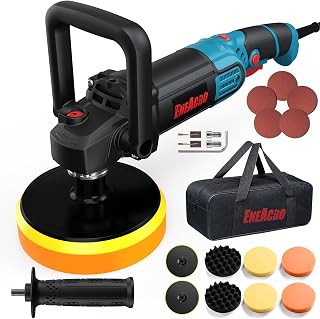 ENEACRO 1700W Rotary Car Buffer Polisher Waxer 7-inch/6-inchCheck price on Amazon
 SPTA Cordless Mini Car PolisherCheck price on Amazon
 GEVEELIFE Buffer PolisherCheck price on Amazon
 ZOTA Mini PolisherCheck price on Amazon
 Adam's Polishes Swirl Killer 15mm Car PolisherCheck price on Amazon
GarageToolHQ earns a commission when you buy through links on our product pages, at no extra cost to you. Read our affiliate disclosure.
Below: how drive actions differ, which machine fits your garage, and a checklist to guide your purchase.
How to choose a car polisher: key factors to weigh first
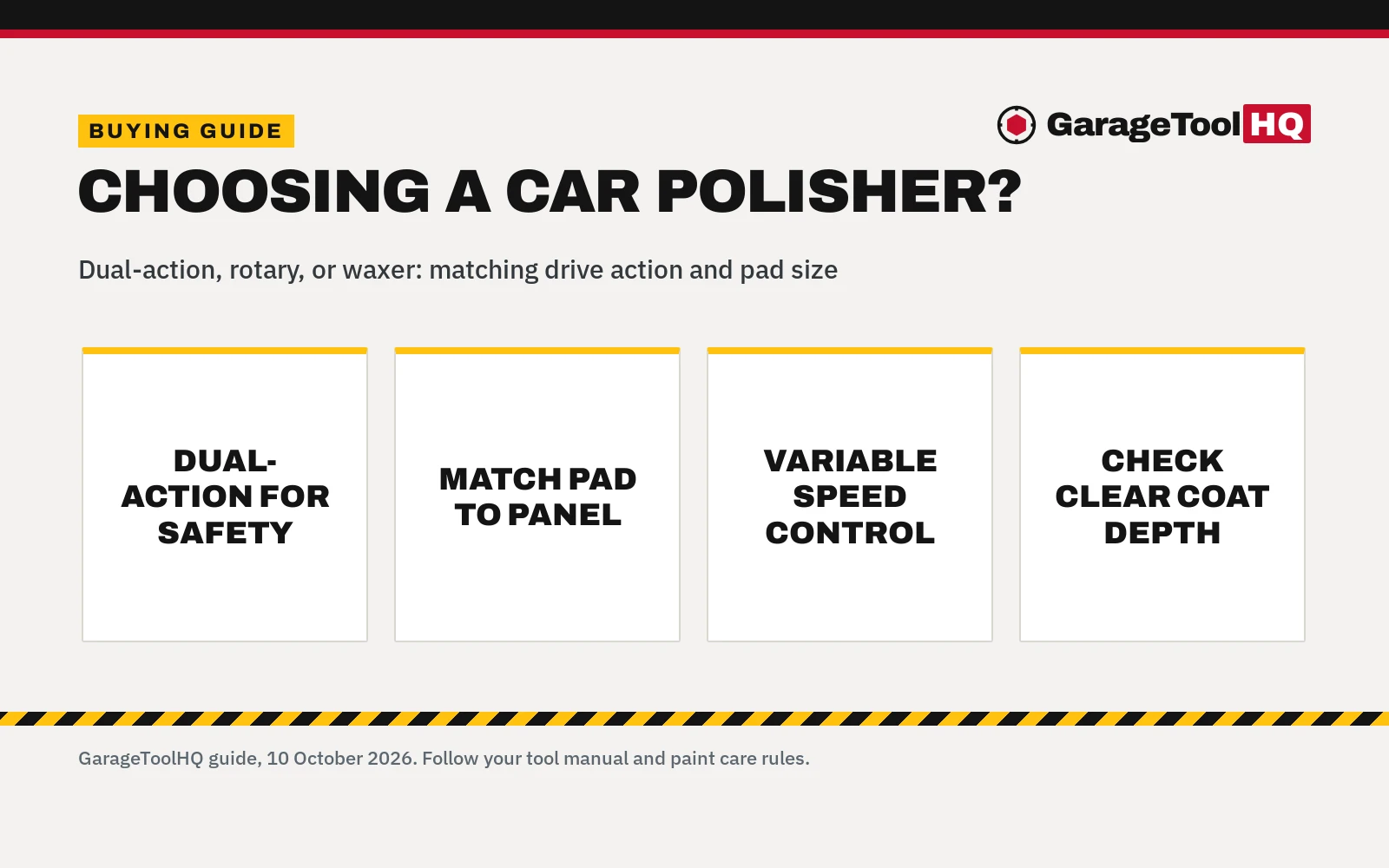
Car polishers restore vehicle paint by removing clear coat defects, leveling swirls, and restoring gloss. Choosing the right machine requires evaluating four mechanical factors:
- Drive mechanism and safety margin. The spindle drive determines whether the pad rotates with direct torque or oscillates on an eccentric spindle, controlling defect cutting speed and paint safety.
- Backing plate and pad dimensions. Pad diameter dictates coverage and control. Larger pads cover hoods quickly, while compact pads navigate bumpers, mirrors, and pillars.
- Motor power and variable speed. Variable speed dials let you start low to spread compound without slinging, then increase speed to break down abrasives and level defects.
- Tool weight and power source. Corded polishers deliver continuous power for full-vehicle compounding, while cordless battery models eliminate dragging cords across fresh paint.
Car polisher types: dual-action, rotary, and orbital waxers
| Polisher Type | Drive Mechanism and Action | Best Garage Detailing Role |
|---|---|---|
| Dual-action random orbital | Oscillates and rotates on an offset spindle; free-spinning spindle slows under heavy downforce to prevent burns | Swirl removal, light to moderate scratch correction, polish finishing, and DIY paint care |
| Direct-drive rotary | Spindle turns the backing plate in constant circular rotation without oscillating | Aggressive defect removal, heavy oxidation cutting, sanding mark leveling, and gelcoat restoration |
| Orbital waxer and buffer | Large pad oscillates with low cutting friction | Applying liquid waxes, spreading paint sealants, and buffing coatings over flat panels |
Spindle action sets cutting speed and safety. Dual-action orbital polishers balance defect removal with paint safety. For example, AOBEN lists its corded dual-action polisher with a 6-inch disc, 700 watts motor, and speeds from 1000 to 4500 rpm, noting the machine naturally stops under excessive pressure in speed 1-3. In contrast, rotary buffers turn with constant torque. SPTA lists its rotary polisher with a 1200W motor, 110 volts power, and speeds from 500 to 3000 Rpm with a 7-inch backing plate. Dedicated waxers focus on spreading product. WEN lists its 6010 waxer with a 6-inch bonnet and a 60 watts motor at 3500 rpm, while its 10PMC model pairs a 10-inch bonnet with a 0.75 hp motor at 3200 rpm.
How to choose a car polisher for your garage: the checklist
- Select the drive action for your skill level. Dual-action random orbital polishers provide the safest margin for beginners. Rotary polishers cut faster but generate localized heat that can burn through edges if held in one spot.
- Match backing plate and pad diameter to panel contours. Mid-size 5-inch or 6-inch pads suit doors and hoods. AOBEN equips its polisher with a 6-inch disc and 6.5 inch foam pads to protect paint from plate edges. For tight contours, SPTA supplies backing plates across 3, 5, 6, and 7 inches, while Fanttik offers 2 and 3 inch plates on its mini polisher.
- Evaluate motor wattage and variable speed range. OFISPEED lists its rotary buffer at 1600 watts with 7 variable speed settings from 1000 to 3500 RPM. For dual-action work, AOBEN provides 6 variable speed settings from 1000 to 4500 rpm. For delicate low-speed spots, Fanttik lists 3 variable speed settings from 300 to 950 RPM.
- Weigh tool weight and handling fatigue. Fanttik lists its mini polisher at 0.78lbs for lightweight spot work. Mid-size tools balance handling, with Protmex listing its battery polisher at 3.3 lb and WEN listing its corded 6010 waxer at 3.4 pounds. Heavier corded tools include OFISPEED at 4.5 lbs, AOBEN at 5.29lb, SPTA at 6.6 pounds, and WEN 10PMC at 9 pounds.
- Choose between corded electric power and battery mobility. Corded models on 110 volts or 120 volts provide continuous runtime without battery fade. Cordless tools eliminate cords dragging across paint. Protmex includes two 21 volts batteries rated at 2000mAh for continuous swapping, while Fanttik packs a 4000 mAh battery for up to 50 minutes of runtime.
- Check operating noise levels for garage comfort. Working in an enclosed garage amplifies gear whine. Fanttik specifies a noise rating as low as 65 dB on its planetary gear mini polisher to reduce fatigue.
- Review included attachments and accessory value. Protmex includes 18 attachments with pads and sandpaper. Coranex supplies a 28 piece kit with goggles, pads, and a hard case. AOBEN includes 4 buffing pads, and SPTA bundles backing plates and pads.
- Verify manufacturer warranty protection. WEN provides a 1 year warranty, AOBEN covers 12 monthes, and Protmex, OFISPEED, and Coranex provide 2 Year terms. SPTA and OFISPEED also publish 24 hours customer response commitments.
Automotive clear coat is thin. Rotary tools and heavy compounds cut aggressively and create friction heat that can burn edges quickly. Always begin paint correction with a mild pad and polish on an inconspicuous spot before compounding.
Keep electric pressure washers on a GFCI outlet, never point the wand at people or pets, wear eye protection with polishers and chemicals, and read the label before mixing any cleaning products. Read our Safety Disclaimer.
Dual-action vs rotary car polishers
Deciding between a dual-action orbital polisher and a direct-drive rotary buffer is the central choice in choosing a car polisher:
- Safety margin: Dual-action polishers oscillate and rotate on an offset spindle. Excess pressure slows pad rotation, reducing friction heat. Rotary polishers spin with direct torque, which can gouge paint or burn clear coat if held in one spot.
- Defect removal speed: Rotary polishers cut oxidation and sanding scratches faster, but can leave holograms requiring a secondary finishing step. Dual-action polishers finish swirl-free with less correction speed.
- Paint heat: Rotary friction heats sheet metal and plastic bumpers quickly. Dual-action orbital motion spreads heat over a wider pattern, keeping panels cooler.
- Learning curve: Dual-action tools are intuitive for DIY enthusiasts. Rotary polishers require precise angle and pressure control to prevent paint damage.
If you are correcting paint for the first time, check our guide to the best dual-action polisher for beginners. To compare sanding motions, see our review of DA sander vs orbital sander designs. For cordless options, compare the best cordless polisher buffer models.
Corded power vs cordless battery convenience
Power source determines where and how long you can polish. Corded polishers running on 110 volts or 120 volts supply constant power for multi-hour compounding without battery fade, though cords must be managed to avoid dragging across clean panels.
Cordless polishers offer mobility in driveways and carports without outlet access. Look for kits with two battery packs, like Protmex or Coranex, so one charges while the other runs. For narrow badges and door pillars, compact tools like Fanttik provide lightweight reach. To compare compact tools, read our guide to the best mini polisher cordless options.
Frequently Asked Questions
Is a dual-action polisher safe for beginners?
Yes. Dual-action polishers oscillate on an offset spindle. If you apply excess pressure or tilt the pad, rotational movement slows while oscillation continues. This slip design minimizes friction heat and protects clear coat.
What pad size is best for an all-around car polisher?
A 5-inch or 6-inch pad provides the best balance for general vehicle polishing, covering hoods and doors efficiently. Smaller 2 or 3 inch pads suit narrow bumpers, pillars, and mirrors where large pads cannot sit flat.
Can a car polisher burn through clear coat paint?
Yes, especially direct-drive rotary polishers on plastic bumpers and sharp body edges. Dual-action polishers greatly reduce this risk, but aggressive pads, heavy compound, and prolonged friction in one spot can still damage clear coat.
What speed setting should I use for waxing and polishing?
Use low speed to spread liquids and apply wax, medium speed for polishing swirls, and high speed for defect compounding. For example, AOBEN specifies low speed for waxing, medium for polishing, and high speed for removing paint defects.
Do I need a mini polisher for car detailing?
Standard 6-inch polishers cannot fit tight bumper recesses, grilles, or door handle pockets. A mini polisher with 2 or 3 inch pads handles intricate trim and badges without requiring hand rubbing.
Is a cordless car polisher powerful enough for paint correction?
Yes, for light scratches, swirls, and waxing. For example, Protmex lists speeds up to 5500 rpm on its battery polisher for defect correction. However, severe oxidation and full-vehicle corrections still benefit from the continuous power of corded polishers.
Related: compare our picks for the best dual-action polisher for beginners, find cordless tools in our best cordless polisher buffer guide, evaluate compact tools in our best mini polisher cordless roundup, and browse our car detailing hub.