Oil Free vs Oil Lubricated Air Compressor: Differences Explained
Oil free vs oil lubricated air compressor differences: compare pump maintenance, service life, noise ratings, CFM delivery and workshop demands to choose the right compressor.

On this page
Top picks at a glance
As an Amazon Associate we earn from qualifying purchases.
- 1
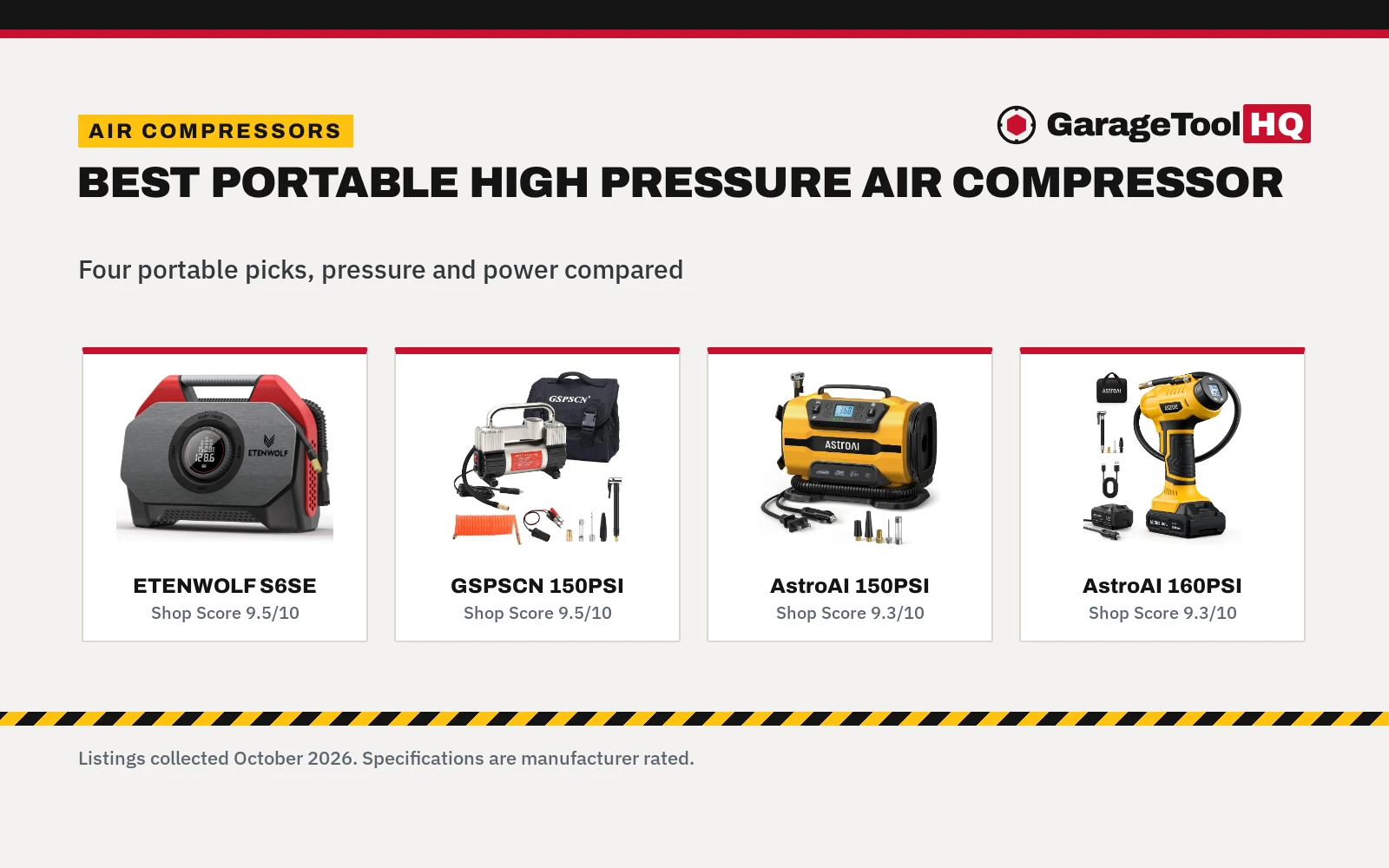
 Stealth Air Compressor 2 Gallon9.7/10View on Amazon
- 2
 VEVOR Air Compressor Pump Head9.3/10View on Amazon
- 3
 Stealth 20 Gallon Ultra Quiet Air Compressor9.6/10View on Amazon
- 4
 15-Gallon Air CompressorView on Amazon
- 5
 BOSTITCH Pancake Air CompressorView on Amazon
- 6
 Craftsman 2 Gallon Portable Air CompressorView on Amazon
- 7
 Craftsman Air CompressorView on Amazon
- 8
 Craftsman 3 Gallon Hot Dog Air CompressorView on Amazon
- 9
 3 Gallon 1/3 HP 110 PSI Oil-Free Hotdog Air Compressor Brand:View on Amazon
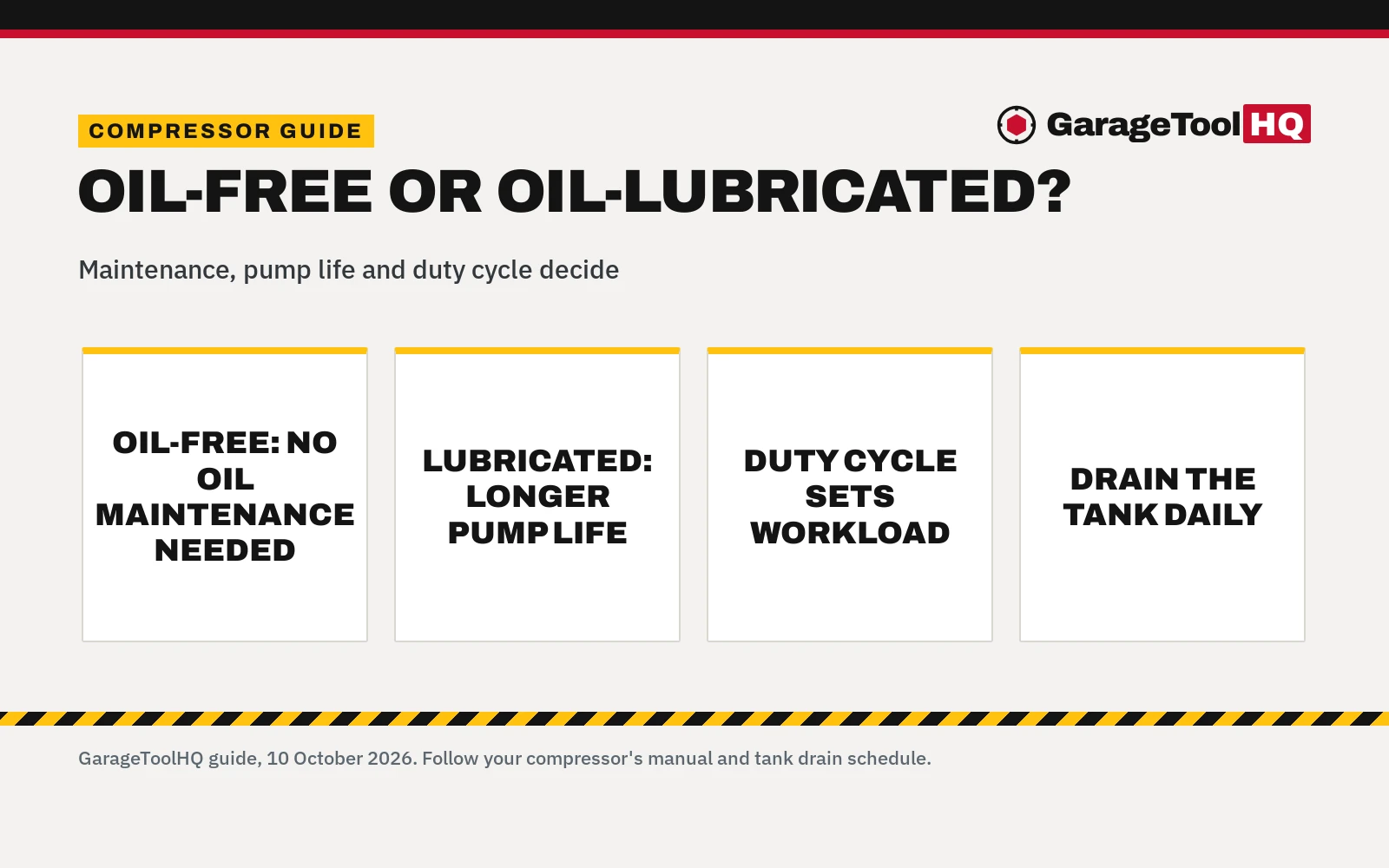
Choosing between an oil free vs oil lubricated air compressor comes down to maintenance tolerance, air purity requirements, and how many hours you run air tools. Oil-free compressors use factory-coated cylinders that require no oil changes and start easily in cold weather, making them practical for DIY garages, mobile jobs, and workspaces requiring clean air. Oil-lubricated compressors rely on an oil bath to cool cast iron pumps, delivering longer operating life and sustained CFM for heavy workshop use, but they require regular oil checks and level ground.
More options to compare
 15-Gallon Air CompressorCheck price on Amazon
 BOSTITCH Pancake Air CompressorCheck price on Amazon
 Craftsman 2 Gallon Portable Air CompressorCheck price on Amazon
 Craftsman Air CompressorCheck price on Amazon
 Craftsman 3 Gallon Hot Dog Air CompressorCheck price on Amazon
 3 Gallon 1/3 HP 110 PSI Oil-Free Hotdog Air Compressor Brand:Check price on Amazon
GarageToolHQ earns a commission when you buy through links on our product pages, at no extra cost to you. Read our affiliate disclosure.
Below: mechanical differences between oiled or oilless compressor pumps, sound and maintenance comparisons, side-by-side specs from published listings, and a checklist to match a pump to your garage workflow.
Oil free vs oil lubricated air compressor: how each pump works
Air compressors create pressure by drawing in ambient air and compressing it with a reciprocating piston. How the pump lubricates friction surfaces defines the difference between styles.
An oil-free pump features cylinder walls coated with low-friction materials such as Teflon, paired with factory-sealed bearings. Because the crankcase contains no liquid oil, the pump discharges clean air without oil mist. However, dry friction coatings gradually wear down over time. For example, the California Air Tools 2010A listing features an oil-free dual piston pump system operating at 1680 RPM, built to last over 3000 hours before wear, producing 2.20 CFM at 90 PSI with a 1.0 HP motor.
An oil-lubricated compressor uses a crankcase filled with oil. As the crankshaft rotates, dippers splash lubricant across cylinder walls and bearings, dissipating heat and creating a protective oil layer. For instance, the Makita MAC2400 listing highlights a cast iron cylinder and Big Bore piston paired with a 2.5 HP motor, delivering 4.2 CFM at 90 PSI at 1,730 RPM for cooler running temperatures and reduced wear. With routine oil maintenance, an oiled cast iron pump delivers exceptional longevity.
Comparing oil-free and oil-lubricated compressors side by side
| Comparison Factor | Oil-Free Compressor | Oil-Lubricated Compressor |
|---|---|---|
| Crankcase Lubrication | No oil; sealed bearings and coated cylinder walls | Oil bath crankcase; splash lubrication across cylinder and bearings |
| Routine Maintenance | No oil changes; clean intake filter and drain tank | Check sight glass, top off fluid, and change crankcase oil |
| Sound and Noise Levels | Varies by motor speed; 60 dB on low-RPM models (CAT 2010A) up to 81 dB (VEVOR) | Varies by pump RPM; Makita MAC2400 lists 79 dB at 1,730 RPM |
| Cold Weather Operation | Starts reliably in unheated spaces; no crankcase oil drag | Conventional oil thickens in cold; all-temperature synthetic oil maintains flow |
| Portability and Transport | Can be transported in any orientation without leaking | Must remain upright and level to avoid crankcase oil spills |
| Air Stream Purity | Clean discharge; ideal for finish spraying and painting | Carries microscopic oil aerosol; requires coalescing filters for painting |
| Pump Durability | Piston coatings wear over service life; replacement pump heads available | Extended service life; cast iron cylinders and valves can be serviced or rebuilt |
Oil-free pumps emphasize convenience, low weight, and clean air discharge. Oil-lubricated pumps emphasize continuous mechanical cooling, pump rebuildability, and long-term durability.
How to choose between oil-free and oil-lubricated: workshop checklist
- Evaluate tool air volume demands. Intermittent tools like finish nailers and tire inflators run comfortably on compact oil-free pumps. Continuous air tools like sanders demand sustained CFM. Review our guide on what CFM air tools need before selecting a tank size.
- Factor in operating hours and workload. For weekend DIY projects, an oil-free model delivers years of service without maintenance overhead. For daily automotive repair, an oil-lubricated cast iron pump withstands heavy duty cycles far better.
- Account for workspace sound levels. Modern dual-piston oil-free units run quietly at low motor speeds. The California Air Tools 8010A lists 60 dB with an 8 Gallon aluminum tank, and the RyanTek DOF1500-50V lists 66 dB with a 15-Gallon tank. Higher-speed units are louder: VEVOR lists 81 dB for its 2 Gallon 1 HP unit, while the oil-lubricated Makita MAC2400 lists 79 dB. Check our guide on how loud an air compressor runs to match decibels to your garage.
- Consider garage climate and temperatures. Unheated winter garages can thicken conventional compressor oils, increasing mechanical drag during startup and potentially tripping breakers unless using an all-temperature synthetic lubricant. Oil-free pumps eliminate crankcase oil drag entirely, enabling dependable cold starts.
- Review transport and storage needs. If hauling a compressor in a vehicle trunk, an oil-free pump is easier to handle because it will not spill fluid on its side. Oil-lubricated units must remain level and upright.
- Determine acceptable maintenance time. An oil-lubricated pump requires checking the sight glass before startup and changing crankcase oil. If you prefer plug-and-play convenience, choose an oil-free model.
- Verify electrical circuit capacity. Match motor current draw to your garage wiring. The Baococo 10 Gallon 2 HP compressor lists 10.2 A on 120 volts, the Makita MAC2400 lists 12.3 A on 120 volts, and the California Air Tools 2010A draws 8 A on 110 volts. Verify your breaker capacity and consult a licensed electrician for dedicated shop circuits.
Never power on an oil-lubricated air compressor without confirming that oil covers the center dot of the sight glass. Running an oiled pump with low or depleted lubricant causes rapid friction, overheating, and seized pistons within minutes. Always check the crankcase before plugging in the power cord.
Drain the tank after use so water does not rust it from the inside, never exceed the tool's rated pressure, wear eye protection, and run 240V units on the circuit the manual calls for. Do not run a gas engine compressor in a closed garage. Read our Safety Disclaimer.
Compressor maintenance, duty cycles and lubricant requirements
Maintaining an air compressor depends on the pump mechanism. An oil-free pump requires virtually no mechanical upkeep beyond keeping intake filters clear and draining the receiver tank. Adding oil or spray lubricant into an oil-free intake fouls the dry friction coatings and damages the pump.
For oil-lubricated compressors, using proper oil protects internal components. Standard passenger car motor oil contains detergent additives that cause foaming in air compressors and leave baked-on carbon deposits across hot valves. Compressor pumps require non-detergent or specialized synthetic compressor lubricants.
For example, the Ingersoll Rand All Season Select synthetic air compressor lubricant listing specifies an all-temperature synthetic blend with 20W-40 viscosity under SAE J300. The maker rates this lubricant for 100% continuous duty and states that it provides four times the life of petroleum oil while preventing carbon buildup. Explore top options in our guide to the best air compressor oil.
Duty cycle defines how long a compressor pump can run before resting to dissipate heat. Oil-lubricated cast iron pumps dissipate heat through their oil reservoir and cooling fins, supporting demanding workloads. Compact oil-free pumps generate heat in the cylinder heads, making them better suited for intermittent use. When an oil-free pump head wears out, replacement pumps can restore performance. For instance, VEVOR lists an oil-free replacement air compressor pump head delivering 5.2 CFM at 90 PSI with a 2 HP motor at 1680 RPM, rated for 145 PSI maximum pressure and 78 dB noise. Follow the care recommendations in our guide to air compressor maintenance.
Air quality, moisture management and tank safety
Compressed air purity is another key distinction. Oil-lubricated pumps introduce small amounts of oil vapor into the air stream through ring blow-by. While fine for air wrenches, oil mist causes defects in paint spray finishes. An oil-free compressor discharges air free from oil mist, providing clean air for painting. For instance, the AAIN 6.3 Gallon 1.5 HP oil-free compressor listing highlights 6 CFM output at 116 PSI with a 70 dB noise level for spray painting and auto repair.
Regardless of pump type, compressing atmospheric air generates moisture. Water vapor condenses inside the receiver tank as air cools. Draining condensation prevents internal corrosion and keeps water from entering air lines. Follow the step-by-step procedure in our guide on how to drain water from an air compressor tank.
Always verify that your compressor tank includes an ASME-coded construction design and an ASME safety relief valve. For example, the VELPAX 6.4 Gallon 2HP unit listing specifies an integrated safety relief valve that opens at 128 PSI to prevent over-pressurization. Understanding airflow ratings is equally important: consult our explainer on what CFM at 90 PSI means to match volume and pressure.
When planning your garage setup, compare CFM delivery, tank size, and maintenance demands. Read our detailed guide on how to choose an air compressor for sizing rules, and browse top models in our roundup of the best air compressor for home garage.
Frequently Asked Questions
Which lasts longer, an oil free or oil lubricated air compressor?
An oil-lubricated compressor generally delivers longer service life. The continuous oil bath minimizes friction on bearings and pistons, and cast iron cylinders dissipate heat effectively, allowing components to be serviced or rebuilt over years of workshop duty. Oil-free pumps rely on dry friction coatings that gradually wear down. While specific dual-piston models like the California Air Tools 2010A list a pump life of over 3000 hours before wear, oil-lubricated cast iron pumps remain the standard choice for heavy commercial workloads.
Can I use automotive engine oil in an oil lubricated air compressor?
No. Automotive motor oil contains detergent additives designed to suspend combustion soot. In an air compressor, detergents cause oil to foam, thinning the protective film and forming carbon deposits on hot discharge valves. Always use dedicated non-detergent compressor oil or a manufacturer-approved all-temperature synthetic lubricant.
Are oil free air compressors louder than oil lubricated models?
Not necessarily. Operating sound depends primarily on motor RPM and intake muffler design rather than lubrication method. While high-speed oil-free compressors like the VEVOR 2 Gallon unit run at 3400 r/min and produce 81 dB, low-RPM dual-piston oil-free designs run significantly quieter. For example, California Air Tools lists 60 dB at 1680 RPM for its 2010A model, and RyanTek lists 66 dB for its 15-Gallon unit. Meanwhile, the oil-lubricated Makita MAC2400 runs at 1,730 RPM and lists 79 dB. Both pump designs can be quiet or loud depending on motor speed.
Do oil free air compressors still require tank draining?
Yes. Atmospheric air naturally contains water vapor that condenses into liquid water inside the storage tank during compression. Pump lubrication has no effect on moisture. Both oil-free and oil-lubricated compressors require opening their moisture drain valves after every session to prevent internal rust.
Can an oil free air compressor run pneumatic spray guns?
Yes. Oil-free compressors are well suited for spray painting because they discharge air free from oil mist. An oil-lubricated compressor requires inline coalescing filters to prevent oil droplets from ruining painted surfaces. Check that the compressor provides sufficient continuous CFM at your spray gun operating pressure.
Why do oil free air compressors start easier in cold weather?
In unheated winter garages, conventional petroleum compressor oils thicken, creating mechanical drag against pistons and bearings. This resistance forces the motor to draw heavy startup current, which can trip circuit breakers unless an all-temperature synthetic lubricant is used. Because oil-free compressors have no liquid crankcase oil, the motor spins up freely without fluid drag in freezing temperatures.
Related: how to choose an air compressor, our air compressors hub, the best air compressor for home garage, air compressor maintenance, and best air compressor oil.